Happy Marine Day (plus a yokai!)

Yesterday was a national holiday in Japan known as Marine Day. It’s meant to be “a day of gratitude for the blessings of the oceans and to hope for the economic prosperity of maritime Japan.” Certainly appropriate, considering how important the sea is for an island nation.

Of course, the sea is not just a source of bounty for Japan. It also can be a source of terrible tragedy, such as the tsunami earlier this year which began the whole current nuclear crisis. It also is a source of yokai — usually terrible ones — such as the one I am showing you today.

You may remember I painted an Ushi-oni from Shikoku last year, which was a large, horned, bear-like monster which terrorized villages. There are many different kinds of Ushi-oni, however, as the term simply means “bull demon” and can refer to pretty much any large, beefy, demonic yokai. This particular Ushi-oni hails from the Sea of Japan off of the coasts of western Japan. It scours the beaches for human prey, often working in conjunction with Nure-onna and Iso-onna to catch its prey.

Ushioni

Ushioni

Night Parade Preview: Kirin

One of the coolest mythical Asian animals is the Kirin. You may remember my earlier post on Kirin from last year’s A-Yokai-A-Day entry, so I won’t get into too much detail about what exactly a Kirin is.

You may remember earlier I mentioned how seasons are going to play a theme in this book. Fans of Haiku and other Japanese art may be aware of how important seasonal motifs are. In fact, there is even a specific word for seasonal vocabulary: kigo.

You can often tell the month of a Japanese painting by key flowers, animals, or activities inserted into the image. Hiroshige and Hokusai used seasonal motifs in many of their works, and the detail is so precise that you can almost arrange the paintings of their larger series into specific weeks of the year.

If you pay attention to the yokai in these book, you’ll notice similar clues as to when each picture takes place. (Of course, I’ve been uploading summertime images for the present time, simply because it’s summer. I’ll put up a few different seasonal pieces later on though.)

Kirin

Kirin

Night Parade Preview: Aosagibi

The other night I was walking home at around 10:30 pm, and as I crossed a river I noticed a blue heron stalking frogs and fish in the dark water. It reminded me of a yokai called Aosagibi, or “blue heron fire,” and that is what I painted today.

Aosagibi occurs during the summer months near riversides. It’s a kind of phantom fire caused by herons and other water birds. When these birds reach an advanced age, their breast feathers fuse into reflective scales. Their breath begins to expel a yellowish powder, and on hot summer and autumn nights the powder ignites into brilliant blue flame. The birds’ feathers also begin to luminesce, giving an all-around eerie appearance to the creatures.

If you’ve ever been glared at by a huge heron mid-hunt, you know their sharp eyes can send chills down your spine. When they glow and spew blue fire too, well, it might just be time to run home!

The particular heron in this picture is a species called a “night heron.”

Aosagibi

Aosagibi

Night Parade Preview: Yamabiko

Today I present another preview from my upcoming book. This yokai is a cute little thing called a Yamabiko. It looks like a cross between a monkey and a small dog. It’s name means “echo” and that it pretty much its only claim to fame. The Yamabiko is very very shy, and lives deep in the mountains, making its home in ancient camphor trees. It is a skilled mimic, and can copy any sound in nature, even human voices. Yamabiko live their lives away from humans and are thus rarely ever seen. The only real way to know a Yamabiko is nearby is when you call out in the mountains and your echo returns just a bit later than it should, or perhaps slightly altered from the original sound.

Yamabiko

Yamabiko

Yamabiko detail

Yamabiko detail

Night Parade Preview: Hitodama

Today we preview a very special yokai: the Hitodama, or human soul. These are ghostly yokai which appear near graveyards, flying around roughly at eye level. They appear most often shortly after a person dies, but occasionally they can even appear when a person faints and his or her soul temporarily wanders out of their body. They appear as flaming blue orbs with long tails of glowing light which follow them wherever they go. They may be eerie, but fortunately they are not dangerous.

Hitodama

Hitodama

Happy Tanabata! (and a Yokai)

While Japan has no celebration on the 4th of July, the 7th is a holiday called Tanabata. It’s not as lively as Independence Day, but it is just as beautiful. Cities put up enormous bamboo poles that reach high into the sky, and hanging from them are bright paper lanterns and streamers of all different shapes and colors. Bamboo stalks are put up everywhere, almost like Christmas trees, decorated with various papers, tinsels, and streamers. People write wishes on colored strips of paper and tie them to the trees in hopes that the wish will come true. Most wishes are for love, as the story behind Tanabata tells of two lovers separated by fate. (See my post from last year.)

Tanabata is also a great time to see people wearing summer yukatas in the hot night air, which is how I drew the yokai in today’s Night Parade preview. You may remember Kawauso from my A-Yokai-A-Day project.

Seasons play a huge role in Japanese art. Look at any collection of ukiyoe and you will find that each picture has distinct clues as to what season it takes place in. Sometimes it’s the strategic placing of a seasonal flower or a bird, in others you can tell by the activities going on, whether it is a festival, or rice planting, or harvesting. The ukiyoe masters were very clever in putting seasonal motifs into their art, and I am trying to replicate some of that in my yokai book. With 100 monsters to paint, that covers a lot of time! So you will see summer, fall, winter, and spring yokai, and the book will be organized by seasons, just as the classic woodblock printers did with their series. That should make paging through the book more interesting, as you get not only a look at various bits of folklore, but you get a seasonal tour of the country!

Kawauso

Kawauso

Kawauso detail 1

Kawauso detail 1

Kawauso detail 2

Kawauso detail 2

Night Parade Preview: Yamawarawa

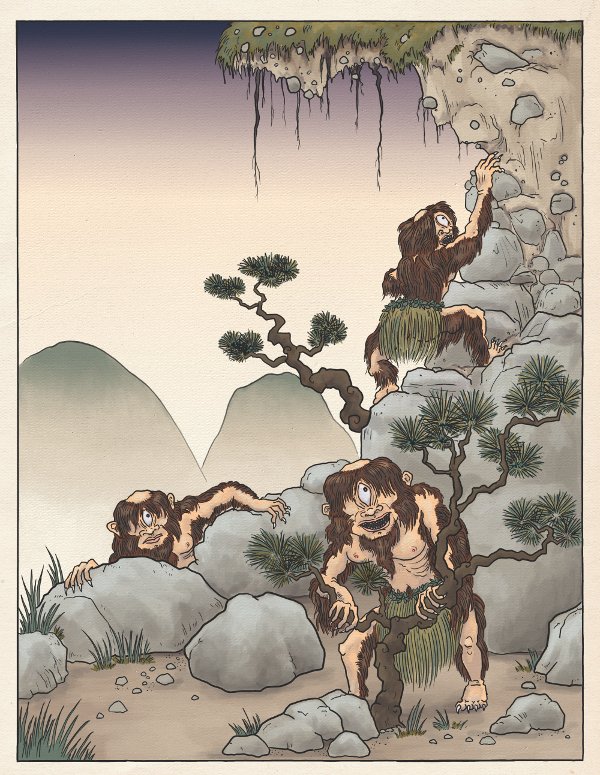
We’ve already looked at the Kappa, Garappa, and Hyousube. Today I present you the final member of the Kappa family: the Yamawarawa.

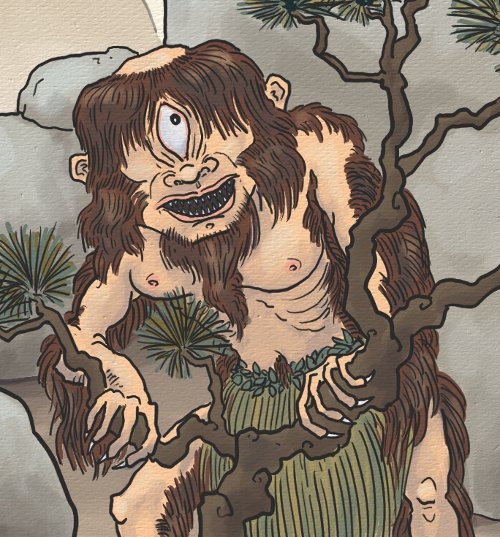
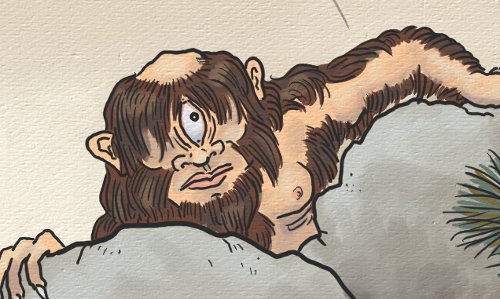
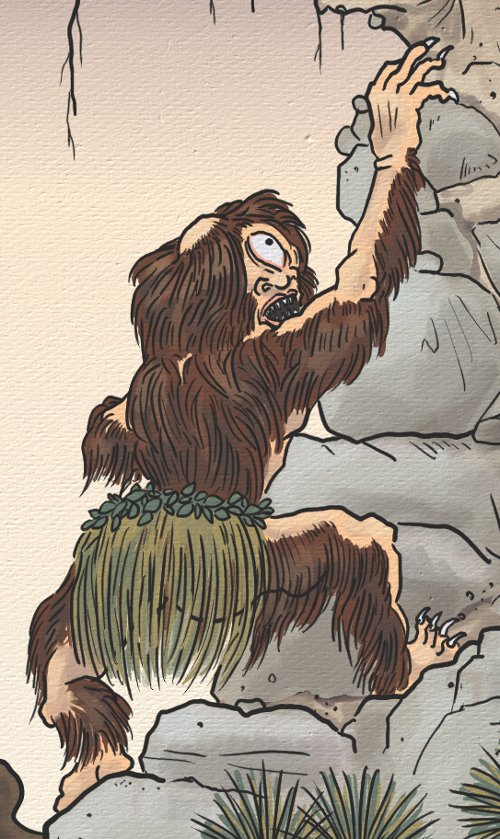
All the Kappa we previously looked at are summertime spirits. Every year on the fall equinox they perform a mass migration into the mountains, transforming into one-eyed hairy beasties the size of small children as they go. They live in this form as Yamawarawa for the whole winter, and return back to the rivers in another mass migration that takes place on the spring equinox.

Anyone unlucky enough to be caught in the middle of this massive migration is in for a nasty surprise. Yamawarawa hate to be spied upon, and they might viciously slaughter anyone they suspect of peeping on them. Any houses unlucky enough to be in the way of the migration are torn apart by the masses of monsters coming down the mountains, angry that someone had the gall to put up an impediment to their journey.

Yamawarawa

Yamawarawa

Yamawarawa detail 1

Yamawarawa detail 1

Yamawarawa detail 2

Yamawarawa detail 2

Yamawarawa detail 3

Yamawarawa detail 3