A-Yokai-A-Day: How A Wager Led to a Child’s Decapitation

With only three stories left in this year’s A-Yokai-A-Day, it’s time for me to plug my Patreon again. If you like these stories and illustrations, I do this year-round, not just in October! And the only reason I’m able to make them is because my patrons support me enough for me to do this full time. Becoming a patron means you’ll get weekly stories and artwork, so if you want to keep this going all year round, even just $1 a month gets you insider access, and helps me a lot. (Plus you can get cool rewards like yokai postcards and art prints.) Become a patron here!

The yokai in tonight’s story is only described as a bakemono,” which isn’t helpful because that really just means monster. However, from its behavior we can make a decent guess as to what it might be. Care to wager?

If I had to bet, my money would be on this being a tengu. We’ve already seen several tengu stories this month, and aside from just being common yokai, they tend to go after foolish people who bite off more than they can chew, and especially those with an excess of pride. That definitely describes our story’s leading man. (Tengu also live deep in the mountains, which is where all this strangeness begins.)

Tragically, as is often the case in kaidan, the one who suffers most is not the man who started it all, but his family.

How A Wager Led to a Child’s Decapitation

In a certain mountain village in Kishū, five or six samurai were gathered one night and chatting, when they made a wager:

“If you go about two kilometers from the village, there is a shrine near the mountain ridge. There is a river in front of the shrine, and from time to time, corpses wash up along this river. Let’s make a bet that if anyone is willing to go tonight to that river and cut off the finger from a dead man, we will all give that person our swords.”

However, not one of them said they were willing to go.

Then, a greedy and cowardly man said, “I will go.”

He went back to his house and told his wife, “I made such-and-such a wager, but my heart trembles so much that I cannot go.”

Hearing this, his wife replied, “It’s already too late for you to go back and change the wager. I’ll go there, and cut off the dead man’s finger. You stay here and watch the house.” Then, she strapped her two-year-old child to her back, and went out to the shrine.

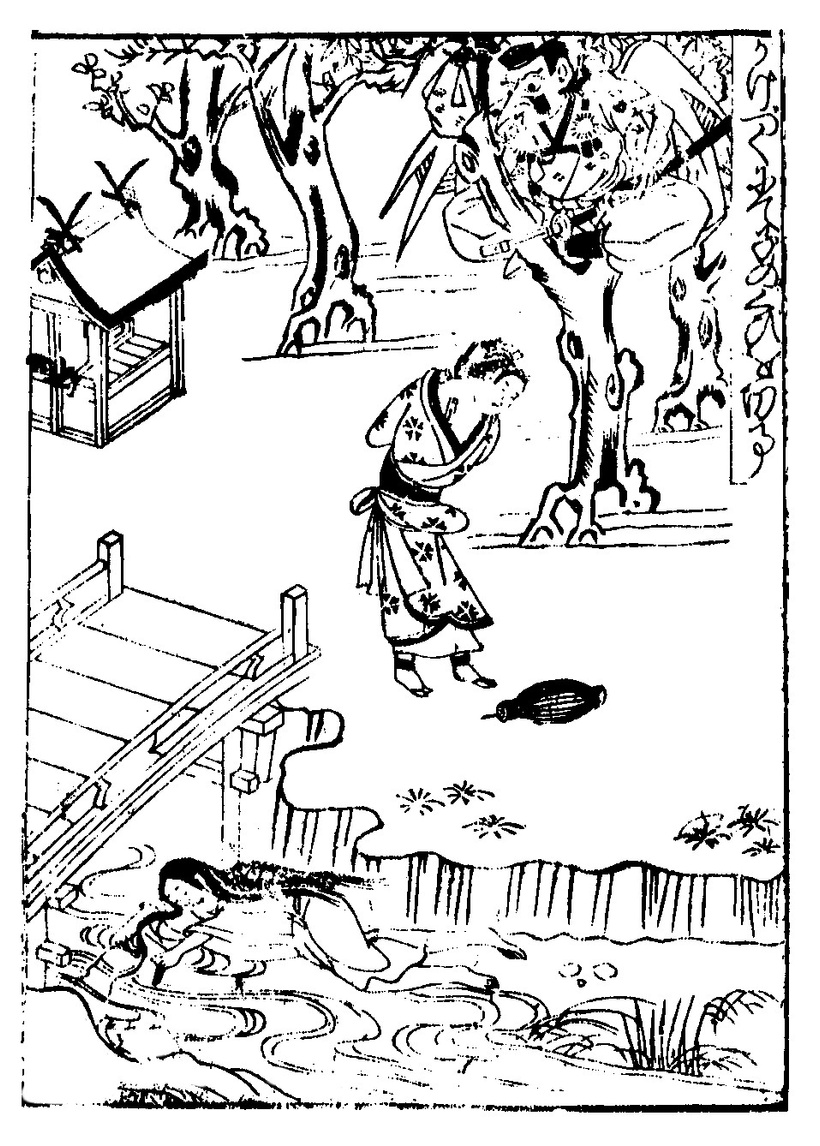
In front of the river there was a forest about 100 meters deep. She passed through that terribly eerie place and arrived in front of the shrine. She went down beneath the bridge and found the corpse of a woman. She took out her wakizashi and cut off two fingers, and tucked them into her pocket. When she went back to the forest to return home, a scratchy voice called out from above the forest:

“Watch your step!”

Terrified, she looked down and saw something wrapped in a small straw bundle. She picked it up, and it was quite heavy. Thinking that it was surely a gift from the gods and buddhas out of pity for her, she picked it up and went home.

The man was waiting impatiently for his wife to return. He was hiding under his blanket and shivering with fear, when a sound like twenty men stamping their feet came from the roof.

“Why aren’t you going to the place you wagered you would?”

The man was even more terrified, and he shrunk back and held his breath. Just then, his wife came home. At the sound of the front door opening smoothly, the man was sure that a bakemono had come inside. He screamed and fainted.

The wife called out, “It’s me! What’s the matter? What’s going on?”

The man came to his senses and he was overjoyed. The wife took out the fingers from her pocket and handed them to the man.

“By the way, something wonderful happened,” she said. And she opened the straw bundle, only to see that it contained the head of the child she was carrying on her back. She was terrified, and she screamed and cried, and she quickly unstrapped her child from her back to find that there was only a headless corpse. Seeing this, the wife grieved and lamented, but there was nothing that could be done.

But, because he was a greedy man, the husband took the fingers and received the swords from the people he wagered with.

the hands of a corse, two fingers chopped off one of them, lie on the ground

A-Yokai-A-Day: How the Obsession in Love Letters Became an Oni

Tonight’s story features another oni and another chigo. The chigo here is presented as a sex symbol, the embodiment of the ideal male youth. The oni is born from the strong, obsessive attachment of the long-distance admirers, and the bored apathy of the uninterested chigo. (Tonight’s oni is also very similar to Toriyama Sekien’s fuguruma yōhi.)

An interesting part of this story is that it stars Ikkyū, a character who is only somewhat known in the West but is extremely famous in Japan. Ikkyū was a real person, but there are so many stories about him that he has become a legendary figure as well. He’s beloved for being a mischievous monk who breaks all the rules but still always winds up on top. He does everything a monk is not supposed to do; he eats meat, he drinks sake, visits brothels; but he is also able to perform miracles, and shows those who criticize him how their perception is wrong. One of my favorite stories about him is when he meets the courtesan Jigoku tayū.

In tonight’s story, true to form, Ikkyū does the opposite of what most monks would do. He fearlessly enters a haunted temple when any normal person would run away. When the oni tries to kill him, he does the opposite of what any priest would do; he neither prays nor recites scripture, nor screams. He just sits there, chill, and watches. I love it.

How the Obsession in Love Letters Became an Oni

In a place called Kūhachi in Iga Province, there were sixty temples. When Ikkyū was training and the sun set here, he looked around the temples for a place to stay, but there was not a single person around. Ikkyū thought this was odd, so he checked every last temple, until at a certain temple he discovered a beautiful chigo all alone.

Ikkyū approached him and said, “Please let me stay here.”

“Certainly. But every night a monster comes to this temple and takes a person,” the chigo said.

“I am a monk, so that does not bother me,” replied Ikkyū.

“Very well then, please stay the night,” said the chigo. And he let Ikkyū into the reception hall, while the chigo slept in the next room. Around midnight, several flames the size of temari came out from under the veranda of the chigo’s room, floated towards the chigo’s heart, then suddenly transformed into a six-meter-tall oni and came into the reception hall.

“Where is the monk staying in this temple tonight? I’m going to catch and eat him!”

The oni searched around the room. Since Ikkyū neither prayed, nor chanted, and just sat there unfazed, the oni was unable to find him. Before long, dawn broke, and when the oni looked like it was about to return to the chigo’s room, it disappeared.

Ikkyū was mystified and said to the chigo, “Show me underneath the veranda where you slept.”

Under the veranda, Ikkyū found countless blood-stained letters. When he asked about them, the chigo told him that people from all over had fallen in love with him and were sending him love letters, which he never replied to but just tossed them all off of the veranda. The obsession of the writers of those letters had piled up more and more, until it became the oni which visited the chigo every night.

Ikkyū retrieved all of the letters, piled them up and burned them away, then recited scripture. After that, there were no more strange occurrences.

a green oni wreathed in pink flames emerges from a pile of love letters

A-Yokai-A-Day: The Tanuki Who Transformed into an Old Woman at Nabari, Iga Province

Tonight’s story is another one featuring a tanuki, and like the one from last week, it has a bloody ending. This time, though, the yōkai is a lot more dangerous.

The ending of this story matches a pattern that is seen in several yokai stories from all around Japan. Aside from a wild animal disguising itself as an old woman, discovering the pile of bodies underneath the floorboards seems to have been a popular folklore trope. We see it in story patterns like senbiki ōkami, although that is with wolves and not tanuki.

Anyway, this story serves as a reminder that even the furry little critter yōkai are sometimes vicious man-eaters!

The Tanuki Who Transformed into an Old Woman at Nabari, Iga Province

In Iga Province, there is a mountain village to the southeast of a place called Nabari. In this village, every night, one by one people were disappearing. Nobody knew who or what was responsible. One person had their child taken, another person had their parents taken, and the crying and grieving was too painful to watch.

One day, a hunter from that village went into the mountains at dusk. A person came at them from out of the mountains, and when he looked to see who it was, it was a hundred-year-old woman, with disheveled white hair scattered in all directions, and shining eyes. Her appearance was inhuman, so the hunter immediately nocked a crescent-headed arrow and recklessly fired it with a loud twang. It looked like he hit, but the woman got away.
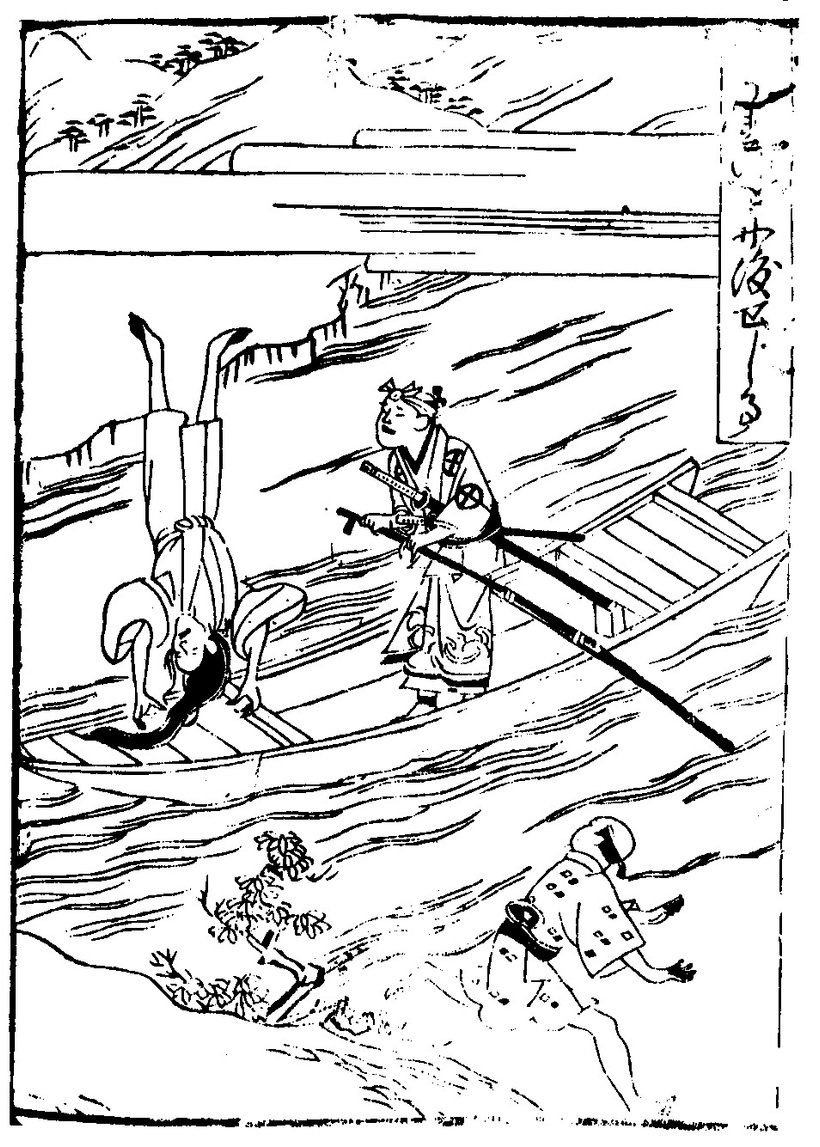
In the morning, the hunter went back to that spot and found a trail of clotted blood that went here and there among the mountains. He followed the trail of blood back to his village, to a small hut behind the village headman’s manor. The hunter was mystified. He asked the village headman, “Who lives in the small hut behind your house?”

“My mother lives there,” he replied. “She is retired. She hasn’t been feeling well since last night, and she won’t eat or let anyone near her.”

The hunter replied, “Well, I have a strange story about that…” And he told the headman everything that had happened.

The headman was also mystified. He went to the small hut, but his mother realized out what was going on, and in an instant she tore through the wall of the hut and ran off. They looked into the bedroom and found a pool of blood the size of a rug. When they looked under the floor, they found countless human bones, including the hands and feet of a child, which had been chewed up and discarded there.

After that they searched the mountains and found the corpse of an old tanuki whose chest had been pierced by an arrow. The headman’s mother had earlier been eaten by this tanuki, which then disguised itself as her and took her place.

a small hut in the forest with a blood trail leading to it and bones underneath the flooring

A-Yokai-A-Day: Watanabe Shingorō’s Daughter and Her Affection for a Chigo in Wakamiya

Tonight’s story is another one dealing with attachment. And once again, snakes are used as a symbol for that attachment.

One term that might be unfamiliar to some readers is chigo. This term pops up a fair amount of yōkai stories, and while it literally just means a child, it refers to young boys who were apprenticed to temples but too young to shave their heads and officially become monks. Chigo served as pages and attendants to elder priests, who often dressed them up and had pederastic relationships with them. This adds a layer of complexity to the situation between the boy and the girl in the story. Was the reason he was disinterested in her that he simply did not like her that way? Was it because he was still too young to see this girl as a romantic partner? Were her affections towards him so strong that they made him uncomfortable? Or was he maybe being pressured by an elder lover at the temple to break things off with her? The ambiguity in the story means each reader will probably see it slightly differently.

Watanabe Shingorō’s Daughter and Her Affection for a Chigo in Wakamiya

There was a man named Watanabe Shingorō in Kamakura. He had a fourteen year old daughter. One day she went on a pilgrimage to Wakamiya, and when she first laid eyes upon the priest’s chigo, she fell so deeply in love that she became gravely ill from lovesickness.

The girl confided her feelings to her mother, and so her father, who had been worried about her illness, sought out a good intermediary and contacted the chigo’s parents. The chigo’s parents gave their permission for the girl to begin seeing the boy.

However, as the chigo was still very young, he did not have very deep feelings towards the girl, and the idea of marrying her disinterested him. The girl’s spirit grew ever weaker, and finally she died. Her grieving parents had her cremated, and placed her bones in a box in a certain room with the intention of interring them in Zenkōji in Shinano.

Later, the chigo also became ill, and although various remedies were tried, they had no effect. Afterwards, he did not like to be near other people. His mother and father were perplexed, and so they spied on him through a crack in the door to discover him sitting across from a giant serpent and speaking with it. His parents were so grieved and saddened by this that they asked priests and yamabushi to pray for his protection, but these had no effect either, and finally he died.

When they buried the chigo in the mountains west of Wakamiya, a giant serpent was found in the coffin entwined around the chigo’s corpse, and they had to bury it together with the chigo. Later, when the daughter’s remains were taken to Zenkōji to be interred, the mother discovered that all of the bones had either turned into or were currently transforming into tiny snakes.

How terrifying a thing it is that the daughter’s attachment possessed and finally killed the chigo.

a pair of hands holds a bone urn containing ashes, bone chunks, and white snakes

(My Wife Draws) A-Yokai-A-Day: How Hating a Stepdaughter Backfired in Shimōsa Province

I’m resting my broken arm today to make sure I don’t over-stress it, so my wife has kindly taken over for the illustration again.

Tonight’s story features a daija—aka a giant snake or dragon. This daija is called the “lord of the swamp.” The Japanese word used here is nushi, which translates as lord or master of a particular location. A head of a household is a nushi, a ruler of a land is a nushi, and a supernatural monster that claims dominion over a particular area is the nushi of that place, and is often treated like a deity. Snakes and dragons in particular, but also giant yōkai fish or animals, often show up in folklore as the nushi of small local geographical features.

When the wife offers her stepdaughter as a bride to the lord of the swamp, what she really means is that she is offering her up as a human sacrifice. The daija will be free to do whatever it wants with the girl—eat her, tear her to shreds, turn her into a dragon and make her rule by her side… All of these have precedence in folklore. So while it sounds bad enough to be married off to a giant snake, it’s actually far worse, and the father’s reaction at the end is far more understandable than if it were just an awkward supernatural marriage.

How Hating a Stepdaughter Backfired in Shimōsa Province

In Shimōsa Province there was a man named Matsumoto Genpachi. He had a daughter who was twelve or thirteen years old. After her mother passed away, Genpachi remarried, but his new wife hated her stepdaughter. One day the stepmother brought her stepdaughter to a nearby swamp and said, “I offer this girl to the lord of the swamp. Come and be her husband!”

She did this five or six more times. Once, when they went back to the swamp, the sky suddenly became cloudy, a terrible wind blew, and heavy rain fell incessantly. They were frightened and went back home.

When the daughter told her father everything that her stepmother had done, Genpachi was furious. He was about to kill the girl’s stepmother when a daija around 500 meters long came. It raised its head and flicked its red tongue, and then turned towards the girl.

Genpachi said, “Hey, serpent, this girl is my true daughter. Even if her stepmother consented to it, you cannot take my daughter without my permission. In her place, I offer you her stepmother.”

The daija turned towards the stepmother and flicked its tongue. Meanwhile, Genpachi took his daughter and fled.

The daija coiled its body around the stepmother seven or eight times, then summoned a rainstorm. As lightning flashed around them, it took her down to the swamp. The stepmother hated her stepdaughter, but in return, retribution came to her.

a giant serpent wiggles its tongue at a man who is pointing at two woman, saying yes to one and no to the other

A-Yokai-A-Day: The Arrogance of Ukita of Bizen Province’s Widow

Tonight’s story describes the workings of one of the most popular yokai there is: a tengu. But first, there’s a few cultural terms to talk about in this story.

First, the subject of the illustration: a kamuro. Kamuro (also sometimes kaburo, as with the yokai ōkaburo) is a word that describes several things depending on the era; a hairstyle involving a mostly-shaved head that was common in the late Edo period; a hair style that was not shaven, but instead bobbed used until the middle Edo period; the children who wore such hairstyles; and young girls employed as handmaids in high end brothels. Since this book was written in the early Edo period, kamuro would have referred to a child, who would have had a bobbed hairstyle.

Secondly, the comment “They would never let Benkei do that all by himself.” This is a reference to a massively famous legendary warrior monk about whom many stories were written. One of his most famous legends is about how he died. After the Genpei War and the destruction of the Heike, the brothers Minamoto no Yoshitsune and Minamoto no Yoritomo fought with each other over who would be the ruler of Japan. Benkei was one of Yoshitsune’s retainers, and fought by his side at the Battle of the Koromo River. When Yoshitsune’s army was encircled and all but defeated, Benkei told his master to flee, then stayed behind and single-handedly held off the enemy army by guarding a bridge. Not one of Yoritomo’s men was brave enough to cross the bridge to fight the legendary monk. Instead, they rained arrows down upon him. When dust cleared and the arrows stopped falling, they looked out and saw Benkei still standing on the other side of the bridge. Eventually, they found the courage to cross the bridge, and they discovered that the brave monk had died standing up! Talk about epic.

Now on to the yokai… Although we don’t actually see the tengu in the story — we just see the results of its magic and its personality. Tengu are famous for their disdain of prideful people, just as was the case in the tengu story we saw earlier this month. Tonight’s story is no exception. Imagine having the pride and boldness to walk on top of a child and then use the toilet right in front of their face!

The Arrogance of Ukita of Bizen Province’s Widow

In Bizen Province there was a certain woman who was known as the widow of Ukita. One night, to alleviate her boredom, she had some dancers perform for her. They performed “Takadachi,” and as she listened to them recite the part where Benkei makes his final stand, she chortled, “They would never let Benkei do that all by himself…” Then, laughing, she stepped out into the courtyard to use the outhouse.

When she opened the door of the outhouse, there was a kamuro about twelve or thirteen years old lying across the floor. The kamuro looked up at the widow and grinned. The widow was dauntless by nature, so without hesitation, she locked the door, trampled across the kamuro, and then leisurely relieved herself. Then she coolly left the outhouse and walked several meters, when she heard a dry cackle behind her that pierced right through her ears. She thought she was going to be pulled backwards, but she fell flat on her face right where she stood.

Everybody was surprised, and they ran outside to find the widow fainted. When they somehow managed to revive her, she came to her senses and told them what had happened. It is said that a tengu arranged this punishment because the widow was so arrogant.

a child in a kimono lies on the floor and grins at the viewer

A-Yokai-A-Day: The Elder of Saikōji in Bungo Province Who Was Attached to Gold

Tonight’s story is another example of a problem caused by attachment to material things — the core sin of Buddhism. That this story takes place at a temple, and to a temple elder, serves to underline that fact. Even priests are susceptible to this most basic of human faults, and can become undead monsters as a result of it.

The last part of the story points out that everyone slandered this elder after the money was found. But it’s not simply the fact that he was attached to the money that was the problem. The key lies in the amount: one thousand ryō. You don’t have to be an Edo period accountant to imagine that this is an obscenely large amount of money. One thousand gold coins is going to be worth a lot no matter what time period or country this takes place in. The value of gold fluctuated a lot over the Edo period, and it’s hard to place the exact time for this story, but since Shokoku hyakumonogatari was published in 1677, it’s safe to say this took place probably somewhere between 1600 and 1670. Currency Museum of the Bank of Japan, at the beginning of the Edo Period, one ryō was worth approximately 100,000 yen in today’s money. So this temple elder had a secret buried stash worth one hundred million yen. That kind of money isn’t something a priest is normally going to get his hands on, so there’s a strong implication that he was doing some immoral things to gather and hide that much gold. So the slander was almost certainly deserved, although the story never tells us just what this man did to get that money.

The Elder of Saikōji in Bungo Province Who Was Attached to Gold

At a temple called Saikōji in Bungo Province, an elder who was about seventy years old fell ill, and said in his final days, “When I die, leave me as I am for seven days, and after that, cremate me.” After that, he died.

His disciples obeyed his last will, and had him washed and placed in a coffin. At around midnight on the third day, there was a rustling sound inside of the coffin. Then the lid of the coffin opened up, and the elder, wearing a black hood, crawled out of the coffin and walked into the tatami room. The disciples were amazed, and they watched to see what would happen. The elder went out to the veranda and pointed a finger towards the northwest corner of the garden. The disciples were so afraid that they ran away and hid in the kitchen. Eventually the elder went back into his coffin.

The following night, the elder did the same thing as the night before. The disciples held a meeting to discuss the matter. They dug up the northwest corner of the garden and they discovered an incredibly beautiful jar. When they looked inside, they found one thousand ryō in gold coins had been placed inside.

Afterwards, everyone disparaged the elder because of his lingering attachment to this gold.

a corpse wearing a black kerchief stands on a veranda and points into the night