Night Parade Preview: Hitodama

Today we preview a very special yokai: the Hitodama, or human soul. These are ghostly yokai which appear near graveyards, flying around roughly at eye level. They appear most often shortly after a person dies, but occasionally they can even appear when a person faints and his or her soul temporarily wanders out of their body. They appear as flaming blue orbs with long tails of glowing light which follow them wherever they go. They may be eerie, but fortunately they are not dangerous.

Hitodama

Hitodama

Happy Tanabata! (and a Yokai)

While Japan has no celebration on the 4th of July, the 7th is a holiday called Tanabata. It’s not as lively as Independence Day, but it is just as beautiful. Cities put up enormous bamboo poles that reach high into the sky, and hanging from them are bright paper lanterns and streamers of all different shapes and colors. Bamboo stalks are put up everywhere, almost like Christmas trees, decorated with various papers, tinsels, and streamers. People write wishes on colored strips of paper and tie them to the trees in hopes that the wish will come true. Most wishes are for love, as the story behind Tanabata tells of two lovers separated by fate. (See my post from last year.)

Tanabata is also a great time to see people wearing summer yukatas in the hot night air, which is how I drew the yokai in today’s Night Parade preview. You may remember Kawauso from my A-Yokai-A-Day project.

Seasons play a huge role in Japanese art. Look at any collection of ukiyoe and you will find that each picture has distinct clues as to what season it takes place in. Sometimes it’s the strategic placing of a seasonal flower or a bird, in others you can tell by the activities going on, whether it is a festival, or rice planting, or harvesting. The ukiyoe masters were very clever in putting seasonal motifs into their art, and I am trying to replicate some of that in my yokai book. With 100 monsters to paint, that covers a lot of time! So you will see summer, fall, winter, and spring yokai, and the book will be organized by seasons, just as the classic woodblock printers did with their series. That should make paging through the book more interesting, as you get not only a look at various bits of folklore, but you get a seasonal tour of the country!

Kawauso

Kawauso

Kawauso detail 1

Kawauso detail 1

Kawauso detail 2

Kawauso detail 2

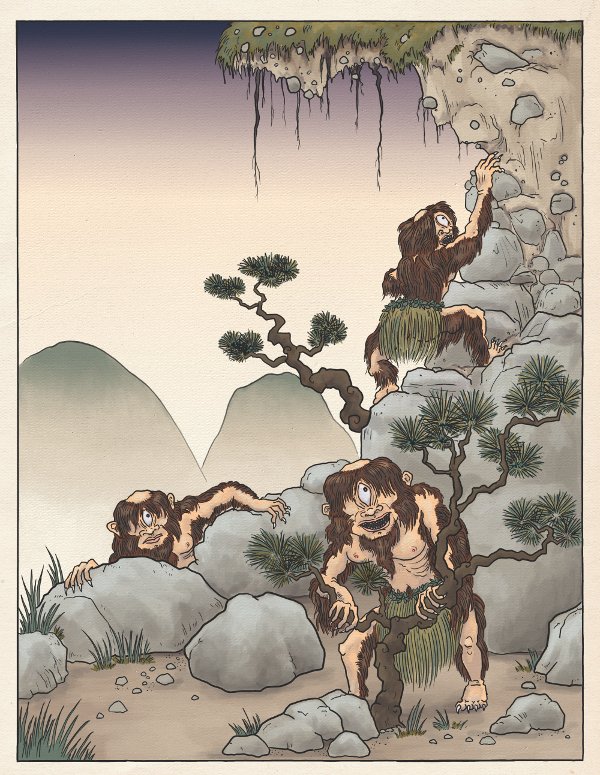
Night Parade Preview: Yamawarawa

We’ve already looked at the Kappa, Garappa, and Hyousube. Today I present you the final member of the Kappa family: the Yamawarawa.

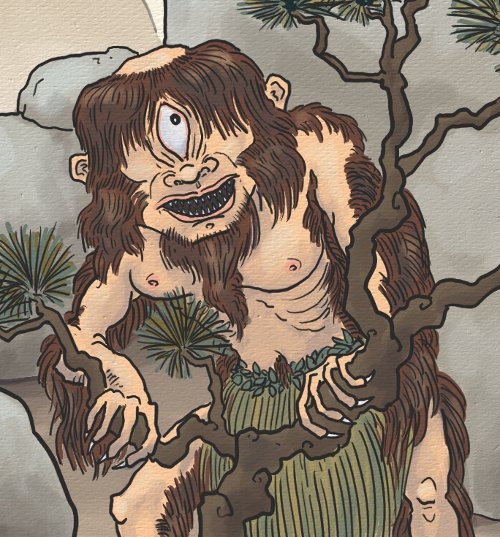
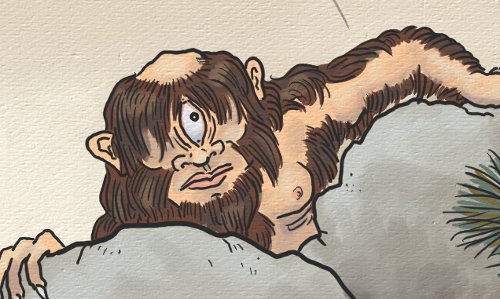
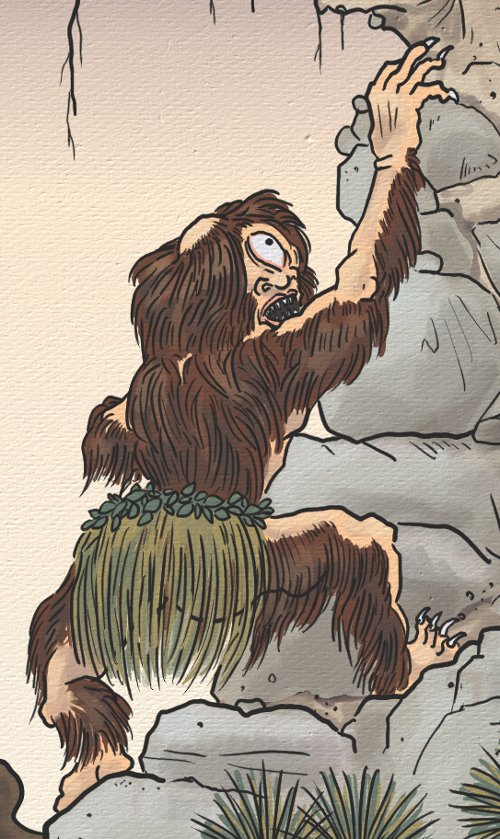
All the Kappa we previously looked at are summertime spirits. Every year on the fall equinox they perform a mass migration into the mountains, transforming into one-eyed hairy beasties the size of small children as they go. They live in this form as Yamawarawa for the whole winter, and return back to the rivers in another mass migration that takes place on the spring equinox.

Anyone unlucky enough to be caught in the middle of this massive migration is in for a nasty surprise. Yamawarawa hate to be spied upon, and they might viciously slaughter anyone they suspect of peeping on them. Any houses unlucky enough to be in the way of the migration are torn apart by the masses of monsters coming down the mountains, angry that someone had the gall to put up an impediment to their journey.

Yamawarawa

Yamawarawa

Yamawarawa detail 1

Yamawarawa detail 1

Yamawarawa detail 2

Yamawarawa detail 2

Yamawarawa detail 3

Yamawarawa detail 3

Happy 4th of July! (and a Yokai)

Like every good expat, I do my best to celebrate the 4th of July every year. Fortunately, in Japan, it’s very easy to get fireworks and have outdoor barbecues. Today we had one heck of a downpour that lasted most of the day, so it was no time to be outdoors celebrating, unfortunately. But my wife and I did manage to go out to eat and have a small happy 4th. Even though it was too rainy to light fireworks, I managed to paint some today instead:

Nekomata

Nekomata

This is Nekomata, an evil cat-yokai. It has two tails and all sorts of magic powers, such as the ability to create fireballs, change its shape, and even puppet the dead like some kind of necromancer. They often devour their masters and run the house in place of them, shapeshifting into human form whenever suspicion might be aroused.

Fireworks are a big thing in Japan, and most towns have a few fireworks festivals over the summer. The best time to see them is right now — July and August are the big summer holiday months, full of festivals, parades, outdoor markets, and all sorts of celebratory goodness. A bunch of the yokai in this book will feature festival scenes, this one included. Stay tuned for more!

Night Parade Preview: Garappa

Today’s heat was deadly!! The rainy season can be awful, but this year’s weather seems especially hot and humid.

Today I took my art class down to the riverside for the final class of the summer. (July and August are just too hot to paint outside.) The river was so cool and inviting! The water was crystal clear with an emerald blue tint to it, visible all the way to the rocky bottom. Big and small fish were swimming in it, and herons, swallows, and other birds were flying around and splashing in the shallows. I waded in up to my feet, and it felt so nice.

More than anything else, I wished I were a Garappa today. Garappa are very similar to Kappa — closely related cousins, actually. They live on the island of Kyushu, and resemble Kappa in appearance and behavior, except that Garappa have much much longer legs and arms than Kappa. I would have loved to dive into the river head first and just drink in all that fresh mountain water.

Garappa

Garappa

Night Parade Preview: The Hyousube

Today I bring you another sneak peak at some of the artwork in my upcoming book, The Night Parade of One Hundred Demons. Today we take a look at the Hyousube!

Hyosube

Hyousube

Hyousube detail 1

Hyousube detail 1

Hyousube detail 2

Hyousube detail 2

As you may remember from my last hyousube post way back a couple years ago, they are huge eggplant enthusiasts. They are also extremely violent and nasty! If you should happen to catch a hyousube picking at your eggplant patch, look away and pretend you didn’t see anything — if the hyousube catches you spying on him, he will curse you with a deadly illness that turns your whole body purple and kills you the following day. (And really, you should have properly made a sacrifice of eggplants to the hyousube instead of forcing them to come all the way from the river to your patch just to get a meal!)

The Night Parade of One Hundred Demons

For many weeks now I’ve been alluding to a project I am working on, but I didn’t want to go into too much detail until I reached a certain point in the project. I’ve finally reached that point, and I am excited to announce my Very-Big-Project-That-Until-Now-I-Couldn’t-Talk-About-And-Is-The-Reason-Why-I-Haven’t-Posted-Much-Art-On-My-Website-This-Year!

I am making a book about yokai! It will be an illustrated field guide to yokai, and it will also other supernatural Japanese beasties. It will be fully illustrated, full color, and choc-a-block full of awesome information about these creatures, which I have been researching for a long time now. The book is tentatively titled The Night Parade of One Hundred Demons, which as you may know was the title of one of yokai master Toriyama Sekien’s yokai anthologies. One hundred, so yes, there will be 100 yokai in this book. In fact, a little more than that. And that means 100 full-page, color illustrations! There will be text and descriptions accompanying each yokai, but the main focus of the book will be the artwork. I am hoping to make this the most comprehensive and the most beautiful collection of yokai ever published in English. Some of the images will be cute, some will be grotesque. I am trying to present the yokai as they are described in tales, rather than in contemporary popular culture. That means there is some violence, some sex, and so on. It won’t be a kid’s book, but it won’t be rated R either.

I spent the entire first quarter of this year collecting stories from books, the internet, and (the most fun part) native Japanese who remember the stories from when they were children, translating them into English, and trimming them down to single-page tidbits that give a nice overview of each yokai. The 2nd quarter of the year was spent drawing, designing, and doing layout for the book, until I had a fairly complete working manuscript. Now, that the third quarter is starting, I am starting the biggest part of this project: painting all of the pictures!

You’ll see some similarities between this project and my A-Yokai-A-Day series, including many of the yokai. Almost all of the yokai I’ve presented on this website will be in the book, with new illustrations accompanying them (as you can see with the Kappa below). Of course, I haven’t shown nearly 100 yokai on this site, so you will get to see a large number more yokai that most people have never seen or heard of before (including many of the Japanese people I have talked to). Later on I will post a list of all the yokai included in the book.

In a few more weeks I will also be launching a Kickstarter funding project to help with the cost of publishing it (not to mention to cost and time involved in making it). There will be a number of patronage levels, starting from $1 on upwards, each one with specific rewards as a way to say thank you for your support. In the meantime, I will be posting updates on the book here on my blog, and on my Facebook page.

For now, here is a little preview of what the interior art will look like. The Kappa, one of Japan’s most famous and most loved yokai. I said there would be some blood, and here is a good example. The Kappa, while one of Japan’s favorite yokai, especially among children, is not at all the cute little rapscallion that most people know him as. In older folklore, they hunt and eat humans, rape women, and murder horses and cattle. Their favorite food is raw, bloody, human anuses. So be careful!

Kappa

Kappa

And some up-close details of the artwork:

Kappa detail 1

Kappa detail 1

Kappa detail 2

Kappa detail 2

Kappa detail 3

Kappa detail 3

I hope you enjoy these! And stay tuned for more updates on this book, especially for the Kickstarter project! I guarantee it will be worth becoming a patron of this project! 🙂