Monkey, the Precursor to Ecchan

Small Monkey

Monkey

Before there was Ecchan, I went through a number of different characters trying to come up with a good theme. One of my favorite concept characters before we came up with Ecchan was this monkey.

Monkey is a character I have been drawing ever since I was a little kid. In fact, I think the first monkey cartoon I ever did dates back to when I was in 5th or 6th grade, and he had a few precursors before then. He has evolved a little bit over the years, but the general look has stayed the same.

We ultimately decided not to go with Monkey and I went on to develop Ecchan, but before we went that route I wrote up two Monkey comics, which never got printed. They would never have seen the light of day if not for this blog, so I’m glad I can post them here and Monkey can get just a little bit of viewership.

Monkey Comic

Monkey #1

Panel 2:「ゴミ袋に名前を書くなんて・・・! 日本はおかしいよ!」
“Why do I have to write my name on the trash bags? Japan is strange…”
Panel 3:「確かに嫌だよねえ。でも、ちゃんと理由があるんだよ。」
“It really is a pain… but there’s actually a good reason for it.”
Panel 4:「それって、きっと変な理由なんじゃないの?」
“Well, it must be a pretty strange reason, right?”

Monkey Comic #2

Monkey #2

Panel 2: 「こんなに細かいんだろう?」「このゴミ箱1つじゃ足りないわね」
“Why are the trash rules so complicated?” “This one little trash can isn’t big enough.”
Panel 3:「このゴミ箱すてきだと思わない?」
“Don’t you think this trash can is nice?”
Panel 4:「買っていい?」日本のゴミ箱メーカーは儲かってるんだろうな。。。」
“Shall we buy it?” “Japanese trash can makers must be really do really well for themselves…”

Ecchan #3

Ecchan -- summer version

Summer Ecchan

Here is the 3rd “issue” of Ecchan no Eco-na Hanashi. This is the June issue, so I redid the little Ecchan face spot that I posted on the first comic. The face goes below the comic and helps introduce the bulkier text part where the month’s ecology theme is explained further. So this is “summer Ecchan” which will be used probably for this month and next month. In August I may do an “Obon Ecchan” wearing festival clothes.

Since this one is this month’s issue, you’re all caught up on Ecchan, and it probably will be a few weeks before I post the next issue in July. But I still have a couple of alternate comics that didn’t get published, so I’ll be publishing those soon as well.

This is the first issue to start using returning characters as well… I needed a couple of characters, and when I was sketching up ideas for what animal to use for the series, I went through a whole list of animals. The bear and the frog were both candidates, so I am glad to be able to give them a spot in subsequent comics.

Read on below for the translation of this month’s comic!

Ecchan #3

Ecchan #3: June 2011

Panel 1:「新しいのを買わないとだめかな…」
“Do I have to buy a new one…?”
Panel 2:「自転車屋さんで直してもらえば、まだ乗れるんじゃないかな!」
“I bet if you take it to the bike shop, they can fix it for you!”
Panel 3:「この制服、もう小さくなっちゃった。」
“This school uniform is already too small.”
Panel 4:「学校のバザーに出すと喜ばれるよ!」
“You can make someone happy by donating it to the school bazaar!”

Ecchan #2

Here is the second Ecchan comic I did. This one was the May version, printed last month. Translation below!

Ecchan #2

Ecchan #2

Panel 1:「よし、今日からREDUCE(ゴミ減量)生活だ!」
Alright! Starting today, let’s live based on “Reduce!”
Panel 2:「詰替え用の商品もReduceにつながっているね」
Refill packs are part of “Reduce” as well.
Panel 3:「食べきれる分だけ買おう!」
Let’s only buy as much as we need.
Panel 4:「マイバッグ、持ってますよ!」
I brought my own bag!

At this point I have to say it: translations from Japanese to English and English to Japanese always sound really weird, just because the languages are completely unrelated to each other, and the style of speaking is completely different too. It sounds weird and unnatural when translated, but it doesn’t sound so silly in Japanese.

Meet Ecchan

Ecchan the stork

Ecchan

Recently I was given the opportunity to design a character for Echizen City’s Department of Environmental Affairs. The theme was supposed to be environmental, and the character was going to be used in comics talking about local environmental issues, and through the Echizen City International Association it would be geared towards foreigners as well, and translated into Portuguese and Chinese (no English). I was also going to get to design the comics! 🙂

It wasn’t too hard to come up with a character idea. In the 1960’s, chemicals and overdevelopment completely wiped out the Oriental Stork in Japan. Through a long process of captive breeding and stricter environmental laws, the stork was reintroduced to Japan, and wild hatchlings were reported for the first time in 2007. A few years ago, one of the storks made its home in Echizen city, and it has become a favorite mascot in town. It seemed like the obvious choice for a character symbolic of environmental action, so I drew up Ecchan the stork.

These comics are being published one a month, and can be seen in Japanese, Chinese, and Portuguese on the Echizen City webpage, and International Association monthly newsletters. Hopefully they will be expanding viewership to a larger area. Since there’s no English version, I’ll translate it here. Anyway, here is the first comic.

Ecchan comic #1

Episode 1

Panel 1: 日本の人口は世界で10番目に多い。
Japan’s population is the 10th largest in the world.
Panel 2: でも、日本の国土面積は世界で61番目。
But Japan’s land area is only the 61st largest.
Panel 3: 日本のゴミの年間排出量 5273万トン・・・
Japan creates 52,730,000 tons of trash every year…
Panel 4: 「私たちにできること。それは3R!」 「3R?」
“There’s something we can do… 3R!” “3R?”

After the panels there is a paragraph with tips and information on the month’s theme, this one being Reduce, Reuse, and Recycle. The strange tan blank spot at the top of the comic is for Ecchan’s profile. This comic was for April’s edition, so I’ll post May’s and June’s later on!

The Awesomeness That Is Kickstarter

Have you heard about Kickstarter?

I discovered it last year, and it immediately struck me as a really awesome idea, and quite possibly the solution to the question of how to make art in a copy-and-paste world.

As soon as the internet became widespread, the old way of doing art died. Sure, it’s still around now, but its in its final death throes. Napster, mp3 sharing, bit torrent, and a whole host of similar initiatives changed the way we access music, tv, movies, and so on. Now with handheld e-readers even books are being absorbed into the sea of piracy. This is great for consumers, and scary for the producers of media — but only if they don’t adapt to the system. Already a few companies have had great success by adapting themselves to the new world presented by the internet — iTunes, Netflix, Hulu, Youtube and so on have all found ways to make music, movies, and tv available easily, and no doubt we’ll see digital libraries handling ebooks soon enough. But one part of the art world which hasn’t changed too much yet, but is in as much danger of being left behind as music was, is visual art.

Many visual artists work with big companies, and so they will adapt along with those industries. But what about the smaller, independent and freelance artists? When everyone has color printers and high quality digital cameras and scanners it means that any image can be captured and reproduced infinitely at a very high level of quality. And with images floating unimpeded around the internet, it’s not easy to see how there soon could be a crisis for artists who lie outside of the corporate safety net. And with e-business cutting costs, its just as easy for these big firms to hire talented artists in India or elsewhere to make beautiful pictures at a fraction of the cost that it would take to hire an American illustrator. It looks the feasibility of doing freelance artwork is drying up for those who do not have full-time position

But companies like Kickstarter are doing exactly what the internet is supposed to be doing for everyone: knocking down barriers and bringing new opportunities. The business model they use is so simple and elegant: patronage. Everyone knows that art is expensive to make (though many people probably don’t know just how expensive it really is!). In the old days, artists had to be supported by rich patrons. The most obvious example is the House of Medici, without whom we would not have the works of Michelangelo and many other Renaissance masters. But the patronage custom went well beyond those ages, and even in the Industrial Era we had the big business tycoons supporting the arts — Carnegie and Rockefeller to name only a few. The patronage tradition has continued for a long time, but has always had one huge problem: you have only a few patrons, but millions of artists who could potentially be competing for that support.

This is where the internet comes in. With the ease and low cost of global communication brought about by the internet, it is not possible to have patrons support causes through micro-payments. Micro-payment services have been used for research projects, charities, funding education in poor districts, and countless other things. I even know of a few publishing companies that have gone from nothing to fairly big publishing though hard work and micro-payments made by patrons who appreciate the work they do. Kickstarter follows this philosophy, and provides a forum where artists can link up with patrons who are willing to support their projects.

It’s hard to overstate how cool this actually is. 10 years ago it would have been impossible. Even 5 years ago it would have been difficult. An artist, or a musician, or an author might have great talent and the perfect idea, but without a rich backer or a corporation to provide funding, he or she would be stuck and the project would never come to be. That world no longer exists. Thanks to the internet and companies like Kickstarter (it’s not the only one — there are quite a few net businesses that have sprung up around this model), possibilities that never could have existed 10 years ago are becoming real. Even cooler, the people using Kickstarter are often part of the internet intelligentsia — folks who support open source and creative commons, copyleft, and DIY projects. So not only is Kickstarter helping new artists do their projects, but it is making the world a better place by supporting projects that most companies would have dismissed as unprofitable! Yet find the right people, and anything is possible.

The best part of the patronage system is that each patron gets to provide input on the project and see it along as it progresses. Patrons get to be a part of the development process, and they also receive some kind reward for their support as well — so it’s not simply a donation: its an investment.

If you are a fan of the arts, you should definitely check out Kickstarter. I’ve been watching them for a year or so now, and some of the projects that caught my attention are just so cool: one group hires an orchestra to make professional recordings of classical pieces and then donates them to the public domain (because even though the music is public domain, often times the recordings aren’t). Others have made physical merchandise after receiving the funding for supplies. Custom dice, iPad games, board games, graphic novels, large-scale art projects… the variety up there is amazing. Go check it out!

It must sound like I am doing a commercial for Kickstarter… and in a way I am, because I think we should all support the arts in every way we can. But a big part of the reason I wanted to mention the potential awesomeness is because I, too, will be launching a Kickstarter project soon and I hope that you will be interested in supporting me. I’ve been working on it since January and it’s the reason I have been much more quiet on my blog than I would have liked to this year so far — I haven’t had much new art to show outside of this project, and I didn’t want to show anything for this project until it was ready. I’ll be making another more detail blog post about it this month, but I can say what it is for now: a fully illustrated field guide to yokai, featuring over 100 full-color illustrations and descriptions from the weird and wild folklore of Japan. More on it later!

Another Great Day for Sketching

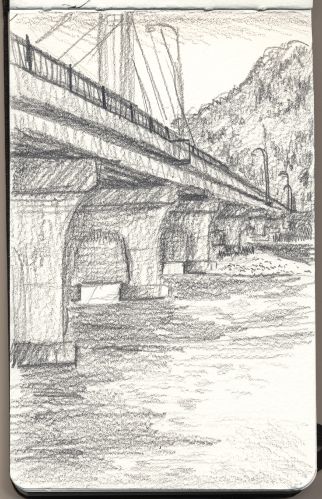
The bridge to Takefu

Bandai-bashi over the Hino River

I took my art class to the river again today to sketch birds and mountains. It was beautifully overcast — the perfect amount of light to make the river glow an emerald blue — with a cool breeze that brought the wonderful smells of flowers, wet grass, and burnt cypress along with it.

One of my students recognized the mysterious white bird that I posted about last week. She said its a sekirei, and checking my Japanese-English dictionary that turns out to be a wagtail. What an appropriate name!

Well, according to Wikipedia, its name is actually a mistranslation of its Latin name motacilla, but “wag-tail” is far more fitting than the Latin “little mover” due to the very distinctive tail bobbing it does every time it moves.

Judging by the distinctive eye stripe I would guess it is a Japanese pied wagtail: Motacilla albis lugens (http://en.wikipedia.org/wiki/White_Wagtail)

I had been wondering what they were ever since I came here, as I had never seen them in North America. Unfortunately people rarely know the answers to the weird questions I ask (like “what species of bird is that?”) but today I was just lucky.