Springtime Sketching

May is one of the best months of all, especially in Japan. In fact, it is in the running with October for my favorite month of all. Nearly every day has been sunny and warm, with a cool breeze, cool nights, and a pleasant breeze blowing all day long. The wind carries the smell of flowers and timber from the nearby mills, and the songs of frogs and birds carry on all day long.

Yesterday I took my art class to the Hino River in the center of town for sketching — it’s one of my favorite places to sketch here. We sat under the bridge in the shade, surrounding by darting swallows, catching bugs and feeding them to their chicks. The sound of the water and the sweet breeze made it a wonderful day for sketching outside. In between monitoring class I was able to jot down this little pencil sketch in my moleskine:
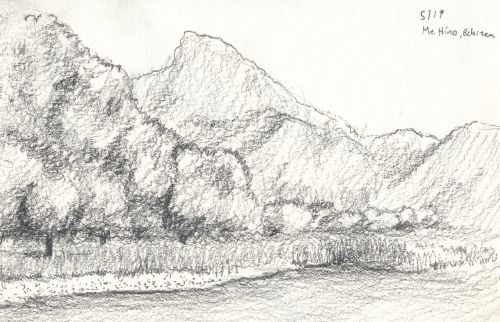
Mt. Hino

Mt. Hino from Takefu

After sketching the mountain, we spent the rest of the class watching the birds dart about. Swallows have the most amazing movement which was hard to capture, but I was about to do a couple of 10-second gesture drawings of them. These short, tiny bird sketches are refreshing in comparison to the relatively longer landscapes. If you don’t finish them in under 10 to 15 seconds you lose all of the energy and the end result looks lifeless, so you are forced to just take a snapshot with your eyes and then transfer all of that energy onto the paper in just a few strokes. You can see the result below.
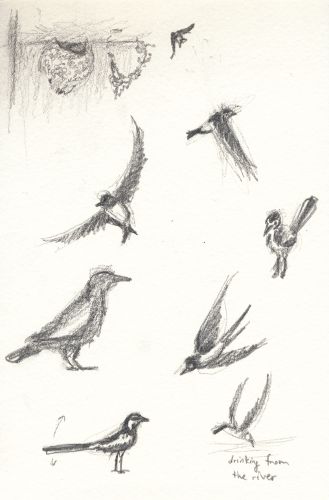
Birds

various birds

By the river, tons of other birds stop by for drinks and baths — crows, kites, herons, storks, pheasants, sparrows, and more. There is this one black and white bird that I see around here a lot. I have no idea what it is, but it is very beautiful and its tail bobs up and down in the most amusing manner whenever it stops running. It reminds me of the plovers of the Atlantic coast, but it’s a bit smaller and I don’t think it’s a shore bird.

Tenjin-sama

Earlier this year I was commissioned to do a kakejiku — a Japanese hanging wall scroll — of Tenjin-sama, the Shinto kami (god) of scholarship. I did a little post on him back then, but I haven’t been able to show the work because these kind of scrolls take a long time to frame (over a month), and I didn’t want to upload any images until the owner had received the finished piece. The scroll is long — taller than I am — and the image itself is about 4 feet high. These kind of scrolls go in an alcove called a tokonoma, which is found in Japanese-style rooms with tatami mat floors. Kakejiku are often changed with the seasons, so families that can afford it often have many different ones that they can rotate in and out depending on the time of year.

Tenjin-sama was an interesting project for me to do. There are lots of symbols and things to take into consideration in this kind of artwork, so I had to do a lot of research before putting my brush to (a very very large piece of) paper. You can read more about him on his Wikipedia page, but the long and short of it is that a nobleman and poet named Sugawara no Michizane fell out of favor with the emperor and was exiled to far-away Kyushu. He died while still in exile, and it is said that his spirit turned into a vengeful ghost, or an onryo. Immediately after his death, the capital was struck by a number of disasters, and the court magicians and priests ascribed the storms and fires to the angry ghost of Sugawara. In order to placate his spirit, they enshrined him as a god, calling him Tenjin. He was ranked very high as a god and his shrine was supported directly by the government, so he became quite popular. Tenjin was worshipped first as a sky deity and bringer of disasters, but eventually this gave way to his status as a scholar and a poet during life, and he became a popular kami of education and scholarship. He is prayed to by parents and students during exam periods and so on.

The trees in the painting behind him are pine, bamboo, and plum. Pine and bamboo have auspicious meanings attached to them, and are common motifs in scrolls, while the plum was Sugawara’s favorite flower. His shrines are commonly decorated with plum trees, and there is a famous poem he wrote in exile in which he laments his favorite plum tree which he had to leave behind in the capital.

Obviously the picture was too large to scan, so I had to stitch a few digital photos together to make this composite. As a result, the color isn’t perfect, but I think it comes close and can give you a good idea of what the finished, full size piece looks like.

Tenjin-sama

Tenjin-sama wall scroll

Sakura!

Of course everyone knows that Japan is the country of cherry blossoms. We had a very cold winter, even up until last week, but all of a sudden we had a few warm and beautiful days, and then suddenly POP! All of the cherry blossoms are in full bloom! Their light sweet smell is in the air and it’s perfect weather for walking in the blossom tunnels along the riverbanks. I’ll have more photos of that after this weekend, when I do hanami — a cherry blossom viewing picnic.

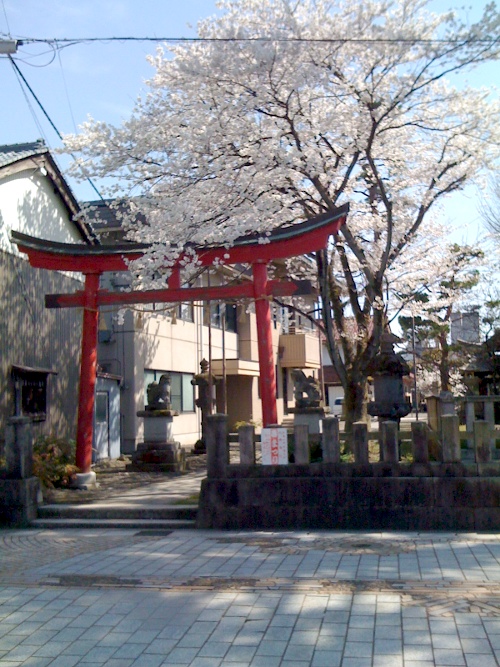
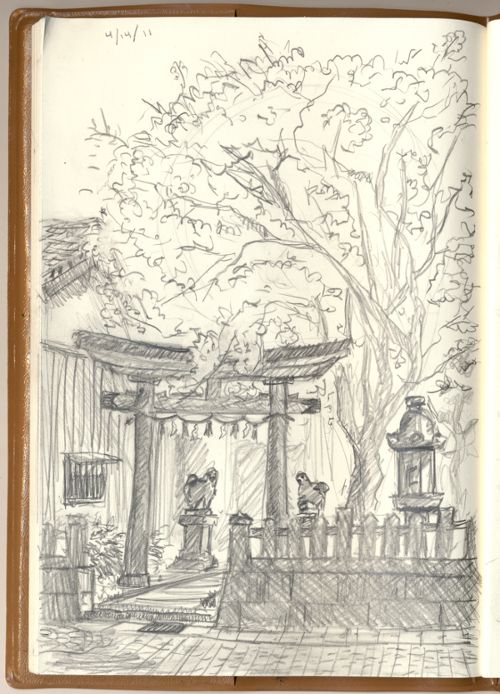
Today I had art class, and it was a perfect day for sketching outside. I took the class to the Souja Shrine in the center of town, and there was a beautiful old cherry tree hanging over a big weather-worn gate and some moss-covered statues. It was too nice to pass up, so we did our sketching there.

Usually I don’t get to spend much class time drawing, but today I was able to get a 20 minute sketch done in between helping the students:

sakura sketch

sakura sketch

Here’s a photo of the sakura:

Souja shrine sakura

Souja shrine sakura

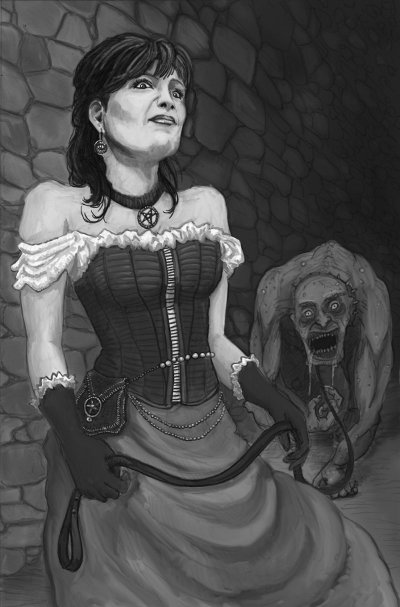
Minu Dunwielder

That is the name of this character I illustrated for Nevermet Press’ The Dead Queens of Morvena. She is a villain, the leader of an evil cult, mentally disturbed, and an all-around nasty lady — all of the elements of a genuine bad-guy.

Click on the image to visit their site and read her back story.

Minu Dunwielder

Minu Dunwielder

And stay tuned to the Nevermet Press blog for more information on their upcoming book The Dead Queens of Morvena!

Kakejiku

Japanese houses have little alcoves, called tokonoma, where important things are usually placed. Sort of the equivalent of the mantle above a Western fireplace… but not exactly. They are usually very beautifully decorated with precious china, or katana, or vases, paintings or calligraphy. Especially at this time of year, you will find them decorated with trays of mochi topped with an orange — an New Years offering to the gods. By far the most common decoration is a kakejiku, a hanging wall scroll.

There is far too much symbology that goes into kakejiku for me to write it all here. More than simply pretty pictures, they are often representations of mythological or religious figures, nature or animal scenes, or calligraphy. There are many common themes, such as cranes, turtles, tigers, pine trees, bamboo, gods, and so on, and each one has a very specific meaning. One could spend years, I’m sure, studying the nuances of the positioning and facing of the subjects, not to mention their individual meanings. Chinese feng shui also goes into the decoration process. All of this consideration is part of the reason the tokonoma — and the kakejiku — are such striking and beautiful, uniquely Japanese, features of the house.

I had the chance to paint a kakejiku last summer, for my wife’s family. I thought very hard about what to paint, and I did a lot of research. There are thousands available at art stores to choose from, so I knew I had to do something special. I was overwhelmed by the importance of the symbology and for a while felt like I was in over my head… I was afraid of doing something wrong, or messing up a symbol, or somehow making a blunder that would render my kakejiku into something worthless and un-hangable.

Eventually, after realizing that the symbology was something I would not be able to grasp within a few short weeks of study, and that it would be nearly impossible to create anything other than a poor imitation of some other painter’s work, I decided just to do my own thing. After all, they wanted a kakejiku by me, not just any old kakejiku.

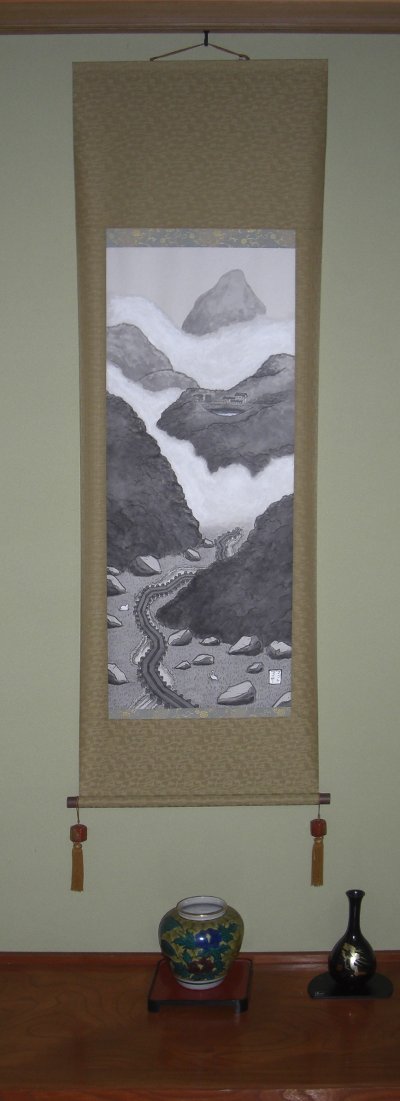
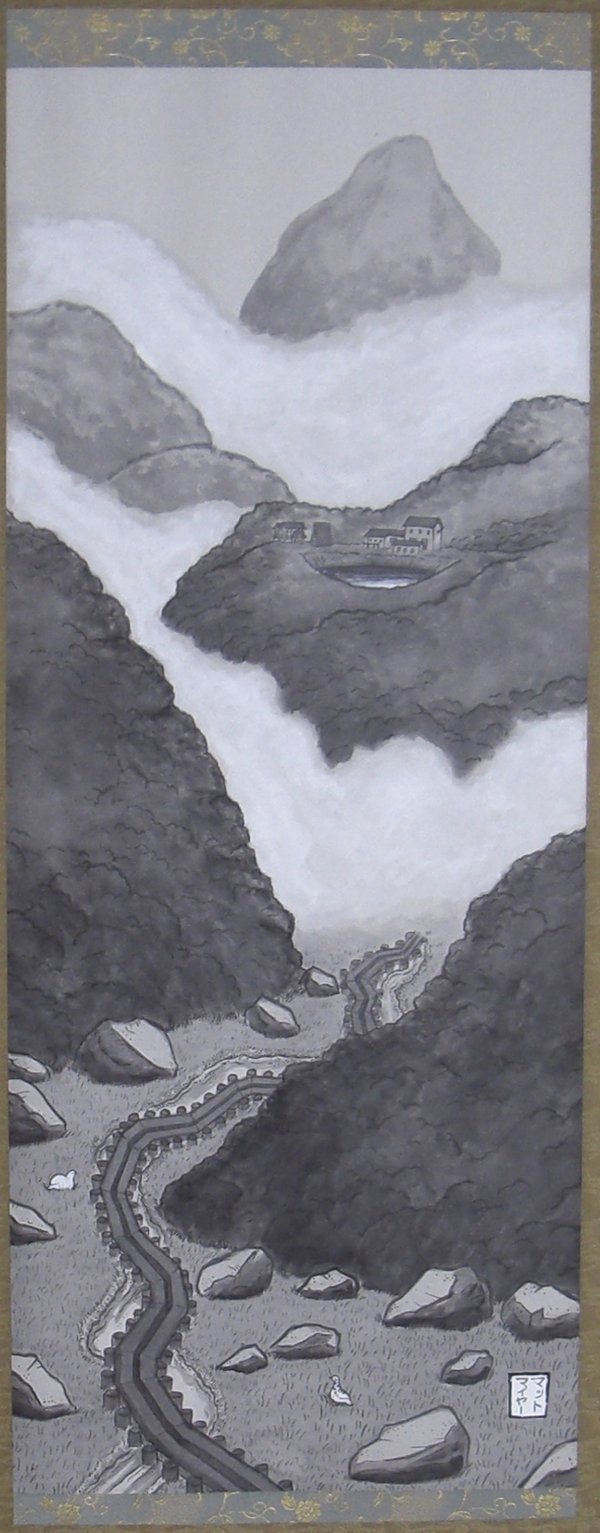
I stuck with the nature motif, and I decided to illustrate the vacation my wife and I took with her parents to Mt. Norikura — one of the first big trips I went on with her family. Norikura is a beautiful mountain right smack in the middle of the Japan alps, and it has a lot of very unique features, including a board walk through a mountaintop valley, beautiful ptarmigans (raicho, or “thunder birds,” in Japanese), and amazing mists and clouds that drift through the valleys and below the mountaintops. It was a great memory for me, and also (I hope) for them, so I thought, if anything, that should be appropriate for a Matt-made kakejiku.

They were very happy with it.

I forgot to take a picture after I painted it, and finally, after months of writing notes on my hand and subsequently forgetting to photograph it (it’s far too big to scan), I finally remembered today to take a shot and post it up here.

My wife's family's tokonoma

My wife's family's tokonoma

Kakejiku of Norikura -- detail

Kakejiku of Norikura -- detail

More from Nevermet Press

I hope everyone had a Merry Christmas!

I’m busy doing the traditional post-Christmas Japanese tradition of cleaning the house. Frankly I prefer the American tradition of spring cleaning, because when you open the windows to air everything out, snow doesn’t fly into the house. And if the gas shuts off, you can survive without hot water for a day or two in the spring… but it’s freezing cold and I have to wash everything in half-frozen tap water! All the same, there’s nothing quite as refreshing as a clean house.

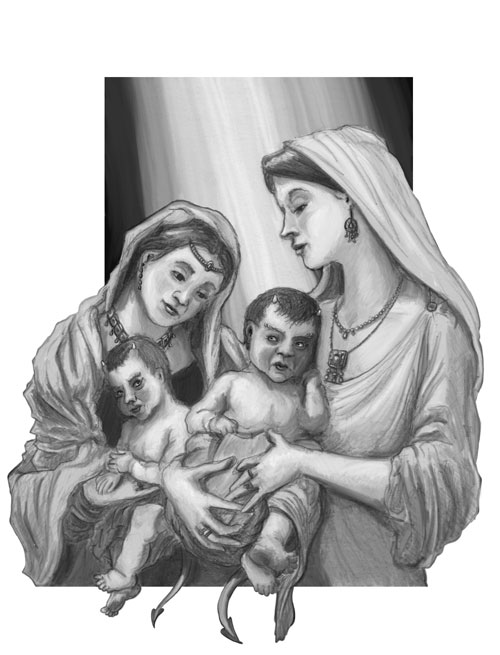
Anyway, I just wanted to write a quick post about the latest update on Nevermet Press — another post featuring my artwork for the upcoming book, The Dead Queens of Morvena. Check out the web enhancements and previews for the book at nevermetpress.com!

The Queens With Their Babies

The queens with their babies

Remember the Reason for the Season!

And of course, there are countless reasons!

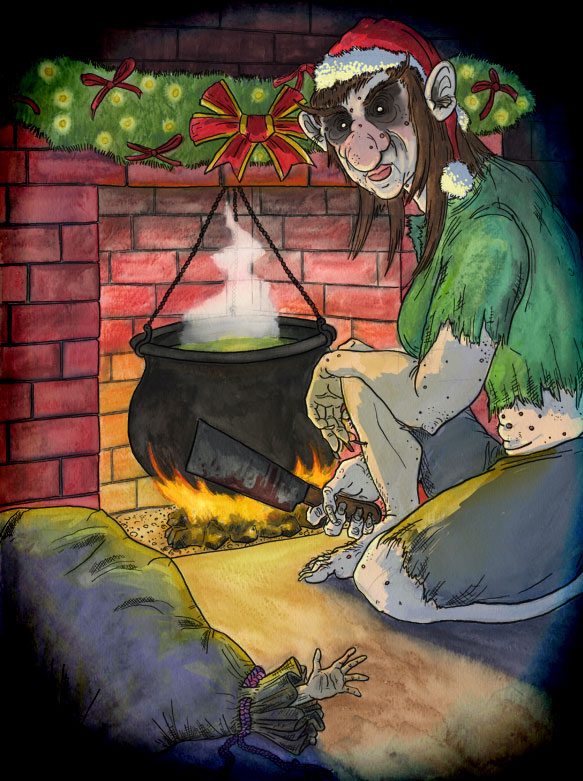
For example, Grýla, a terrifying ogress native to Iceland who comes down from the mountains at Christmas time in search of delicious children!

Grýla is one of those legends that are just too good to be made up — like Krampus of the Alps. As they say, truth is stranger than fiction, but even considering that it’s hard to believe that this legend could have come to be. Apparently she goes way way back in Norse folklore, as she is even mentioned in the 13th century eddas. At some point, Grýla became associated with Christmas as the mother of the Yule Lads.

The Yule Lads themselves are a terrifying story. There are 13 of them, and their names are as colorful as they are descriptive: Sheep-Cote Clod, Gully Gawk, Stubby, Spoon-Licker, Pot-Scraper, Bowl-Licker, Door-Slammer, Skyr-Gobbler, Sausage-Swiper, Window-Peeper, Door-Sniffer, Meat-Hook and Candle-Beggar. Each one is associated with one of the 13 days before Christmas, and they perform varying levels of mischief related to their names — ranging from licking bowls all the way up to eating children.

If the Yule Lads are that bad, you can imagine what their mother must be like! (Probably something like Mama Fratelli from The Goonies, only bigger.) As a testament to her scariness, there was actually a public decree issued in 1746 in Iceland prohibiting the use of Grýla and the Yule Lads to frighten children. I guess the earlier Viking children were made of tougher stuff…

Grýla

Grýla (watercolor & digital)

So have a Merry Christmas! And remember, when you hear someone whining that the original meaning of Christmas has been lost, or that there is a war on Christmas or some other nonsense like that, give them a slap in the face and tell them about Grýla!