A-Yokai-A-Day: Kijimunaa | 今日の妖怪:キジムナー

Today’s yokai is a bit unique in that he’s the one really well known yokai exclusive to Okinawa.

Okinawa is to Japan a bit like Hawai’i is to the US. It was an independent island country for a long time, and only about 100 years ago was annexed into Japan proper. The old name for Okinawa was the kingdom of Ryukyu. In the 1600’s, Japanese settlers conquered and occupied the fairly weak kingdom, and kept it as a vassal state. The native culture was suppressed, Japanese language education was forced upon the people, and other attempts were made at assimilating the islands. Despite this, the island retained a unique culture, with many customs assimilated from Japan, but also a tradition existing independent of mainland Japan. One of these traditions is today’s yokai.

Kijimuna

No mention of kijimuna can be found in the “classical” yokai bestiaries by the great Japanese painters of past centuries, probably because Okinawa really wasn’t considered part of Japan in those times. However, the kijimuna is well known and beloved all throughout the island prefecture. Countless Okinawan folk tales talk about kijimuna, and one of the biggest annual festivals in the region is named the Kijimuna Festival.

Kijimuna live in the banyan trees that can be found all over the islands of Okinawa. They look like small, hairy, wild boys, and like little boys they are often mischievous, but generally good at heart. Physically they are short, they either go naked or wear leafy loincloths, and they are covered in wild red hair. My best description of them would be a cross between a troll doll and Link from the Legend of Zelda. In most depictions of kijimuna on the islands, they are rather cute and boyish, like Peter Pan, while the famous yokai chronicler Shigeru Mizuki depicts them as round, hairy, ball-like monsters with huge, crazy eyes and fanged mouths. I liked both depictions equally — the crazy eyes of Mizuki’s kijimuna, and the more “authentic” native Okinawan version — so I drew my version as a blend of the two.

Kijimuna are said to befriend humans easily, doing good deeds for them and bringing them presents, but also quickly become jealous and will punish people in very childish ways who don’t act friendly enough. Despite living in the banyan trees, kijimuna are expert fishermen, and often offer their help to kind human fishermen as well. If they really like you, they might even offer you the bodies of the fish they catch (after they suck out the most delicious part — the eyes)! As far as pranking goes, kijimuna will sometimes sit on a person’s chest at night, rendering them immobile and unable to breathe (sounds kind of like sleep paralysis, which I suffer from fairly often). Apparently they will also happily carry humans that they like piggy-back style through the banyan forests. However, if the person should *ahem* fart on the kijimuna’s back… well, he’d better beware!

One final fact of note about kijimuna — they loathe octopuses! I am so far unable to discover why they hate them so much, but the lowly octopus is the one thing they cannot stand. Kijimuna will avoid them at all costs, so keeping octopuses around is a fairly foolproof way for humans to avoid potential kijimuna-related troubles.
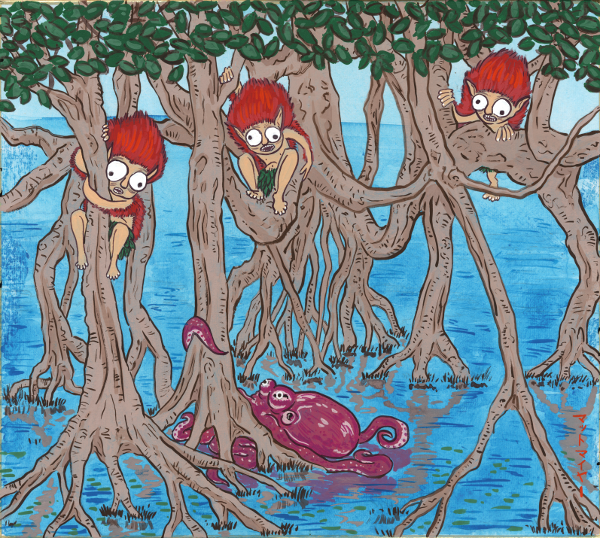
Kijimuna

Kijimuna

| 「今日の妖怪シリーズ」今日は、キジムナーです。今回の妖怪はややユニークな妖怪で、特に沖縄でよく知られています。

キジムナーに関しては、古い伝統的な記述の中ではなかなかみつけることはできませんでした。その理由としては、これまでのような古典的な妖怪の話が描かれていた時代には、沖縄は日本ではなかった(琉球王国でした)ためだと思われます。
キジムナーは沖縄県内で有名であり、県内の大きな祭りにもその名前が使われています。

キジムナーは沖縄でよく見られるガジュマルの木に住んでいる、小さくて毛深くて赤い毛の野生的な子共のような妖怪です。時にいたずらもしますが、一般的には良いものとしてしられています。トロールと「ゼルダの伝説」のリンクの間くらいと表現すると分かりやすいかなと思います。もしくはピーターパンよりももっと可愛らしいとも表現できます。
有名な水木茂さんのキジムナーは、丸くて毛深くてボールのような形をしており、大きくてクレイジーな目と牙がある口で表現されています。
今回私は、水木茂さんのキジムナーと沖縄に伝統的に伝わっているキジムナーを統合させる形で描いてみました。

キジムナーは人間と簡単に友達になり、魚をプレゼントしたりいいことをしてくれますが、友達じゃない素振りを見せてしまうとすぐに嫉妬深くなり子供のようなやり方で仕返しをするようです。

ガジュマルの木に住んでいるキジムナーは、漁をしている人を見つけると近づいて漁の手伝いをし、捕まえた魚の目以外の部分はその漁師に全てプレゼントします(魚の目はキジムナーが食べます)。

キジムナーの行動には色々と伝えられていることがあります。例えば、夜になって人の胸の上に座って苦しめ、動けず呼吸ができないようにしてしまうそうです(私も時々感じる金縛りのような状態です)。または、喜んで人間をおんぶしてガジュマルの林を走り抜けたりもするそうです。ただしキジムナーはおならが大嫌いなので、キジムナーの背中ではおならをしないように気をつけましょう!
そしてもう一つキジムナーの嫌いなものがあります。それはタコです!どうしてタコを嫌うのかについてはよくわかっていませんが、もしキジムナーと関わりなくないと思われるのでしたらタコを周辺に置いておくのも良いかもしれません。

キジムナー

キジムナー

A-Yokai-A-Day: Tengu | 今日の妖怪:天狗

Today’s yokai is not only awesome in its own right, but it is also the name of one of my favorite chain restaurants over here.

Tengu

This is one of the most famous and most interesting yokai, with a lot of documentation, and probably more paintings and imagery than all other the yokai combined. It is interesting for a number of reasons, the first being its name.

The name tengu is derived from the Chiense tiangou, a type of black dog that lives in the sky and eats the moon (during lunar eclipses). This brought about the Chinese superstition of beating dogs during an eclipse until the tiangou spits up and the moon returns to the sky. The characters for tengu, 天狗, literally mean “celestial dog,” and the writing is the same as it is in Chinese. Like many yokai we’ve looked at, the tengu was brought over to Japan from China along with Buddhism, Confucianism, government, writing, and many other things over 1000 years ago. And also like many of the yokai we’ve seen, the tengu quickly adapted into a completely unique Japanese being. For one, although it still retains the name, the tengu has no dog-like traits whatsoever, and does not swallow the moon. In fact, other than the name it bears no resemblance whatsoever to its Chinese namesake.

So what is a tengu exactly? Well, its been described as a god, a demon, and a kami, but mostly it is accepted as a yokai. Physically it appears in a few common forms: one is that of an anthropomorphic kite-like monster (kite the bird, not the toy); another is a human yamabushi, a Japanese ascetic mountain warrior-sage; and a third is a hybrid of the previous two, usually with an enormous nose that would make even Cyrano de Bergerac blush, and a deep red face. The tengu is extremely wise, extremely powerful, and extremely dangerous. They enjoy eating humans, and they are fierce enemies of Buddhism. There are many stories of tengu carrying off monks into the mountains to be ravaged and devoured. They mislead the pious with false images of Buddha, impersonate women and try to seduce holy men, they rob temples, and they can also grant great unholy power to evil men who would worship them. They often abduct young boys and drop them in the woods, or tie them to the tops of trees, or forcing them eat feces until they go mad. There are dozens upon dozens of tales of tengus doing harm to mankind. Even the Japanese Emperor Sutoku, in the 12th century, is said to have died in torment and sworn to haunt the country forever as a great demon, and so his ghost transformed into a vicious tengu. But don’t worry — according to local lore from Ishikawa prefecture, tengu hate mackerel, so if you hang the fish up around your house, you may just be able to keep yourself safe!

So how is a tengu born exactly? Well, in most cases they are the ghosts of bad men and women whose souls cannot go to Heaven, but as Buddhists also cannot go to Hell. Often people with excessive pride become tengu after death. It is said that wise and knowledgeable men become very powerful daitengu, while ignorant people turn into the weaker kotengu. Being an important enemy of Buddhism, the priests did a lot of work to document them, and there are even a number of famous named tengu, as well as locations which are specifically infested with tengu. One of these books is the Tengu Meigiko, which documents the 17 best-known daitengu and the mountains that each one calls home. These daitengu often take on the more human-like, long-nosed appearance, while the kotengu are often more monstrous and bird-like.

But not all tengu are bad! There are, in fact, a number of good tengu written down in Buddhist parables. And in the last 300 years or so, the horrific image of tengu has given way to more stories of good — or at least neutral — tengu. Tengu eventually evolved into the vigilant protectors of mountains and forests, and they inflict terrible punishments on foolish mortals who would so much as pick a single leaf from their protected grounds. As they are often described as yamabushi, or shugenja, there have even been a number of religious cults that worship tengu as kami. Tengu are also well-known for being martial arts masters, and there are many legends of people seeking tengu out for training. These legends were popularized by later Japanese painters and printers, as well as playwrights and dramatists.

Tengu are extremely popular even today, and if you’ve even spent only one day in Japan you’ve likely seen at the very least a wooden mask with a long red nose, or a painting of a tengu on a freight truck, or a restaurant with tengu masks or sculptures. They are everywhere, a testament to their popularity and versatility as heroes and villains, monsters and masters.

Tengu

Tengu

Don’t forget that you can buy prints from the A-Yokai-A-Day project from my Etsy store. They make great Halloween gifts, and look incredibly stylish in any room of the house. (They also make great conversation pieces!) Originals are also available; please email me for details! | 「今日の妖怪シリーズ」今日は天狗です。

天狗は、最も有名で興味深い妖怪のうちの一つであり、他の妖怪に比べると多くの絵画やイラストが見られます。

私が天狗に興味を興味を抱いた理由の一つがその名前です。天狗の名は中国でtianguと呼ばれていたものが伝わったもので、空に住み月を食べる(月食の時)黒い犬をさします。中国には、tianguが月を食べてから吐き出すまでの間(月食の間)にまつわるたくさんの言い伝えがあります。
「天狗」の名前の意味は、”天の狗(いぬ)”で、中国語でも「天狗」の漢字が使われています。多くの妖怪達と同様に、天狗についても仏教,儒教,政治,書字などとともに1000年以上前に中国から伝わったもののようです。

そしてこれまた他の妖怪達と同様に、天狗は日本に伝わるとすぐに日本特有のものに変わっていったようです。実際に、日本で伝えられている天狗は、「天狗」という名前こそ同じですが狗の形をしておらず月も食べませんので、名前以外に類似する所はないといえます。

では、「天狗」とはいったい何なのでしょう?神であったりdemon(デーモン)であったりしますが、多くは妖怪として語られているようです。
天狗にはさまざまな種類がありますが、いくつかのよく見られる特徴を紹介しましょう。
1つは、擬人化された鳥のような形。2つ目は人の山伏(やまぶし)に似た形。3つ目は上の二つよりも驚く特徴で、非常に長い鼻がある形です。
天狗は膨大な知識を持ち、非常に強力で危険です。彼らは人間を食べることを楽しみます。そして仏教を妨げる者とされています。
天狗にまつわる話はたくさんあり、それは修行僧を襲ったり、子供を木の上に落としたり木に縛り付けたりと様々です。中でもこんなエピソードがあります。第75代天皇である崇徳上皇は、保元の乱に敗れた後讃岐の国に流されました。そこで彼は自らの血で大乗経を書き、「この写経の功力を三悪道に投げ込み、その力をもって日本国の大魔縁とならん」と言って舌を噛み切ってその血でさらに呪詛をしたというものです。その後彼は生きたまま天狗になったと言われています。

こわい話がありましたが、石川県に伝わっている話によると、天狗は鯖が嫌いなようです。家の周りに魚を吊るしておけば、安全に生活できるでしょうから安心してください。

さて、天狗はいったいいつ生まれたのでしょうか?多くの場合、天狗は天国にいけなかった悪い人間のゴーストであるとされています。しばしば強すぎるプライドを持っている人は、死後天狗になるとされているようです。賢明で博識な人は大天狗になり、無知は人はより弱い小天狗になるとされています。
天狗は仏教にとって大きな敵でありましたので、仏教徒たちは天狗に関する沢山の記録を作りました。そしてそれは今残っている多くの有名な天狗の名称になっています。その中の一つの本Tengu Meigikoで、そこには17種類の良く知られている大天狗と、彼らの家である山について書かれています。大天狗はより人間に近く、長い鼻を持っており、小天狗はよりモンスターのようか鳥のようであるとされています。

しかし、全ての天狗が悪い天狗ではありません。多くの良い天狗についても、仏教徒の書物に書かれています。300年ほどの間で、怖いイメージの天狗は良いかもしくはニュートラルなイメージにかわっていきました。彼らは山を守る存在であり、守護している山から葉っぱを摘みすぎているものに罰を与えるなどしています。天狗の姿がしばしば山伏や修行者として記述されているように、神として天狗を崇拝している多くの話もあります。また、天狗はブドウの達人であるとも知られており、天狗を探すためトレーニングする話もあります。これらの多くの伝説は、画家や劇作家などによって普及されてきました。

大変昔から伝わっている天狗ですが、現代でもとても人気があります。もし日本に1日だけでも滞在するときがあったら、きっと鼻の長い赤い天狗の顔を、お面かトラックの側面、レストランなどで見つけることができるでしょう。

天狗は本当にいたるところで見ることができます。それは英雄であたり悪者であったり怪物であったり達人であったりと多才で有名な証拠でしょう。

天狗

天狗

私のEtsy storeのチェックを忘れずに!販売が可能になっていますよ!

A-Yokai-A-Day: Kodama | 今日の妖怪:木霊(こだま)

Anyone who has been to a Japanese festival will tell you that they are one of the coolest events in the world; the perfect mixture of ancient tradition and modern fun. That is even more true in the countryside, where the festivals are not tourist attractions or economic events, but just a way for the local people to get together and celebrate life together. If you haven’t ever been to one, you need to try to imagine an ordinarily plain and sleepy country town, with 100-year old wooden-facaded shops lining the cobblestone streets, ancient wooden temples and shrines straddling the border between the village and the sheer, forested mountain ranges. Then imagine the sleepy village suddenly springing to life at night, like out of some fantasy story. The empty streets are now lined with bright and colorful food stalls reminiscent of some kind of electric renaissance fair, the smell of various foods, the shouts of food vendors and game stands beckoning you to come, and more people than you could have imagined actually live in this tiny little hamlet. And then, at the end of the street, the big vermilion archway at the entrance to the shrine is lit up with spotlights so it commands the whole neighborhood.

Torii

…welcoming you to the shrine

Tonight was the autumn festival in Imadate, and it’s hard to describe the experience in words, but I will try my best.

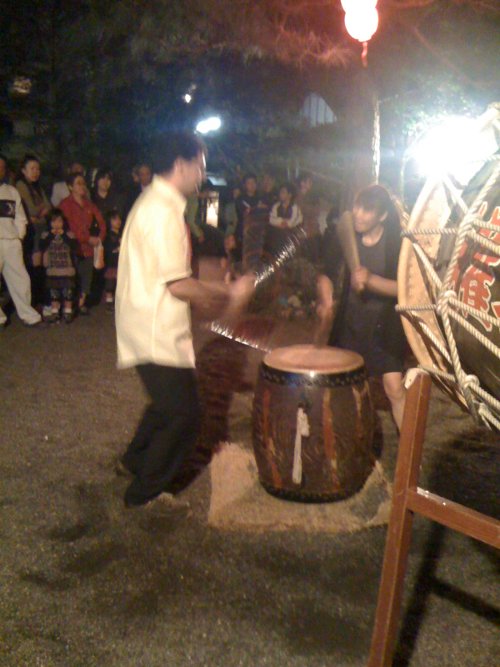
Coming from the shrine grounds came the thundering sound of taiko drums. But this wasn’t some concert with professional musicians. This was just a pair of drums and a couple of townsfolk going crazy on the drum, dancing wildly and still wearing their work clothes. We stayed and watched for a while, and after few minutes of watching people jump in and out of the drum circle, some carrying their own sticks, others swapping off, it became clear to me that this was a free-for-all. At first there was a young construction worker in his coveralls playing with an 80 year old grandfather wearing a Karate Kid-style headband. When one got tired, he switched out with a 20-something girl with dyed hair, wearing trendy street clothes and plastic platform sneakers and a miniskirt — and she was so good I was blown away. The people kept rotating: a local flower shop owner, parents, kids, and eventually an office lady still wearing her stockings and suit (though she had taken off her shoes and was walking around in the dirt barefoot) took charge and began drumming like nobody had ever drummed before. At some point, being a shrine, the noisy droning reed instruments you can always hear at Shinto ceremonies began playing too, and then some other people began playing a samba beat on their own latin drums that they had brought to the festival. It was bizarre, but it all blended together in a really cool way.

Crazy Girl Playing Taiko

It takes real spirit to play the drums wearing that!

Eventually, being one of if not the the only foreigner there, I was asked to drum too. I said no at first, but then they grabbed me and literally dragged me to the drum and put the sticks in my hands. Craziness!

Captured!

Here I am, coerced into playing too…

Old Meets New

Old meets new — I love this juxtaposition.

Unfortunately my phone isn’t so great at taking night photos, so these don’t really capture the full spirit of the event, but it was one of those times where you can really feel the soul of Japan. The modern mixed with the old, a sense of community and unwinding after a hard days work, outdoors and being one with nature, completely unashamed to play drums like an idiot in front of complete strangers. There’s something spiritual about that.

And my telling you about souls and spirits is my roundabout way of introducing today’s yokai:

Kodama

This is a very famous and popular yokai, both in and out of Japan. They’re most well known for the role they played in the Studio Ghibli animation “Princess Mononoke,” which hopefully you’ve seen if you have any interest in Japan at all. Ghibli’s kodama are cute little fairy-like spirits who cockle their heads sideways and make funny rattling sounds.

The name kodama means tree spirit, and they are said to be both the guardians of trees, and the soul of the actual tree itself. They are sort of a parallel to ancient Greece’s dryads, although if I recall correctly, dryads can do some nasty things to humans, while kodama are quite peaceful.

Kodama are formed (born?) when a tree reaches an advanced age. In fact, there are many myths about objects turning into yokai (tsukomogami) after their 100th birthday, or animals developing magical abilities after a certain number of years; this is the tree equivalent of that. This makes a lot of sense when you consider the important role that one’s elders and the ancestors play in Japanese society.

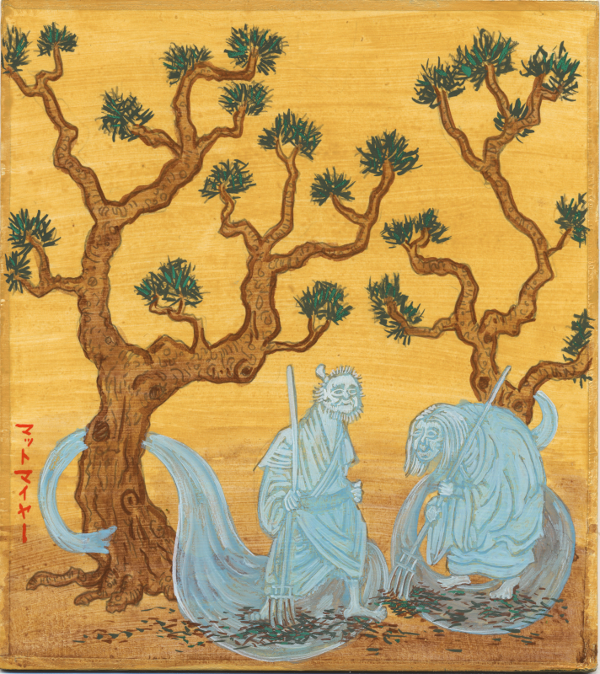
Deciding how to paint these was a bit of a challenge. I didn’t want to copy the Ghibli kodamas — although they are absolutely adorable, 1) there isn’t really any “folkloric basis” for them looking like that, and 2) I didn’t want to steal that particular image of kodama. Finally, I was able to find Toriyama Sekien’s painting of kodama from his yokai bestiaries, and he presented them as eldery human-like spirits. I really liked that concept, as it goes well with the idea of protector spirits and aged trees, so I based my kodama after an eldery couple. I really wanted to capture the spirit I felt at tonight’s festival. I also happened to come across some acrylic gradation medium the other day, which made painting ghost-like figures an absolute joy!

And now I’ve said enough and it’s time to sleep. Here are kodama:

Kodama

Kodama

Just one more reminder: the first batch of this year’s yokai are posted and available on my Etsy page! I’ll be posting a 2nd batch soon, but in the meantime you can pick up those first prints now.

Thanks for watching!

「今日の妖怪シリーズ」今日は木霊です。木霊は有名でよく知られている妖怪で、宮崎駿監督の「もののけ姫」にも登場しています。この作品に登場する木霊はカタカタという不思議は音を立ててながら木の下でたたずずんでいるかわいらしい妖精のような姿をしています。

木霊の名前の意味は、木の精で、木を守護しているものでもあるか、もしくは生きている木の魂そのものでもあります。ギリシャにも木の精(dryads)のお話がありますが、日本の木霊は平和的なのに対してこのdryadsは人間に対して悪いこともします。

木霊は高齢になった時に生まれます。これは、100年経過した物に神や霊魂が宿るという付喪神(つくもがみ)や、同じような伝承にある動物などと同様なもので、木に宿るものと考えられます。日本の社会で高齢・長寿である事は、敬われるべきであるという事が背景にあるのでしょう。

今回、木霊を描くという事は一つのチャレンジでした。「もののけ姫」の木霊はとてもかわいく、伝承をもとにしたものではなく映画のために創造されたものでした。私はこのイメージを盗んでコピーすることはしたくありませんでしたので、木霊について沢山のリサーチを行いました。そして終に鳥山石燕(とりやませきいん)の描いた、年老いた人間の精霊の姿の木霊を見つけたのです。
年老いた木の精として年老いた人間の姿がうまく合っていて私はこれだと思いました。そして、今日訪れた粟田部祭りで感じた精神をこの絵に写したいと感じました。それでは、今日の妖怪「木霊」を楽しんでください!

A-Yokai-A-Day: Otoroshi | 今日の妖怪:おとろし

Boo!

Did I scare you? I hope not, otherwise you will never make it through this week, where I will show you some yokai which are a tad bit spooker than last week’s (though not all of them are horrific).

Otoroshi

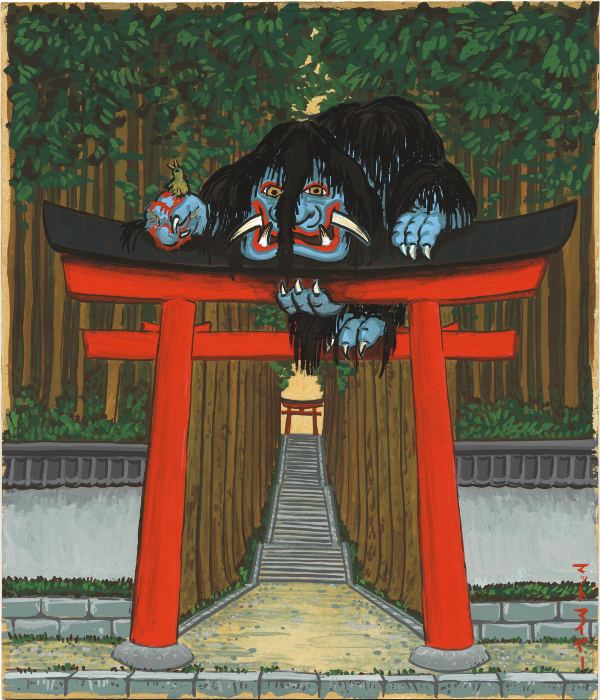
Today’s yokai is a bit of a mystery. There are no real records of this yokai, and its oldest roots seem to trace it back to an illustration by Toriyama Sekien, in which he drew a hairy beast, clinging to a bird, perched atop a torii — the gateways leading into Shinto shrines.

It goes by other names too — odoro-odoro and odoro-gami (which describes it desheveled, hairy appearance) — though its name seems most likely to have been derived from a Kansai-dialect word related to the “standard” Japanese word for “scary:”  osoroshii.

Despite its uncertain origin, otoroshi is a fairly popular yokai. Many famous yokai painters have done their own versions of otoroshi, but unlike ushi-oni, they all tend to stick to the same script: long hair, tusks, a funny smile. The mythology that has evolved around this guy seems to place him as a kind of shrine guardian. Anyone who is impious or evil who tries to enter the shrine will be pounced upon and devoured by the beast. So make sure you always look up before you enter a Japanese shrine!

Otoroshi

Otoroshi

| 「今日の妖怪シリーズ」今日は「おとろし」です。この妖怪に関しては実在する記録などがなく、ミステリアスな妖怪です。
「おとろし」についての最も古い記載は、鳥山石燕(とりやませきいん)によるイラストだと思われます。そこでは、「おとろし」はぼうぼうとした長髪のおどろおどろしい妖怪であり、鳥を手にして鳥居の上にいるとされています。

「おとろし」の姿のオリジナルは定かではありませんが、画家達の間では「おとろし」はよく描かれており、それぞれにオリジナルな「おとろし」を創造しているようです。しかし、「牛鬼」とは違い基本となる部分は全て共通しているようで、長髪に牙、不気味な笑みに神社の守り神であるかのように伝えられている言い伝えがあります。

不信な者、非道な者などが神社の鳥居をくぐろうとすると、鳥居の上から物凄い勢いで落ちてくるといわれています。
日本の神社を訪れたときは、鳥居の上を見上げてから中に入りましょう!

おとろし

おとろし

A-Yokai-A-Day: Suzaku | 今日の妖怪:朱雀(すざく)

Today is the final painting involving the four gods of Chinese astrology: Byakko, Seiryuu, Genbu, and Suzaku. It’s also the end of the first “chunk” of this yokai project, involving the more animal-like yokai; as well as the end of the “questionable” yokai — creatures whose status as yokai isn’t 100% determined. Tomorrow I will continue with the next batch of 100% pure yokai, and in the 2nd batch we’ll be looking some more monstrous creatures.

Suzaku

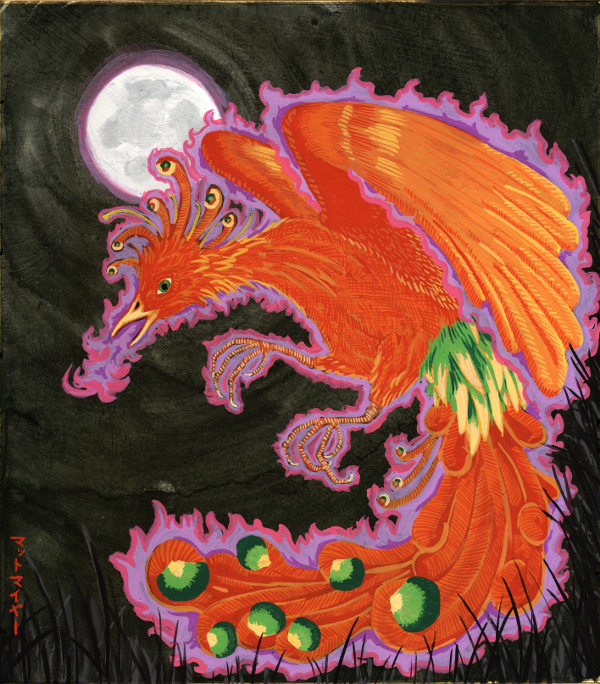
Also known as the Vermilion Bird, Suzaku is the guardian god of the south, the representative of the element of fire, and a symbol of the summer. Don’t confuse it with the hou-ou/fenghuang/Chinese phoenix though — although they look similar, they are very different legendary beasts!

Suzaku is a being or elegance and nobility. He is extremely picky about where he will perch and what he will eat. Like many other legendary beasts we’ve seen, Suzaku is a common theme in pop culture today, including video games and animation. If you’ve played Final Fantasy or Pokemon, or watch Japanese anime, you will probably recognize this beautiful magical bird with bright red feathers.

Suzaku

Suzaku, the Vermilion Bird

| これまで描いてきた西の白虎、東の青竜、北の玄武に今回の「南の朱雀」を加えると四神(しじん)が全て揃うことになります。今年の「今日の妖怪シリーズ」で今回までは、動物や伝説の生物などそれほど怖いものは描いていませんでした。しかし今回の「朱雀」の後は100%妖怪を描く予定でいますので、楽しみにしていてくださいね。

「今日の妖怪シリーズ」今日は朱雀です。
朱雀は南を守護する神で、炎と夏の象徴でもあります。鳳凰やフェニックスと姿が似ていますが、全く違う種類ですので間違わないようにして下さいね。

朱雀は高貴さと優雅さを併せ持ち、これまでに登場した伝説の生物達と同様現代の文化でも大変有名です。テレビゲームやアニメーションの中でも良く見られており、ファイナルファンタジーやポケモンにも登場していますよ。

朱雀

朱雀

A-Yokai-A-Day: Genbu | 今日の妖怪:玄武(げんぶ)

Today we’ll take a look at another of the Chinese astrological gods.

Genbu

We’ve already seen Byakko and Seiryuu, the White Tiger of the West and the Azure Dragon of the East. Genbu here is the Black Tortoise of the North. Although technically he is both a tortoise and a snake (or sometimes he is a tortoise with a snake for a tail)…

In ancient China, the snake and the tortoise both symbolized long life. The four constellations were brought over to Japan a long, long time ago and so they have retained a lot of their original meaning, while also developing a unique Japanese identity. Because of that influence, the tortoise is often used as a symbol of honor and long life here in Japan, and paintings of elderly couples often include a tortoise in the picture.

Mostly I like Genbu because he reminds me of Morla from the NeverEnding Story.

Genbu

Genbu

By the way, if you’d like to help spread the word about my yokai project, please click here to visit Digg and digg up this project!

And don’t forget to visit my Etsy store to get your very own prints from A-Yokai-A-Day! | 「今日の妖怪シリーズ」今日は玄武です。
これまでに、四神のうち西の白虎と東の青竜を描きましたが、今回の「玄武」はそのうちの一つです。

古代中国では、蛇と亀は長寿の象徴でした。玄武は青竜などと同様に中国からの言い伝えが日本に伝わったもので、その後日本特有の話も付け足されましたが、中国のオリジナルな言い伝えは今も色濃く残っているようです。

日本では亀は名誉・長寿の象徴であり、年老いた夫婦の絵や掛け軸などにはよく亀と蛇が登場しています。

玄武

玄武

さて、私はこの「今日の妖怪シリーズ」のプロジェクトをたくさんの人に知ってもらいたいと思いDiggに紹介しています。是非ここをクリックしてDiggに参加してみて下さい。そして私にDiggして下さい!

そしてもう一つ、私のmy Etsy storeを訪れることも忘れないで下さいね!

A-Yokai-A-Day: Seiryuu | 今日の妖怪:青竜(せいりゅう)

Most of the yokai I’ve painted so far have been kinds of yokai rather than unique creatures. Today’s, however, is not a kind but rather a one-of-a-kind, named yokai.

Seiryuu

Seiryuu, also known as The Azure Dragon of the East, is one of the four great gods of Chinese mythology. Like the kirin and the hou-ou, he was brought over from China to Japan more than 1000 years ago, and has since developed his own unique Japanese-ness.

Seiryuu, along with his 3 buddies Byakko, Gembu, and Suzaku, is one of the great symbols of the constellations. He represents the eastern sky as well as seven positions of the moon. The other 3 also have similar designations. (You may remember that I painted Byakko back in January, and I styled this one to match that painting.)

Another interesting fact about Seiryuu’s symbolism is that, in addition to the sky, he also guards and represents a section of Kyoto, the ancient capital of Japan. Seiryuu is the guardian of the eastern quarter, and his chief temple is the very famed Kiyomizu temple. In fact, when you visit Kiyomizu temple you will probably wash your hands before entering the temple at a fountain adorned with a statue of Seiryuu.

Seiryuu

Seiryuu, the Azure Dragon of the East

And by the way,the first week’s worth of yokai is now up on my Etsy store! The prints look absolutely wonderful and come matted and ready to frame or even hang as-is. Visit http://osarusan.etsy.com and check out the available yokai! | 「今日の妖怪シリーズ」今日は青竜です。天の四方を司っている四神(しじん)の一つで、東が青竜になります。前に描いた麒麟や鳳凰と同様、1000年以上前に中国から日本に伝わったものですが、日本に伝わってからは日本特有の伝わり方をしています。

青竜の他に四神には白虎、玄武、朱雀がおり、それらは偉大な星座の象徴でもあります。昨年の1月に白虎を描きましたので、今回はその白虎に続いて四神をそれぞれ白虎に合わせたスタイルで描いていこうと思っています。

青竜に関しては一つ興味深い話があります。青竜は京都(当時の都)の東を守っており、主となる寺は有名な清水寺であったとされています。清水寺を訪れる機会がありましたら是非見ていただきたいのですが、本堂に入る前にある手水場(ちょうずば)で青竜が水を提供していますよ。

Seiryuu

Seiryuu, the Azure Dragon of the East

「青竜」の絵は私のEtsyストアで購入が可能になっています。オリジナルの「青竜」の購入がご希望でしたら、こちらのお問い合わせフォームからご依頼をおねがいします。世界に1枚のオリジナルですので、売れてしまう場合もございます・・・。ご注文はお早めに。