A-Yokai-A-Day for the Month of October: Isonade | 今日の妖怪:磯撫で(いそなで)

Today was a busy day! I woke up early to do a cable TV interview at my studio, and it ended up taking 4 hours to finish. And all the rest of my day was spent doing this very detailed painting! I was worried I wouldn’t finish by midnight, and on the very first yokai of the month! But I managed to finish up with 30 minutes to spare. So without further ado, I bring you:

Isonade

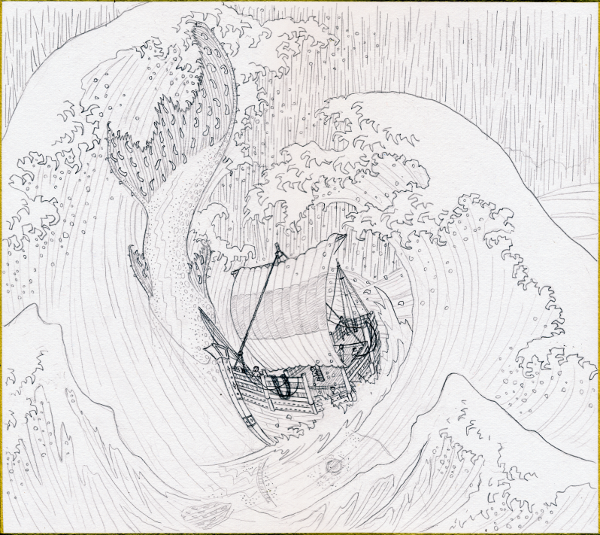
Our first yokai of the month comes from Kyushu, the third largest island of Japan, and the most southwesterly of the main four islands (excluding Okinawa). Isonade, whose name means “beach stroker” in English (and although it sounds like some of kind of summertime criminal pervert, the actual monster is much scarier than that), is a huge shark-like sea monster with barbed iron hooks on its tail which it uses to snatch sailors off of ships or to sink boats. It also uses its tail to strike the beach and snag people there as well, which is most likely where it got its name from.

If we were to analyze the myth, it might have originated due to the fact that Kyushu and the southern coast of Japan are highly vulnerable to typhoons and summer storms, which were be very destructive to ancient boats (there are stories of entire navies being swallowed up by the sea in Japanese history), which could have been responsible for the disappearance of sailors, swimmers, or even entire boats. Or who knows, there could be an actual giant, iron-barbed, man-eating shark-monster in the waters off of southwestern Japan!

Enjoy!

磯撫で

Isonade, the beach stroker

Isonade sketch

...and the image before painting, just for fun!

Isonade prints will be available on my Etsy store soon. Check back again later this week! If you’re interested in buying the original, please send me an email via my contact form. | 10月です!

今日の妖怪シリーズが今年も始まりました。10月はハロウィーンの月で、私の一番好きなシーズンです。ハロウィーンにちなんで、日本ならではの妖怪を毎日1枚ずつ描いていく企画です。昨年もやりましたが、世界各国から大変な反響がありました。

さて、「今日の妖怪」1日目は 「磯撫で(いそなで)」です。

磯撫では、形は鮫に似ており、尾びれには船を襲う針がある九州につたわる妖怪です。
海で人を襲う妖怪ですが、襲い方はとても怖いです。海に出ている船にゆっくりと、海を撫でるように近づき、一気に尾びれの針で人を襲います。

人間にしてみれば、のんびり漁をしていて、気がつくと巨大な尾びれが襲い掛かってくるというものですね。

一説によると、九州付近に頻発していた台風などによって古い船が壊され死体が浜辺に打ち上げられることからこの妖怪が創造されたともありますが、誰も見てはいないのでわからないですね。もしかしたら巨大なモンスターが海に潜んでいるのかもしれません・・・

それでは、今日の妖怪「磯撫で」を楽しんでください。

磯撫で

磯撫で

磯撫でのスケッチ

磯撫でのスケッチ

「磯撫で」の絵は私のEtsyストアでもうすぐ購入が可能になります。オリジナルの「磯撫で」の購入がご希望でしたら、こちらのお問い合わせフォームからご依頼をおねがいします。世界に1枚のオリジナルですので、売れてしまう場合もございますのでご了承をお願いいたします。
Announcing: A-Yokai-A-Day for the Month of October (2010 Edition)

The other big thing I’ve been working on is preparing for the (drumroll) A-Yokai-A-Day project! For the entire month of October, I will complete a full illustration of one of Japan’s folkloric yōkai. Yokai are to Japan what the boogeyman, Bloody Mary, the Sandman, elves, fairies, bugbears, trolls, and ghosts are to Americans and Europeans. They run a whole range of styles and types, from cute and cuddly to vengeful, grotesque, and horrifying. And while many of them come from ancient superstitions and tales, their influence pervades Japanese culture all over — in art, in decorations, and even in Pokemon, many of which are taken straight out of the pages of folklore. There’s a lot of fun information on yokai on their Wikipedia entry, The Obakemono Project, as well as from Mizuki Shigeru, Japan’s most famous yokai expert/manga artist. Many of Japan’s famous woodblock printers and painters have also left us their own visions of yokai over the centuries, but those are a little harder to find.

Last year’s project was so much fun that I couldn’t resist revisiting it. It was inevitable anyway, as the fall weather and feeling of Halloween approaching forces my mind to dwell on ghosts and goblins and spooky things like that, so it’s only natural to want to paint those things. Compared with last year, my schedule is much fuller this October, so I’ve been spending parts of the last week and a half drawing up my battle plan to tackle this big project again. Last year I was a bit freer and so I chose whatever yokai I felt like drawing that particular day, starting with the research. This year, I’ve done my research beforehand and made up a daily yokai schedule so all that remains is to draw and paint the beasties.

There will also be a slightly different thematic element this year. Last year I started with tamer yokai and gradually moved up to scarier ones as it got closer to Halloween. This year I’ve broken it down into three sections: the first 10 days of the month I will be doing paintings of animal-like yokai; the second 10 days will feature slightly more wild and monstrous yokai; and the final part of the month is reserved for everybody’s favorite kind of yokai — haunted girls. No, I’m not a misogynist — you can blame the Japanese for the fact that there are so many evil women in their folklore — but the scary stories featuring women as the antagonists are by far the most interesting and scariest. Just look at the way Japanese horror movies have transformed the way ghosts are depicted all over the world in recent years. And then, there’s the fact that out of last year’s paintings, the ones I did of scary girls were immensely more popular than the others, and after all I do need to make a living here.

Anyway, A-Yokai-A-Day begins on October 1st, so get the kids, tell your friends, bookmark this page, and please share the link to the project (http://matthewmeyer.net/blog/tags/a-yokai-a-day) on Facebook, Twitter, and anywhere else! Help me get the word out!

And stay tuned for the first yokai on October 1st!

Finally! Fall is Here!

The weather has been crazy in recent years, with summers getting hotter and winters getting wetter. We’ve been getting hit with typhoons and strange weather spells. This year we didn’t even have a spring season; it went from freezing to sweltering literally over one night in May. Pollen allergies in summer, house dust allergies in winter… But all of that is worth putting up with for the one perfect day in early fall when the air is clean and cool, the sun is warm, and everything seems at balance in the universe.

I haven’t posted anything here for a while and I feel guilty for that. I’ve been busy and as you know when that happens, blogging gets pushed back to the end of the list of things to do. In brief, I’ve been working on a bunch of illustrations for some gaming products, which I’ll post at some point. I finished a very large hanging kakejiku (wall scroll) for my wife’s parents which is currently being “framed” in a cloth hanger, but I will go into more detail on that when we get it back from the framer. I’ve started aikido lessons — something I wanted to do back when I lived in Takefu before, but the times didn’t match with my work schedule. And I’ve begun teaching art lessons out of my studio, which has been quite fun.

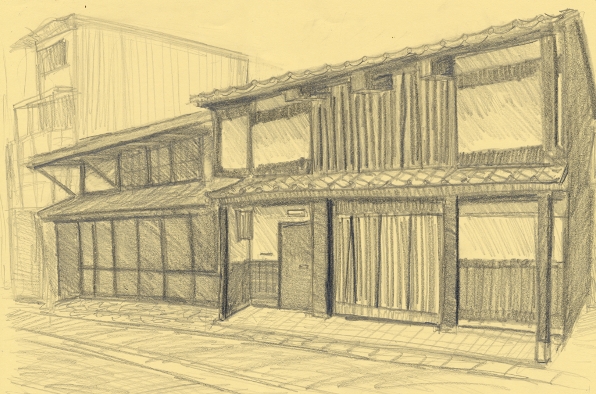
We’ve had 2 classes so far and we’ve been really lucky avoiding morning thunderstorms and getting bits of sun and overcast just in time for class, so we’ve been able to sketch outside rather than being stuck in. So far we’ve gone to an ancient temple that was built on top of the ruins of an old castle, as well as a traditional shopping street lined with old buildings that is famous for its woodwork furniture.

Tansu-machi Street, 9/28

The building above is a table and dresser shop, and as we were drawing the owner invited us in for coffee. The shop is full of enormous tables made from single slaps of wood cut from strangely shaped trees. The result is gorgeous solid wooden tables that snake and curve in wonderful shapes. We were also approached by an old dwarf woman with a voice like a frog who stayed and watched us for a little while. Strange things happen in the fall!

Art Classes | マットマイヤーの絵画教室

click to download my flyer

Now that my studio is more or less set up, I’m finally able to open up my art class!

For now, to start, there are two days per week for regular classes: Tuesday and Thursdays in the afternoon. We meet at my studio in Takefu and from there we head somewhere in the neighborhood for sketching. There are tons of temples, historic buildings, alleys, and parks within walking distance, so it’s an incredibly convenient location.

Classes are 90 minutes long, and during the beginning I go over one or two basic points, and then we spend the majority of the class drawing. For now I’m starting out with just sketching, as it’s the most portable and simplest way to begin. In the future I hope to move on to teach some oil and watercolor techniques too.

There are so many beautiful places here, it’s hard not to be inspired just walking around town. I hope to share that feeling with everyone around me.

If you happen to be reading my English blog and live nearby, please join us!

(For the Japanese version of this post, click here.) |

チラシのダウンロードはこちら↑

*只今絵画教室の募集は行っておりません。また募集の再開が決まりましたらホームページにてお知らせ致します。*

やっと念願の絵画教室を開くことができるようになりました!

火曜と木曜の週二回越前市(旧武生市)市内にある町家の一角のスタジオに受講生が集まり、デッサンのやり方から絵画を楽しみます。

スタジオの中で絵を描くこともあれば、外に出かけて街の情景や自然の風景を描く事もあります。この周辺には趣きのある古い街並みやお寺、歴史ある建物、ノスタルジックな路地や公園などがあり、絵を描くには大変恵まれた環境があります。

1回のクラスは90分で、最初の1〜2回は基本的な絵の描き方について学び、その後は基本をベースに自由にスケッチを行っていきます。

スケッチクラスの後に、油絵や水彩についても段階的に練習していけるようにクラスの構成を考えています。

この街の情景は本当に素晴らしく、しばらく歩いているだけで沢山のインスパイアを感じます。是非皆さんとこの感覚を共有したいと考えています。

このブログを読んで興味をもたれた方がいらっしゃいましたら、是非お問い合わせ先メールアドレスにてお問い合わせ下さい。一緒に絵を楽しみましょう。

Chrysanthemum Earth Festival 2010

Last year around the same time as LoveDen, I also was lucky enough to be asked to do a poster for the Kiku Chikyuu Haku, or the Chrysanthemum Earth Festival, here in Takefu. You can see the old poster here on my blog.

Last year I was asked last-minute to do it, so I was only able to do the front side of the poster, and a university student over here did the back side. This year I there was enough time for me to do both sides, and I think we ended up with a decent poster (I know that sounds awfully cocky, but honestly I improved a lot on what we had last year).

I stuck with the same theme and the same initial painting for the poster as last year, but with a number of tweaks. This is now the 3rd or 4th year of the festival, and its been growing in size quite a bit. Hopefully this year will help it spread across the whole prefecture.

The festival’s theme is ecology, mixed with a lot of local imagery (the chrysanthemum is Takefu’s official flower). It coincides with Takefu’s Chrysanthemum Doll Festival so there should be some cross pollination (see what I did there? ;)) between the two events. Festival-comers are encouraged to bring their own bowls and chopsticks for the concessions there, and there are lots of local crafts and food on sale, including eco-bags made from chrysanthemum fiber. You can also eat chrysanthemum soba and chrysanthemum ice cream, which are very delicious!

The festival takes place in Takefu’s Ajimano-en gardens, which is an incredibly beautiful and large garden nestled in between the tall mountains with a Japanese-style pond, all kinds of flowers, a small waterfall, and a very old, traditional wooden farmhouse where you can rest and eat homemade food. There are even some castle ruins off down an old mountain trail (which I can’t believe I haven’t been to visit yet, considering how much I’ve been researching the old castles in this town).

So anyway, if you can make it to Echizen and you read my English blog, please come to the Chrysanthemum Earth Festival! It’s a great way to enjoy autumn in Japan!

front side (click for bigger image)

back side (click for bigger)

LoveDen 2010

Long-time readers of my blog might remember last year’s LoveDen post. Or not. Either way, I’ll explain what it is.

In Japan, the dating scene is a lot different from in the US. There’s a pretty different social/cultural atmosphere here, and partially because of shyness and partially because of business, it seems to be harder to find dates here than in the US (despite the fact that so many single people do desperately want boyfriends/girlfriends).  It’s even gone so far that recently the government has begun sponsoring dating services to help people get married. It wasn’t long ago that arranged marriages were the norm in Japan, and while they’re becoming less and less common, the tradition will probably never die off completely. Likely that cultural aspect also has played a part in the way the dating scene has evolved in Japan as well. Look at me, though, I’m getting all philosophical and away from my main point.

So anyway, the most common way to find a date here seems to be the kompa or goukon, a kind of group date in which an even number of young men and women get together for dinner or drinking and socializing. From what I’ve witnessed it seems like many people hate these kind of events and only go to them in order to help one of their friends find a date. One the other hand, many people really enjoy them too, but I suppose going to one you never know if you’re going to get set up with someone who is only there to support a friend or someone who is actually looking for a partner.

Okay, so back to LoveDen. The local rail company where my wife’s brother works has been sponsoring, for a few years now, a kompa event on a train in an effort to reach out to the younger population and get them to ride more. This event has turned out to be extremely successful and last year sold out almost immediately. To its credit, a couple from the first event eventually got married after first meeting on the LoveDen train.

Thanks to the familial connection, I was able to design last year’s poster, and I also just completed the poster for this year’s event. It’s a modification on the same theme but a little brighter. Hopefully this year’s event will be even more successful than last year’s!

LoveDen 2010 (click for a larger size)

The New Studio

front alley view of my studio

I promised photos some time ago… Forgive me for being a little overdue, but it’s taken a while to clean the place up to a presentable condition.

This is my new painting studio. My town of Echizen is very remote and rural, so it has a real rustic feeling to it. It was never firebombed during WW2 like its neighbor to the north, Fukui, was. Its pretty rural so it hasn’t seen a big building boom like most cities have during the post-war years. And its so remote that globalization/Westernization hasn’t taken place nearly so much here as it has in other places.

A lot of people might consider these bad points, but I think most of the foreigners who come here see those as very positive points. And the town seems to see that as a good thing too, because they spend a lot of money promoting this as a “time capsule” town, with placards and signs all over displaying historic photos. The town has seen a lot of history, and to be honest, it’s the only town I’ve seen in Japan that is putting real effort into preserving what little history it has left (sadly, none of the 4+ castles that were built here over the centuries remain).

a traditional antique stove

But I digress. My point is that there are lots of very very old houses here — ancient houses from the pre-electricity days, from back before the Japanese customarily tore down houses every few years to rebuild a fresh new plastic cookie-cutter monstrosity in its place. Through the magic of 6 Degrees of Kevin Bacon, my English student who used to be my Japanese teacher has a friend who knows somebody who works for the local radio station whose owner also happens to like these ancient style houses and happened to have some rooms to rent. So after a long string of contacts, I was able to rent one of these houses for pretty cheap.

It would be my dream to live in one of these and do a big fixer-upper project, but that’s for another time.

So I’ll tell you a little more about the building. It’s built in a very old style of traditional townhouse (machiya) which originated in the ancient capital of Kyoto and spread to other urban areas (ancient Echizen was a huge urban center). If you’ve visited Kyoto or Kanazawa, you’ve no doubt seen tons of these gorgeous traditional buildings. Here is Echizen there is less money to use to preserve these houses, so they’re in varying stages of decay, but I would say there are almost more old buildings per capita than in Kyoto (of course Kyoto is huge and Echizen is tiny). The houses typically have a storefront area and a residential area, and are fairly cool in the summer (cool is a relative term, since these are pre-air conditioning houses). The building I’m using is shared between me and a radio station. Its in an area filled with old houses, alleys, no big streets, old shops, temples, and traditional crafts. A neighboring house has also been rented by an artist and is being used as a gallery. It’s a really nice area, with a slightly old and dirty look, but I tend to think of it as the patina of centuries of culture.

And now for a very brief photo tour:

inside the front door, with the staircase to the 2nd floor on the left

view of the radio studio on the 1st floor

the 6’x6′ backyard space, currently overgrown, but you can see the remains of an old stone lantern

one of my painting rooms on the 2nd floor; the other is still pretty messy and not fit for showing

rear view from the machiya from a back alley — the window opens to my painting room above

neighboring art gallery (look closely and you can see some of my chickens on the window poster)

another neighbor, Natsukashiya, connected to the gallery above