A-Yokai-A-Day: The Zatō Who Met a Bakemono on a Journey

Today’s story talks about a monster called a bakemono (pronounced bah-keh-mo-no). Like yesterday’s henge, this is not a specific monster’s name, but a generic term for any monster. Bakemono is written 化物, and it also means “changed thing.” Like henge, bakemono were often thought to be animals using magic to change themselves or other things into monstrous shapes in order to mess with humans.

The main character of the story is a zatō, a word which I have chosen not to translate. A zatō was a member of a guild for blind people. These guilds were established to guarantee that blind people could find employment rather than having to rely on charity or welfare. They were granted monopolies of certain trades, including massage, acupuncture, moxibustion, and playing the biwa. Only zatō could legally perform these jobs.

Zatō functioned on the periphery of society. They traveled from place to place peddling their trades, and were able to do certain things that sighted people were forbidden to do. Because of this, they appear in a lot of yōkai tales. You can find zatō yōkai, like ōzatō, umizatō, and tenome, and there are famous legendary zatō like Zatōichi and Miminashi Hōichi. Even biwa yōkai is related to zatō.

This story also references Sanjō Kokaji, a man who might be more familiar to some as Munechika. Munechika was a legendary swordsmith who lived in the 10th century and is considered one of the greatest swordsmiths to ever have lived. It might feel like a weird casual name drop at the end of the story, but Edo period readers would have immediately understood the reference and recognized that a Munechika blade would be a holy relic, with powers beyond that of a normal sword.

The Zatō Who Met a Bakemono on a Journey

A zatō from the capital was traveling through the countryside with one of his disciples. They were passing through a remote mountain village when the sun went down. There was no place to stay in the village, so they made camp at a wayside shrine.

Sometime after midnight the zatō heard a woman’s voice: “Where have you visitors come from? My hermitage is not a very nice one, but instead of camping out here why not come spend the night at my place?”

The zatō replied, “You are generous, and I will not forget your kindness. But we are used to traveling, and so staying out here is no problem. On top of that, it is quite late and thus impossible to travel.”

The disciple said, “But it is a kind offer. Instead of staying in a place like this, wouldn’t it be better to rest in a place with a fire and hot water? Let us go.”

“Certainly,” said the woman.

“Nevertheless, we will stay here,” the zatō replied. And he refused to argue further.

“In that case, would you please watch my child for a short time,” said the woman.

“No, no. I am blind. On top of that it is the middle of the night. I cannot take care of a child,” the zatō was stubborn.

“That is so unkind! Please, you must watch my child,” she asked again and offered her baby.

“If it’s just for a short time, surely we can watch him,” said the disciple.

Upon hearing this the zatō became furious. “Never!”

“Well I don’t mind,” said the disciple. He took the child and cradled it in his arms, and the woman left.

Soon, the child began to grow larger in the disciple’s arms. By the time the disciple could call out, “What is going on?” the child had grown as large as a boy of 14 or 15 years. Then it started to bite and eat the disciple.

“What is happening?!” he screamed. In just a few moments, the child had eaten him up.

Then the woman’s voice reappeared. “Now let Master Zatō hold you,” she said.

The zatō was terrified. Fumbling around, he found the box containing his family sword. Gripping the sword tightly, he readied himself to stab at whatever might come close to him. The child was too scared to approach the zatō.

“Why won’t you let him hold you?” the woman’s voice scolded.

A child’s voice complained back, “I can’t get close enough to him.”

The zatō listened to them argue for a bit, and then they vanished.

“What a frightful thing to happen!” thought the zatō. He continued to grip his sword tightly, and soon dawn broke. The zatō decided to leave as quickly as possible. He hurried out to the street, and he bumped into a stranger on the road.

“Master Zatō, where are you headed to? Do you have a place to stay?”

The zatō told the stranger about his encounter the previous night.

“That place is haunted by bakemono!” the stranger said. “It’s a wonder that you escaped with your life. Please come inside and tell me all the details of what happened.”

The stranger brought the zatō to his home and prepared a fine meal for him.

“By the way, let me have a look at that sword of yours.”

The zatō considered for a moment, and then replied, “No, I cannot show this sword to anyone.” He held the sword at his side, ready to draw, just in case.

Then, right next to him, a voice said: “If he won’t show you, then devour him!”

The voice repeated itself over and over. The zatō knew it was the same bakemono from before. He drew his blade and slashed wildly in all directions. Then everything grew quiet. The zatō waited for a while, and the sky grew light. This time it was truly dawn.

It is said that the reason the zatō barely escaped with his life and made it back to the capital was thanks to his sword, which was forged by Sanjō Kokaji.

A blind man swings a sword wildly.

A-Yokai-A-Day: How Itagaki Saburō Was Killed by a Henge in Suruga Province

Hello yokai lovers!

It’s that time of the year again: A-Yokai-A-Day is here! In celebration of Halloween season, every day this October I will post a translation and an illustration of a yokai story on this website & social media.

You can follow along by checking back every day for a new story & art, or participate along with me and many others by posting your own yokai-themed doodles, paintings, or anything on social media using the hashtags #ayokaiaday or #ayokaiaday2022.

This year, I am sharing stories from an Edo period book called Shokoku hyakumonogatari (“One Hundred Tales From Various Provinces”). This collection of spooky stories was compiled and published in 1677. It contains five volumes, each with 20 stories. The author and editor are unknown, but it was one of the forerunners of the ghost story boom that took place during the Edo period, and thus its influence can be seen in countless later works.

Perhaps because of its age, copies of this book are exceedingly rare. The only remaining full set containing all five volumes is owned by the Tokyo National Museum. Fortunately, they have graciously made scans of the book available online. You can see the original book here, including the original illustrations contained within!

All of the translations I share this month are my own. I don’t know of any English language translations of Shokoku hyakumonogatari, although I’m sure at least some of the individual stories have been translated before. Some of them appear in the articles on yokai.com as well, so you may be familiar with some of the stories I share this month. Hopefully, some, many, or even all of them will be new to you, and help you develop a deeper appreciation for Japanese folklore!

Note that I will not be translating the names of the monsters in these stories, for I believe they work better as loanwords. However I will do my best to explain unfamiliar terms found in each story.

Our first story deals with a henge (pronounced hen-geh). This is a generic term for monsters and doesn’t refer to a specific type of creature. Henge is written 変化, which literally translates to “change.” It frequently refers to a shape-changed tanuki, mujina, or kitsune, but can mean pretty much any ghost, spirit, or monster. These days, yōkai is the more common catch-all term for Japanese monsters, but before the 20th century, henge and mononoke were the main terms used for monsters in Japanese.

How Itagaki Saburō Was Killed by a Henge in Suruga Province

In Suruga Province there lived a man named Yoshimoto. One night, overcome with boredom, he gathered all of his family and servants together for a night of feasting and merrymaking. Then, he said, “Is there anyone amongst you who is willing to climb to the shrine on top of Mount Asama this night?”

Normally, there were many people who boasted about their bravery, but this was a place rumored to be inhabited by evil spirits. Thus, nobody readily stepped forward and volunteered to go.

There was one man, Itagaki no Saburō from Kai Province, whose family had a reputation for bravery and his skill with the bow and arrow going back several generations.

“I will go,” he said.

Yoshimoto was moved by this display of bravery that he immediately gave the warrior a token to use as proof of his visit. Itagaki, being a man of great courage, left for Asama without so much as another word.

It was mid-September. The full moon shone bright through the forest canopy. A strong wind howled, and the sound of the blowing leaves was dreadful. The mountain road was forlorn, but Itagaki passed through it and planted the token in front of the shrine at the top of the mountain.

As he was returning, a woman wrapped in a white traveling robe suddenly came out of nowhere. Itagaki thought this must be the henge who lived on Mount Asama, trying to test him. He ran towards the woman and tore away the white cloth covering her face. Underneath it was a single eye, and countless horns sticking out from beneath her parted hair. She wore light make up and her teeth were blacked. No words can describe how dreadful a sight she was, yet Itagaki was not scared.

“What are you?” he shouted, and put his hand on the sword at his waist. But the figure suddenly vanished.

Itagaki completed his journey and returned to Yoshimoto’s party.

“I have placed the token and returned, my lord,” he reported.

All of the men praised him, saying that only a man such as Itagaki could return safely from such a place.

“And did anything unusual happen to you?” they asked.

“No, nothing at all,” he replied.

Then, although the moon had been bright, suddenly the sky grew dark. It started to pour, and thunder roared. All of the men at the party including Yoshimoto turned white with fear. Then, from the sky, a hoarse voice shrieked:

“Itagaki! Tell them! Tell them!”

All of the men present cried to Itagaki: “If you saw something, you must tell Master Yoshimoto! Tell it exactly as it happened!”

Thinking he might lose his life if he did not speak the truth, Itagaki told the whole story of what had happened on Asama, leaving nothing out. However, the wind and rain did not let up, and lightning thunder continued to crash around them. No words can convey how terrible it truly was.

“If we don’t do something, Itagaki will not survive this!” the men cried. “Hurry, hide him in a trunk!”

The men shut Itagaki in a heavy wooden chest, then took up arms and stood watch over it.

Eventually the storm subsided, and morning came. The men decided to let Itagaki out, however when they opened the trunk, it was empty!

The men were terrified and asked each other and Yoshimoto what was going on.

Then, they heard a noise like two or three thousand voices bursting out in laughter. When they ran outside to investigate, Itagaki’s severed head fell from the sky. It rolled underneath the veranda, then disappeared forever.

A monstrous woman with only one eye, wearing a white kimono, with many horns sprouting from the top of her head. Lightning flashes behind her.

Yokai: Cataloging the Unknowable

Last year I did a virtual talk with the Museum of International Folk Art in Santa Fe, New Mexico. I gave a brief history of yokai and the tradition of collecting and categorizing them which has existed for hundreds of years and continues to this day. I also spoke about the challenges that arise from even attempting to catalog something that is, by definition, unknowable. I also told a few yokai stories, then took questions from the audience.

It was a really fun talk, and I hope to do it again some time!

You can view the talk on Youtube below:

Mononoke Ichi Report

Last weekend saw the return of the Mononoke Ichi (モノノケ市) yokai flea market in Kyoto. Normally, this event takes place several times per year, with a spring flea market, an autumn yokai parade, and several smaller events at various temples and other locations. However, due to coronavirus, the festival has been on hold since 2019. This was the first Mononoke Ichi in over 2 years. This time, the event was stretched over two days (April 16-17) in order to reduce crowding.

Getting from Fukui to Kyoto is not the longest journey, but it’s still a bit of a haul. It’s a 3 hour drive through the mountains, then along Lake Biwa. During April when everything is blooming it’s an incredibly scenic drive. We left the day before the event so we wouldn’t have to leave before the crack of dawn in order to reach the event in time. Fortunately, Kyoto has lots of AirBnB rentals in the area of the event.

Mononoke Ichi is held at the Daishogun Hachi jinja, an ancient shrine that was originally an Onmyodo/Taoist temple dedicated to the gods of the stars. Astrology and geomancy were a very important part of politics, religion, and society in ancient times, and this temple was established at the northwest extent of Heian Kyo (the ancient name of the capital) in order to protect that direction. Part of the reason for the selection of this site for the festival is that the street it is located on served as the border of the capital in ancient times. Yokai live in borderlands, such as the border between land and sea, dark and light, light and death, and, in this case, the “civilized” capital city and the “barbaric” wilderness beyond it. This road is where yokai were said to appear in those times, and that makes it an ideal location for a modern yokai festival. The shops and residents of the street have embraced this history, and the area is known today as “Yokai Street.” The street is lined with yokai-themed statues and artwork maintained by the shops and businesses operating there. The fact that the shrine itself is dedicated to magic and mystery only adds to the folkloric atmosphere.

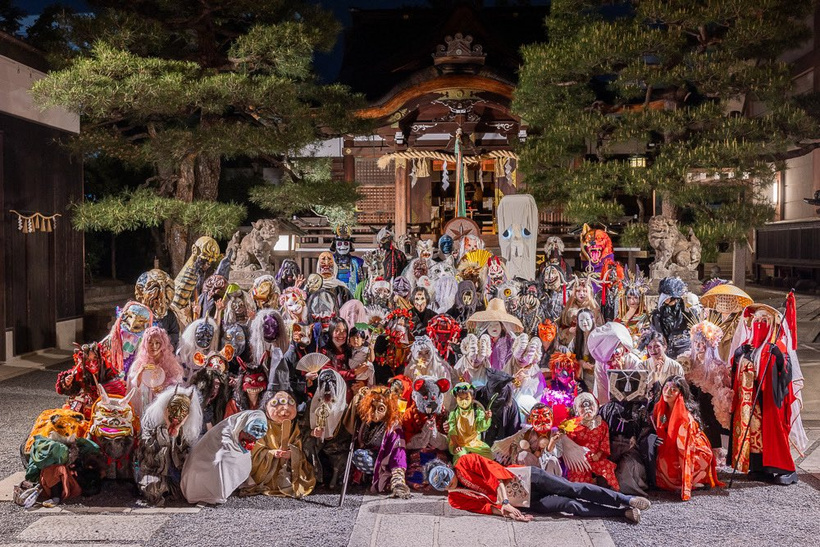
Mononoke Ichi is organized by Hyakuyobako, a yokai art group run by Kono Junya, a professor at Kyoto Saga University of Arts. The first thing that greets you at the festival are Kono’s yokai masks, which are sometimes worn by art students who parade around the festival dressed as yokai. Several of these masks are currently on display in the Museum of International Folk Art in Santa Fe, New Mexico, while the rest are here at the festival. This year, to prevent crowding, only a limited number of yokai were parading around. However, they leave a very strong impression!

It’s clear the students really enjoy performing as yokai. They’ve each practiced their poses and motions, and bring life to their characters. Part of the joy of this performance is scaring children, and throughout the event the period shrieks and screams of little children crying, “Don’t come any closer!” bring about spontaneous chuckles from all of the vendors and visitors.

The weather was perfect for an outdoor festival. The event was busy, but never so crowded that it felt unsafe. I think that both vendors and guests all felt a sense of excitement to be able to experience events like this once again, after such a long hiatus.

For me, this was especially fun because I so rarely get to participate in events like this. Yokai-themed festivals happen fairly regularly in large cities like Kyoto, Osaka, and Tokyo, but not in Fukui. So I treasure the opportunity to participate in yokai events that take place not too far from my home.

It’s also thrilling to get to interact with so many yokai fans (or even maniacs) up close and all in one place. Most of the time, my work involves introducing people to yokai for the first time, or sharing my work with English-speaking yokai fans who don’t have access to them in Japanese. It’s a rare thing to encounter fans who can name every yokai I have on display.

One anecdote that illustrates this phenomenon is that when I show my postcards at events, people often ask me why I have a picture of Godzilla among my illustrations. It’s a fun opportunity to explain that it is not Godzilla, but a yokai called hōnengyo that coincidentally looks very much like him. But at Mononoke Ichi several people approached my table and immediately commented that they liked my hōnengyo, without even questioning whether it was Godzilla or not. Witnessing that level of fandom is very satisfying.

Speaking of fans, there was one surprise guest who came to the event unannounced. It was professor Komatsu Kazuhiko, one of the world’s top yokai scholars and creator of the International Research Center for Japanese Studies’ yokai database. I’m pretty sure on any other street in Kyoto he would have been seen as just another man walking down the street, but when he suddenly appeared in the shrine grounds at Mononoke Ichi, everyone’s eyes lit up as if a major celebrity had appeared.

A TV crew followed him around and also interviewed several of the vendors and fans. I had the opportunity to speak to them about my work and my goal of sharing yokai with English-speaking fans around the world.

It was a great event, and it felt especially satisfying to participate again after such a long hiatus due to the pandemic. It helped me feel like life is slowly returning to some kind of normalcy. (And it was also the most exhausting thing I have done in over 2 years!)

You can see more photos and posts from vendors, participants, and fans by viewing the hashtag #モノノケ市2204 on Twitter.

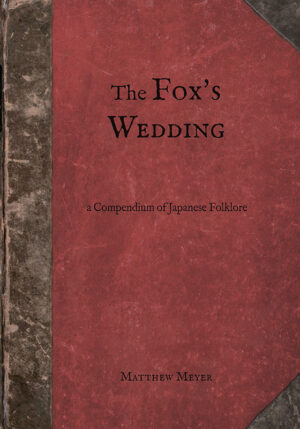
The Fox’s Wedding (limited release) on Amazon

Readers have been asking me for some time now about the status of my 4th yokai encyclopedia, The Fox’s Wedding: A Compendium of Japanese Folklore.

book cover of The Fox's Wedding

The book was funded on Kickstarter in December of 2020, and finished development in 2021. It was originally slated for release in 2021, however, the launch has been delayed several times. Here’s what happened:

Protective measures against coronavirus essentially slowed production down at every step. Smaller staffs working at printing facilities and a reduced number of truck drivers  and warehouse workers added several months of delay to production. Then, the global logistics crisis caused delivery of Kickstarter rewards to be delayed by about half a year while trying to secure space on board a freight ship to the US delivery site. On top of that, the outbreak of war in Ukraine caused parcel systems from Japan to Europe to shut down entirely, so delivery of books to Europe has been halted again.

My intention has been to release The Fox’s Wedding on Amazon once all of the Kickstarter rewards are fulfilled. Thus, while the book has been ready since fall of 2021, the inability to deliver rewards to backers has kept me from doing any kind of general release as well.

If you’ve been following the Kickstarter page, you’ll know that some progress has finally been made on delivering rewards. Space on a freight ship has been secured, and the books will be making their way to the US distribution center later this month.

That is why I am doing a limited release of The Fox’s Wedding in ebook format only. All backers have received their ebooks, and so The Fox’s Wedding will become available on Amazon in DRM-free ebook format next week!

Paperback, hardcover, and collector’s editions will be available at a later date, once all backers have received their rewards.


A-Yokai-A-Day: Hakoiri musume (page 30)

If you’ve enjoyed this year’s A-Yokai-A-Day, please support me Patreon and get stories like this all year round!

Happy Halloween!

All good things must come to an end, and so today, Halloween, I present the final page of Hakoiri musume menya ningyo. Kyōden is well known for a number of books; this is not one of them. But I still think it is a fantastic book, not only for its sense of humor and its wonderful illustrations, but for its unique insight into the Edo of 1791.

In Kyōden’s illustration, Heiji and the mermaid are pictured happily married, enjoying some tobacco together. Behind the couple are stacks of boxes containing 1000 ryō, showing how incredibly rich they have become. On top of the stack are two tall bottles of holy sake. The mermaid’s eyebrows are plucked, denoting her married status.

This story took place about seven thousand nine hundred years ago¹. While it sounds like a lie when you hear it at first, it’s all true!

Mermaids are immortal to begin with, and Heiji just recovers his youth by licking his mermaid whenever he gets old, so the couple is still alive and well to this day. In fact, they live next door to the author of this book. I wonder how much longer they will live… They are only one hundred years younger than Tōhō Saku², and they’ve saved up quite a bit of money, so while it’s traditional to end a book with “happily ever after,” this time it truly is a the happiest of endings.

By Santō Kyōden³

  1. Counting from Kyōden’s perspective in 1791. So more than eight thousand one hundred years ago counting from today.
  2. On New Years Day, beggers would go from door to door offering blessings in exchange for money or rice, and one of the songs they would sing was about how Tōhō Saku lived for eight thousand years. Tōhō Saku is the Japanese name for Dongfang Shuo, a legendary Chinese wizard who attained immortality by stealing and eating the peaches of immortality from the Queen Mother of the West.
  3. Kyōden leaves one final joke at the bottom of the page. Beneath his name there is a printed seal which reads “stinky.” It’s a final apology for the mermaid’s fishy smell.