A-Yokai-A-Day: Munemushi

If you’d like to join me and many others in painting a yokai a day this month, all you have to do is paint, draw, or create any yokai you like, and share it using the hashtag #ayokaiaday. There’s no set list of yokai you have to paint, but you’re free to browse yokai.com or any other yokai resource and choose your favorites.

Munemushi
胸虫

Translation: chest bugs

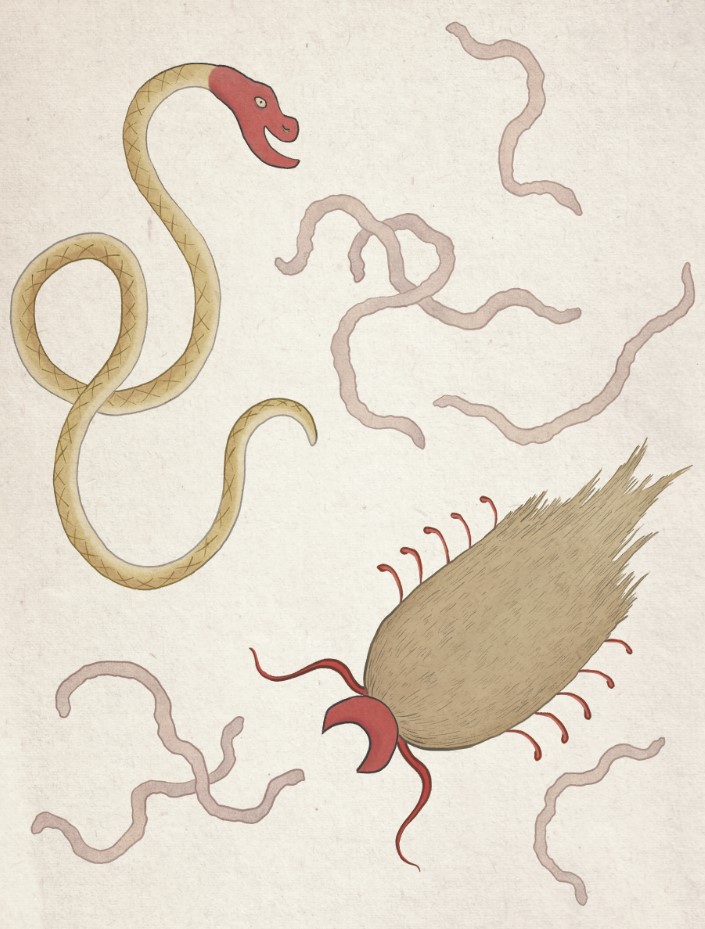
Munemushi are a broad category of yokai bugs that infect–you guessed it–your chest. They come in all shapes and sizes. Harikigaki does not list names for them–apparently there were just too many to catalogue them all, or perhaps they’re so similar they don’t need separate entries? Like a lot of the bugs we’ve seen this month, some of these can live in you naturally, cause no issues most of the time. But they can become dangerous if they start to act up.

Although there are many kinds, the primary symptoms they create are the same. When they attack you it causes sharp chest pains, and you to lose the ability to speak. Before long, the pain becomes unbearable and you lose consciousness.

Treatment varies depending on the type of bug. Secondary symptoms are often a clue; such as if your body temperature decreases or if you feel chills despite having a normal temperature, vs if you have a fever or if you feel hot despite having a normal temperature. Hohō* vs shahō* techniques are recommended. However, Harikikigaki cautions strongly against superficial or half-hearted measures. People attempting to cure a munamushi infection must receive a great deal of training, including secret techniques passed down only orally, before attempting treatment.

*Hohō (補法) is an acupuncture technique where the needles are inserted slowly and gently, left in place for a short while, and then quickly removed. The puncture wound is then massaged vigorously.

*Shahō (瀉法) is an acupuncture technique where the needles are stabbed into the target areas quickly and then aggressively jiggled around. Then they are slowly removed from the body and the wound is not massaged at all.


If you enjoyed today’s A-Yokai-A-Day entry, please consider becoming a patron and supporting my work by visiting patreon.com/osarusan.
A-Yokai-A-Day: Shinshaku

If you’d like to join me and many others in painting a yokai a day this month, all you have to do is paint, draw, or create any yokai you like, and share it using the hashtag #ayokaiaday. There’s no set list of yokai you have to paint, but you’re free to browse yokai.com or any other yokai resource and choose your favorites.


Shinshaku
心積

Translation: heart shaku*
Alternate name: bukuryō

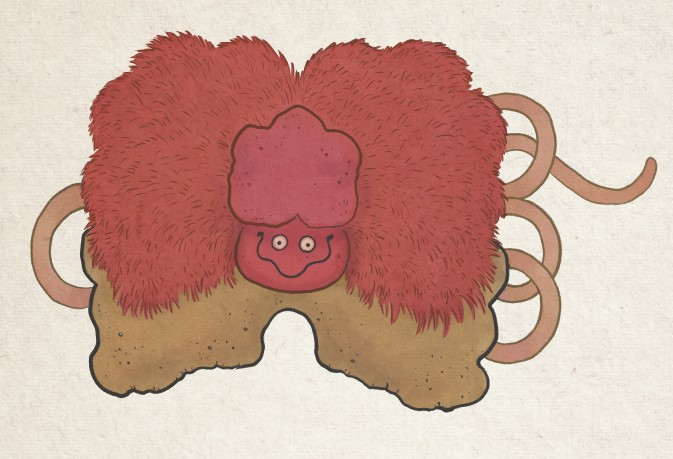
Shinshaku infect the torso, between the belly button and the heart; essentially they live right behind your solar plexus. Chinese medicine holds that the consciousness exists in the chest, around the solar plex/heart area; right where the shinshaku is found.

People infected by shinshaku develop a fondness for burnt smells and bitter flavors. They begin to smile and laugh thoughtlessly. They often have flushed cheeks. Their force of will and emotional strength also become very weak.

Treatment is possible using secret acupuncture techniques passed down orally. However, once this mushi evolves into its adult form, it becomes much more difficult to treat. Best to catch it early!

*Shaku is a category of yokai parasites which accumulate in the organs, building up numbers until they become a large mass, which then causes various symptoms to occur.


If you enjoyed today’s A-Yokai-A-Day entry, please consider becoming a patron and supporting my work by visiting patreon.com/osarusan.

A-Yokai-A-Day: Kanshaku

If you’d like to join me and many others in painting a yokai a day this month, all you have to do is paint, draw, or create any yokai you like, and share it using the hashtag #ayokaiaday. There’s no set list of yokai you have to paint, but you’re free to browse yokai.com or any other yokai resource and choose your favorites.


Kanshaku
肝積

Translation: liver shaku*
Alternate name: hiki

Kanshaku roughly resemble a breast. Their head looks like a woman’s nipple, and their sacklike body resembles breast tissue. They have two long moustache-like growths sprouting from their heads. They live in the liver, however, they are born in the left side of the chest. The develop around the area of the pectoral muscles and fiercely headbutt their host’s organs as they crawl around inside the body.

Symptoms of a kanshaku infection include anger, irritability, and a short temper. The face also grows pale and sickly. The infected patient develops a craving for sour, acidic foods, and a revulsions towards oily foods.

Treatment is done using alternating acupuncture techniques. First, the shaku in the left side of the torso must be treated. After that, the spine (around the 9th thoracic vertebra) is treated.

When the patient’s energy is low, the shaku’s energy will also be low, and a slow treatment is performed. The body is stabbed very gently with the needle. The needle is left in place for some time, after which it is quickly removed, and the pucture area is massaged deeply.

When the patient’s energy is high, the shaku’s energy is also high. In this case, the body is stabbed quickly with the needle, and then the needle is violently wiggled about. After that, the needle is slowly removed. The puncture area is not massaged.

All in all, it sounds like a very unpleasant treatment!

*Shaku is a category of yokai parasites which accumulate in the organs, building up numbers until they become a large mass, which then causes various symptoms to occur.


If you enjoyed today’s A-Yokai-A-Day entry, please consider becoming a patron and supporting my work by visiting patreon.com/osarusan.

A-Yokai-A-Day: Kanmushi

If you’d like to join me and many others in painting a yokai a day this month, all you have to do is paint, draw, or create any yokai you like, and share it using the hashtag #ayokaiaday. There’s no set list of yokai you have to paint, but you’re free to browse yokai.com or any other yokai resource and choose your favorites.


Kanmushi
𧒄虫

Translation: unknown*

Kanmushi live in your abdomen, and travel about between the heart and liver. They have a single tail, but their head is split in two. Their back is red and their belly is yellow.

People who become infected with this parasite feel a strong urge to drink large quantities of hot liquids. As this worm wraps itself around its host’s liver, they lose consciousness.

Kanmushi infections can cured very quickly by ingesting jiō (the roots of Rehmannia glutinosa), a kind of figwort.

*The kanji used in this creature’s name 𧒄 is an old and very rare one. I wasn’t able to find any explanation of it in Japanese or Chinese dictionaries, and even the book I have which breaks down the pages of Harikikigaki does not make any attempt to explain the meaning of this rare character.


If you enjoyed today’s A-Yokai-A-Day entry, please consider becoming a patron and supporting my work by visiting patreon.com/osarusan.

A-Yokai-A-Day: Ase no mushi

If you’d like to join me and many others in painting a yokai a day this month, all you have to do is paint, draw, or create any yokai you like, and share it using the hashtag #ayokaiaday. There’s no set list of yokai you have to paint, but you’re free to browse yokai.com or any other yokai resource and choose your favorites.


Ase no mushi
汗の虫

Translation: sweat worms

There are two colors of ase no mushi: black ones and yellow ones. They live in the hearts of both men and women. No, that’s not a metaphor, they actually live inside of your heart.

There are two main symptoms that these worms inflict on their hosts. They make people feel hot and flushed, causing them want to flirt with each other. After that, the increased body temperature causes excessive sweating in both sexes.

Harikikigaki doesn’t list any ways to exterminate these mushi, so it may be a case where these are worms that are always inside of us, and which we must learn to control. It says that when these worms act up, if men and women remain calm, the ase no mushi will also calm down. This will then cause body temperatures to return to normal, and they will stop sweating.

I’ve often heard it said that love is like a drug, but this is the first time I’ve heard it described as an infectious parasite.


If you enjoyed today’s A-Yokai-A-Day entry, please consider becoming a patron and supporting my work by visiting patreon.com/osarusan.

A-Yokai-A-Day: Nakisubaku

If you’d like to join me and many others in painting a yokai a day this month, all you have to do is paint, draw, or create any yokai you like, and share it using the hashtag #ayokaiaday. There’s no set list of yokai you have to paint, but you’re free to browse yokai.com or any other yokai resource and choose your favorites.


Nakisubaku
鳴き寸白

Translation: crying white sun* (i.e. tapeworm)

Nakisubaku is a long white worm with heads at both ends of its body. It lives in the abdomen. It gets its name from the fact that if you squeeze the belly of a person infected with it, the worm lets out an audible cry!

The only symptom of this infection listed in Harikikigaki is a that the patient’s stomach growls. It’s rather a light disease compared to its brethren the kamisubaku and the subakuchu.

This infection is easily cleared out by taking nira (garlic chives, Allium tuberosum) and binrōshi (seeds of the areca palm, Areca catechu)

*A sun is old Japanese unit of measurement equal to about 30.303 millimeters. It’s the same word that we saw earlier in the subakuchu. In old Japanese terminology, subaku refers to segmented tapeworms.


If you enjoyed today’s A-Yokai-A-Day entry, please consider becoming a patron and supporting my work by visiting patreon.com/osarusan.

A-Yokai-A-Day: Kamisubaku

If you’d like to join me and many others in painting a yokai a day this month, all you have to do is paint, draw, or create any yokai you like, and share it using the hashtag #ayokaiaday. There’s no set list of yokai you have to paint, but you’re free to browse yokai.com or any other yokai resource and choose your favorites.


Kamisubaku
噛み寸白

Translation: biting white sun* (tapeworm)

Kamisubaku is a long white worm that lives just behind the liver. It is a nasty, vicious little bugger. Its long body is segmented like many worms, only in this guy, every single segment has its own tiny mouth.

As it slithers around its host’s insides, each of these mouths snaps and chews at the internal organs. As you can imagine, this causes intense abdominal pain.

Medicine does not work against this worm. However, there is a treatment! First, you need to finely chop some hairs from the tail of a dapple-grey horse. You mix these hair filings with soba (buckwheat) flour. Then, you add in sake of the finest grade and knead it into a dough. Eating this will exterminate the worm.

If that doesn’t sound like a typical remedy to you, that’s because it’s not. It’s black magic. The idea behind this curse is that the finely chopped up hairs of what was once a long, beautiful horse tail carry with them a residual memory — a grudge — of what was done to them. Once ingested, the pieces of the dough that the kamisubaku eats transfer that grudge to the worm. Its long white body absorbs the residual memory of the long horse hairs, and is torn apart from the inside out.

*A sun is old Japanese unit of measurement equal to about 30.303 millimeters. It’s the same word that we saw earlier in the subakuchu. In old Japanese terminology, subaku refers to segmented tapeworms.


If you enjoyed today’s A-Yokai-A-Day entry, please consider becoming a patron and supporting my work by visiting patreon.com/osarusan.