A-Yokai-A-Day: Domo komo

Greetings yokai fans!

If yesterday’s yokai was a cross between Sloth and Eddie Munster, then today’s is probably the conjoined twin offspring of a Ninja Turtle and a Fraggle. The loose kimono and his hand position also make me think he is taking a break backstage in a vaudeville follies show. He looks like he’d be a fun yokai to hang out with.

For added enjoyment, when you get to the story below, imagine him on stage in full theatrical costume telling you the story himself.

Now, on with the show!

Domokomo

Domokomo is another odd-looking fellow (fellows?) originating in the Matsui Bunko Hyakki yagyo emaki. He/they appear(s) in plenty of other later scrolls as well.

No story or explanation was given when this yokai was written down, however there are a few clues. His name is usually written どうもこうも in hiragana, a phonetic syllabary which doesn’t carry any extrinsic meaning. However, in the older written style of the Edo Period, his name was sometimes written 右も左も, which was still pronounced domokomo but also carries the meaning “right and left.” That makes a lot of sense, considering his two heads.

It still doesn’t tell us anything about who or what this yokai is or does. But there is one more folk tale that might be able to provide us some insight. Domokomo is a word in the local dialects of Ishikawa and Niigata Prefectures. It’s usually seen in the phrase どうもこうもならない (dо̄mokо̄mo naranai), which is kind of like saying “either way you look at it, it’s impossible.” The folk origin of this phrase is this story:

Long ago there were two doctors, Domo and Komo. Together they were the most skilled doctors in Japan, and were equally renowned for their skills.

One day, Domo and Komo decided to have a competition to see which of the two of them was the better surgeon. They agreed to perform surgery on each other to see who did the better job.

First Domo cut off Komo’s arm. Then he reattached it with such expertise that it left no scar at all. Afterwards, Komo cut off Domo’s arm and reattached it. Similarly, there was no mark. Both doctors had performed so excellently that it was impossible to say which one was better.

So they elected to perform a second, more difficult competition. They decided to cut off each other’s heads and reattach them. By this time a large crowd had gathered to see which doctor performed better.

The second competition went much like the first. The first doctor cut off the second’s head and reattached it. Then the second doctor cut off the first’s head and reattached it. Neither was worse for wear, and neither had left even so much as a tiny scar. There was no way to say who was better.

Finally, they decided to cut off their headssimultaneously. The doctors prepared as the crowd watched on. Then, they cut off each other’s head at the same time. Without their heads, neither doctor was able to continue the surgery, and they both died.

The townspeople who had gathered to watch all said “dо̄mokо̄mo naranai,” which translated one way could mean “there’s no way that was going to work” but translated another way could mean “neither Domo nor Komo won.”

rimshot

So maybe that folk etymology was also the origin of this yokai. It’s just a guess, but with the name and the two heads, it’s not a bad guess. Either way, it makes for a fun story!

A-Yokai-A-Day: Bekataro

Greetings yokai fans!

Today’s yokai is another Matsui Bunko Hyakki yagyo emaki character. And I think he’s one we can all relate to. This is pretty much the way I look/feel after binge-eating Halloween candy, or any other fall treats (seasonal beer, donuts, and beef jerky are my eternal vices). And best of all, he’s easy to draw! 

Bekataro
also known as: bekuwataro, bekabo, beroritaro, peroritaro, akanbei, bekanko (and other variations)

Bekataro is a unique looking yokai! He looks like a naked little boy with a massive belly and squashed body proportions. (Or maybe the morbidly obese offspring of Sloth and Eddie Munster?) Of course his defining feature is his pose: he sticks his tongue out and pulls both his eyelids down with his fingers. Though you can’t hear it in the painting, he’s almost certainly making a teasing “bleaaaaaaaaaaaa” sound.

Bekataro comes from the same Matsui Bunko scroll as yesterday’s asuko koko does, though he appears in many other places as well. A similar looking yokai appears in another scroll as “akanbei” and he has been copied into other scrolls and books under slightly different name variations.

There’s no story included with the Edo Period paintings that depict bekataro. However, the great Mizuki Shigeru was kind of enough to include (invent?) one for him in his yokai encyclopedias.

Long ago, a boy was born who loved to eat. His name was Taro. He regularly consumed as much as 10, even 20 normal people would eat. He ate so much that his parents could no longer afford to feed him, and so one day they kicked him out to live on the streets.

Baby Taro wandered the streets begging strangers for food, but no matter how much they gave him, it was never enough. He just ate, and ate, and ate. Eventually, he even began to contemplate eating human flesh! Eventually, the townspeople became afraid of Taro and began to run away from him whenever he appeared on the streets.

According to Mizuki, bekataro was also included in Edo Period scrolls used as charms against evil spirits. So, despite the bizarre and perhaps slightly gruesome behavior of this yokai, it apparently has some positive powers as well.

These days, akanbei, perori, and other variations of this yokai’s name are used to describe the facial expression that he is making. If you watch a lot of anime, no doubt at some point you’ve seen a character pull down their eyelids, stick out their tongue, and say “bleaaaaaaaaaaaaa” or something of the like.

Is the gesture named for the yokai? Or is the yokai named for the gesture? I wonder…

A-Yokai-A-Day: Asuko koko

Greetings yokai fans!

I can’t say it enough: I love October. October is the perfect month! It’s both warm enough and cool enough that you can be comfortable in anything from t-shirt and shorts to a fleece hoodie with a warm blanket wrapped around you. The sun doesn’t bake you the way it does in the summer months, but it’s still bright at noon. The flowers that bloom in October have the best fragrances, the smell of burning leaves and wood stoves fill the air. The changing leaves paint the world in vibrant beautiful colors. Twilight comes earlier and lasts longer, and the days that are dark and overcast have the best moods to them.

That last part is the only part that matters for today’s yokai. Read on!

Asuko koko
“there and here”

Asuko koko is a yokai which looks like a swirling, gloomy cloud. Within the cloud float all sorts of grotesque faces and claws. (I wonder if they are riding this yokai, or if the heads and arms are actually part of asuko koko…)

Asuko koko comes from the Matsui Bunko Hyakki yagyo emaki. It’s a beautiful and important yokai scroll, with a lot of unique yokai. If you look it up on Wikipedia you’ll probably recognize a number of yokai from this project! Most of the yokai here don’t have back stories or folk talks describing their behaviors, but they do have names which can be illuminating and give us a bit of insight into what they are/do.

While asuko koko may look like just a strange-looking cloud on the surface, there’s something deeper about it that really touches upon the true essence of what yokai means.

– It’s formless, which is something that is often said about yokai, but gets forgotten when we see the clear shapes and forms of various yokai in colorful woodblock prints. But really, yokai are shifting, formless, and ever-changing.

– As a smokey cloud, it’s not quite opaque, but not quite transparent either. Yokai are things that we can kind of see in the shadows, but just can’t make out; just like a cloud of smoke. It’s hard to focus on, impossible to grasp, and it can vanish just when you think you see it.

– And of course if you go into a cloud of smoke, your eyes will sting, you’ll choke—it’s dangerous! If the smoke is toxic you could get quite sick, or it might just be a harmless cloud. Similarly, most yokai are dangerous, but it’s not always quite clear precisely what the threat is.

– However, the part I like best about this yokai is it’s name: asuko koko means “there, here.” In other words: here, there, everywhere. It lurks in the corner, in the shadows, under your bed, just behind you! One of the important things about yokai is that they can be found everywhere, if you know where to look for them.

The vagueness of asuko koko’s form, its faces, and even its name perfectly matches the uncertainty which is the core of what yokai are.

The takeaway? Even if you can’t name it, can’t describe it, or can’t see it… there are monsters nearby. Here, over there, and all around you.

Boo!

A-Yokai-A-Day: Kubi kajiri

Hello everyone! Today is October 1st, and I am so happy because that means Halloween season is upon us! In the spirit of Halloween, as I do every year, I am painting one yokai every day: A-Yokai-A-Day for the month of October.

Just like other drawing projects (such as Inktober), I’m invite all readers to participate and share their own A-Yokai-A-Day images on social media using the hashtags #ayokaiaday and #ayokaiaday2018

Normally, I like to start A-Yokai-A-Day with some of the weirder or cuter yokai and gradually work towards the bloodier and scarier ones as we approach Halloween. However, you’ll notice that today’s yokai isn’t exactly what you’d call cute. The reason is that this guy comes out on the Autumn equinox, which was just over one week ago today. I wanted to share him early, since the equinox is still close.

So, let’s take a closer look at today’s yokai:

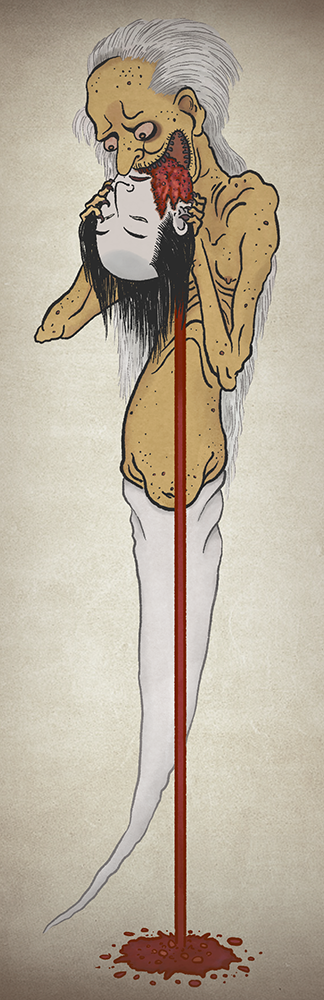
Kubi kajiri

Kubi kajiri

Kubi kajiri
“head biter”

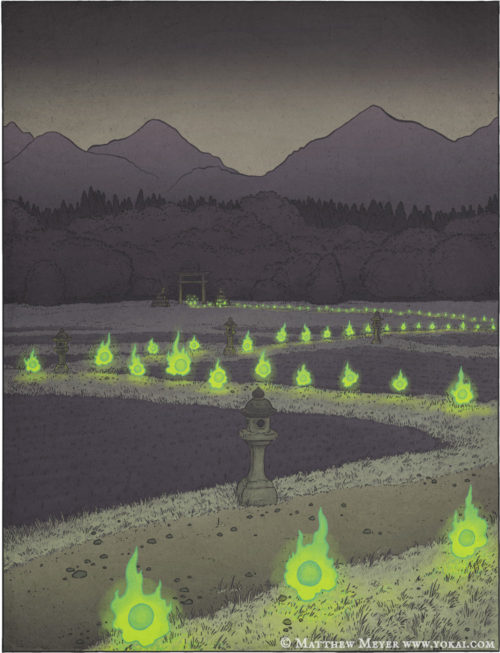
Kubi kajiri is a yokai that is found lurking around in graveyards on the Autumn equinox. As you may guess by his name, he is primarily hunting for heads to eat. They look very similar to typical Japanese ghosts: long, disheveled hair, discolored skin, sunken eyes, and a white burial kimono. Like Japanese ghosts, they have no legs.

When they find a corpse that has been freshly buried, they dig it up and begin eating the head, leaving a mess of blood and gore all over the ground.

The reason they look like ghosts is because they were developed from a painting (by Ippitsusai Bunchō) called “Ghost eating a man’s head.” At some point, the picture was copied and the name kubi kajiri was slapped onto it, and this character was born!

There are two different popular explanations for kubi kajiri’s origin. The first one says that they are created when a person dies and is buried without their head. Their corpse turns into a yōkai and begins to hunt for fresh heads in graveyards.

The other explanation is a little more gruesome. It says that kubi kajiri are created from the corpses of eldery people who have starved to death—particularly those who starved due to negligence and abuse. This is related to the idea of “ubasute” which occurred long ago when food was scarce. During famine, the elderly members of a family might be allowed to starve to death in order to relieve the burden on the younger members. When they were too weak to travel, the elderly might even be piggy-backed into the mountains by their children and left there to die. It’s so sad and cruel that there’s no wonder this is the original story for so many different kinds of yokai. In such cases, the kubi kajiri was only said to appear after their abuser died. Then they would appear beside the grave of their abuser, dig up the corpse, and devour its head.

Justice! (Maybe?)


Want more yokai? Visit yokai.com and check out my yokai encyclopedias on amazon.com! Still want more? You can sign up for my Patreon project to support my yokai work, get original yokai postcards and prints, and even make requests for which yokai I paint next!

Next Month: A-Yokai-A-Day

It’s been a little while since the last update. August and September have been wildly busy, finishing up with the book and getting it to the printers. But the good news is that if you are a Kickstarter or BackerKit backer, you should have access to your ebook download links now in your BackerKit downloads area!

A-Yokai-A-Day for the Month of October

I would be remiss if I let September pass without mentioning the project that is probably what this blog is most well known for: A-Yokai-A-Day! Keeping with my annual tradition I will be posting one yokai every day for the entire month of October.

A-Yokai-A-Day started in October of 2009, so this year marks nine years of October yokai. In that time all sorts of similar drawing challenges have popped up, including Inktober. In that spirit, I’d like to invite my readers and yokai fans all over the world to join me in A-Yokai-A-Day by painting/sketching/doodling/drawing/photographing a yokai every single day next month!

Hashtag your posts #ayokaiaday and #ayokaiaday2018 and share them on Twitter/Facebook/Instagram/wherever!

Last Month’s Yokai

Here are the yokai you may have missed in August and September by not being part of my Patreon project. If you like this site, or yokai in general, and especially if you have a yokai request you’d like to see my paint, join my Patreon project and help support this site and yokai.com!

Taki reio

Yonaki ishi

Mekurabe

Jigoku tayu

Kohada Koheiji

Mumashika

Oi no bakemono

July Update

May and June have gone by in a flash, as I have been so busy working on the book as well as the Patreon that I haven’t had a moment to even think about updating the blog! We are also having our house remodeled so that has taken up a lot of my attention.

It’s been a busy couple of months for yokai painting. Here are the images you may have missed if you haven’t been following the Patreon or my social media:


http://yokai.com/chouchinbi


A Visit to the Yokai Museum

This weekend I went to Nagoya to see the Yokai Mummy Exhibit at Parco Gallery. If you can get to Nagoya before this ends, I strongly recommend you go see it! It was pretty fantastic.

This exhibit is a preview event for a brand new yokai museum set to open next year in Miyoshi City, Hiroshima. The museum is going to be the new home of Yumoto Koichi’s yokai collection. Yumoto holds the largest collection of yokai in the world, and is a prolific yokai researcher with a few books published detailing the contents of his massive collection. Having a museum built for them is a pretty incredible thing, and this preview showcased some of the highlights of his collection; the mummies!

And unlike lots of art galleries, photos were allowed, so I am happy to share some of what I saw with you! You’ll have to forgive the poor quality of the photos. It was difficult to take shots without my own shadow getting in the way, so most of my pictures were taken at sharp angles. There are some glares and lots of perspective distortion, so you’ll have to use your imagination a bit.

Part One: Paintings

Here I am peering at the first scroll: a hyakki yagyo emaki featuring tsukumogami cavorting in a night parade.

These are yokai you’ve probably seen countless times. They have been painted over and over in many different picture scrolls. Some have names, some don’t, but it’s fun to see the same characters appear over and over by different artists.

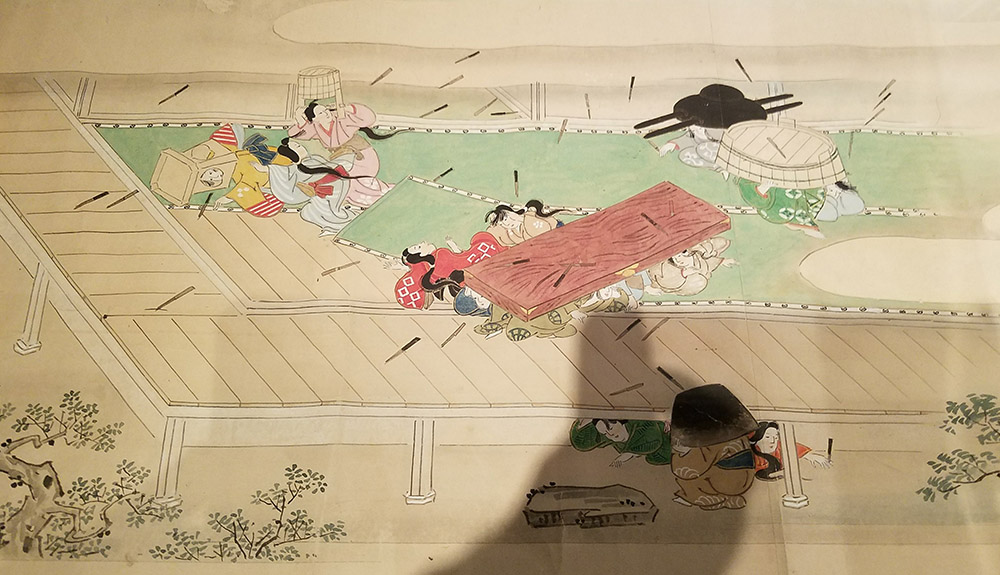
Next up is a picture scroll depicting a long story, with yokai interacting with humans among a lavish-looking samurai house.

Only parts of the scrolls were visible; they unfurl different sections of different days of the exhibit, so if you can go for multiple days you can catch even more of the stories!

Next up is a scroll with a number of famous yokai, including this old school nurikabe! I also liked this version of nurikabe more than Mizuki Shigeru’s version, which is what you mainly see nowadays.

This next character is heavily distorted because I took the photo at a sharp angle, but it’s a giant catfish! This was another scroll that had a number of large sea monsters on it.

I know I’ve seen this ghost before! This is a copy of another painting.

An inugami and a rokurokubi, also copies from an earlier scroll.

The next one is a bizarre scroll worth mentioning. This scroll depicts a group of wisemen from China who developed a method of defeating yokai… by farting on them! Fart scrolls are surprisingly common among yokai paintings, and there are lots of images of people farting on kappa or other yokai to drive them off. I’m not sure how this particular scroll falls into the timeline of things, but the silliness of it is charming.

This is an Edo period book about a young man who goes kitsune hunting off in the mountains, and runs into yokai after yokai. How I would have loved to turn the pages and see the other parts of this book!

This scroll depicts a house full of yokai; you can see faces on the walls, and ghostly heads floating about.

These next few images were from a relatively modern (Showa Period) scroll, and I absolutely love them! In particular, chikusho (the skull with a skeletal deer’s body) has definitely become one of my new favorite yokai. This scroll was also unfurled over many days, so I wish I could come back and see the others! (Fortunately Yumoto Koichi’s books do display more details of this and his other pieces.)

Part Two: Prints

First up are two of the most famous yokai images ever: Hokusai’s prints of Oiwa and the sarayashiki ghost (aka Okiku). You can find better scans online than my photos, but seeing them in person is something else!

This is a copy of Inou mononoke roku, which I’ve posted about on here and yokai.com in the past. It’s a collection of pictures from the life on Inou Heitarou, a young boy from Miyoshi, Hiroshima who had a series of very bad nights as yokai repeatedly visited him. How I would love to read this whole book!

Next up is a series of prints framed all together. If you look closely you can see all kinds of yokai hidden in the pictures. Even the walls have eyes!

This story features a big tsuchigumo!

Below is a yokai-themed board game (sugoroku).

Here is a set of yokai karuta.

This is a newspaper article, believe it or not. It tells the story of a shop owner who was attacked by the ghost of the man who owned the shop before him. It looks like it would have been very fun to be a newspaper illustrator back then!

Part Three: Clothing

There were a couple of neat articles of clothing at the exhibit. This is a kimono and obi featuring Ibaraki doji, a famous oni.

Below is a thick outer jacket with a nue on it. Nue were disaster beasts, associated with fire and lightning. So this jacket was actually worn by a fire brigade. It’s made of very thick and heavy cotton, like a judo uniform. The firefighters would soak it with water to protect themselves when running into the fire. Then they would turn it inside out when returning. It’s quite clever.

Part Four: Mummies!

This, of course, is the main event! The yokai mummies! In their day, these were toured around as sideshows, displayed in temples as curiosities, and even kept as charms.

First up we have a ningyo. The first page is a description of the creature and its story. Of all the man-made mummies, this one was by far the most realistic. Check out those teeth!

Next up is a creature that was billed as a “three headed dragon.” Three snake heads on an alligator. I guess it didn’t specify whose heads…

You’ve probably seen these images before. These famous kappa paintings are circulating around the internet. They diagram the kappa and suiko mummies presented below.

A kappa’s hand!! This reminds me of the old ghost story about the monkey’s paw.

This one here is a suiko.

Human for scale. I definitely picture suiko as much bigger in my mind! Isn’t that what people always say at sideshows?

Next up are a couple of raiju mummies. This illustration accompanied them:

There was also a karasu tengu mummy! This document describes it.

And now, the grand finale: the kudan! There were a number of posters advertising it from ages long past. I especially liked this one:

Human for scale. I’ve seen this guy on so many websites and in so many books. While there are other kudan mummies out there, this one is probably the most famous. He has a very serene look on his face. It’s not hard to see why people thought these were special or magical beasts.

Seeing these mummies really makes me long for a time I’ve never experienced. I’d love to visit that age of wonders, when science and fantasy were still at odds with one another, and sideshows like this traveled around the world. Although I suppose it’s not so different today. Instead of being scammed out of my money to see a “real mermaid,” I happily paid to see a fake one.

Anyway, it was an awesome exhibit. I am eagerly looking forward to the opening of Yumoto’s Yokai Museum in Miyoshi!