A-Yokai-A-Day: How Mankichi Tayū Became a Bakemono’s Master

Tonight’s story is wonderfully silly. And the yokai in this story is a rare one! Instead of a tanuki, yūrei, or a daija, as this book is fond of, we have something like a kodama. To be more specific, this is the spirit of an enoki mushroom, which for some reason or another, has decided to play pranks on humans. Wonderful! Everything about this story, from the evil mushroom, to the ridiculous actor, to the way the mushroom is defeated, is just silly. I love it.

How Mankichi Tayū Became a Bakemono’s Master

In Kamitachiuri, Kyōto there was a sarugaku master named Mankichi Tayū. His noh acting was poor, and when his money ran out he decided to head to Ōsaka. On the way, he stopped to relax and drink tea at a roadside teahouse in Hirakata. It was almost dusk, so he said to the teahouse owner, “I would like to stay here for one night.”

The teahouse owner replied, “That is no problem, except that there is a bakemono who comes here every night and takes people. So we won’t be here at night.”

Mankichi replied, “Even so, I don’t mind.” And he spent that night at the roadside teahouse.

At around midnight, sure enough, he heard the sound of someone crossing the river from the other side. When he looked, he saw a rich monk standing over two meters tall. Mankichi called out to the monk:

“No, no, that kind of transformation is no good. You’re still a novice.”

The monk replied, “What kind of person are you to speak in such a way?”

Mankichi said, “I am a bakemono from the capital, and I heard that a bakemono lives around here, so I came to meet him and see how skilled he is. If he is skilled, I thought I would take him as my master, and if he is unskilled, I thought I would take him as an apprentice. That’s why I’m staying at this teahouse.”

The monk said, “In that case, show me your transformation skills.”

“Very well,” said Mankichi. And he took his noh costumes out of his pack and dressed himself up as an oni.

The monk was impressed and said, “Well now, you’re very good! Next, turn into a woman.”

“Very well,” said Mankichi. And he turned himself into a woman.

The monk replied, “I am amazed at how skilled you are! I would like to ask you to become my master from now on. I am a mushroom who lives under a hackberry tree across the river. I’ve been living here and bothering the people nearby for several years.”

Mankichi asked, “What is your least favorite thing?”

“I can’t stand soup made from miso that has been fermented for three years,” replied the monk. “And what is your least favorite thing?”

Mankichi answered, “I can’t stand freshly caught and cooked sea bream. If I eat it, I will just die right away!”

As they spoke, the dawn was beginning to break. The monk said farewell and went back across the river.

Mankichi dayū told all of the people of Hirakata and Takatsuki about his meeting with the bakemono and their conversation. Then they all gathered together and boiled some miso that had been fermenting for three years. When they poured it on the mushroom underneath the hackberry tree, it immediately shriveled up and disappeared. The bakemono was never seen after that.

A-Yokai-A-Day: The Jealousy of Shibata Shume’s Wife

Jealousy once again rears its ugly head! It’s a very common theme in Shokoku hyakumonogatari. In fact, tonight’s story contains quite a few repeated themes that we’ve seen throughout this book. But what I find more interesting is what it doesn’t say.

For one, why did the wife murder Momiji? It seems quite extreme, even for the most jealous person in the world, to murder someone just for being beautiful. After all, Momiji was just a maidservant. The wife could have easily fired her. And why, in the end, does Shume become a monk? If his wife murdered the maidservant, the proper thing for a samurai to do would be for Shume to put his wife to death as a murderer. And why does Momiji’s ghost appear with the lower half of her clothing soaked in blood?

These questions all point to an unsaid answer: that Shume was sleeping with Momiji and got her pregnant. This explains the bloodstained clothing; Momiji’s ghost appears in the form of an ubume — a ghost associated with pregnancy and childbirth. It also explains why the wife was upset enough to kill the girl. And, as Shume wasn’t innocent himself, he had no recourse to punish his wife, and instead he became a monk to atone for his own sins.

The Jealousy of Shibata Shume’s Wife

In Miyazu, Tango there was a man named Shibata Shume. His wife was a jealous woman, and she suspected that Shume had his eye on their beautiful maidservant Momiji. One time, after Shume went to Edo, she tossed Momiji into a well and then sealed her inside, killing her.

When Shume returned from Edo he asked his wife, “Why did you dig a new well?”

She answered him, “It suddenly collapsed so I had to dig a new one.”

“Where is Momiji?” asked Shume.

“She quit,” replied the wife.

Shume was suspicious, but he let the matter pass.

Shume had three children, but they suddenly became ill and within 40 or 50 days all three of them died. Shume and his wife were overcome with grief and endless sorrow. Around that time, Shume’s wife was pregnant, and before long she gave birth without incident. The child was a blessing in the middle of their grief, and they showered him with affection.

Before long, the child turned three years old. He suffered repeatedly from epileptic convulsions, and they tried all sorts of treatments, but none had any effect. A rōnin acquaintance of Shume’s knew of a skilled acupuncturist, and brought him to see the child. After the acupuncture treatment, the child recovered a little bit, so Shume asked him to stay the night.

Since it was summer, the rōnin and the acupuncturist hung up a mosquito net and left the area open while they talked. While they talked, they heard the sound of geta from the alley. When they checked to see who it was, they saw a girl. From the waist down, she was stained with blood; her body-length hair was standing on end; and her face was emaciated and blue-tinged. She stepped up onto the veranda. The acupuncturist nearly fainted, and cowered in the corner. The rōnin said, “Who goes there?”

“I am a maidservant who was employed by this house, but the lady of the house, in her jealousy, falsely accused me, murdered me, and buried me at the bottom of the well. I have already taken my revenge on three of her children, and now I have come to take her fourth. No matter how much money you spend on treating him, it will not won’t be enough,” replied the girl. Then she vanished into thin air.

At that moment, they heard a scream from the back room. When they went to check, they found that the child was already dead.

Afterwards, the rōnin told Shume everything that had happened. Shume was shocked, and he divorced his wife and became a monk himself.

A-Yokai-A-Day: Retribution for Kicking a Three Trunk Cedar

Hey yokai lovers! I’ll be at Toei Kyoto Studio Park all day tomorrow for the KaiKai Yokai Festival. This is Kyoto’s greatest yokai festival of the year, and it’s come to define Kyoto’s Halloween celebrations in recent years. And it’s set in Uzumasa’s Edo period samurai film set, which puts the yokai right where they belong. You won’t want to miss this one!

Anyway, on to tonight’s story!

Retribution for Kicking a Three Trunk Cedar

A certain monk of the Tendai sect went on an ascetic pilgrimage across the country with his servant. They went from Edo to Nikkō, and on the way back his servant observed a three trunk cedar tree and said, “Is this lame cedar the one that I’ve heard so much about? There are tons of cedars just like it back in Kyōto.”

Then he kicked it and continued home.

That night, the servant began to tremble and babble all sorts of things as if he was possessed. When the monk saw this, he thought it must be the work of an evil spirit, and he performed the incantations and prayers he had learned in his Tendai training.

The servant babbled, “These prayers are so powerful that I can’t stand it! I’m leaving!”

The monk commanded, “Show yourself right away and then leave.”

The servant turned into a large stone buddha.

“No, no, show me your true form,” said the monk, and continued incanting.

The stone became a 3 meter tall priest with a single eye in its forehead.

“This is not your true form either,” said the monk, and he prayed even harder.

The giant priest became a 30 meter long snake with a single 150 centimeter long horn.

“If you won’t show me your true form, then I will show you what will happen!” said the monk. And he beat the snake with the large square bead on his rosary.

“Okay, I am leaving! But my female form has tainted his body so you must wash him!”

“Then I will perform ablutions,” said the monk, and he washed the servant’s body in hot water.

Before long, the servant said, “Alright, I’m leaving now. I won’t come back after this. It’s because he kicked me. I’m telling you, your prayers are too strong. Goodbye.”

Then the snake turned into a 16 or 17 year old girl, and she left out the back door. Immediately, the servant returned to his senses.

A-Yokai-A-Day: The Wife of Matsumotoya Kyūbei of Wakayama, Kishū

Tonight’s story is rather short, but it is one of the more disturbing ones in Shokoku hyakumonogatari. The final sentence is an example of a feature I love in Japanese foklore, and a way of ending the story that pops up from time to time in this book. It’s the way stories are presented generally without much embellishments or meandering, and get straight to the story. “I heard this from so-and-so,” or “everybody knows this fact,” add a sense of authenticity to these ghost tales — to let you know that these are not stories made up on the spot by the author just to scare you, but creepy stories that were collected and passed down as if they were factual events. The starkness of these stories contrasts a lot with English language horror, which often overflows with descriptors and adjectives that are meant to evoke a mood but don’t add much to the story. These feel stripped down by comparison, but the horror also feels more raw. I prefer it this way.

The Wife of Matsumotoya Kyūbei of Wakayama, Kishū

In Wakayama, Kishū there was a man named Matsumotoya Kyūbei. He lived an affluent life, but he unexpectedly became ill and died. His wife remarried, and her new husband succeeded Kyūbei as his heir. As the years passed, Kyūbei’s daughter grew into a young woman with beautiful features, and her step-father became obsessed with her and, against all propriety, slept with her.

The wife learned of this, but out of concern for public appearances she told nobody, despite the pain it caused her morning and night. Yet before long, everybody found out about it and mocked her husband, calling him a beast. The wife grew sick living with the thought of this, and she died.

Her daughter, glad that her mother was finally out of the way, made all of the proper funeral arrangements, and in preparation to bury her mother’s corpse at dawn, set the casket in the sitting room that night.

Around midnight, the wife got out of the casket, looked around, and then went to the room where her daughter and her husband were sleeping. She bit out her daughter’s throat, then climbed back into the coffin.

Everybody said it was an inevitable outcome. They held a combined funeral for the mother and daughter. Afterwards, the family fell into ruin and perished. A merchant who happened to be there at the time and saw everything came to Kyōto and told this story.

A-Yokai-A-Day: How Baba Kurōzu Defeated a Daija

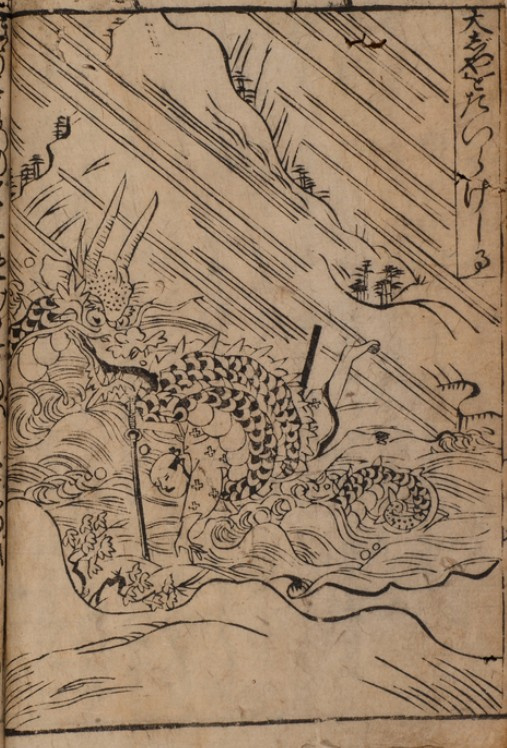
Tonight’s yokai is another daija — a word that covers serpentine creatures all the way from large snakes to dragons. I’m always torn over how to paint these — more snake-like, or more dragon-like? The images in Shokoku hyakumonogatari tend to favor dragon-like depictions, as you can see in the original illustration for this story:

How Baba Kurōzu Defeated a Daija

In Kyūshū there was a rōnin named Baba Kurōzu. He hoped to serve Hosokawa Sansai, but so far his desire had gone unmet.

One day, he went river fishing with four or five men, and along the edge of a certain mountain they found a roughly 1.1 square kilometer marsh. They cast their nets into this and began to relax, when all of a sudden a great roar was heard from the marsh. Smoke began to billow out of it, and then some unknown thing came straight towards them. Everyone was startled and fled. Kurōzu was not the least bit afraid, and he wanted to see what it was no matter what. When he investigated, he discovered a six meter long serpent. Kurōzu thought he would catch the serpent, so he leaped at it, but the serpent coiled itself around Kurōzu and pulled him into the marsh.

The men who fled told everyone about how Kurōzu had been taken by the serpent, and everyone of high and low rank was talking about this story.

Three days later, around noon, Kurōzu came out of the marsh. All of the water in the marsh was stained with blood. When the nets were pulled out, inside of them was the six meter long uwabami, slain by Kurōzu and cut into seven or eight pieces.

Sansai saw this and declared, “Kurōzu is a real warrior.” And he awarded him a salary of 3000 koku. To this day, it is said, his descendants are still serving in Kyūshū.

A-Yokai-A-Day: How Ōno Dōkan Was Unfazed by Ayashimi

Tonight’s story deals with something called ayashimi. I chose not to translate this word, because it is vague even in Japanese. Ayashimi means something strange or mysterious, and doesn’t really refer to any specific type of monster or phenomenon. It’s written with the kanji 怪, which is one of the kanji found in the words 妖怪 (yokai) and 怪談 (kaidan). I think it carries with it a nice sound that works better and sounds more mysterious than simply translating it as “strange phenomenon.”

This story is another one that I find quite funny. Or at least absurd. Dōkan’s explanations and brushing off of these strange occurrences gives off some real “ackchyually” vibes. Especially how he just casually handles the revelation at the end.

How Ōno Dōkan Was Unfazed by Ayashimi

One day, a man named Ōno Dōkan went hunting. In the mountains, a single matsutake mushroom the size of an umbrella sprouted up in the path after Dōkan passed by. His servants saw this and were astonished, and called out to Dōkan.

Dōkan turned around and said, “There’s nothing strange about this. Matsutake mushrooms can grow to this size. Now if it had sprouted upside-down, that would be strange…”

He continued on his way, and ahead of him he saw on the path ahead another matsutake mushroom, growing upside-down.

His servants grew even more astonished, but Dōkan said, “Since I was just talking about them growing upside-down, there’s nothing strange about this either.” Then they returned home.

On the first day of the following year, the iron trivet in the hearth started to dance around the room. The servants were astonished and called out to Dōkan.

Dōkan said to them, “Humans walk about with just two legs, but a trivet has three legs, so there’s nothing strange about one walking around or dancing.” And he didn’t let it concern him at all.

However, in the summer of that year, his only daughter died. It occurred to him later that this may have been due to these mysterious phenomena.

A-Yokai-A-Day: Otohime of Ryūgū’s Infatuation with Igarashi Heiemon’s Son

Tonight’s story features a character who was popular in folklore throughout much of Japaense history: Otohime. She is the princess of the sea, daughter of the king of the sea, and technically also a dragon. The most famous story about her is the tale of Urashima Taro, but she is such a major figure in folklore that countless spin-off tales have been cooked up by people for hundreds of years. There are even books of what you could call Edo period “fan fiction” about her. So just by mentioning her name in the title of this tale, an Edo period reader would have known what this story was about, despite the fact that the text itself doesn’t mention her name or give any explanation as to why she does what she does. We already know that Otohime is a serpent, and that she has a thing for handsome young human men.

Speaking of Otohime, my newest book The Palace of the Dragon King is available on the yokai.com shop! This book is, like its predecessors, an illustrated encyclopedia of yokai; but this one has a special focus on aquatic yokai and an en entire chapter dedicated to the inhabitants of Ryugu, the castle that serves as home to Otohime and the oceanic royal family. Paperbacks, hardcovers, and collector’s editions are now available!

Otohime of Ryūgū’s Infatuation with Igarashi Heiemon’s Son

During the Genkyū era (1204-06), there was a rōnin in Kamisakamoto named Igarashi Heiemon, and he had one son. The boy was beautiful, with perfect features, and everyone was obsessed with him and constantly fought for his attention. His parents thought that this would be a burden on him, so they sent him up to Mt. Hiei to study.

One time the boy took a vacation to Karasaki, and while relaxing underneath a pine tree, a beautiful girl around 15 or 16 years old appeared out of nowhere and approached him.

She asked him, “Where are you from? I live near here, and I always come to this pine tree to relax. Come sit with me and watch the boats leaving from the north.”

The boy accepted her invitation, and joined the girl at the water’s edge. She seemed to cling to his sleeve, and then all of a sudden she turned into a serpent, wrapped around the boy seven times, and leaped into the sea. At that moment, the sky suddenly filled with dark clouds, heavy rain fell, and the sea became covered in white-crested waves.