Night Parade Gallery Show at Space Oichi | 百鬼夜行@スペースオイチ

日本語版はこちらです。

In Japan, summer is the season for scary things (unlike in the US, when horror revolves around late fall and Halloween). Summer is when the new scary movies come out, when ghost stories are told, and when creatures from beyond are said to return to our world. The idea is that being scared chills your body and helps you beat the summer heat, but this also has more ancient roots going back thousands of years — the same roots that lead to the superstitions of the dead returning to our world and the boundaries of the spirit world being weaker during the Obon holiday.

As such, summer is the perfect time to talk about yokai! And in the spirit of keeping everyone cool, I’m having a gallery show featuring illustrations from The Night Parade of One Hundred Demons next month in Fukui City.

The show will feature a broad range of yokai, from the funny and cute, to the weird and creepy, to the downright terrifying. If you can make it to Fukui city this summer, definitely come check it out!

Hyakki Yagyou poster

Hyakki Yagyou, 7/26-8/16 @ Space Oichi

The full dates of the show are July 27 until August 16, 11 am to 7:30 pm. The location is Space Oichi, Apple Building 2F, right behind Seibu and above Seatle’s Best Coffee and Theatre Cinque. Hope to see you there! | 日本では、夏といえば何か怖いホラーの季節のイメージがあります。(アメリカではハロウィーンの時期ということで遅めの秋がホラーシーズンですからちょっと違いますね)夏にには毎年新作のホラー映画がでてきて、怪談話もあちこちで聞かれるようになります。死者が蘇る時期でもありますね。夏の暑さ対策にはもってこいです!

と、言うことで・・・夏です!妖怪の季節がやってきました!涼しくなりたい皆さんに朗報です。私の本「The Night Parade of One Hundred Demons」の妖怪たちの展示がスペースおいちさんで開催されます。

Hyakki Yagyou poster

Hyakki Yagyou, 7/26-8/16 @ Space Oichi

展示は7月27日から8月16日まで、時間はAM11時~PM7時30分までです。フェニックス祭りをはさんで展示が行われますので、お祭りに来られた際には是非立ち寄って見てください!

場所は福井市中央1-17-1アップルビル2Fです。妖怪たちがあなたを待っていますよ!

Reconstructing Fukui Castle

I love history. When my mind wanders, one of the things I constantly go back to is imagining different worlds if history had been different. You know, like if you could go back in time and give Julius Caesar a modern chemistry textbook, or warn the American Indians about the crap the Europeans are trying to pull. Japan has an amazing and rich history, and riding my bike through town usually ends up with me daydreaming about different time periods here (a little dangerous perhaps). Particularly here in Fukui prefecture, where the modern world has just barely taken a foothold, there are so many places where the land is untouched by foreign influence or the modern global culture. It’s easy to get lost in one’s imagination.

Historically, Fukui was a very important military and cultural center of Japan for many centuries. After the feudal period its power waned considerably, but in its heyday it was one of the top population centers in Japan. Sadly, though, that history is mostly buried here. All of the castles have been leveled and paved over, the aqueducts filled in and turned into streets and real estate, and most of it has been forgotten even by the residents.

Fukui castle is one of the sites that almost brings tears to my eyes when I think how much history has been squandered. Currently the prefectural capital and largest city in the prefecture, Fukui used to be a rural swampland called Kitanosho. In the late 1500’s a castle was built here, and soon afterwards war came. The first castle was burnt down after 8 short years, and in 1606 a new castle was built at a nearby site. The whole city was designed and developed into a paragon of a castle town. Moats and canals were dug all over town separating it into many districts, walls and gates were erected all over for defense, and walled samurai towns sprung up. Looking at the old maps of Fukui city, it looks like it must have been completely impregnable.

Although the town was never taken after that, a fire destroyed the main keep in 1669 and it was never rebuilt. The innermost walls remained, as did the noble’s houses on the castle grounds, though, and it continued to be an important castle town until the Meiji Restoration. Sadly, the remaining walls and palaces were burned down when Fukui was firebombed in World War 2. A few years after the city was burnt to the ground by bombers, a huge earthquake struck and re-leveled the city once again. The stone walls of the castle still bear the marks of that earthquake. During the second reconstruction, the cityscape was changed and it lost its identity as a castle town. The aqueducts and moats were paved over with cement and a lot of important cultural heritage was lost. While other cities on Japan reconstructed their castles and turned them into parks and tourism centers, Fukui erased its past, even going so far as to build a hideous government building on top of the remains of the castle palace.

Today the city is expanding, and as it grows and new construction takes place, workers are constantly finding old walls and remnants of the castle town. Thankfully, some work has been done to restore these artifacts when they have been found, and there are plaques scattered about the city wherever a historical remnant has been uncovered. Whenever I run into one of these I stop for a while and try to picture what the city could have looked like if the people in charge of reconstructing the city had had a little more foresight (and hindsight) about preserving their history.

A few years ago, a minor reconstruction at the castle grounds took place. One of the rotting wooden footbridges was reconstructed into its original, beautiful form. On the day it opened, I went to visit it, and it was just superb. Even though it was only a bridge, the smell of the new timber and the authentic reconstruction of the ancient building stirred my imagination. I decided I wanted to paint a view of what the town might look like if the castle had never burned down, and if it had been preserved properly.

I started this painting two years ago and got about halfway done when I hit a big roadblock: I couldn’t find any reference of what the castle looked like! I thought about making up a new facade for the castle based on the other castles I have visited, but that just didn’t seem right. Each castle is unique, and that wouldn’t be fair to Fukui castle or the castle I would have copied. I had to put the painting on hold until I could accurately reconstruct it.

For the past two years I have visited libraries, history museums, and done countless image searches trying to build up a database of images I could use to reconstruct the castle. Every now and then I would find a goldmine. One store was selling postcards with pre-WW2 photographs of the town. I could finally reconstruct the outer walls! At another store I found a few old woodblock prints with images of the castle, printed back when the castle was still around! But sadly the perspective was way off and it was hard to get an accurate measuring from them. I did a lot of research and discovered a whole lot about Fukui’s history as well — not just the castle. It was like unfolding a mystery that was hidden all around me; in the street names, the rivers, under the streets, and the property lines remnants of the old castle town were still evident. From one of the paintings, I learned that one of my friend’s apartments was actually built right on top of one of the old gateways into the city!

Fukui Castle scale model

A scale model of Fukui Castle I stumbled upon while climbing Mt. Asuwa. Who hides such a beautiful piece of artwork in a field behind a parking lot on top of a mountain??

Old photo of Fukui Castle

A pre-war photo showing the walls of Fukui castle

Old photos of Fukui City

Photos showing various shots of old Fukui

An old painting of Fukui castle

A very old painting showing the castle before it burned down

A diagram of Fukui Castle

A diagram of the main keep located on a plaque outside of the castle ruins

3D digital image of Fukui Castle

3D digital recreation of Fukui Castle

Finally, I discovered a website that created some 3D images of old castles, and lo and behold, they recreated a shot of Fukui castle! It was the final bit of reference I needed to be able to reconstruct what the castle might have looked like. I spent the better part of this week putting together my references and sitting down to finish this two-year-old painting, and here is the result. The only part I was unable to faithfully recreate is the gatehouse beyond the bridge, as none of the references I found were able to give me a good image of it. So I did my best to recreate what it may have looked like, based on other castles’ gatehouses.

Fukui Castle, if it were still around today

Fukui castle, seen from the south, during cherry blossom season (click for a larger version)

In one week, I will be moving back to Echizen city after spending a year here in Fukui. Even though Echizen is only 30 minutes away from Fukui, I’m especially happy that I was able to finish this painting now, rather than later. I feel like I can present it now, saying thank you to the city that has struck my imagination so strongly. (After all, after I return to Echizen I’m going to resume obsessing over that city’s own rich, forgotten history.)

Whatcha Lookin’ At?

The Gangster

The Gangster

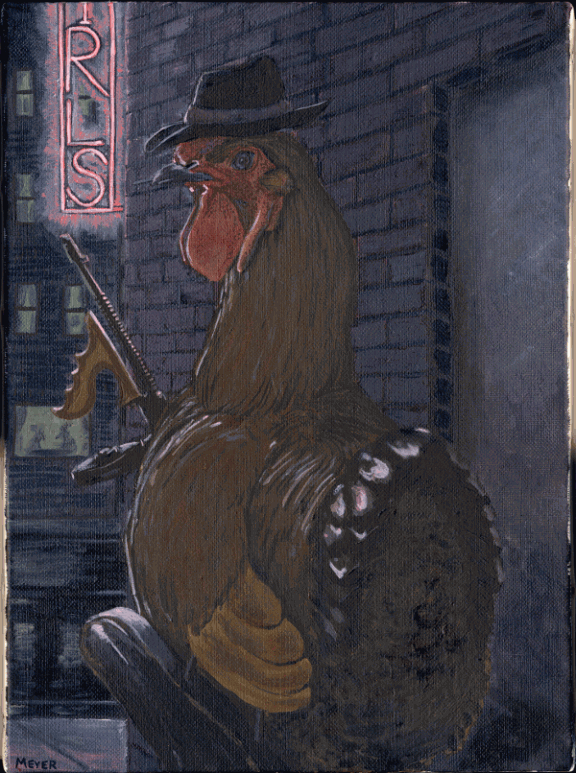
It’s been a busy month, what with studying for the JLPT, organizing things for the move, such as shutting off the utilities and turning them on at the new apartment, and packing things up. I really haven’t had that much time to paint (hopefully I can make up for that with ample painting time starting next month). I did manage to get one done this month though: a new chicken, The Gangster!

I recently ran a Call of Cthulhu game set in 1920’s Boston and NYC, and the final game had a pretty fun car chase/shoot out with a bunch of cultists/bootleggers/gangsters. I had such vivid images in my head after that I really wanted to paint a gangster, so I sketched out this chicken one day and spent this week painting it. I didn’t use any lemon yellow this time so it didn’t have any trouble drying. On the other hand, though, as it’s a pretty dark painting, it was really hard to get the colors and values right in the scan. They’re pretty close to the real image, though the bricks on the wall are just a bit bluer than in the real painting.

A Lady

A Lady

A Lady

As promised, here is the counterpart to yesterday’s post.

Sadly, it didn’t dry up to 100% today, but as I need to submit it tomorrow there’s really nothing I can do. Fortunately, there’s only about a 3 millimeter area of yellow that’s not dry (everything else is) so it only made a tiny speck on my scanner glass, which I was easily able to wipe up.

They should look nice framed and side-by-side.

A Gentleman

A Gentleman

A Gentleman

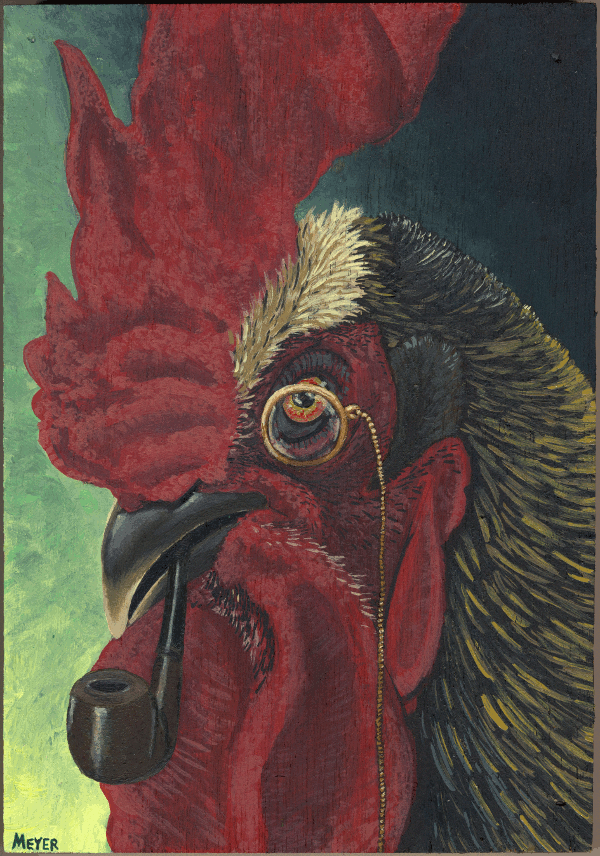
This painting was a quick 1-day deal which took over a week to dry… If you saw my Facebook page no doubt you saw me complaining about it. I think it was due to a new yellow paint I used in the background. Everything dried quickly in a couple of days except for that yellow corner. By Monday I was getting worried it would never dry in this humidity (it’s the rainy season now) so I left it under the air conditioner for 2 days. That didn’t help very much, so yesterday I put it outside in the sun all day long. That did a good job, and after one more day of sunning it, it was finally dry. I actually painted a pair of chickens — his wife is on another panel — but the other one is not dry enough to scan yet. Perhaps another day sitting in the sun will do the trick.

It’s a pretty simple piece because of its size. It’s on a very small wood board and I did it for a show/competition next week based on this size image. Hopefully I’ll be able to post the other panel tomorrow. They look pretty good side-by-side. In fact, I think they would make decent men/women restroom signs.

Fukuiraptor at Nishiyama Koen Station

Fukuiraptor at Nishiyama Koen Station

Fukuiraptor at Nishiyama Koen Station

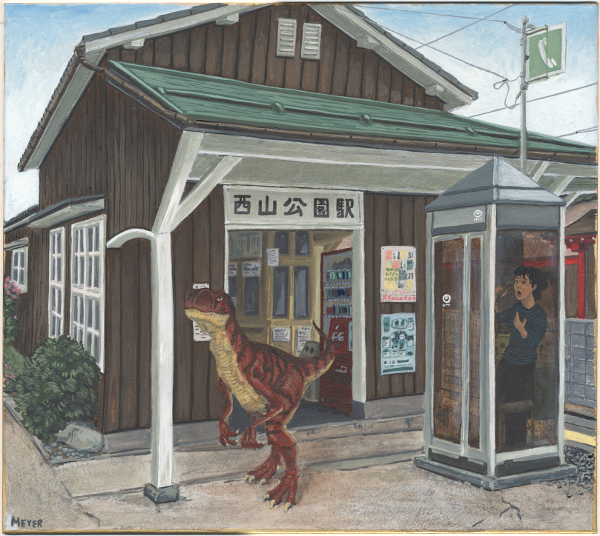
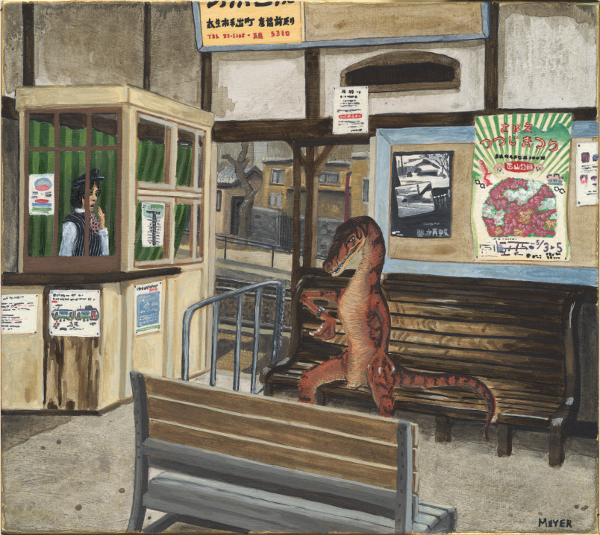
The latest in the Fukuiraptor Riding the Train series is finally dry enough to scan, though I think I got a few speckles of titanium white on the scanner glass.

Nishiyama Koen is a famous park in Sabae city, and one of the more popular destinations among residents of Fukui prefecture. It’s a small mountain (or a very large hill) with a park on top. The mountain is covered in various flowers which bloom at different times of year, and is the pride of Sabae city. It’s also home to the city’s red panda mascots, who live in the small zoo on the mountain top. I’m sure Fukuiraptor would want to go there, if nothing else to see the red pandas (and maybe to eat them).

Process is Everything

I’ve been pretty quiet on this blog recently, due to the fact that I haven’t been up to any thing particularly interesting recently. I’m working on a handful of projects, but I generally don’t post anything about a project until it’s finished. Well, not today!

I thought it would be fun to post my next Fukuiraptor painting at the stage it’s in now. Have a gander!
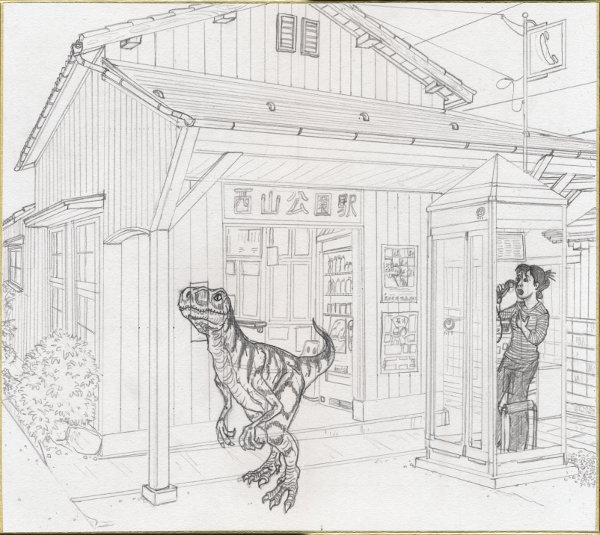
WIP - Fukuiraptor at Nishyama Koen Station

WIP – Fukuiraptor at Nishyama Koen Station

Last October when I was working on the A-Yokai-A-Day project a lot of people said I was insane to paint a new one every day. That may be true, and I did lose a lot of sleep that month, but the fact is that monsters are easier to paint than real things. The anatomy is made up, and our eyes can’t really tell the difference. Plus, the yokai were basically one monster on a fun textured background.

Realistic pictures (or at least semi-realistic) are a lot harder to fool the eye with. As you can see by the sketch, I have to take a lot of time drawing all the linework on the architecture with a ruler, and though you can’t see them now there are also many guide lines all over that board helping me to measure accurately. With buildings, you can’t fake the perspective by much or else our eyes will tell us something is wrong. Maybe we can’t identify what it is, but our brains and eyes work together to tell us it’s not natural. Dinosaur anatomy is a bit easier to fool people with, but it still does involve lots of study. I have a ton of dinosaurs toys that I use as reference, and for movement ideas I watch the crows in the rice paddies outside my window — I always imagine that is how dinosaurs would watch. And finally, human beings! They’re the hardest thing of all to draw, because even the slightest anatomical mistake and your character will look like a diseased or disabled person. Perhaps it’s part of our genetic heritage that we are able to read emotion, intention, even health in even a single glance at another human being — but this is also the artist’s greatest challenge. There are two ways to go with this problem: you can either spend years and years practicing until you can produce anatomically perfect figures like masters of painting and illustration, or you can simplify the character until it’s an abstract human form, like cartoon or anime characters. I tend to prefer a slighty-cartoonish but still anatomically human character, which isn’t as taxing as painting a realistic human but still requires a lot of anatomical work.

My process for these goes like this. First, I gather my reference materials. In this case, going to the local train stations and gathering photo references. After I have an angle/viewpoint that I like I do thumbnail sketches to decide the forms, then a larger rough sketch to confirm how everything fits on the paper. Then I do separate sketches of the dinosaur from my toys, and the human from other reference shots (in this case my wife). Then I scan the 3 sketches and blend them together in GIMP on my PC. Then I use a ruler and basically very carefully lay out the architecture and then the figures onto the final board, spray-fix it, and put a layer of matte medium on it for a little texture. After that I’m ready to paint.

There you go! That’s how I generally work with most of my paintings, thought sometimes I do more or fewer steps depending on time and purpose. This process takes a bit of extra time and preparation in the beginning, but it means that the final stages of the painting are a lot less stressful, and it usually pays off in the end. It takes a while for the paint to dry, but I’ll post the final version of this once it’s complete.