Night Parade Preview: Yamawarawa

We’ve already looked at the Kappa, Garappa, and Hyousube. Today I present you the final member of the Kappa family: the Yamawarawa.

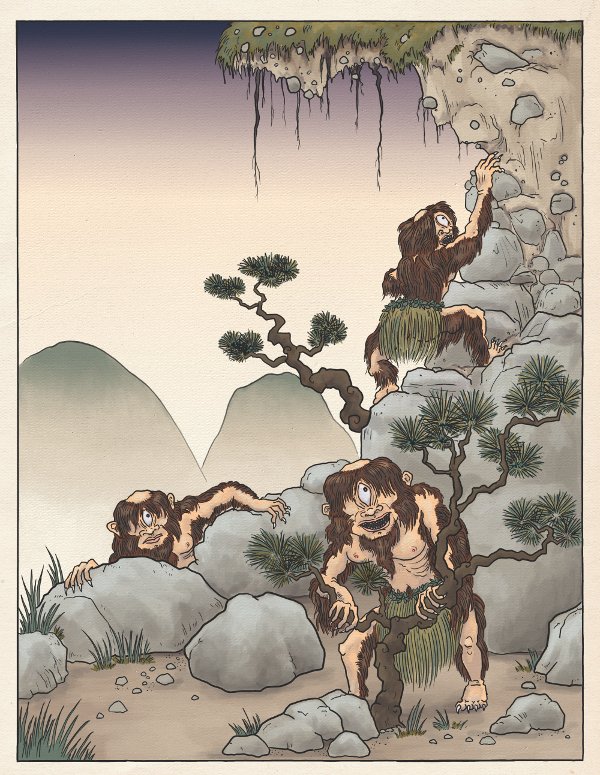
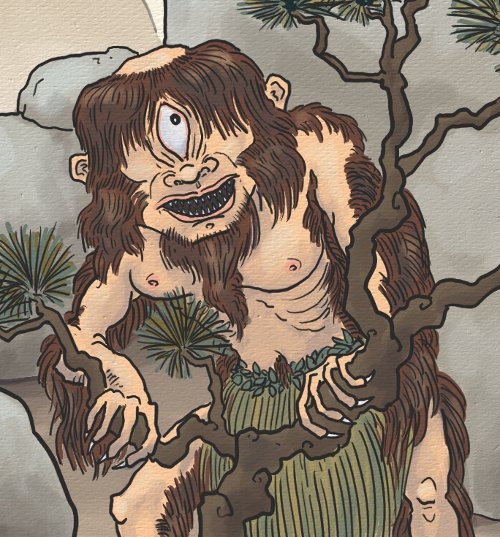
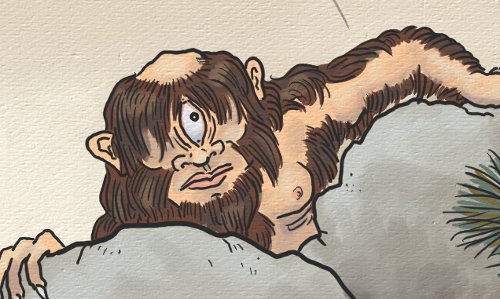
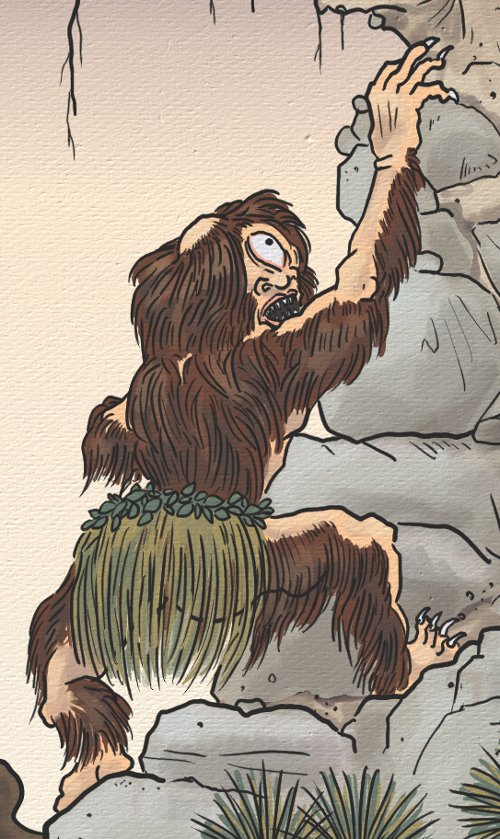
All the Kappa we previously looked at are summertime spirits. Every year on the fall equinox they perform a mass migration into the mountains, transforming into one-eyed hairy beasties the size of small children as they go. They live in this form as Yamawarawa for the whole winter, and return back to the rivers in another mass migration that takes place on the spring equinox.

Anyone unlucky enough to be caught in the middle of this massive migration is in for a nasty surprise. Yamawarawa hate to be spied upon, and they might viciously slaughter anyone they suspect of peeping on them. Any houses unlucky enough to be in the way of the migration are torn apart by the masses of monsters coming down the mountains, angry that someone had the gall to put up an impediment to their journey.

Yamawarawa

Yamawarawa

Yamawarawa detail 1

Yamawarawa detail 1

Yamawarawa detail 2

Yamawarawa detail 2

Yamawarawa detail 3

Yamawarawa detail 3

Happy 4th of July! (and a Yokai)

Like every good expat, I do my best to celebrate the 4th of July every year. Fortunately, in Japan, it’s very easy to get fireworks and have outdoor barbecues. Today we had one heck of a downpour that lasted most of the day, so it was no time to be outdoors celebrating, unfortunately. But my wife and I did manage to go out to eat and have a small happy 4th. Even though it was too rainy to light fireworks, I managed to paint some today instead:

Nekomata

Nekomata

This is Nekomata, an evil cat-yokai. It has two tails and all sorts of magic powers, such as the ability to create fireballs, change its shape, and even puppet the dead like some kind of necromancer. They often devour their masters and run the house in place of them, shapeshifting into human form whenever suspicion might be aroused.

Fireworks are a big thing in Japan, and most towns have a few fireworks festivals over the summer. The best time to see them is right now — July and August are the big summer holiday months, full of festivals, parades, outdoor markets, and all sorts of celebratory goodness. A bunch of the yokai in this book will feature festival scenes, this one included. Stay tuned for more!

Night Parade Preview: Garappa

Today’s heat was deadly!! The rainy season can be awful, but this year’s weather seems especially hot and humid.

Today I took my art class down to the riverside for the final class of the summer. (July and August are just too hot to paint outside.) The river was so cool and inviting! The water was crystal clear with an emerald blue tint to it, visible all the way to the rocky bottom. Big and small fish were swimming in it, and herons, swallows, and other birds were flying around and splashing in the shallows. I waded in up to my feet, and it felt so nice.

More than anything else, I wished I were a Garappa today. Garappa are very similar to Kappa — closely related cousins, actually. They live on the island of Kyushu, and resemble Kappa in appearance and behavior, except that Garappa have much much longer legs and arms than Kappa. I would have loved to dive into the river head first and just drink in all that fresh mountain water.

Garappa

Garappa

Night Parade Preview: The Hyousube

Today I bring you another sneak peak at some of the artwork in my upcoming book, The Night Parade of One Hundred Demons. Today we take a look at the Hyousube!

Hyosube

Hyousube

Hyousube detail 1

Hyousube detail 1

Hyousube detail 2

Hyousube detail 2

As you may remember from my last hyousube post way back a couple years ago, they are huge eggplant enthusiasts. They are also extremely violent and nasty! If you should happen to catch a hyousube picking at your eggplant patch, look away and pretend you didn’t see anything — if the hyousube catches you spying on him, he will curse you with a deadly illness that turns your whole body purple and kills you the following day. (And really, you should have properly made a sacrifice of eggplants to the hyousube instead of forcing them to come all the way from the river to your patch just to get a meal!)

The Night Parade of One Hundred Demons

For many weeks now I’ve been alluding to a project I am working on, but I didn’t want to go into too much detail until I reached a certain point in the project. I’ve finally reached that point, and I am excited to announce my Very-Big-Project-That-Until-Now-I-Couldn’t-Talk-About-And-Is-The-Reason-Why-I-Haven’t-Posted-Much-Art-On-My-Website-This-Year!

I am making a book about yokai! It will be an illustrated field guide to yokai, and it will also other supernatural Japanese beasties. It will be fully illustrated, full color, and choc-a-block full of awesome information about these creatures, which I have been researching for a long time now. The book is tentatively titled The Night Parade of One Hundred Demons, which as you may know was the title of one of yokai master Toriyama Sekien’s yokai anthologies. One hundred, so yes, there will be 100 yokai in this book. In fact, a little more than that. And that means 100 full-page, color illustrations! There will be text and descriptions accompanying each yokai, but the main focus of the book will be the artwork. I am hoping to make this the most comprehensive and the most beautiful collection of yokai ever published in English. Some of the images will be cute, some will be grotesque. I am trying to present the yokai as they are described in tales, rather than in contemporary popular culture. That means there is some violence, some sex, and so on. It won’t be a kid’s book, but it won’t be rated R either.

I spent the entire first quarter of this year collecting stories from books, the internet, and (the most fun part) native Japanese who remember the stories from when they were children, translating them into English, and trimming them down to single-page tidbits that give a nice overview of each yokai. The 2nd quarter of the year was spent drawing, designing, and doing layout for the book, until I had a fairly complete working manuscript. Now, that the third quarter is starting, I am starting the biggest part of this project: painting all of the pictures!

You’ll see some similarities between this project and my A-Yokai-A-Day series, including many of the yokai. Almost all of the yokai I’ve presented on this website will be in the book, with new illustrations accompanying them (as you can see with the Kappa below). Of course, I haven’t shown nearly 100 yokai on this site, so you will get to see a large number more yokai that most people have never seen or heard of before (including many of the Japanese people I have talked to). Later on I will post a list of all the yokai included in the book.

In a few more weeks I will also be launching a Kickstarter funding project to help with the cost of publishing it (not to mention to cost and time involved in making it). There will be a number of patronage levels, starting from $1 on upwards, each one with specific rewards as a way to say thank you for your support. In the meantime, I will be posting updates on the book here on my blog, and on my Facebook page.

For now, here is a little preview of what the interior art will look like. The Kappa, one of Japan’s most famous and most loved yokai. I said there would be some blood, and here is a good example. The Kappa, while one of Japan’s favorite yokai, especially among children, is not at all the cute little rapscallion that most people know him as. In older folklore, they hunt and eat humans, rape women, and murder horses and cattle. Their favorite food is raw, bloody, human anuses. So be careful!

Kappa

Kappa

And some up-close details of the artwork:

Kappa detail 1

Kappa detail 1

Kappa detail 2

Kappa detail 2

Kappa detail 3

Kappa detail 3

I hope you enjoy these! And stay tuned for more updates on this book, especially for the Kickstarter project! I guarantee it will be worth becoming a patron of this project! 🙂

2010 A-Yokai-A-Day Lineup

I’ve been enjoying my return to a normal sleeping pattern and 3 meals a day, and this past week has been so relaxing compared to the previous month! But I almost got carried away with my leisure and forgot that I have a website to maintain! I’ll post a few updates with new artwork and photos of some cool local places this week, but for now, for your viewing pleasure, I thought I would do a month-in-review post just to have easy access to all of the yokai. I realize it can be a bit of a pain to scroll through pages of my blog looking for the yokai you want to read about. (Hmmm… now that I have a bit of free time maybe I can do some site design…)

Also, the Japanese translations of the yokai are still being worked on, so please be a bit more patient if you’re waiting for them! A couple of the posts got to be so long-winded that translating them is proving much more difficult!

Isonade Mujina (with a Noppera-bo) Kawauso Baku Bake-kujira
Ushi-oni Hou-ou Kirin Seiryuu Genbu
Suzaku Kodama Otoroshi Tengu Kijimuna
Keukegen Gagoze Nure-onna Sessho-seki and Hoji Kage-onna
Kerakera-onna Taka-onna Ubume Hari-onago Ao-nyoubou
Ame-onna Hanako of the Toilet Otsuyu
Onibaba Okiku Oiwa

Matted, fine art prints of each of these images are available from my Etsy page, and some of the originals are still available. If you’re interested in one of the originals, please send me an email using the contact form.

I will continue to paint more yokai throughout the year, though not on a daily basis, so remember to keep checking back here, or you can subscribe to my site via RSS, Facebook, or Google Friend Connect.

A-Yokai-A-Day: Oiwa (The Ghost Story of Yotsuya)

We’ve made it! The final A-Yokai-A-Day painting for October 2010! For Halloween I wanted to present something special. Today I bring you the story of Japan’s scariest and most famous ghost of all time! Tokaido Yotsuya Kaidan, the Japanese name of this story, is by far the most popular, most well known, and most terrifying of Japan’s ghost stories. It is a tale of love, betrayal, murder, and revenge. Despite its age, Yotsuya Kaidan makes even today’s ghost stories seem a timid. The ghost story was created by combining and adding some fiction to two contemporary real-life murder stories and adapting them into a single kabuki show. (The first involved two servants who had murdered their respective masters; they were caught and executed on the same day. The second murder was from a samurai who discovered his concubine was having an affair with a servant; the samurai had the faithless concubine and servant nailed to a wooden board and thrown into the Kanda River.) The show became an instant success and went down in history as Japan’s most popular play ever. Since then it has been reproduced into every form of media imaginable, including over 30 movies. Not only that, the influence of the story on Japan’s culture was so strong that every Japanese ghost story since has borrowed from the powerful imagery and mythology in this story, and you can see its direct influence in today’s well-known ghost stories like Ju-On/The Grudge and Ringu/The Ring and their many spin-offs. Even Chinese, American, and other countries’ ghost stories are now taking their imagery from Yotsuya Kaidan (indirectly via the Japanese hit movies which were inspired by it).

Oiwa (The Ghost Story of Yotsuya)

A long time ago in the area of Tokyo known as Yotsuya there was a masterless ronin samurai named Iyemon. He wished to marry a beautiful woman named Oiwa, but her father, Samon, had heard of Iyemon’s past misdeeds and refused to allow him to marry his daughter. Iyemon’s servant Naosuke also wished to marry Oiwa’s sister Osode, who was unfortunately already married to a man named Yomoshichi. So Iyemon and Naosuke conspired to murder Oiwa’s father and his servants, and Osode’s husband. In order to win Oiwa’s and Osode’s marriages, they claimed that a local bandit had done the killings and promised that they would avenge their deaths. The women agree to marry them.

Time passes, and Oiwa bears Iyemon a son. But she grows sickly and weak after giving birth and never completely recovers. Iyemon is forced into lower work in order to support his family, and he grows to strongly resent his invalid wife. Soon, Iyemon falls in love with another woman, Oume, who is the granddaughter of a rich doctor. Iyemon schemes to murder his wife with Oume, and Oume recieves some poison from her grandfather, and gives it to Iyemon who in turn delivers it to Oiwa, telling her that it will make her stronger. Oiwa takes the medicine and grows weaker and weaker, but it does not kill her. Rather, it disfigures her face, causing her eye to sag her skin to scar over and bleed, and her hair to fall out in bloody clumps.

Meanwhile, Naosuke and Osode are married, but despite his numerous advances, she keeps refusing his attempts to consummate the marriage.

Iyemon, grown disgusted by Oiwa’s mangled face, then bribes a local man named Takuetsu to rape Oiwa so that Iyemon will have grounds to divorce her. Takuetsu attempts to do so, but is unable due to the way she looks. Instead, he shows Oiwa her own reflection in a mirror, and Oiwa grows furious. She rushes to kill Takuetsu with a sword, and he tries to block her. Oiwa trips and cuts her own throat open with the sword. Bleeding to death, she kills her infant son so that he will not be raised by Iyemon, and she curses her husband’s name with her dying breath. One of Iyemon’s servants, Kohei, becomes aware of the murder. To silence Kohei, Iyemon murders him, and nails the bodies of Oiwa and Kohei to a board, and drops them into a river. He claims the two were having an affair, and he is released from his marriage.

Iyemon and Oume arrange to be married. On their wedding night, Iyemon sees a vision of Oiwa’s ghost. He slashes at her, cutting off her head, but then the vision clears and he realizes he has just murdered his new wife Oume. Terrified, he rushes to his new father-in-law’s house, where he sees a vision of Kohei. He attacks his ghost as well, and ends up murdering his father-in-law too.

Iyemon then works to purge his now-dead second wife’s family, throwing his mother-in-law into a canal, and drowning their servants. His friend Naosuke continues to pressure Osode to consummate the marriage, but she oddly continues to refuse. Around that time, Yomoshichi returns, having not actually been killed, and accuses Osode of adultery. She is shamed, and resigns to an honorable redemption in death. She begs her two husbands to kill her, and they gladly oblige. Her final act, though, is to leave a note to her husband Naosuke informing him that she was actually his own younger sister. Shamed, Naosuke commits suicide as well — but not before Yomoshichi acquires damning evidence against Iyemon from him.

Meanwhile, Iyemon flees, constantly pursued by the ghosts of the people he has killed. Oiwa’s ruined face follows him everywhere, even appearing (famously) in a paper lantern. He flees to the mountains, but when he goes fishing, instead of fish, he pulls out the board with Oiwa’s and Kohei’s bodies nailed to it. He flees to a cabin, where the vines from the trees and the smoke from the fire transform into Oiwa’s hair and try to ensnare him.

Finally, Iyemon flees his cabin, having lost his mind and descended into madness as his nightmares become his reality. He runs into Yomoshichi, who slays Iyemon out of both pity and vengeance.

Her story doesn’t end there, though. She continues to haunt even today. From my post on onryo last year you may remember that Japanese ghosts, unlike Western ghosts, don’t go away after they are put to rest. There is generally no end to their haunting. And Oiwa, being the most horrible ghost in Japan is certainly no exception.

Oiwa’s body is buried at a temple (Myogo-ji) in Sugamo, Tokyo, and the date of her death is listed as February 22, 1636. There have been numerous reports of accidents, injuries, and even deaths surrounding productions of the play Tokaido Yotsuya Kaidan, and even during TV and movie productions of the story. As a result, there is said to be a famous curse that touches anything and everything related to this story (like the MacBeth curse, only worse). Nowadays, it is customary before starting any movie or TV show that even talks about Oiwa’s story for the principal actors and the director to make a pilgrimage to Oiwa’s grave and ask her permission to perform and for her blessing for their production. Imagine if  you were supposed to play the role of Oiwa!! (Incidentally, I did not go to Tokyo prior to writing this, so if anything happens to me in the coming days…)

Oiwa (The Ghost Story of Yotsuya)

Oiwa

There you have it, the number one ghost story in Japan! I hope it makes your Halloween a special one!

Okiku is the final yokai in this year’s A-Yokai-A-Day series. But that doesn’t mean I am done painting yokai! I will continue to paint and post yokai throughout this next year. I am now working on an illustrated book of yokai which will include a number of yokai from my A-Yokai-A-Day projects, as well as additional ones I have not yet posted. So stay tuned for more information on that! Remember, you can subscribe to my site via RSS feed, Facebook, Google Friend Connect, or by following @matthewmeyerart on Twitter to stay on top of all of my artwork and blog posts.

Finally, starting tomorrow, the remaining yokai from this series will become available on my Etsy store. You can help support the project as well as own a very special piece of Japan in your own home by visiting osarusan.etsy.com.

Have a Happy Halloween, and thanks so much for clicking back here every day this month!