A-Yokai-A-Day for the Month of October: Mujina | 今日の妖怪:ムジナ

Fall here in Hokuriku is as beautiful as anywhere on Earth, but there is one thing that, at least for me, makes it especially special. There is some kind of fragrance — whether it’s a flower or a tree, or a special kind of incense coming from the many temples here in Takefu, I have no idea — a sweet and fresh smell that lingers all over in the air. It only lasts for a few weeks from the end of September throughout some of October. When I was riding my bike through town to get to aikido earlier, the smell was so enthralling and entrancing that I could have ridden down that rode forever — or at least until it went deep into the mountains. It’s a good thing I didn’t, though, for I might have run into today’s yokai:

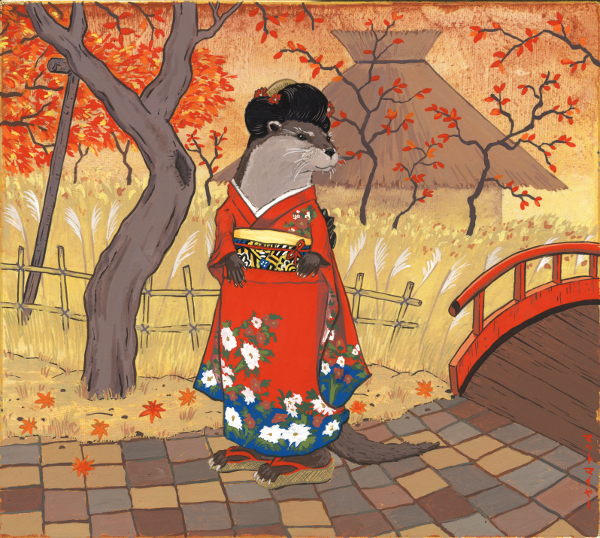
Mujina

There are a number of yokai based on real animals. You may remember the tanuki and the kitsune from last year’s A-Yokai-A-Day. Today’s yokai is another. Mujina is a Japanese name for the badger; although today badgers are usually called anaguma. In Japanese folklore, the badger is a magical animal with shapeshifting abilities and a penchant for playing tricks on humans. They’re not malevolent, but neither are they benevolent. Sometimes they do good, and sometimes they do very bad things, but most of the time they just like the screw with us pathetic humans.

At least in English, the mujina is often associated with the noppera-bo, which you may also remember from last year. This is because of a famous folktale transcribed by the famous Lafcadio Hearn, a folklorist from a century ago who collected and translated many of Japan’s folklore and customs, and is one of the most famous foreigners-turned-Japanese. Hearn told the tale of the noppera-bo, but in his story he refers to the monster as a mujina. It’s possible that when he was told the story, the noppera-bo was actually a shapeshifted mujina, or perhaps it was a human transformed by a mujina’s magic. (I’ve read in other places that mujina are fond of taking the form of faceless people, and are known for turning people into noppera-bos when it suits them, but those may also just be the result of Hearn’s mistranslation.) In any case, I don’t think I would want to get on the bad side of a badger — magical or not.

Mujina (with a Noppera-bo)

Mujina (with a Noppera-bo)

Matted prints will be available on my Etsy store pretty soon, so please check back again later this week. If you’re interested in buying the original, please send me an email via my contact form.

Mujina, by Lafcadio Hearn
from Kwaidan (1904)

On the Akasaka Road, in Tôkyô, there is a slope called Kii-no-kuni-zaka, — which means the Slope of the Province of Kii. I do not know why it is called the Slope of the province of Kii. On one side of this slope you see an ancient moat, deep and very wide, with high green banks rising up to some place of gardens; — and on the other side of the road extend the long and lofty walls of an imperial palace. Before the era of street-lamps and jinrikishas, this neighborhood was very lonesome after dark; and belated pedestrians would go miles out of their way rather than mount the Kii-no-kuni-zaka, alone, after sunset.

All because of a Mujina that used to walk there.

The last man who saw the Mujina was an old merchant of the Kyôbashi quarter, who died about thirty years ago. This is the story, as he told it :—

One night, at a late hour, he was hurrying up the Kii-no-kuni-zaka, when he perceived a woman crouching by the moat, all alone, and weeping bitterly. Fearing that she intended to drown herself, he stopped to offer her any assistance or consolation in his power. She appeared to be a slight and graceful person, handsomely dressed; and her hair was arranged like that of a young girl of good family. “O-jochû,” he exclaimed, approaching her,— “O-jochû, do not cry like that!… Tell me what the trouble is; and if there be any way to help you, I shall be glad to help you.” (He really meant what he said; for he was a very kind man.) But she continued to weep,— hiding her face from him with one of her long sleeves. “O-jochû,” he said again, as gently as he could,— “please, please listen to me! … This is no place for a young lady at night! Do not cry, I implore you!— only tell me how I may be of some help to you!” Slowly she rose up, but turned her back to him, and continued to moan and sob behind her sleeve. He laid his hand lightly upon her shoulder, and pleaded:— “O-jochû!— O-jochû!— O-jochû!… Listen to me, just for one little moment!… O-jochû!— O-jochû!”… Then that O-jochû turned round, and dropped her sleeve, and stroked her face with her hand;— and the man saw that she had no eyes or nose or mouth,— and he screamed and ran away.

Up Kii-no-kuni-zaka he ran and ran; and all was black and empty before him. On and on he ran, never daring to look back; and at last he saw a lantern, so far away that it looked like the gleam of a firefly; and he made for it. It proved to be only the lantern of an itinerant soba-seller, who had set down his stand by the road-side; but any light and any human companionship was good after that experience; and he flung himself down at the feet of the old soba-seller, crying out, “Aa!— aa!!— aa!!!“…

Kore! Kore!” roughly exclaimed the soba-man. “Here! what is the matter with you? Anybody hurt you?”

“No— nobody hurt me,” panted the other,— “only… Aa!— aa!“…

“— Only scared you?” queried the peddler, unsympathetically. “Robbers?”

“Not robbers,— not robbers,” gasped the terrified man… “I saw… I saw a woman— by the moat;— and she showed me… Aa! I cannot tell you what she showed me!”…

He! Was it anything like THIS that she showed you?” cried the soba-man, stroking his own face— which therewith became like unto an Egg… And, simultaneously, the light went out. | 「今日の妖怪シリーズ」、今日は「むじな」です。

昨年の「今日の妖怪シリーズ」で狸や狐を描きましたが、今回も動物がベースになっている妖怪です。

「むじな」とは、現在はアナグマと呼ばれている動物です。人間をだまし、化けることもできますが、大変ひどい妖怪ではありません(やさしくもありませんが)。時々いいこともしますが、弱い人間にいじわるをするなど悪いこともよくします。

英語では、「むじな」はラフカディオ・ハーンさんの翻訳によって、「のっぺらぼう」と関連して知られています。「のっぺらぼう」も昨年の「今日の妖怪シリーズ」で描きましたので、ギャラリーの中から探してみてくださいね。ハーンさんによると、ムジナはのっぺらぼうに化けることができ、また人間をのっぺらぼうに変えてしまうこともできるそうです。怖いですね。

ムジナ

ムジナ

「むじな」の絵は私のEtsyストアでもうすぐ購入が可能になります。オリジナルの「むじな」の購入がご希望でしたら、こちらのお問い合わせフォームからご依頼をおねがいします。世界に1枚のオリジナルですので、売れてしまう場合もございますのでご了承をお願いいたします。

Mujina, by Lafcadio Hearn
from Kwaidan (1904)

On the Akasaka Road, in Tôkyô, there is a slope called Kii-no-kuni-zaka, — which means the Slope of the Province of Kii. I do not know why it is called the Slope of the province of Kii. On one side of this slope you see an ancient moat, deep and very wide, with high green banks rising up to some place of gardens; — and on the other side of the road extend the long and lofty walls of an imperial palace. Before the era of street-lamps and jinrikishas, this neighborhood was very lonesome after dark; and belated pedestrians would go miles out of their way rather than mount the Kii-no-kuni-zaka, alone, after sunset.

All because of a Mujina that used to walk there.

The last man who saw the Mujina was an old merchant of the Kyôbashi quarter, who died about thirty years ago. This is the story, as he told it :—

One night, at a late hour, he was hurrying up the Kii-no-kuni-zaka, when he perceived a woman crouching by the moat, all alone, and weeping bitterly. Fearing that she intended to drown herself, he stopped to offer her any assistance or consolation in his power. She appeared to be a slight and graceful person, handsomely dressed; and her hair was arranged like that of a young girl of good family. “O-jochû,” he exclaimed, approaching her,— “O-jochû, do not cry like that!… Tell me what the trouble is; and if there be any way to help you, I shall be glad to help you.” (He really meant what he said; for he was a very kind man.) But she continued to weep,— hiding her face from him with one of her long sleeves. “O-jochû,” he said again, as gently as he could,— “please, please listen to me! … This is no place for a young lady at night! Do not cry, I implore you!— only tell me how I may be of some help to you!” Slowly she rose up, but turned her back to him, and continued to moan and sob behind her sleeve. He laid his hand lightly upon her shoulder, and pleaded:— “O-jochû!— O-jochû!— O-jochû!… Listen to me, just for one little moment!… O-jochû!— O-jochû!”… Then that O-jochû turned round, and dropped her sleeve, and stroked her face with her hand;— and the man saw that she had no eyes or nose or mouth,— and he screamed and ran away.

Up Kii-no-kuni-zaka he ran and ran; and all was black and empty before him. On and on he ran, never daring to look back; and at last he saw a lantern, so far away that it looked like the gleam of a firefly; and he made for it. It proved to be only the lantern of an itinerant soba-seller, who had set down his stand by the road-side; but any light and any human companionship was good after that experience; and he flung himself down at the feet of the old soba-seller, crying out, “Aa!— aa!!— aa!!!“…

Kore! Kore!” roughly exclaimed the soba-man. “Here! what is the matter with you? Anybody hurt you?”

“No— nobody hurt me,” panted the other,— “only… Aa!— aa!“…

“— Only scared you?” queried the peddler, unsympathetically. “Robbers?”

“Not robbers,— not robbers,” gasped the terrified man… “I saw… I saw a woman— by the moat;— and she showed me… Aa! I cannot tell you what she showed me!”…

He! Was it anything like THIS that she showed you?” cried the soba-man, stroking his own face— which therewith became like unto an Egg… And, simultaneously, the light went out.

A-Yokai-A-Day for the Month of October: Isonade | 今日の妖怪:磯撫で(いそなで)

Today was a busy day! I woke up early to do a cable TV interview at my studio, and it ended up taking 4 hours to finish. And all the rest of my day was spent doing this very detailed painting! I was worried I wouldn’t finish by midnight, and on the very first yokai of the month! But I managed to finish up with 30 minutes to spare. So without further ado, I bring you:

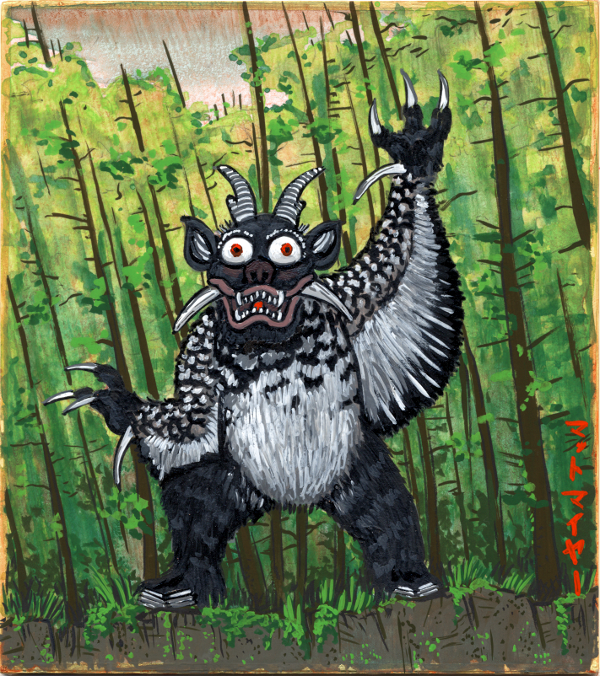
Isonade

Our first yokai of the month comes from Kyushu, the third largest island of Japan, and the most southwesterly of the main four islands (excluding Okinawa). Isonade, whose name means “beach stroker” in English (and although it sounds like some of kind of summertime criminal pervert, the actual monster is much scarier than that), is a huge shark-like sea monster with barbed iron hooks on its tail which it uses to snatch sailors off of ships or to sink boats. It also uses its tail to strike the beach and snag people there as well, which is most likely where it got its name from.

If we were to analyze the myth, it might have originated due to the fact that Kyushu and the southern coast of Japan are highly vulnerable to typhoons and summer storms, which were be very destructive to ancient boats (there are stories of entire navies being swallowed up by the sea in Japanese history), which could have been responsible for the disappearance of sailors, swimmers, or even entire boats. Or who knows, there could be an actual giant, iron-barbed, man-eating shark-monster in the waters off of southwestern Japan!

Enjoy!

磯撫で

Isonade, the beach stroker

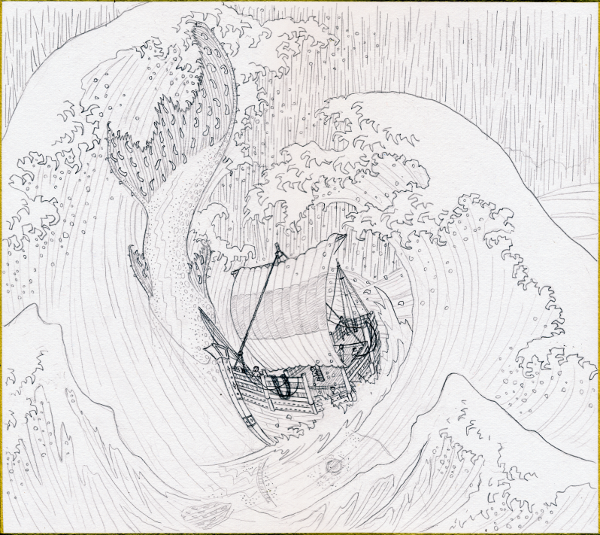
Isonade sketch

...and the image before painting, just for fun!

Isonade prints will be available on my Etsy store soon. Check back again later this week! If you’re interested in buying the original, please send me an email via my contact form. | 10月です!

今日の妖怪シリーズが今年も始まりました。10月はハロウィーンの月で、私の一番好きなシーズンです。ハロウィーンにちなんで、日本ならではの妖怪を毎日1枚ずつ描いていく企画です。昨年もやりましたが、世界各国から大変な反響がありました。

さて、「今日の妖怪」1日目は 「磯撫で(いそなで)」です。

磯撫では、形は鮫に似ており、尾びれには船を襲う針がある九州につたわる妖怪です。
海で人を襲う妖怪ですが、襲い方はとても怖いです。海に出ている船にゆっくりと、海を撫でるように近づき、一気に尾びれの針で人を襲います。

人間にしてみれば、のんびり漁をしていて、気がつくと巨大な尾びれが襲い掛かってくるというものですね。

一説によると、九州付近に頻発していた台風などによって古い船が壊され死体が浜辺に打ち上げられることからこの妖怪が創造されたともありますが、誰も見てはいないのでわからないですね。もしかしたら巨大なモンスターが海に潜んでいるのかもしれません・・・

それでは、今日の妖怪「磯撫で」を楽しんでください。

磯撫で

磯撫で

磯撫でのスケッチ

磯撫でのスケッチ

「磯撫で」の絵は私のEtsyストアでもうすぐ購入が可能になります。オリジナルの「磯撫で」の購入がご希望でしたら、こちらのお問い合わせフォームからご依頼をおねがいします。世界に1枚のオリジナルですので、売れてしまう場合もございますのでご了承をお願いいたします。

Announcing: A-Yokai-A-Day for the Month of October (2010 Edition)

The other big thing I’ve been working on is preparing for the (drumroll) A-Yokai-A-Day project! For the entire month of October, I will complete a full illustration of one of Japan’s folkloric yōkai. Yokai are to Japan what the boogeyman, Bloody Mary, the Sandman, elves, fairies, bugbears, trolls, and ghosts are to Americans and Europeans. They run a whole range of styles and types, from cute and cuddly to vengeful, grotesque, and horrifying. And while many of them come from ancient superstitions and tales, their influence pervades Japanese culture all over — in art, in decorations, and even in Pokemon, many of which are taken straight out of the pages of folklore. There’s a lot of fun information on yokai on their Wikipedia entry, The Obakemono Project, as well as from Mizuki Shigeru, Japan’s most famous yokai expert/manga artist. Many of Japan’s famous woodblock printers and painters have also left us their own visions of yokai over the centuries, but those are a little harder to find.

Last year’s project was so much fun that I couldn’t resist revisiting it. It was inevitable anyway, as the fall weather and feeling of Halloween approaching forces my mind to dwell on ghosts and goblins and spooky things like that, so it’s only natural to want to paint those things. Compared with last year, my schedule is much fuller this October, so I’ve been spending parts of the last week and a half drawing up my battle plan to tackle this big project again. Last year I was a bit freer and so I chose whatever yokai I felt like drawing that particular day, starting with the research. This year, I’ve done my research beforehand and made up a daily yokai schedule so all that remains is to draw and paint the beasties.

There will also be a slightly different thematic element this year. Last year I started with tamer yokai and gradually moved up to scarier ones as it got closer to Halloween. This year I’ve broken it down into three sections: the first 10 days of the month I will be doing paintings of animal-like yokai; the second 10 days will feature slightly more wild and monstrous yokai; and the final part of the month is reserved for everybody’s favorite kind of yokai — haunted girls. No, I’m not a misogynist — you can blame the Japanese for the fact that there are so many evil women in their folklore — but the scary stories featuring women as the antagonists are by far the most interesting and scariest. Just look at the way Japanese horror movies have transformed the way ghosts are depicted all over the world in recent years. And then, there’s the fact that out of last year’s paintings, the ones I did of scary girls were immensely more popular than the others, and after all I do need to make a living here.

Anyway, A-Yokai-A-Day begins on October 1st, so get the kids, tell your friends, bookmark this page, and please share the link to the project (http://matthewmeyer.net/blog/tags/a-yokai-a-day) on Facebook, Twitter, and anywhere else! Help me get the word out!

And stay tuned for the first yokai on October 1st!

Bonus Near Year’s Yokai: Byakko | 明けましておめでとうございます

Here’s a special holiday treat for you: a bonus yokai!

This is Byakko, the white tiger. It’s got a lot of cultural significance in Chinese astrology (which was imported to Japan from China, like many things). I’m not familiar with any particular stories or myths about Byakko, other than that it represents the west in Chinese astrology.

This picture will be our New Year’s card, or nengajo. It seemed a sin, being an artist, to just buy ordinary New Year’s card, particularly because nengajo are kind of the equivalent of the “Christmas letter” which many families in the US send. They’re not as long, being a postcard rather than many sheets of printed out paper on corny stationery, but they often have photos of the kids or the family, updates, and things like that. So ours will be entirely void of valuable information and instead just be a giant white tiger. Oh yeah, and 2010 is the Year of the Tiger, which is why I picked Byakko. So there you go.

Byakko

Byakko

ハッピーニューイヤー!

今月、もう一枚妖怪の絵を描きました。来年は寅年なので、白虎を描きました。

皆さん、良いお年を迎えて下さい!

来年の一月に、日本の神様の絵を描く予定です。

来年もよろしくお願いします。

2009 A-Yokai-A-Day Line-Up | 今日の妖怪シリーズ

Get ’em while they’re hot!

The yokai are all being posted to my Etsy store, http://osarusan.etsy.com. They will be available as high quality, archival fine art prints, matted and mounted on acid-free board, just like my other Etsy prints. There will also be special deals for buying 10 yokai prints, or the entire set.

Nurarihyon Hyosube Zashiki-warashi Usu-tsuki-warashi Azuki-arai
Kamaitachi Kitsune Kappa Rokurokubi Hitotsume-kozo
Kamikiri Jubokko Tanuki Umibozu Yuki-onna
Yama-uba Akaname Futakuchi-onna Kuchisake-onna Dorotabo
Ohaguro-bettari Gashadokuro Noppera-bo Jorogumo Basan
Wanyudo Ningyo Nuppeppo Hone-onna Onryo
Hyakki Yako (panel 1)
Hyakki Yako (panel 2)
Hyakki Yako (panel 3)
Hyakki Yako (panel 4)
Hyakki Yako (panel 5)

Anyone interested in buying one of the original paintings should contact me by email.

2009年10月、ハロウィーンの月に毎日異なった種類の妖怪をシリーズで描きました。こちらが全57種類の妖怪です。これらの絵のプリントは、私のEtsy store — http://osarusan.etsy.com — で買うことができるようになりました。 これらのプリントは、マットが付いている状態で送られます。10枚セットか又はフルセットで割引があります。

A-Yokai-A-Day for the Month of October: Hyakki Yako

The final yokai of the month is actually more than one yokai. This is Hyakki Yako, the Night Parade of 100 Yokai. Every year, all of the yokai parade through the streets during summer nights. Anybody unfortunate to come across this supernatural procession will die, unless they have been specifically protected with magical charms.

Obviously 100 yokai is too many to paint in one day. I decided, for the sake of time, just to do 5 panels of yokai, with 27 more yokai. Unfortunately, I was called in to work on Saturday for 7 hours, so I lost a huge chunk of my painting time. I worked all night, painting like a demon, and I almost finished them all before midnight EST, but I need another 2 hours or so to finish the final touches. But I promised yokai on Halloween, and it wouldn’t be a-yokai-a-day if there weren’t a yokai today… so here are five:

Hyakki Yako (panel 1)

Hyakki Yako (panel 1)

I will post the remaining 4 panels just as soon as I finish the final touches, but right now I need a shower and a nap badly. I’ll update this post in a few hours with the others. They should be up before noon on November first, along with their names.

Happy Halloween!

~Update:

Well, as soon as I finished them, my internet access went down, so I wasn’t able to upload them last night. But here they are, only slightly late due to situations beyond my control… Acts of Yokai, perhaps?

The yokai in panel one are (from right to left) Tengu, a very famous, wise, and powerful bird-goblin; Kawauso, a river otter which, like many animals in Japan, develops magical powers as it ages; Uwan, a harmless incorporeal monster that lives in temples and shouts, “UWAN!” just to screw with people; Nekomata, a kind of ghost cat who develops magical powers after tail has grown long even to fork in two, giving it magical powers including creating fireballs, shapeshifting, and reanimating corpses; and Tesso, a cursed monk who tranformed into a swarm of rats and laid waste to an enemy temple.

Hyakki Yako (panel 2)

Hyakki Yako (panel 2)

Panel two contains a class of yokai known as Tsukomogami — household items which become conscious and magical after a long time, usually 100 years. Generally they are harmless, animate spirits, but there are exceptions to that rule. This procession starts with Bakezori, a sandal; Karakasa, a paper umbrella; Chochinobake, a paper lantern; Ittan-momen, a roll of cotton cloth — this one is a little more malicious than the others, often attacking humans by wrapping them up and smothering them; Biwa-yanagi, from a kind of musical instrument called a biwa; Furu-utsubo, an old archer’s quiver; and Morinji-no-okama, a tea kettle.

Hyakki Yako (panel 3)

Hyakki Yako (panel 3)

Panel 3 is full of more monstrous, animal-like yokai. The leader of this procession is Aosagibi, a glowing blue heron which flies at night, appearing as a fireball; Kirin, the famous unicorn-like-dragon-like-lion-like-horse-thing found throughout East Asia. In Japan the kirin is the most powerful of all spirits, ranking above dragons and phoenixes. It’s also famous for the brewery of the same name, which makes my favorite beer, Akiaji (my nurarihyon was drinking it too); Baku, another chimeric monster composed of bear, rhino, cow, elephant, and tiger parts, who devours dreams and preys on the spirits of the diseased and plague-ridden; and Ushi-oni, a demon bull which comes in many varieties — this one being the head of an ox attached to a hairy, six-legged, spider-like body.

Hyakki Yako (panel 4)

Hyakki Yako (panel 4)

Panel four’s yokai are getting a little creepier, but not so horrible yet. The leader of this line is Abura-sumashi, the oil-presser, who is the ghost of a man who stole oil and is now cursed with a squat, straw-covered body and a potato-like head; Hyakume, a pretty self-explanatory monster whose named means “100 eyes”; Shokera, a monster who climbs on roofs and peers in through skylights on sleeping people, occasionally attacking them; Tsurube-otoshi, a giant, disembodied head which preys on travelers by dropping out of trees and devouring them; and Akashita, a hairy beast with a long, red tongue that hides in the clouds and guards floodgates.

Hyakki Yako (panel 5)

Hyakki Yako (panel 5)

Panel five has a couple of truly frightful yokai, though nothing as bad as the onryo from October 30th. The leader of this part of the parade is Nuribotoke, a corpse with popped-out eyes dangling by the optic nerve who crawls out of family Buddhist altars (remember to close the shrine at night!); Hitodama, a basic ghost which is pretty much identical to the English Will o’ the Wisp, a sometimes-malevolent soul embodied in a ball of light which likes to mislead people into danger in the night; Aoandon, the spirit who appears after the Hyakumonogatari Kaidankai, the Edo-era game of ghost-story telling in which 100 candles are lit and 100 ghost stories are told, each one progressively scarier — one candle is snuffed after each story until the final candle is extinguished, and this ghost appears. Sort of a Japanese Bloody Mary or Candyman; Harionago, a barbed-haired ghoul who appears as a beautiful lady with long hair done up. She walks the streets until she comes across a man, and then she laughs. If the man laughs back, she undoes her hair and then rips him to pieces with the hooked barbs on the end of each strand; Betobeto-san, and invisible yokai who walks the streets at night, following people with the sound of its footsteps — betobeto; and Nure-onna, an giant woman-headed snake, said to grow up to 300 meters long, who waits on the shore, washing her hair. She often carries a small bundle which looks like a child in an attempt to lure strangers to come and attempt to help her. After they pick up the bundle, it becomes incredibly heavy and prevents them from running away, after which the nure-onna uses her long, snake-like tongue to suck all the blood from their body. Sometimes she also works in consort with other sea monsters.

So there you have it! A grand total of 58 yokai throughout the month of October. It was a great pleasure painting these, and I think I could go on painting them forever. One a day was an incredibly pace to keep up, and it was worth it, but there’s only so much a painter can do in one day… I’m sure I’ll come back to yokai in the near future and paint some more detailed, full scenes instead of rushing to finish in one day. But in the meantime, I want to say thanks for keeping up with my site this month, and thanks for putting up with the snags I had on the final day of the project.

Finally, I hope you’ll keep coming back to see my art. You can bookmark my site, or my RSS feed, or fan me on Facebook to keep up with what I’m doing. And if you liked the yokai, you can support my art by buying prints on my Etsy store (I’ll be adding the yokai within the next few days).

Thanks for viewing! Stay tuned for my next painting!

Hyakumonogatari Kaidankai

A-Yokai-A-Day: Onryo

Anyone who has seen a few Japanese horror movies knows that today’s yokai is, bar none, the scariest of them all. True, Kuchisake-onna or Hone-onna might appear more grotesque — but they’re just one-trick-ponies compared to the terror that is the onryo. Immortalized in countless paintings, woodblock prints, and movies like The Ring and Ju-On, the onryo is Japan’s vengeful ghost. The look we see today — long black hair, piercing eyes, white skin and burial kimono — originated in ancient kabuki ghost stories, and is one reason why this ghost is so expressive.

Both Japanese and Western ghosts usually have a powerful motive for their vengeance. But what makes an onryo so much scarier than its Western vengeful spiritual counterpart is that, while the Western ghost ceases to haunt once it is put to rest, an onryo appears and never goes away. There’s no concept of justice in an onryo’s revenge; in many stories the ghost will terrorize a village, murdering hundreds of poor, innocent souls in the most unimaginable fashions, but she rarely takes revenge on the actual cause of her unrest (usually a nasty husband). If Scooby and the Gang went to Tokyo to solve a mystery, they’d no doubt pull the rubber mask off old farmer Jenkins, call it a night, and then die in a horrible freak Mystery Machine accident, their bodies flayed and twisted into physically indescribable forms.

Yokai

Onryo

There’s some confusion as to how to define yokai and bakemono in Japanese folklore, which one is a subset of the other, and whether or not yurei — ghosts — fit into either category or exist on their own. There doesn’t seem to be a clear definition of either term, but from my understanding of them I think that “yokai” is a pretty encompassing term that collectivizes all supernatural beings in folklore, Japanese and non-Japanese alike. Whether bakemono are a subset of that or just a related term, I don’t know, but I definitely think that yurei and their kin (like onryo and zashiki-warashi) fit in as a type of yokai, rather than stand alone.

Today’s yokai makes 30, and tomorrow is Halloween! Tomorrow will be my last yokai! Where do I go from the onryo, who made me lose so many hours of sleep?? Come back tomorrow to find out, and have a good Halloween! (And don’t be a jerk and pretend not to be home when the kids come trick-or-treating!)