A-Yokai-A-Day: How Ōno Dōkan Was Unfazed by Ayashimi

Tonight’s story deals with something called ayashimi. I chose not to translate this word, because it is vague even in Japanese. Ayashimi means something strange or mysterious, and doesn’t really refer to any specific type of monster or phenomenon. It’s written with the kanji 怪, which is one of the kanji found in the words 妖怪 (yokai) and 怪談 (kaidan). I think it carries with it a nice sound that works better and sounds more mysterious than simply translating it as “strange phenomenon.”

This story is another one that I find quite funny. Or at least absurd. Dōkan’s explanations and brushing off of these strange occurrences gives off some real “ackchyually” vibes. Especially how he just casually handles the revelation at the end.

How Ōno Dōkan Was Unfazed by Ayashimi

One day, a man named Ōno Dōkan went hunting. In the mountains, a single matsutake mushroom the size of an umbrella sprouted up in the path after Dōkan passed by. His servants saw this and were astonished, and called out to Dōkan.

Dōkan turned around and said, “There’s nothing strange about this. Matsutake mushrooms can grow to this size. Now if it had sprouted upside-down, that would be strange…”

He continued on his way, and ahead of him he saw on the path ahead another matsutake mushroom, growing upside-down.

His servants grew even more astonished, but Dōkan said, “Since I was just talking about them growing upside-down, there’s nothing strange about this either.” Then they returned home.

On the first day of the following year, the iron trivet in the hearth started to dance around the room. The servants were astonished and called out to Dōkan.

Dōkan said to them, “Humans walk about with just two legs, but a trivet has three legs, so there’s nothing strange about one walking around or dancing.” And he didn’t let it concern him at all.

However, in the summer of that year, his only daughter died. It occurred to him later that this may have been due to these mysterious phenomena.

A-Yokai-A-Day: Otohime of Ryūgū’s Infatuation with Igarashi Heiemon’s Son

Tonight’s story features a character who was popular in folklore throughout much of Japaense history: Otohime. She is the princess of the sea, daughter of the king of the sea, and technically also a dragon. The most famous story about her is the tale of Urashima Taro, but she is such a major figure in folklore that countless spin-off tales have been cooked up by people for hundreds of years. There are even books of what you could call Edo period “fan fiction” about her. So just by mentioning her name in the title of this tale, an Edo period reader would have known what this story was about, despite the fact that the text itself doesn’t mention her name or give any explanation as to why she does what she does. We already know that Otohime is a serpent, and that she has a thing for handsome young human men.

Speaking of Otohime, my newest book The Palace of the Dragon King is available on the yokai.com shop! This book is, like its predecessors, an illustrated encyclopedia of yokai; but this one has a special focus on aquatic yokai and an en entire chapter dedicated to the inhabitants of Ryugu, the castle that serves as home to Otohime and the oceanic royal family. Paperbacks, hardcovers, and collector’s editions are now available!

Otohime of Ryūgū’s Infatuation with Igarashi Heiemon’s Son

During the Genkyū era (1204-06), there was a rōnin in Kamisakamoto named Igarashi Heiemon, and he had one son. The boy was beautiful, with perfect features, and everyone was obsessed with him and constantly fought for his attention. His parents thought that this would be a burden on him, so they sent him up to Mt. Hiei to study.

One time the boy took a vacation to Karasaki, and while relaxing underneath a pine tree, a beautiful girl around 15 or 16 years old appeared out of nowhere and approached him.

She asked him, “Where are you from? I live near here, and I always come to this pine tree to relax. Come sit with me and watch the boats leaving from the north.”

The boy accepted her invitation, and joined the girl at the water’s edge. She seemed to cling to his sleeve, and then all of a sudden she turned into a serpent, wrapped around the boy seven times, and leaped into the sea. At that moment, the sky suddenly filled with dark clouds, heavy rain fell, and the sea became covered in white-crested waves.

A-Yokai-A-Day: The Incident at Nunobiki Falls, Settsu Province; or, The Pilgrims’ Poems

Tonight’s story is another one featuring snakes. This one was a struggle to translate because it contains my least favorite thing to translate: poetry.

Poetry is hard to translate in any language, but I think it’s especially difficult between Japanese and English. That:s because the things that make poetry beautiful in each of these languages are totally different from each other, and it all gets lost in translation.

Japanese poems have specific rules, and are usually restricted to specific rhythmic templates. If you went to school in the US, you probably remember studying haiku or tanka at some point. I remember absolutely hating haiku especially when I was younger. I thought it was lame, boring, made no sense, and had absolutely no artistic value to it. To be honest, I still do a little bit, at least when it comes to English haiku. Japanese haiku, on the other hand, is gorgeous. And I never knew it until I actually started reading them in Japanese.

That’s because everything that is beautiful about Japanese poetry is bleached away when it is translated, leaving it just a husk of what it once was. For example, the short length of these poems means that words must be chosen very carefully; but because of the nature of the Japanese language, there are tons of homophones to choose from. Thus, Japanese poems can be deeply metaphoric, containing 2 or more entirely different meanings that change depending on who is speaking, who is listening, or other context. They also sometimes reference classical Japanese or Chinese works, which only make sense when when the reader has knowledge of those. You simply can’t translate something with that much contextual information packed into such a short phrase. Translators have to make a lot of hard decisions on how to translate a particular poem, and doing so strips it of its alternate meanings, its literary references, and of course the beautiful rhythmic structure that gives it its flow.

It’s not a one way problem. In the same way, Shakespeare simply fails in Japanese, and don’t even think about trying to translate limericks. Some things can only really be enjoyed in their native languages.

So with that in mind, please forgive my awkward translations of the three poems in this story. I’ve translated their literal meaning, but they retain none of the grace and beauty that they had in the original Japanese. Each of these poems contains double meanings, referring to the falls themselves and also to cloth or weaving. This is because Nunobiki Falls literally means “cloth pulling” falls, presumably because of the way the water looks like threads pouring down the mountain. The lack of a graceful way of translating them really frustrates me, and it cheapens the women’s brilliance and their impact on the story. Sorry, this is the best I could do for A-Yokai-A-Day.

The Incident at Nunobiki Falls, Settsu Province; or, The Pilgrims’ Poems

Nunobiki Falls in Settsu Province is a place where women are forbidden to enter; yet, one time, three women came here together and asked the chief priest, “We have heard that there is a famous place called Nunobiki Falls on this mountain. Please show it to us.”

The chief priest was surprised and said, “Now, now, where did you all come from? This mountain is off limits to women. Leave this mountain immediately.”

To this, one of the women composed a poem:

What is the point of folding up clothes and hiding them away in the mountains? Let the people see Nunobiki Falls.

And the three women turned to leave.

The priest thought these women seemed to have a special quality, so he decided to show them the waterfall. When he took them to see it, the women gazed at the waterfall and were delighted. The priest said, “Let this mountain be a story told for years to come. The other two ladies should each compose a poem as well.”

One woman said:

Long have I thought about this woven cloth. Today I cut and dyed it, and now I have worn it.

The other woman said:

The villagers of Settsu Province‘s Ikuta and Koyano see these Nunobiki Falls without leaving home.

Then the three women approached the base of the waterfall and seemed to wash their hands in the water, but then all three of them turned into three meter long serpents and climbed up to the top of the waterfall.

A-Yokai-A-Day: The Ghost of Kiku, Maidservant of Kumamoto Shuri

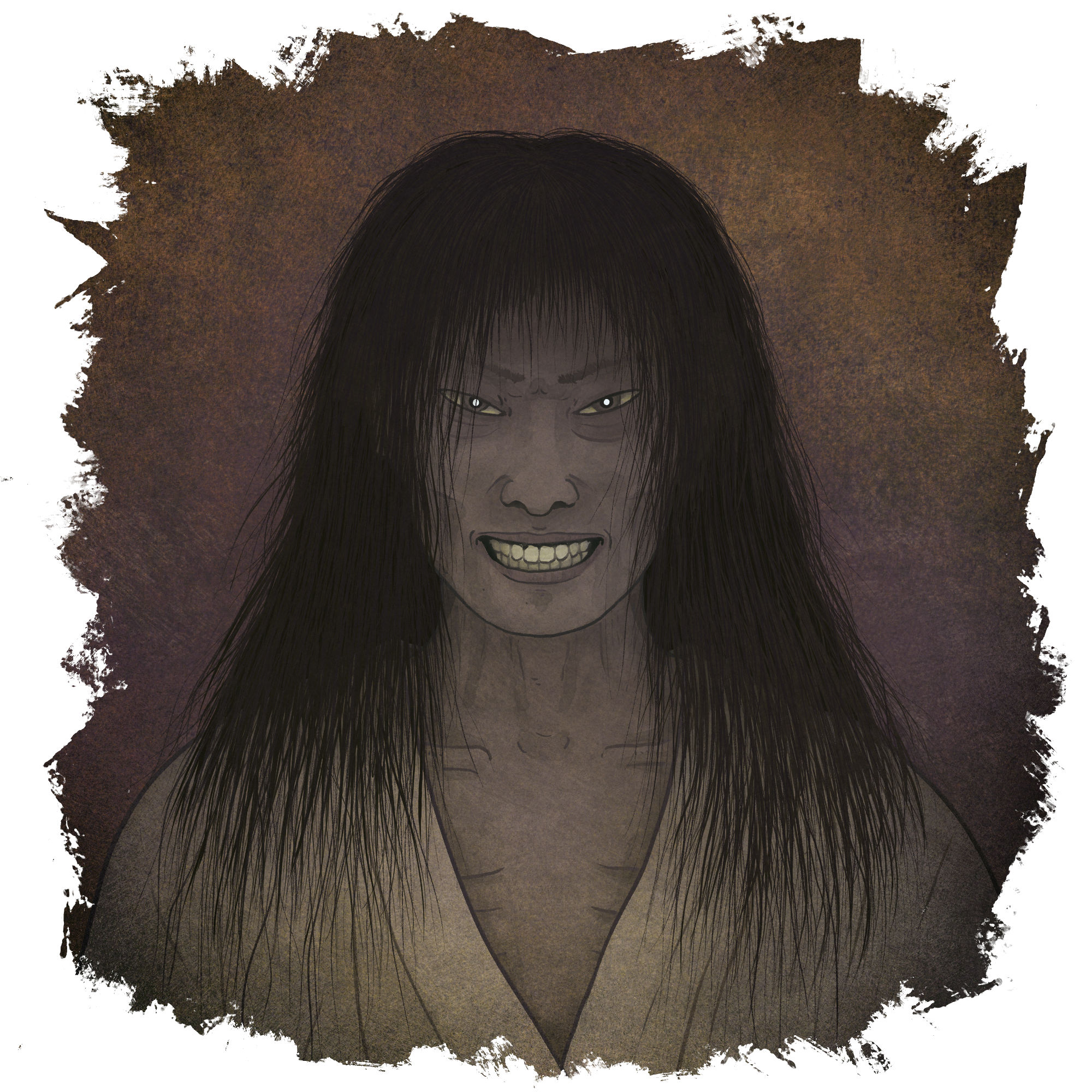
Tonight’s story features an onryō, the most terrifying of Japanese ghosts. Fans of yokai folklore might even think this story sounds somewhat familiar. There’s a clear connection to one of Japan’s most famous ghost tales, Sarayashiki. Everything from the ghost’s name (Kiku), to the setting (Himeji castle; mentioned later on in the story), to the absolutely cruel treatment of the serving girl, culminating in throwing her down a hole to her death (or a well). Despite the many similarities, this story is different enough that it still feels like a fresh version and not just a retelling.

There are a few parts of this story that were hard to translate, because they breezed over things that begged for more explanation. One part is the various types of torture that Kiku had to endure. The story lists water torture, the torture of the iron bars, the wooden horse, and the torture of the old tree without describing what those are. So just to quickly go over them:

  • Water torture includes several unpleasant things, from splashing her with cold water, to holding her head underwater, to wrapping cloth around her face and pouring water over her (i.e. waterboarding).
  • The torture of the iron bars involves binding a person’s hands and legs with heavy iron bars and then adding weight to crush them, or twisting them. It’s pretty gruesome.
  • The wooden horse involves straddling someone on top of a pointed wooden device and weight their limbs down and letting gravity work its horrors. Yuck.
  • And the torture of the old tree is hanging someone upside-down from a tree. From this position you can either beat them like a piñata or allow gravity to make the blood pool in their head and eventually kill them. Choices!
  • Lastly, dripping soy sauce into the open wounds is pretty self explanatory. I’m not sure whether the boiling part or the salt in the wounds part would hurt more, but it is exceptionally cruel.

No wonder the girl becomes an onryō!

My favorite part of this story, though, is easy to miss. The appearance of the elderly servant at the end of the story, who orders the younger footmen to pay the girl’s cab fare. At first I wondered why one of the high ranking servants, basically the majordomo, would tell the doormen to pay double the fee for some random, unexpected woman. But the key is in his age: this man is old enough that he has served four generations of Shuri’s family. That is to say, he has witnessed every single member of Shuri’s family for four generations fall pray to Kiku. He knows what’s up, he knows the curse, and he knows there’s nothing that can be done to stop her. So he just tells them to pay the fare, and he alone knows what is coming next. Chilling!

So with that in mind, enjoy this creepy tale!

The Ghost of Kiku, Maidservant of Kumamoto Shuri

Kumamoto Shuri was an exceedingly wicked and cruel man. When he was serving at the castle, he became furious when he discovered a pin in his food, and he called his maidservant Kiku to him.

“Who ordered you to do such a thing? Tell me the truth. If you don’t tell me I will beat it out of you!”

Kiku was astonished. She said, “Oh my, I’ve made a terrible mistake. Earlier, I was sewing a kimono and I tucked the needle into my hair. It must have fallen out and into your food. I did not intend for such a thing to happen. And I was not ordered by anyone to do it. It was a simple mistake, so please forgive me.”

To which Shuri replied, “So you want to argue? Then I shall torture you.”

First he used water torture. Second was the torture of the iron bars. Third was the wooden horse. Fourth was the torture of the old tree. Fifth, he cut open her back and poured boiling soy sauce into the wounds.

However, all Kiku said was, “There’s nothing more that I can say except what I already told you. Please, just fire me!”

To which Shuri replied, “I see I have been too lenient in my punishments as you will not confess.”

He ordered the peasants to bring two or three thousand snakes, then he dug a hole and put Kiku in it, and had the snakes released into the hole.

Kiku told the other servants, “It seems I will not survive this. Please, at least call my mother and let me say goodbye to her.” They pitied her, and called Kiku’s mother and arranged for them to meet.

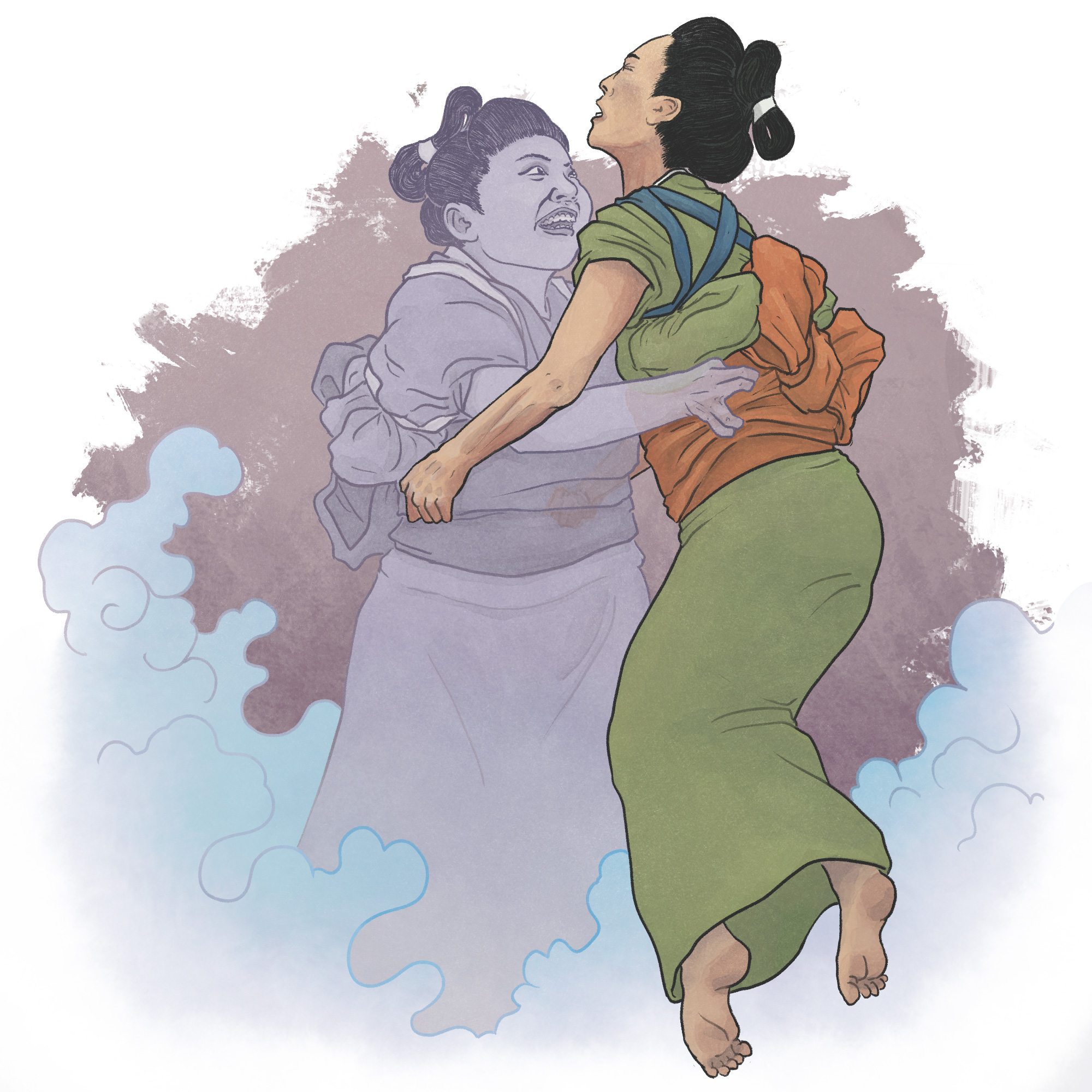
Upon seeing Kiku’s condition, her mother looked up at the heavens and fell to the ground, and cried out, “In order to serve the samurai we have been prepared for a lot, but to this kind of torture as a source of amusement?! When you die, come back as an onryō and take revenge for this! Never forget it!”

Kiku replied, “Be at ease. I will bear this grudge not just against Shuri’s entire family, but against seven generations of his family! If you don’t believe me, plant sesame seeds in front of the place where I die. They will sprout within three days. Consider this as proof. Now I am free. Goodbye.”

And with that, she bit off her tongue and died.

Kiku’s mother was anxious, and so she planted sesame seeds as instructed. As promised, they sprouted within three days. And sure enough, on the third day, Kiku appeared to Shuri and declared her grudge, listing all of the ways he had wronged her. Then she said, “I’ll be back,” and left.

After that, Shuri began to babble incoherently, spouting confessions of all the evil things he did and acting like a madman. On the seventh day, he died. After that, Shuri began to haunt his descendants to death.

Shuri the 4th served under Matsudaira Tadaaki at Himeji in Harima Province. Kiku’s ghost appeared before a packhorse driver on a road about 8 km away and said, “I am traveling to Shuri’s estate and would like to borrow a horse.”

The horse driver assumed she was just an ordinary person and refused, saying, “It is almost night, and the way home will be long.”

“I will pay extra,” said Kiku. She offered him 160 mon – double the normal price of 80 mon.

When they arrived at Shuri’s estate, Kiku got off the horse and went inside, and the horse driver asked the servants for payment.

“What are you talking about? You didn’t have anybody on your horse!” said the servants.

The horse driver replied, “Just now I brought a lady here. You have to pay her fare!”

As they argued, a voice came out of nowhere. It was Shuri’s elder servant, ordering them to pay the horse driver: “Kiku has come back. Pay the 160 mon fare.”

After that, Shuri suddenly became ill and, possessed by Kiku, began to babble about the various ways in which she had been wronged by his ancestor. On the seventh day he died.

For four generations, they tried various prayers and exorcisms, but none were effective; each time that a successor was named, Kiku came and killed him.


A-Yokai-A-Day: The Tanuki’s Wedding; or, The Miraculous Walking Stick

Tonight’s yokai is another animal beloved by all: the tanuki. Tanuki are one of the most common animal yokai found in Japanese folklore, and they are well known for playing tricks and pranks. Sometimes their pranks even get nasty, but tanuki are only very rarely truly wicked. Most of the time their pranks are harmless, or their secret is exposed before they have the chance to do something truly awful.

Since I live in a rural part of Japan, I’m lucky that I get to see tanuki frequently. Around this time of year, I see tanuki just about every day. They visit my home several times per night and I catch them on my outdoor cameras, and they lazily scurry away from the road when I take evening walks. They are very cute and fun to see, with their bushy tails and round, fat butts.

I have yet to see one do magic, though!

The Tanuki’s Wedding; or, The Miraculous Walking Stick

In Kamiyama, Tanba Province, there was a farmer named Utsunomiya Kohyōe. He had four daughters, three old whom were married, but the youngest was not yet married. A rich farmer from a neighboring village heard about this and introduced himself and, with the help of a matchmaker, quickly arranged a marriage date with the youngest daughter.

However, two or three days before the arranged day, the matchmaker came to the farmer and said, “The date that we agreed upon has unexpectedly become a problem, so we would like to change it to one day earlier. That is to say, the bridegroom will come first, and then the following day the bride and bridegroom will return home together.”

The daughter and the father both agreed to the change. And so the arranged day arrived, and the bride’s sisters and their husbands all came to the house. And as the sun set, the bridegroom, his guests, and the matchmaker all came to the house and laid their gifts for the bride’s father, and various gifts were laid out in the tatami room.

The eldest sister’s family was late in arriving because they lived farther away, and she always carried a staff with scriptures carved into it as a walking stick with her when she traveled at night so that she would not encounter any evil spirits on the road. On this night, too, she came with her walking stick.

The eldest sister wanted to peek at the bridegroom, so she walked around to the back of the house and pushed open the bamboo window screen with her walking stick. She saw a group of old, balding tanuki drinking sake and merrymaking. Astonished, she called her husband over and told him to look, but when he did, all he saw were people.

To the sister’s eyes they looked like regular old tanuki, and the objects that were lined up in the tatami room like gifts were all just the bones of horses and cattle. She became suspicious, thought for a moment, then she lifted up the bamboo screen with her walking stick again and showed her husband. Truly, the bridegroom and every one of his guests were all old tanuki. Her husband was so astonished that he quietly called over his brothers-in-law. He explained everything to them and said, “Let us not be fooled!”

They sealed the back door and windows, and blocked off the veranda. Then they went into the tatami room and introduced themselves to the bridegroom, and offered to pour him some sake. Once they were close enough, they suddenly grabbed the bridegroom by the arms and held him as tightly as possible, pinned him down, and said, “You are a loathsome fiend!”

The guests and the matchmaker cried out, “This is an outrage!”

But the brothers-in-law held the bridegroom tightly, drew their wakizashi, and stabbed him through.

The father of the bride was shocked. “Have you gone mad?” he cried, but they did not listen. They proceeded to slay all of the bridegroom’s servants and companions, who cried out, “We are all humans! Please forgive us!” They tried to escape underneath the veranda and through the windows, but there was no way out. When everyone was slain, they saw that they were all elderly tanuki.

Everyone was astonished, and the following day, the real bridegroom arrived and they had the real wedding party. It was all thanks to the power of the holy walking stick.

A-Yokai-A-Day: The Nekomata That Changed into Itō Genroku’s Wife

The yokai in tonight’s story is a fan favorite: the two-tailed version of a bakeneko, known as a nekomata. In a way it’s almost a touching story, about a pet who loves its master so much that it would do the unthinkable. On the other hand, it’s equally horrifying. Why make up such a lie? What were the cat’s long-term plans? Was the cat behind the wife’s death in the first place? Knowing that this was a nekomata, all sorts of nefarious answers pop into mind… In any case, go hug your pets!

The Nekomata That Changed into Itō Genroku’s Wife

In Shinobu, Oshū, there was a man around 20 years old named Itō Genroku. He was a skillful man with a kind heart, and people came from all over to ask him to become their son-in-law.

He heard that a certain person in the same province had a beautiful daughter, so he invited her to come and be his wife. But while they fell deeply for each other, the new wife caught a slight cold and ended up dying. Genroku was deeply grieved; he shut himself away in his home and never left, spending all of his time pining for his wife.

One day, a friend of his named Takeuchi Hyōe came to give his sympathy for Genroku’s pain. He entered Genroku’s room, they talked for a while, and then he left; but something troubled him about Genroku’s condition, so he secretly reached out to Genroku’s parents and said, “There’s something strange about Genroku’s condition, so please check in on him every night.”

That night, Genroku’s parents creeped close to Genroku’s bedroom and listened. In the early hours of the morning, after everyone had gone to bed, they heard an unknown woman’s voice speaking affectionately to him. Genroku’s parents were astonished, and when morning came they called Hyōe and told him about the intimate conversation they heard.

“I thought so…” said Hyōe. They summoned Genroku to his parents’ room and spent the night drinking and merrymaking, while Hyōe went to Genroku’s bedroom and waited. Sure enough, in the early hours of the morning after everyone had gone to sleep, a woman’s voice came out of nowhere and said affectionately, “I’m here.”

Hyōe hid underneath the blankets. The woman said, “Why don’t you speak to me tonight? Are you angry because I am late? I arrived late because I ran into some trouble.” She begged him for forgiveness and pulled back the covers to climb into bed. Hyōe looked up and saw that her mouth was split open from ear to ear and she had horns sprouting from her head, but her black penciled-on eyebrows, red and white makeup, and styled up bangs looked exactly like Genroku’s wife.

Hyōe said, “I’ve got you!” He seized her and stabbed her with both of his swords. Their fight was so chaotic that the noise made people light lanterns and come to see. In the lantern light, Hyōe was able to overpower her, and he stabbed her over and over. Upon closer inspection, it was Genroku’s pet cat of many years.

When Hyōe told what happened to Genroku, Genroku was astonished and grateful. He explained, “Seven days after my wife died, she appeared to me and said, ‘I was resurrected by Lord Enma, under instruction that for one hundred days we must tell nobody about this. During that time, I will visit you in secret. You must not let anybody know about this!’ Until now, I kept everything under wraps. So, it turns out she was a nekomata… Thanks to you, Hyōe, my life was saved.”

A-Yokai-A-Day: The Tumors of Heirokuzaemon of Shimōsa Province’s Father

Tonight’s story once again deals with the topic of attachment, as in the Buddhist sin of improper attachment to others. And like several stories we’ve read so far, it uses snakes as a symbol of that attachment. In this case, the suffering caused by attachment is pretty extreme, and it’s hard not to feel sorry for the father.

The Tumors of Heirokuzaemon of Shimōsa Province’s Father

In a place called Yokkaichi in Usui, Shimōsa Province, there was a man named Heirokuzaemon. One time an itinerant monk came to his place and asked for lodging. Although he had asked for a room, the monk stayed up all night long reciting the Lotus Sutra without sleeping. Throughout the night, he heard something moaning, “Look… Look…” on the other side of a shōji partition.

The monk was bewildered. In the morning he asked Heirokuzaemon, “Do you have a puppy in the other room? Something was moaning all night long.”

Heirokuzaemon replied, “I am ashamed, but as you are a monk let me tell you. The one who was moaning is my father. For more than twelve years he has been suffering. First he developed a tumor on his right shoulder, then he developed a similar tumor on his left shoulder, and after that a large hole appeared in each of them. When he looks to his left, the right tumor says, ‘Look this way!’ Whenever he looks to his right, the left tumor says, ‘Look this way!’ He is tormented day and night by these boils telling him, Look this way! Look this way! so that he has spent the last twelve  years squatting with his hands on the floor, looking left, then looking right, over and over again. For the first five or six years I tried to help him with medical treatments and exorcisms, but they had no effect, so for the last five or six years I’ve just left him there.”

The monk listened, and then replied, “Let me meet him.”

“Very well,” said Heirokuzaemon, and he brought the monk to his father.

“Tell me about when these tumors first appeared,” said the monk to the father.

The father said, “I am ashamed to tell you this. When I was younger, I laid with a servant girl. Heiroku’s mother was the most jealous woman in the world, and she strangled the servant girl to death. Not three days after the servant girl was killed a tumor appeared on my right shoulder. Seven days after that Heiroku’s mother died, and not three days after that a tumor appeared on my left shoulder. Both tumors tell me, ‘Look this way! Look this way!’ and if I refuse even once, the pain becomes so unbearable, like being strangled to death. For the past twelve years they have been ordering me to look at them without rest.”

The monk listened carefully and replied, “Then, let me say a prayer for you.” He uncovered the father’s shoulders, sat behind him, faced the tumors, and recited the Lotus Sutra. Doing so, a tiny snake stuck its head out of the hole in the right tumor. The monk recited faster and with pausing, and soon the snake’s head stuck out nine centimeters. Holding the sutra in his hand, the monk pulled the snake out of the hole. Then he turned towards the left tumor and recited the sutra, and a snake stuck out its head just like before, so holding the sutra in his hand, he pulled that snake out of the hole. He constructed two burial mounds for the snakes, recited prayers over them and mourned them.

Afterwards, the tumors healed and the holes closed up. Both father and son were overcome with gratification. It is said that everyone in this area became devout believers in the Lotus Sutra.