Tonight’s story comes from volume 4 of Mimibukuro. Unlike Shokoku hyakumonogatari, which I translated a few years ago for A-Yokai-A-Day, Mimibukuro is not a kaidanshū (a collection of ghost stories). Instead, it is a collection of anecdotes, hearsay, and rumors that Negishi heard over his time as an administrator on Sado Island, and thus the stories contained within vary greatly. While there are a number of genuinely scary ghost stories, there are also several bittersweet ones, and some that make no sense at all. Tonight’s is one of the sweeter ghost tales.
The majority of the stories Negishi wrote down were likely not told to him for purposes of entertainment or to scare him. Rather, many of them were likely just rumors that happened to be the talk of the town at various times during his service. Most of the tales in Mimibukuro follow my favorite kind of yokai pattern: that in which the story is told as matter-of-fact as possible, without embellishment or flourish, and often with a dash of skepticism—more like a newspaper article than a “tale,” and often very surreal. This is a quality common in kidan (Japanese ghost/yokai/strange stories) and is very charming. We’ll see several examples of that kind of story during this year’s A-Yokai-A-Day.
Now, on to today’s tale:
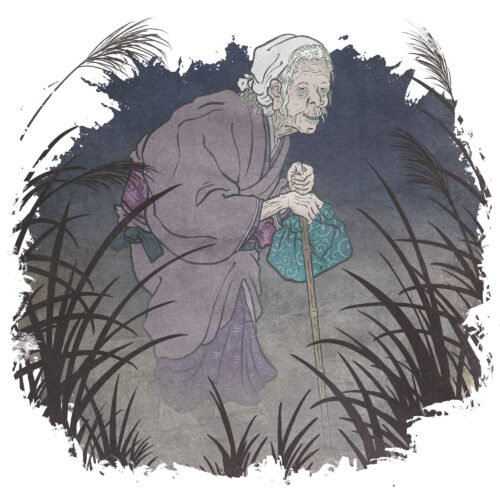
How the Lingering Spirit of an Old Woman Expressed Her Goodwill
Hayakawa Tomisaburō, who served as a senior supervisor of public works, had a grandmother who was often ill.
One day, she went to visit a neighbor of similar social standing with whom she had a friendly relationship to pay her respects. The neighbor’s wife inquired about her illness and remarked, “It is wonderful to see you looking so well.”
The grandmother replied, “When you came and checked in on me while I was ill, I was truly grateful for your kindness. Today, I have come to bid you farewell.”
Since the grandmother’s family was part of the public works department, the neighbor’s wife assumed she might be going on a journey or something of the sort, and so she offered the appropriate farewell greetings.
The grandmother also visited the households of merchants with whom she was on friendly terms and expressed her gratitude in the same manner. Since word had spread that the old woman who had been ill for so long had recovered and was saying farewells, the wives of Tomisaburō’s peers and the wives of the merchants went out to visit Tomisaburō’s home and express their thanks.
However, when they arrived at Tomisaburō’s home, preparations were underway for a funeral. Surprised, they asked what had happened and were told that the elderly woman had died that morning.
Everybody was shocked.