After the shock of this morning’s discovery of the surprise rule change by Japan Post and the stressful hours afterwards trying to figure out how this impacts the Kickstarter which we just started to fulfill, I almost decided not to post a painting today and just take a day off for mental health. Aside from how crushingly frustrating it is to have to notify backers of this huge disappointment, and to hit the brakes on shipping and screech all project momentum to a halt after we’ve been working towards Kickstarter fulfillment for over a year now, this also means that we probably have to close the yokai.com webstore to all US orders—right before the holiday sales season that makes up a huge percentage of our annual income. It’s layer upon layer of suck.
But today’s story from Mimibukuro is really dark and depressing, and if I didn’t spend the day painting, I would have been brooding and feeling miserable, yet unable to do anything to make things better. It’s odd; this tale is horrifically depressing, but somehow that sadness soothes, if just a little bit, my anger and disappointment at today’s news.
The type of monkey show depicted in this story is called sarumawashi, and is fairly common in Japan. I see monkey performances every year down by the river during festivals. Japanese macaques look and behave just like little people, and it is utterly captivating to watch them perform. There is an idiom in Japanese—猿は人間に毛が三筋足らぬ (saru wa ningen ni ke ga misuji taranu)—which means “a monkey is a person minus three hairs.” They are so alike us in every way, and we are so like them, that only three hairs separate us. That makes the tragedy in this story so easy to feel deeply.
Even Beasts Feel Deep Affection
In the fifth year of the Tenmei era (1785) in Sakaimachi, a large number of monkeys were brought together and made to perform in male and female kabuki roles. Their performances attracted a huge audience. I heard from some of the spectators that these monkeys had been well-trained to copy the spirit and mannerisms of the popular actors of the time, and their gestures and movements were highly amusing.
One of these monkeys had given birth to a baby, and as the baby grew it became thoroughly infested with lice, which caused it a lot of distress. The monkey trainer bathed the monkey to remove the lice and, to dry its wet fur, tied it to a clothesline on the second floor. However, a kite spotted the monkey and pecked it to death with its beak. The monkey trainer tried to chase the kite away and tend to the monkey, but his efforts were in vain.
The trainer called the monkey’s mother and consoled her, “You have worked hard for many years, and you have been an integral part of our family business. Seeing how much you loved this young monkey, I can only imagine how sad you must be. We never imagined a kite would come. It is so regrettable that we left the young monkey on the clothesline.”
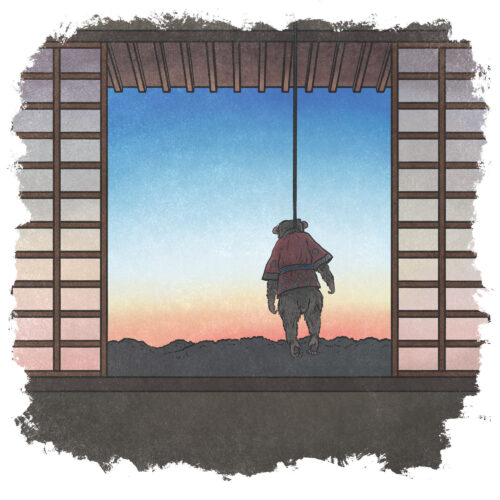
The mother monkey cried and collapsed in grief. When the monkey trainer stepped away for a moment to do something else, the mother monkey tied one of the stage ropes to a roof beam and hanged herself.
People called this a sorrowful example of a mother’s love.