“Ghost paintings”—called yūreiga in Japanese—are a genre of traditional Japanese painting. Some of them are hauntingly beautiful, when they portray a ghost whose story is more pitiable; while other times they can be downright horrifying, when they portray the scarier side of ghosts. Most yūreiga are painted simply, using just ink and water on long scrolls, which is a useful tool for depicting the fading feet and dry grasses that are a staple feature of yūrei paintings. However they can also be painted with pigments on silk, or as woodblock prints, appearing vibrant or comical, depending on what the story needs.
I am enjoying the opportunity to paint several ghosts in this series, and it is a challenge to find something different to paint to express each ghost’s identity without making them look too similar to each other.
Tonight’s story also comes from volume 4 of Mimibukuro, and is in the same vein as last night’s story. It is a ghost story, with a bit of a bittersweet vibe. Let’s take a look!
How a Maidservant’s Ghost Came to Her Master’s House
A woman who had served for several years in the household of a man named Udono Shikibu Nagamori had been ill for a long time and asked to be released from her duties. She was therefore granted an extended leave of absence.
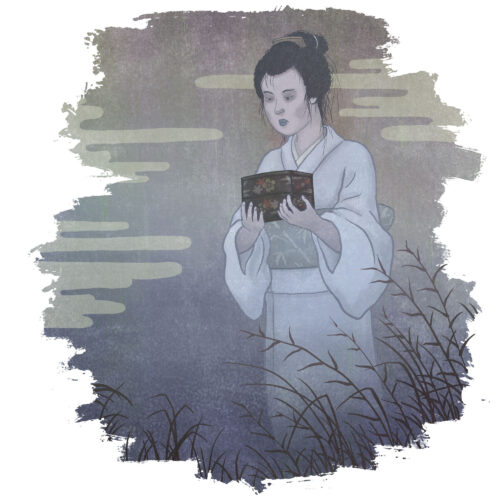
Some time passed, until one day, the woman came back. She went to the home where Shikibu’s mother was living in retirement and offered her greetings, saying, “The great kindness you have shown me for so long has allowed me to recuperate, and I am deeply grateful.”
The elderly mother was delighted to see that she had recovered from her illness and offered her blessings, saying, “Your complexion still looks pale, so take good care of yourself and come back to work for us again when you are better.”
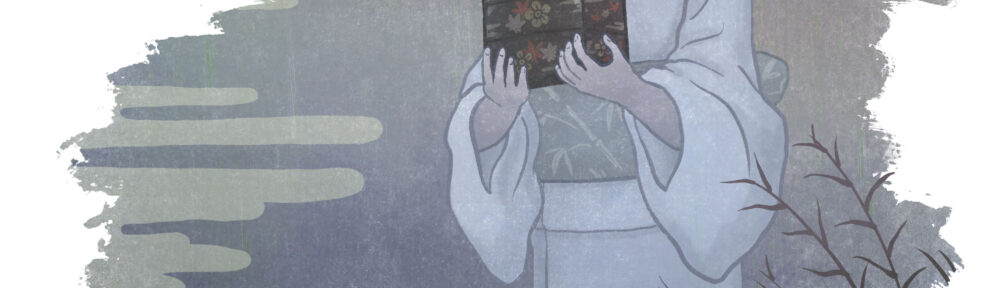
The woman replied, “I am well enough to work now. I brought these as a token of my gratitude. I made them myself.” She offered the appropriate greetings and presented a two-tiered lacquered box filled with dango.
The elderly mother returned her greetings and said, “In that case, take care of your health before anything else, and return to your duties.”
The woman left and went somewhere else, and the elderly mother went straight to the kitchen and told the servants, “That maidservant has returned and says she has recovered from her illness. But she still looks pale, so make sure all of the servants work together to help her.”
The servants replied, “None of us has heard about the maidservant returning.” And they searched all over, but they could not find where she had gone. However, they did find the lacquered box that she had brought, filled with white dango.
They sent someone to the woman’s parents’ home to inquire about the situation, and were told, “She passed away a couple of days ago. We had been putting off telling you.” After that, a member of her family visited the household and formally delivered the news of her death.
It was, as someone from the Udono family later recounted, a most mysterious incident.