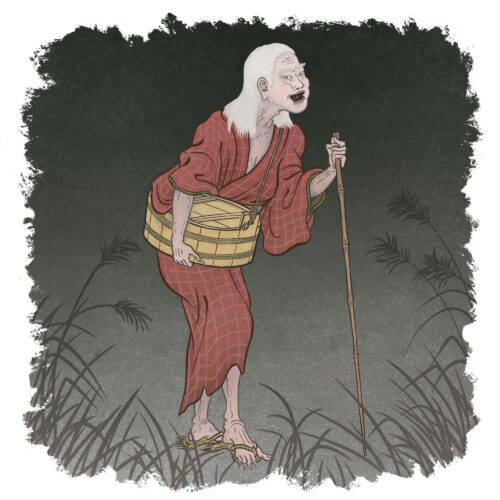
Tonight’s story comes from volume six of Mimibukuro, and introduces us to an unusual term: nyoyō. Nyoyō is written 女妖 and while it literally means “strange woman” or “yōkai woman,” it doesn’t actually seem to mean anything specific. The woman in the story below is “strange,” simply because she is acts more youthful than her age. She is 83, buts acts like a woman in her fifties. She has white hair and all of her teeth. Surely, she must be a monster!
There is plenty of precedence for female yōkai draining the life force of young, virile men in order to extend their lifespans. There was a popular belief that kitsune would disguise themselves as women in order to drain men. Nikusui and kawahime are other examples. In this story, Saki is never actually accused of draining the life force of men to retain her energy at age 83, but that might be one of the assumptions readers are meant to draw. (Is that why her husband died so early? Did she drain him?)
And while there’s nothing inherently yōkai-ish about having all of your teeth, that would certainly be unusual at her age and in that era. The fact that her teeth were blackened probably has something to do with that, as ohaguro did indeed provide cavity resistance. On the other hand, it probably didn’t help at all to dispell the rumors about her being a yokai, as even Edo period people seemed to find blackened teeth eerie, as yōkai were often depicted with ohaguro.
This story reminds me of a kidan from Fukui, in which a woman six shaku tall (about six feet, or 180 centimeters) appeared in a town and caused a great stir. Merely being tall was enough for her to be considered a monster. Although in her story, she at least appeared on top of the roofs of buildings. Meanwhile, Saki is never actually accused of doing anything supernatural, or even particularly strange. The worst that can be said about her is that she enjoyed sex with her husband, who happened to be 30 years younger than her. Hardly monstrous…
So… are we dealing with an energy vampire yōkai woman here? Or just standard misogyny?
The Nyoyō
This incident took place in the village of Kawajiri in Toyota District, Shimōsa Province, where Ogiwara Yagobei served at the local magistrate’s office.
In the third year of Kyōwa (1803), the Year of the Boar, a woman named Saki—the widow of a farmer named Kiemon who had served as a retainer of the village headman Shin’emon—turned eighty-three years old. She was living in Shin’emon’s household, more or less in the role of a servant.
For the previous two or three years, she had been close with a man from the same village named Kichiemon, who was fifty-six years old. Saki privately asked Shin’emon for permission to marry Kichiemon; however, Shin’emon denied her request, saying that it was out of the question for a person of her age.
After that, rumors began to spread that Saki and Kichiemon were planning to elope. Thus, Shin’emon had no choice but to grant Saki’s request, and he took Kichiemon into his household as her husband.
When [the official in charge of accounts for river management] Suzuki Monzaburō was making his rounds in the village, he happened to see Saki working in Shin’emon’s kitchen. She still had all of her teeth, which were dyed black with ohaguro, her hair was white, and her demeanor made her look to be about fifty years old, Monzaburō recounted.
People in the area said that after Kichiemon married Saki, he was bothered because she always took the lead whenever consummating their marriage. While other people claimed to have witnessed them actually having sex with their own eyes. However, it was said that these were just groundless rumors, and there was nothing credible about them.