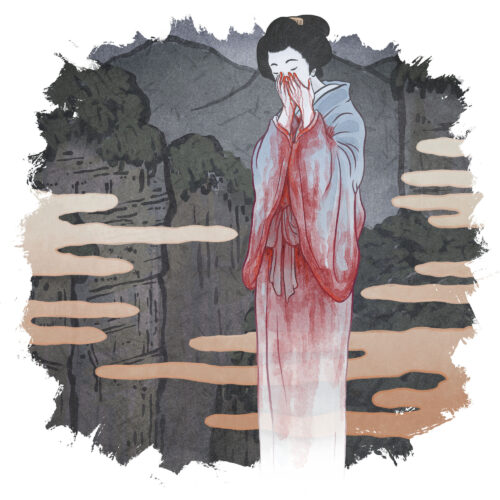
Tonight’s tale deals with a bōrei, which is another word for a yūrei. The world literally means “dead spirit,”—very similar in meaning to shiryō, which we read about the other day. The difference between bōrei and shiryō is subtle, but in general, shiryō seem to be more violent/vengeful spirits, while bōrei seem a bit more neutral. I’m sure a language expert could give a much better explanation than that, but at least comparing the shiryō story from the other day with this bōrei tale, the bōrei seems a bit more sympathetic.
Sankin duty in the first sentence refers to the Edo period policy requiring daimyō to maintain a second residence in Edo and alternate their residence between their homeland and Edo at fixed intervals. This was highly effective at keeping the peace, because the vast amount of money it requires to move a daimyō and his retinue back and forth, as well as maintain two sets of homes for all of his employees, kept them from amassing enough wealth to challenge the shogunate. It also made it easier to spy on daimyō, and provided hostages in case they ever did rebel.
The vague references to “improper conduct” refer to adultery, but I’ve left them vague in the translation to reflect how they are written in Mimibukuro.
Tonight’s tale also contains a waka, which I always struggle to translate. As always, I’ve done my best to translate the meaning of the poem with zero consideration for preserving its meter. I say this every time, but English attempts at Japanese poetry just plain suck. Waka need be enjoyed in Japanese. But this poem contains an extra problem—the text itself claims that the poem included is a false report. Sure enough, the position of this sentence is odd, as it happens after the ghost disappears and the husband wakes from his dream. Still, the poem doesn’t feel so non-sequitur to me. I interpret it as the wife feeling relieved that she was able to clear her name and find peace that mere prayers might not have given her. Yet I am no expert on Japanese poetry either so perhaps I am over-interpreting it. But to leave it out would ruin the title of the story, so I left it in.
The Tale of the Bōrei’s Poem
There was a man serving in the domain of one of the feudal lords of Ōshū who was on sankin duty in Edo. His mother and wife were left behind in his hometown. Some time passed without a word from either of them, however one night, while he was half-awake and half-dreaming, a figure came to his bedside and woke him. He got up to see who it was and, to his astonishment, it was none other than his wife from his hometown.
Startled, he said, “Why have you come here? This is not a place that a woman should cross mountains and seas to reach.”
His wife began to speak, “I missed you so dearly that I had to come. To tell you the truth, I am now a spirit who no longer exists in this world.”
The husband asked, “What do you mean by that?”
She replied, “I met my death unnaturally, by the blade.”
Just as the husband thought to ask her to explain, her form vanished into thin air.
“What a strange thing… I keep thinking it was a dream, but it clearly was not. I wonder what happened back at home,” he thought, his heart heavy with worry. So he wrote to his mother and his wife, asking them casually if anything unusual had happened.
A while later, a reply came from his mother: “After you left, your wife behaved improperly and then disappeared. We have been searching for her in secret, but we still do not know where she is.”
Since he also received letters from family members saying similar things, he thought, “That must be why I haven’t heard anything from her. Even so, what disgraceful behavior for a wife!” He brooded upon this and went to bed.
That night, his wife’s spirit came again, weeping bitterly. She asked, “Did you receive any news from our hometown?”
He replied, “I did indeed receive a correspondence, but I am told you had an affair and then ran off.”
The wife wept bitter tears and said, “I have not committed even the slightest wrongdoing! After you left, your mother’s conduct was not proper. I witnessed this by accident, and she came to hate me for it—and she secretly murdered me with her own hands. And then, I was slandered with a false charge of infidelity. The shame heaped upon me even in death is beyond description! My corpse was discarded in a nearby ravine, where it still lies unburied and not yet decayed.”
Her husband tried to ask for even more details, but she only said, “This is a sign of where my corpse lies.” He watched her cut off a lock of her hair, then he woke up. Thinking it was a strange dream, he looked at his bedside and found a lock of hair there.
It is said that, at that moment, the ghost recited the following verse:
“Though I have long-awaited
the teachings of the Dharma,
so great in number—
Now that my path ahead is peaceful,
how joyful I am.”However, this so-called composition seems to be a baseless fabrication.
The husband secretly sent word of this to a family member he could trust. Since it was a cold, snowy land, when the family member visited the ravine he discovered her remains perfectly intact, showing no signs of decay.
It is said that the mother, after being questioned by her lord, was punished for her crimes. However, the person recounting this story did not hear what happened afterward.