There’s only one more day left after tonight’s A-Yokai-A-Day tale!
When cats appear in kidan, it’s usually going to be a bakeneko, or a nekomata, or some other evil cat. We’ve seen a few of them during A-Yokai-A-Day over the years. My favorite one being this strange cat. Tonight’s cat is indeed a bakeneko of a sort—after all, it has lived unnaturally long, and it speaks. But in this rare case it doesn’t appear to be evil. Cat lovers will probably really like this one, although from the title you can see that it doesn’t have an entirely happy ending.
The Cat’s Loyal Death
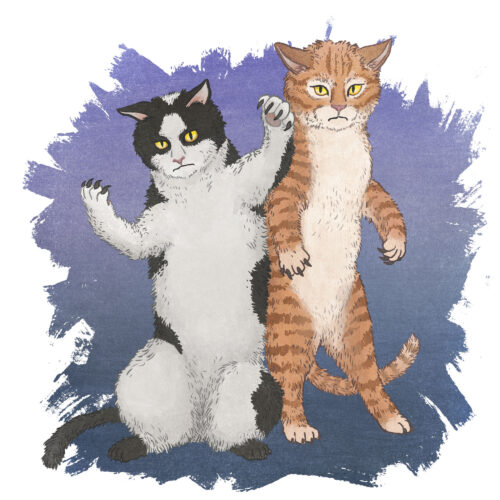
This took place in the An’ei or Tenmei era (1772–1789). At Nōninbashi in Ōsaka, there lived a townsperson named Sōbei Kawachiya. He had an only daughter who was quite beautiful and greatly beloved by her parents. For many years, they had kept a cat—a bicolor cat—which the daughter particularly loved, and it followed her everywhere, never leaving her side for even a moment. Whether she was sitting or lying down, or going to the outhouse, the cat was always there.
Eventually, word spread through the neighborhood that the cat had enchanted the girl. Even when matchmakers were called to arrange for a marriage, many families refused the match, calling her the girl who was bewitched by a cat.
Her parents were greatly distressed by this. They tried driving the cat away to some place far away, but it returned soon after. They concluded that the cat was a dreadful creature and, even though this one had been kept for years by the family, they privately resolved to beat it to death and dispose of it. But then the cat disappeared, and everyone in the family began to pray and display talismans to ward off evil spirits.
One night, Sōbei dreamed that the cat appeared and crouched by his bedside.
“Why did you flee the house only to return again?” asked Sōbei.
The cat replied, “I was about to be killed because I was suspected of charming your daughter, so I went into hiding. Please think carefully about this: I have been supported by this household since the previous generation, and I have received its deep kindness for some forty years. Why would I do anything to harm my master’s family? The reason I do not leave her side is because there is a monstrous rat that has lived here for many years. It stares at your daughter and tries to approach her. Therefore, to prevent this, I do not leave her side for even a moment. I remain close to guard her. Of course, it is a natural duty for a cat to kill a rat, but this particular rat is more than I can subdue alone. Even two or three ordinary cats would struggle to defeat it. However, there is one way: at Shimanouchi, at the home of Kawachiya Ichibei, there is a tiger-striped cat. If you borrow that cat and let it fight beside me, we would be able to defeat it.”
With that, the cat disappeared without a trace.
Sōbei’s wife said that she had dreamed the same thing. The husband and wife compared their dreams and were astonished, but they reasoned that dreams were unreliable, and the day drew to a close.
That night the cat came again and said, “Do not doubt: if you borrow that cat, you will be spared from disaster.”
Sōbei went to Shimanouchi and visited Ichibei’s place, which was run like a restaurant or a teahouse. Near the garden, on the edge of the veranda, he saw an exceptional tiger-striped cat. Sōbei met with the proprietor and, asking him to keep the matter confidential, explained the situation. Although he had kept the cat for many years, Ichibei did not know if it possessed any special abilities; however, since Sōbei pleaded so earnestly, he agreed to lend him the cat.
The following morning, Sōbei sent someone to fetch the cat. Perhaps it had been in contact with the bicolor cat beforehand, for it came without any resistance. After offering it all sorts of delicacies, the bicolor cat also returned from somewhere and joined the tiger-striped cat—the two of them seemed to be sitting and chatting together just like human friends might do.
That night, the husband and wife dreamed of the bicolor cat again. It told them, “The day after tomorrow, we will subdue the rat. When night falls, take me and the tiger-striped cat upstairs.”
Following the instructions, the following day they prepared a feast for both cats. Then, as night fell, they took them upstairs. At what seemed to be around midnight, there was a tremendous commotion upstairs—for a moment, it seemed as if the whole house was shaking. Before dawn, it had quieted down somewhat, so after some discussion, they went upstairs—the husband first—and discovered the bicolor cat with its teeth sunk into the throat of a giant rat larger than the cats themselves. The rat had torn open the cat’s skull, and both died together.
The tiger-striped cat from Shimanouchi lay sprawled across the rat’s back, its strength spent and on the verge of death. They treated it in various ways, and the tiger-striped cat was saved. They expressed their deepest gratitude, and returned it to Ichibei.
Deeply moved by the bicolor cat’s loyalty, they gave it an elaborate funeral and built a memorial for it, enshrining it as the household’s guardian spirit.
This tale was told by a certain member of the ōban guard, who heard it while on duty.