
Greetings yokai lovers!
Today I’m happy to share hime uo with you all. The landscape here is Hirado bay in Nagasaki prefecture, where she supposedly appeared (although the precise location is not recorded).
When it comes to these pandemic-fortelling yogenju, the hime uo/jinja hime type is actually the most common type. After that the three-legged amabiko type is somewhat common. Little amabie, who became so famous recently, is actually very minor and only appears in a single record.
However, there are still some really unique and weird yogenju left to cover, who do not resemble anything we’ve seen yet. I’ll try to pepper them in between other yokai so as to not overload you with the same story over and over again.
This graphic is something I discovered on Twitter a while back, but I believe it comes from the Miyoshi Mononoke Museum. I love how it shows you the scale of some of these creatures. I feel like it would make an excellent wall poster:
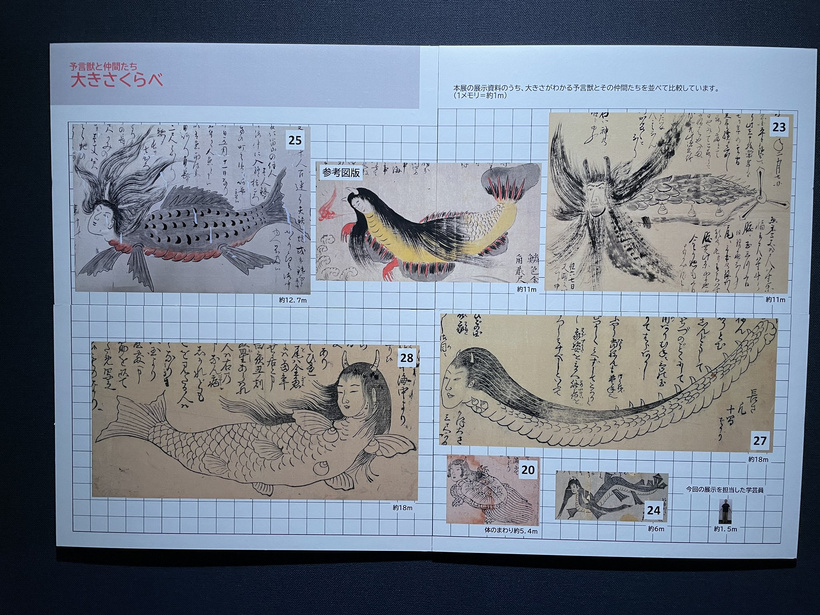
Anyway, on to hime uo:
姫魚
ひめうお
Translation: princess fish
Alternate names: jinja hime
Habitat: deep in the sea
Diet: unknown
Appearance: Hime uo are mermaids that have the body of a fish and the face of a woman. Their bodies are about 4.5 to 5 meters long and their heads are around 90 centimeters long. They have long black hair and two horns sprout from the top of their heads. They are creatures of good luck, and viewing an image of them will protect the viewer from disease and evil spirits.
Interactions: Hime uo are servants of Ryūjin and spend their lives deep underwater. They only appear to humans when they have an important message to deliver from the dragon god, such as warnings of coming plagues.
Origin: A hime uo was sighted in 1819 near the island of Hirado in what is now Nagasaki Prefecture. The hime uo’s words and its details, including body length, hair length, and color, were recorded and printed along with an illustration and distributed like flyers around the country. Due to the instructions that its image should be hung in every house for protection, countless copies of these flyers were made. Some were printed, while others were hand-copied, resulting in a vast number of slightly different depictions of hime uo being circulated across Japan. Some have long hair, some have short hair. Some have pointy horns, others have deer-like antlers. Some are bearded. Some have breasts. The number of swords in their tails varies as well.
Several other yōkai originate from the same story. While they seem to be the same creature, originating from Hirado, Nagasaki in 1819, the depictions vary in several details including the size and shape of the fish. They tend to divided up based on their appearance—with the shorter fish-like ones categorized as hime uo, the longer, serpentine ones categorized as jinja hime, and others with local names such as kamiike hime.
Legends: On April 8, 1819, a strange fish appeared off the coast of Hirado, Hizen Province. The fish delivered a warning: “I am a messenger from Ryūjin. In seven years time a disease called cholera will break out across the country and many people will die. However, if you hang my picture in your house, it will ward off the sickness and your descendants will thrive. I have come now to deliver this message to you.” Then the strange fish disappeared back into the sea.