A-Yokai-A-Day: Datsueba and Keneou

Today’s yokai is a two-fer! Bonus!

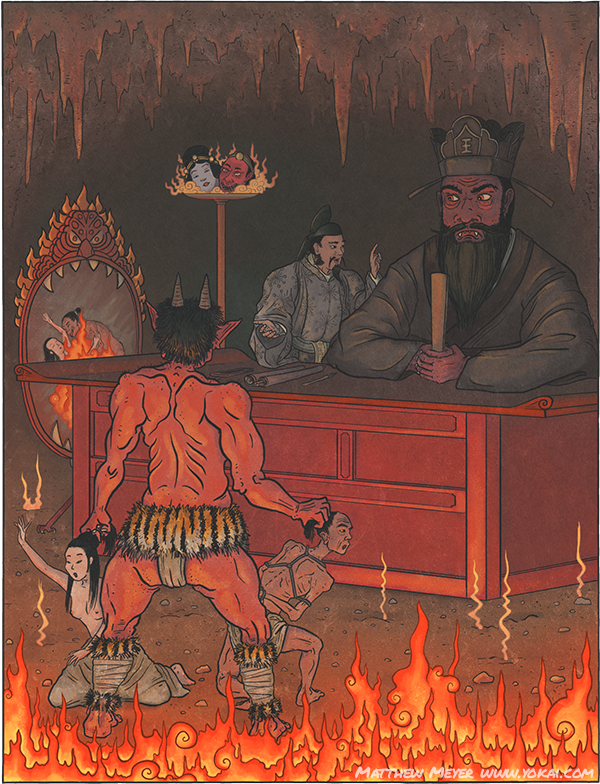
Continuing the mini-theme of the week—hell—we come across this nasty pair. Datsueba is very famous, but much less-known is her husband/consort Keneou. See if you can find them on the map of Meido from the other day!

Datsueba and Keneou are kind of the Japanese equivalent of Charon, the guardian of the underworld in Greek mythology. I know I cautioned earlier about this kind of cross-cultural comparison (and I stick by that!) but I still think it is a fun observation to make. Both Greece and Japan view the underworld as a physical place that can be accessed from Earth, and both of them are guarded by a real-world river which flows underground and becomes the border between the land of the dead and the land of the living. In Japan, this river is called Sanzu no kawa, or the Sanzu River.

That’s where the similarities end. Where Charon is a boatman who takes you across the river, Datsueba and Keneou are far worse, waiting at the opposite end to really mess up your day. Of course, if you’re a kid, it gets even worse.

The souls of children are not allowed to cross the Sanzu River. Instead, they are forced to sit on the riverbanks in a sort of limbo called Sai no Kawara. Their souls remain in Sai no Kawara until enough prayers have been said for them to earn enough merit to cross. Here they sit, building towers out of pebbles, adding one pebble each time someone says a prayer for them. When a tower is completed, the child can finally cross; however, Datsueba and Keneou roam the banks and constantly knock the pebble towers over, rendering the effort meaningless. The only way for children to leave Sai no Kawara is to be saved through intercession by Jizō Bosatsu, the guardian deity of children. This is why Jizō is such a popular god in Japan; prayers to him go towards saving the souls of lost children.

Click on the image below to view the whole story. And don’t forget that you can own this great story by purchasing a copy of The Hour of Meeting Evil Spirits, which contains a chapter on hell and the afterlife, including all of these mini-hell-week entries!

Datsueba & Keneou

Datsueba & Keneou

A-Yokai-A-Day: Enma Daiou

Tonight we continue our mini-theme week on the afterlife, the underworld, and hell. What better way to celebrate Halloween than to celebrate the mythology of hell, right?

Tonight we are taking a look at Enma Daiou, the king and judge of the dead. There are actually a large number of these judges, but Enma is the chief of them all. Like the story of Meido yesterday, Enma comes from Chinese Buddhism, adapted from the original Indian version. The Chinese & Japanese version of hell is a bit different from the Indian version, mostly because it syncretizes Buddhism with Chinese folk religion and Taoism.

One really fun fact I like about Japanese hell and the afterlife is the way it is so much like a reflection of the real world. The judges (including Enma) all wear the clothes of Tang dynasty Chinese bureaucrats, the demons all have specific jobs that they do rather than being chaotic, uncontrollable monsters, and there are even holidays! You may be aware of how Obon is connected with the dead in Japanese/Chinese mythology, but Enma himself sets holidays for his workers and for the tortured. It must be nice to know that, even if you are damned, you still get a day off every now and then!

Enma’s holy days fall on the 16th day of each month. The first and seventh month are particularly important to him, and on these days, he and his servants take off from work and return to their homes. Temples and shrines dedicated to Enma display statues and flags in honor of him, and prayers and supplications made on these holidays are said to provide much more merit than those offered on ordinary days. Temples dedicated to him frequently serve konnyaku treats to guests on these days, as konnyaku is Enma’s favorite food.

In addition, the first day of the seventh month (by the old lunar calendar—this generally translates to mid-August by today’s calendar) is a holiday for all of hell, called Kamabuta Tsuitachi, literally “Kettle Lid First Day of the Month.” On this day, the lids of all of the boiling cauldrons are opened up and the souls are allowed a brief reprieve from torture. This day also marks the beginning of the Obon season, when the dead return from the afterlife to be with their families. The tortured souls in hell crawl out from their boiling pots, cages, and so on, and make the long journey to the world of the living, returning to hell after Obon to resume their torture.

I hope you enjoy the article (click on the image to read it) and if you’re feeling extra curious, go back to yesterday’s illustration and see if you can find Enma Daiou hidden in the picture!

Enma Daiou

Enma Daiou

A-Yokai-A-Day: Meido

Last week’s theme was so popular that I thought it would be fun to do another mini-theme this week. Today’s entry is not actually a yokai, but is deeply rooted in foklore and mythology, so I think it counts anyway. This is a topic I’ve actually written about on this blog before, but not as A-Yokai-A-Day. I wrote that post while researching for The Hour of Meeting Evil Spirits, and today I wanted to share the refined version that eventually made it into the book, along with the illustration, which I haven’t shared on this site before.

Meido is the Japanese underworld, but it’s not Hell. It’s more like the path to hell, or purgatory, or Hades. It’s important to note that Meido comes from the Buddhist/Taoist traditions of China, not Shinto. There is an additional Shinto afterlife/underworld, but that is not related to Meido, and is really only found in ancient mythology before Buddhism was brought to Japan.

Sine I’ve written a lot about it before, and the entry itself is quite long, I won’t say much else in this post. I hope you can zoom in on the illustration and follow along with the story. The first blog post I did on this included a huge number of images from Buddhist hell scrolls, and it was a challenge to fit them all into one painting. The end result looks almost as if you should be searching for Waldo (I promise he’s not in there!). If you look closely, you’ll even see some of the other characters we’ll look at this week!

Click on the image below to read the entry:

Meido

Meido

A-Yokai-A-Day: Hanzaki

People often say that politicians are giant, slimy monsters. Since today was the 3rd presidential debate, I thought it would be appropriate to post a giant, slimy monster from yokai lore. That’s all I’m going to say about politics, because I think yokai are much more fun!

This yokai is based on the Japanese giant salamander. In real life, these guys can grow up to 5 feet long! In folklore, of course, they can get much larger. When I was a kid, I had a number of pet newts which I kept in a terrarium. I loved those guys. They were so much fun to watch, so beautiful, and just all around cool animals. I have never seen a live Japanese giant salamander, but I have seen them on tv, and they are truly impressive creatures. While the newts you can get it pet stores are actually kind of cute, these giant salamanders are warty, monstrous looking creatures and it’s totally understandable why people would come up with horror stories about them.

Sadly, these animals are highly vulnerable to human activity. Like many amphibians, they are sensitive to environmental pollutants, and development near the mountain streams in which they live can ruin their habitats. They are protected in Japan, so hopefully they will remain forever in real life and not just folklore.

Click below for the entry and legend about this awesome creature. Today’s yokai was requested and made possible by my Patreon backers. If you like A-Yokai-A-Day, please consider supporting me with $1 a month so I can keep producing yokai!

hanzaki

Hanzaki

A-Yokai-A-Day: Taizan Fukun no Sai

Because folklore so often deals with scary things, I spend a lot of time going over monsters and curses and other things that are not so pleasant. In yesterday’s post we saw one of Okinawa’s most terrible curses, and I linked to a number of other magical spells that are pretty nasty in general. So today I thought I’d post something to remind us that magic is not always used for bad things.

In fact, the majority of what omyoji did was not casting curses on other people, but actually trying to help people. Using fortune telling to divine when the lucky days were, discerning the unlucky directions and when the unlucky days were so that they could be avoided, discovering the causes of curses and providing protection from them, giving blessings for long life and health for the emperor, trying to cure the royals when they felt sick, and so on.

Of course, some of the more powerful sorcerers, the Abe clan for example, had protected family secrets that were passed down from generation to generation. One of these most important secrets was the ceremony of Lord Taizan, or the Taizan Fukun no Sai. This ceremony allowed him to return the dead to life.

It seems like something straight out of D&D; secret spellbooks passed down from generation to generation, wizards with demon-like familiars who do their bidding… I love it!

Click on the illustration to read on about this most powerful of holy spells:

taizanfukunnosai

Taizan Fukun no Sai

A-Yokai-A-Day: Ichijama

We’ve spent a lot of “wizard week” looking at the tools of the trade—paper dolls, stray dolls, familiar spirits—as well as the main man himself, Abe no Seimei. Now that you know all about what Japan’s sorcerers use, it’s time we turned our attention towards the dark spells themselves! Today we’re going to look at a fun curse from Okinawa.

Before we do that, I should point out a few fun examples of black magic that has been featured on yokai.com during previous A-Yokai-A-Days: Kanashibari, or sleep paralysis which can be caused by ghosts, yokai, and nasty, jealous spellcasters. Inugami, the quintessential example of a shikigami. Tanuki tsuki and kitsune tsuki, or possession of humans by wild animals, often at the direction of an angry spellcaster. Hitobashira, the gruesome entombment of a living human as part of a ritual to protect a building. And of course ushi no koku mairi, or the shrine visit at the hour of the ox—the most terrifying curse of all!

Today’s curse is a little less well-known. It comes from Okinawa, which while part of Japan, retains a unique history and folklore all of its own. Ryukyu was invaded and vassalized by Japan—specifically the Shimazu clan—in 1609. Because onmyodo was developed in Japan hundreds of years prior and was so strongly connected to the imperial court, it didn’t really make its way to the island kingdom. However, Okinawa did develop its own set of spells, charms, and curses. And one of the nastiest of these curses was the ichijama.

Click below to read all about it! Or pick up my book The Hour of Meeting Evil Spirits and keep it on your coffee table to wow all of your guests with your knowledge of mononoke and magic!

Ichijama

Ichijama

A-Yokai-A-Day: Shikigami

What kind of witch or wizard would be complete without a familar—that little helper animal that is used and abused by the spellcaster and performs all kinds of tasks for its baster? Today on A-Yokai-A-Day we dive deeper into wizard week with a fun little yokai type called shikigami.

Shikigami are a really interesting class of yokai. In theory, any yokai could be turned into a shikigami by a powerful enough sorcerer. Usually, though, they were smaller, weaker creatures who didn’t pose as much of a threat to their masters. Abe no Seimei, of course, was able to employ a number of shikigami due to his incredible skill at magic.

The rules of summoning and controlling spirits in Japan are closely related to Shinto cosmology and philosophy about how the soul works. They’re also related to the way ancient ghosts were pacified and turned into gods. Here is a very quick crash-course:

According to Shinto belief, humans and kami all have a soul known as mitama. A mitama is divided into four separate spirits, or tamashii, which oppose each other. These are controlled by another spirit, calling a naohi, which forms a connection between heaven and earth.

The four tamashii are aramitama, nigimitama, sakimitama, and kushimitama. Aramitama is the spirit of courage, perseverance, and extroversion. Nigimitama is the spirit of peace, harmony, and cooperation. Sakimitama is the spirit of happiness, love, and affection. Kushimitama is the spirit of wisdom, observation, and analysis. Aramitama and nigimitama oppose each other, while sakimitama and kushimitama are considered to be aspects of the nigimitama. All four of these spirits are controlled by the naohi—the oversoul—and they work together to form one soul.

When dealing with spirit summoning, it is important to know which tamashii you are dealing with. Nigimitama manifest as benevolent and helpful spirits. Aramitama manifest as raging, wild, dangerous spirits. These opposing tamashii differ so much—even within the same kami—that they can seem to be two separate beings. Much of Shinto is based on the concept of pacifying the aggressive aramitama and bringing forth the peaceful nigimitama.

Helpful prayers and songs are normally directed to the nigimitama of the kami in order to bring out its benevolence. Dark summoning and spells meant to harm others invoke the much more dangerous aramitama.

The art of controlling a shikigami is, of course, the art of speaking to the correct part of the spirit and avoiding invoking the wrath of the wrong part.

You’ll find shikigami in The Hour of Meeting Evil Spirits, available on Amazon and wherever fine books are sold. Click on the image below to read the full entry on yokai.com:

shikigami

Shikigami