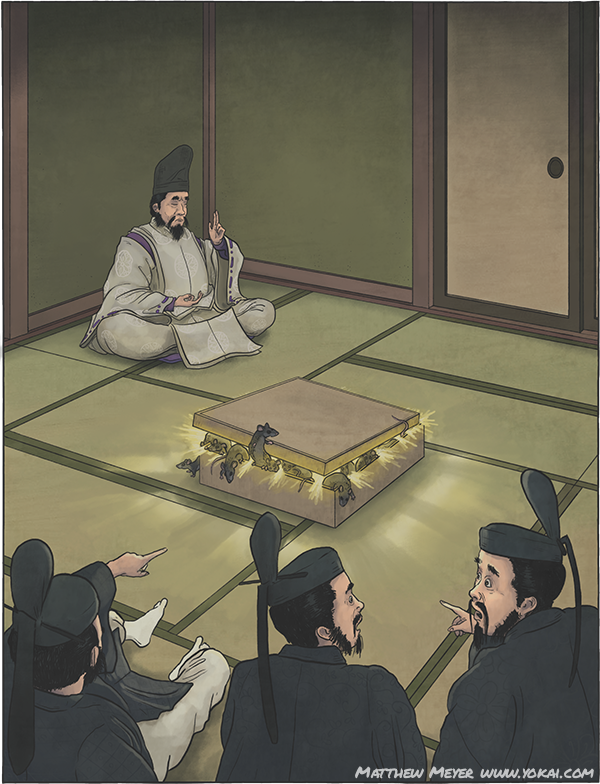
A-Yokai-A-Day: Maneki neko

While we had owls yesterday, today I want to showcase another Halloween staple: cats!

Although this cat is not bad luck like a black cat, but instead is a symbol of very good luck. In fact, you’re probably already familiar with this by its common English name, “lucky cat.” If you’ve ever been to a Japanese restaurant or store, chances are you’ve seen these in statue-form near the entrance. These days, it’s not even uncommon to see them Chinese and other non-Japanese Asian stores, but they are original Japanese creatures. (It’s so rare that you get to see folklore that was invented in Japan make its way to China, because usually it’s the opposite!)

Today’s A-Yokai-A-Day is another request from Patreon from a backer who really wanted to see the maneki neko covered. It was a fun request, because this is one of those creatures that hardly seems yokai-ish. Indeed, while its certainly folklore, it doesn’t seem to have anything strange or eerie about it, and those are hallmarks of yokai-ish-ness (whatever that is!). And while I think most Japanese would not include these in their definition of yokai, some of the folklore around the origins of these lucky idols is clearly square in the realm of eerie, and I think it’s quite fair to say that these fall within the realm of yokai as it is loosely defined.

There are actually quite a few famous stories about the maneki neko, and a few of them claim to be the “original” story that started the entire trend. What’s interesting is that we really can trace the maneki neko back to a certain point (1852) before which there were no maneki neko, and after which they seemed to be everywhere. Wherever it came from, I hope you’ll enjoy the strangeness of the story included, and the art as well!

Click below to read about the maneki neko! And if you want to help me make more of these paintings and translations, become a Patreon backer for just $1 per month and support my yokai work!

Maneki neko

Maneki neko

A-Yokai-A-Day 2016: Tatarimokke

Hello everyone! Tonight is the first of October, and for this site that means it’s time for A-Yokai-A-Day! Every day this month I will highlight a different yokai on this blog.

Our first yokai comes as a request from my Patreon backers. I get yokai requests every day from people who want me to do this yokai or that yokai, and if I had infinite time I would happily paint every single yokai everyone asked for. But I don’t have infinite time, so sadly I have to turn down most requests. I do try to make it a point to paint all of the yokai requests made by my Patreon backers, so (hint, hint) if you have a yokai you’d really like to see me cover, becoming a backer is a great way to make that happen!

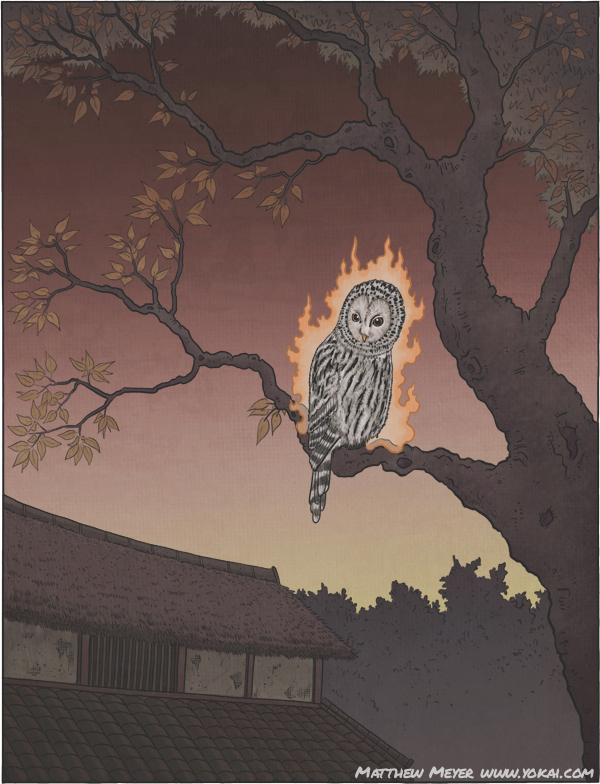
When I first started A-Yokai-A-Day, the purpose was to showcase how Japanese people view ghosts and monsters during the month of October. Halloween is only recently becoming a thing in Japan, so it didn’t really have much to do with Halloween from a Japanese perspective—just the fact that I love Halloween and Halloween season, and these happen to be Japanese monsters. I often tried to pick out the strangest and most original creatures I could find. Well, today’s request was for an owl yokai, and I think that is an awesome way to start the Halloween season, because the owl is such an iconic staple of Halloween that to have an owl yokai seems to be a perfect way to yokai (which normally have nothing at all to do with Halloween) to the holiday.

There aren’t all that many bird yokai out there… As a bird lover I have looked quite a bit, and while of course there are some, comparatively there are fewer birds represented than other animals. The owl seems like such a perfect candidate for a yokai though; it has a creepy facial expression with its enormous, unmoving eyes; it flies around at night; it gives off a strange call; it rarely interacts with humans except for people who go into the woods… All of these are the perfect recipe for a good yokai. So I was happy when I did find a somewhat obscure owl yokai from Aomori Prefecture. Click on the illustration to see the entry on yokai.com:

Tatarimokke

Tatarimokke

Also, I’d like to give a special thanks to everyone who came out and visited my booth at the Collingswood Book Festival today (and a welcome to first-time readers of this blog!). I love meeting my readers face-to-face, and I hope that a few new yokai fans were made today.

If you like today’s yokai, thank my Patreon backers! If you want to see more like it, support my Patreon project, and you’ll get first-look access as well as behind-the-scenes info about how all of my paintings are created, and how I do my work on these illustrations and translations.

Tennyo

Greetings yokai fans!

I’ve been so busy preparing for Comic Con in Baltimore this weekend that I wasn’t able to finish the writeup for August’s last yokai until today! So here it is, just half a day late. Tennyo, the celestial maiden:

天女

てんにょ

TRANSLATION: heavenly woman, celestial woman

HABITAT: Tendō, the realm of heaven in Buddhist cosmology

DIET: as a human

APPEARANCE: Tennyo are extraordinarily beautiful creatures who resemble human women. Aside from their unparalleled grace and elegance, and supernaturally attractive faces and figures, there is little way to differentiate them from ordinary women. They wear beautiful gowns called hagoromo (literally “feather cloth”), which allow them to fly.

BEHAVIOR: Tennyo are servants and courtesans for the emperor of heaven, and companions of buddhas and bodhisattvas. They sing, dance, play music, recite poetry, and do much of the same things as their earthly counterparts in human imperial courts; though they do them all with more grace, refinement, and beauty. They aid and entertain the other inhabitants of heaven, and they even occasionally fly down to earth to visit.

ORIGIN: Tennyo are a female-only subgroup of tennin, one of many celestial races native to Tendō. They are based on the Indian apsaras, celestial nymphs from Hindu and Buddhist mythology. They were brought to China from India along with Buddhism, where they developed into the tennyo we know today. The Chinese Buddhist tennyo was later brought over to Japan.

LEGENDS: Tennyo are a popular subject of folklore throughout all of Japan. Legends often involve love stories and marriage between tennyo and human men. The most famous story is the Noh play Hagoromo.

Long ago, in what is today Shizuoka, a fisherman named Hakuryō was walking along the pine-covered beaches of the Miho peninsula. It was a beautiful spring morning, and Hakuryō stopped for a moment to admire the beautiful white sand, the sparkling waves, the fluffy clouds, and the fishing ships on the bay. A pleasant fragrance filled the air, and it seemed that ethereal music was dancing on the winds. Something caught his eye; draped over a nearby pine branch was a robe of the most splendid fabric he had ever seen. It was made of a soft, feathery material, and was woven in fantastic colors, so he decided to take it home and keep it as a family heirloom.

Just as Hakuryō was preparing to leave, a young woman of breathtaking beauty appeared in the nude before him. She had flowers in her hair, and smelled just as beautiful as she looked. She said that he was holding her hagoromo robe, and asked him to return it. Hakuryō realized that this beautiful maiden was a tennyo. He refused to return to robe, saying it would bring good luck and fortune to his village.

The woman grew sad, and lamented that she would not be able to fly home to heaven without her robe. She dropped to her knees and cried, her tears falling like beautiful pearls into the sand. The flowers in her hair wilted. She looked up at the clouds above, and heard a flock of geese flying by, which only saddened her more as they reminded her of the celestial karyōbinga birds back home in heaven.

Hakuryō was moved by the beautiful maiden’s sadness. He told her that he would return her robe, but first she must perform a celestial dance for him. She agreed to perform the dance, but told Hakuryō that she needed her hagoromo to perform the dance. Hakuryō refused to return the robe. He thought she would just fly off to heaven without performing for him. The tennyo replied to him that deception was a part of his world, not hers, and that her kind do not lie. Hakuryō felt shame, and returned the dress to her.

The tennyo donned her hagoromo and performed the dance of the Palace of the Moon. She was accompanied by celestial music, flutes, koto, and the wind in the pines. The moon shown through the trees and sweet fragrances filled the air. The waves grew calm and peaceful. Her long sleeves danced upon the wind, and she danced in sheer joy. As she danced, she slowly floated up into the sky. She flew over the beach, higher and higher, above the pines, through the clouds, and beyond the top of Mt. Fuji. She disappeared into the mists of heaven.

http://yokai.com/tennyo/

Karura

Greetings, yokai fans!

I’m back from Maine, and it was a great vacation (when I wasn’t getting eaten alive by biting flies that is!). I managed to do quite a bit of painting, and finished this one up over the week. I finished the writeup tonight, after getting home, and am ready to post it to share with all of you. If you remember the ashura entry from the Hour of Meeting Evil Spirits, or are interested in Japanese Buddhism, this should be even more interesting. I hope you enjoy it!

迦楼羅
かるら

TRANSLATION: derived from the Hindu deity Garuda
ALTERNATE NAMES: konjichō (golden winged bird)
HABITAT: Shumisen (aka Mount Meru)
DIET: dragons and poisonous serpents

APPEARANCE: Karura are a race of enormous, fire-breathing demigods. They are humanoid in appearance, with the heads and wings of eagles. They have red skin, and red and gold feathers. Karura are fearsome. They breath fire from their beaks. The flapping of their wings sounds like thunder, and creates gusts of wind so strong they can dry up lakes, knock down houses, and cover entire cities in darkness. Their gigantic wingspans are 330 yojanas wide, and they can leap 3,360,000 li in a single bound. (The lengths of one yojana and one li vary greatly from country to country and era to era—a yojana can measure anywhere between 1.6 km to over 13 km long, and one li can measure anywhere between 400 m and 3.9 km.)

BEHAVIOR: Karura live in Tendō, the realm of heaven. They can be found on Shumisen (known as Mount Meru in English), a sacred mountain with five peaks which exists at the center the universe. They make their homes in trees, and live in cities rules by kings. They are the mortal enemies of the naga—a group of beings which includes dragons and serpents—and feed upon them as their main diet.

INTERACTIONS: Karura are are worshiped in some branches of esoteric Buddhism. Because karura are the enemies of dragons and serpents, they are seen as a counter to things associated with these creatures. They are guardians who keep venomous snakes and dragons away. They protect against poison and disease. They are even helpful against excessive rains and typhoons. Because they are such fierce predators, they are also viewed as destroyers of sin, devouring the spiritual impurities of the faithful just as they devour dragons.

ORIGIN: Karura comes from the Hindu deity Garuda, a giant eagle who served as the mount of Vishnu. Garuda was incorporated into Buddhist folklore, where he became a race of powerful eagle-like devas. They were then later brought along with Buddhism to China, and finally to Japan. The name karura comes from the Japanese pronunciation of Garuda.

Karura are considered to be one of the hachi bushū, the eight legions. These are the eight classes of supernatural beings who were converted to Buddhism by Buddha. The eight races of the hachi bushū are the ten (aka deva in Sanskrit), tatsu (aka naga), yasha (aka yaksa), kendatsuba (aka gandharva), ashura (aka asura), karura (aka garuda), kinnara (aka kimnara), and magoraka (aka mahoraga). All of these creatures are inhabitants of Tendō (the highest state of existence) except for the ashura, who live in Ashuradō (the third highest state of existence).

http://yokai.com/karura/

Genbu

Greetings yokai fans!

I wanted to post this on Sunday but I got into a big fight with the background and so it was delayed a couple of days. But here it is, the final of the four shijin!

玄武げんぶ

TRANSLATION: dark warriorALTERNATE NAMES: genten jōtei (dark emperor of the heavens), showan’ūHABITAT: the northern sky

APPEARANCE: Genbu is a large tortoise or turtle combined with a snake. Sometimes he is represented as two creatures—a snake wrapped around a tortoise—and sometimes he is represented as a single creature—a tortoise-snake chimera. His home is in the northern sky. He spans seven of the twenty-eight Chinese constellations, taking up one quarter of the entire sky. The constellation which makes up the snake’s neck is located in Sagittarius. The constellations which makes up the tortoise’s shell are located in Capricornus, Aquarius, and Pegasus. The constellations which make up the snake’s tail are located in PEgasus and Andromeda.

INTERACTIONS: Genbu is one of the shijin, or Four Symbols, which are important mythological figures in Taoism. Genbu is the guardian of the north. He is associated with the Chinese element of water, the season of winter, the planet Mercury, and the color black. He represents the virtue of knowledge. He controls the cold. He is enshrined in the Genbu Shrine, north of Kyoto’s Imperial Palace.

ORIGIN: Genbu is named differently than the other shijin; rather than directly describing a color and animal, i.e. Black Tortoise, his name is written as gen, meaning dark, occult, or mysterious, and bu, meaning warrior. The word tortoise is not used for his name, because it was also used as a slur in China. So this euphemistic name was used to refer to the Black Tortoise. His name comes from Chinese mythology, where it is with the Taoist god Xuan Wu (the Chinese pronunciation of Genbu). Xuan Wu was a prince who lived in prehistoric northern China. He lived in the mountains, far from civilization, where he studied Taoism as an ascetic. He learned that to achieve full divinity, he would have to purge both his mind and body of all impurities. While his mind had become enlightened, he still had to eat earthly food, and so sin remained in his stomach and his intestines. So he cut them out and washed them in a river to purify them. When he did this, his stomach turned into a large demon tortoise and his intestines into a demon snake. The demons began to terrorize the countryside. Xuan Wu subdued them, and instead of destroying them he allowed them to atone for their sins by serving him. They became his generals: a snake and a tortoise. It is these two generals which became Xuan Wu’s—and Genbu’s—symbols.

Genbu is associated with yin energy—the forces of darkness and shadow—and in ancient China was worshipped as a god of the moon (another strong yin force) in addition to being the god of the north. Because the shell of a tortoise is like a suit of armor, Genbu is also viewed as a warrior deity. The tortoise shell is a symbol of heaven and earth, with the flat part of the lower shell representing the world and the dome of the upper shell representing the heavens. As tortoise shells were a popular tool in divination, Genbu was also viewed as having soothsaying powers and the ability to travel between the lands of the living and the dead. The tortoise is a symbol of longevity and immortality, while the snake is a symbol of reproduction and multiplication. It was believed that all tortoises were female and had to mate with a snake to reproduce. The intertwining of the two was a symbol not only of long life and fertility, but also of the balance of yin and yang.

In later centuries, as belief in onmyōdō waned, the Four Symbols were gradually replaced by the Four Heavenly Kings of Buddhism. Genbu and his symbols were largly absorbed and supplanted by the Buddhist king Tamonten.

Read it at http://yokai.com/genbu/

Byakko

Greetings yokai fans!

Today’s illustration is byakko, the white fox. Not to be confused with byakko, the white tiger. Yes, they’re homophones, but written with different kanji.

This entry will be a bit different, as I don’t have a full writeup on it to share, and it won’t be hitting yokai.com for some time. The reason for that is that I am still restructuring about 10 kitsune posts for the book, trying to come up with the best format and the best way to distribute information among the many types of kitsune. So I haven’t decided just how to do this one’s write up yet. Since I’m busy working on preparing for the Kickstarter as well, finalizing the kitsune writeup will take a back seat until at least December.

But just to give you a brief description, byakko literally means “white fox” and they are the kitsune who serve Inari. In other words, the Shinto kitsune. When you see foxes at a shrine, they are almost always byakko.

We’ve seen a few examples of byakko on yokai.com. Kuzunoha, the mother of Abe no Seimei was a byakko. Also, myobu is a specific rank of byakko — the elite byakko who serve Inari’s inner court would be myobu. They’re mostly good, but not necessary 100% good. Plenty of byakko still play pranks on humans, before they eventually shed those nasty traits and become more enlightened foxes later in life.

Byakko are one of the “families” of foxes. Other families are marked by their colors as well; black foxes, gold foxes, silver foxes, red foxes. We’ll look more at those soon. For now, enjoy this patrons-only illustration. 🙂

Suzaku/Sujaku

Greetings, yokai fans!

Tonight I bring you Suzaku, the red bird of the south. Incidentally, I was just outside admiring the sky and saw red Mars next to the Moon in the southern sky; although Mars has nothing to do with this constellation other than both being quite beautiful and red…

The research for this painting went much like the one for Seiryuu; I modeled a picture of the sky and matched the constellations of the southern sky with an old diagram of the shijin from a Chinese astrological book. The building you see is Suzakumon, the no-longer existent gate on the southern end of the ancient capital cities. This model is based on a reconstruction of what old Nara’s Suzakumon gate probably looked like, though it is not certain.

This post was made possible by the generous support from my Patreon backers. If you like yokai and want to learn more, please consider pledging $1 per month to support my work.

Become a Patron!