A-Yokai-A-Day: Namahage

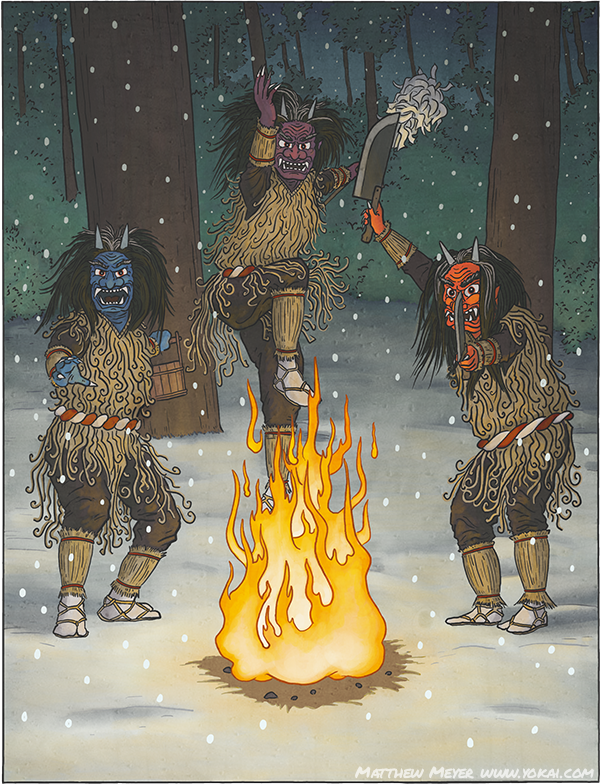
Namahage is a really well-known yokai, famous across Japan—which is strange when you consider that it is only a local yokai from the small, northern prefecture of Akita. For a prefecture that has barely over 1 million people, it has managed to leave its mark on the national consciousness of Japan.

Part of the reason namahage are so well known is because of the namahage festival which is televised nationally. Although many prefectures have yokai that behave similarly to namahage, Akita’s own yokai manages to have the most exciting way of celebrating. I have never seen the namahage in person, but watching them on tv is always fun.

During the festival, cameramen follow the namahage, local villagers dressed up in costume. The namahage act fierce but are actually quite nice. The most entertaining part of this festival is the way it doesn’t quite work the way it is expected to. What is supposed to happen is that the namahage will come up to the young children and menace them, waving knives and screaming “Any bad kids here???” and the kids are of course supposed to say, “No! We’re all good kids!” It’s like the boogeyman, really: they are meant to scare children into behaving. In reality, though, you end up seeing a bunch of people getting really into their costumes and going way over the top with their scary acting. The kids are so terrified they are unable to answer, and just scream and screeeeeeeeeeeeeam, tears and snot running down their face. They are never even able to answer “no,” they just scream and break down instantly. So the namahage move on to the next bunch of kids and try again.

The cameramen follow them the whole time, so what you get to see on TV is close up after close up of children screaming their brains out, one after another. And you catch glimpses of the moms and dads laughing their heads off at their helpless kids who are freaking out from the scary namahage. Watching it, you can’t help but laugh along. You feel slightly guilty and bad for the kids, but when you see it over and over, it’s just so hard not to start laughing.

Of course once the kids are a little older, they all come to love the namahage as all Akita residents do, and the tradition carries on. Sadly, as the number of people having children declines every year in Japan, some local areas are no longer able to carry out these festivals. There is no shortage of people willing to dress up and be the yokai, but there is a shortage of children to scare. For this reason, local variants of the namahage are in danger of disappearing altogether as small towns are absorbed into bigger cities and lose their local identities. In a way, you can say that these yokai are an endangered species.

At least for now, the namahage is not in any danger of disappearing, due to its immense national popularity.
Namahage

You’ll find namahage and many more yokai in my latest book, The Hour of Meeting Evil Spirits. Available from amazon.com in paperback and Kindle formats!

A-Yokai-A-Day: Obariyon

I’ve written a little about yokai themes these past few days, but today’s yokai is another interesting theme: it is often considered to be a metaphor for child-rearing.

Like in many cultures, bringing up children is a very important part of Japanese culture. Motherhood and fatherhood are difficult tasks, and highly respected according to traditional customs. Unsurprisingly, there are many yokai which reflect this duty in one way or another (either cynically or sincerely).

Child-rearing yokai legends usually begin with strange creatures that require something—often this is food, or candy, or even asking a stranger to hold their baby. Nure onna and ubume come to mind, as does the kosodate yurei, which we will look at later this month. The specific details vary from story to story, and sometimes the person who offers support is killed, while sometimes the person is rewarded for their efforts.

In the case of today’s yokai, all that is required is a piggyback ride. However, after giving the piggyback ride, the yokai becomes unbearably heavy and starts chewing on your head. In these legends, those who are able to put up with the pestering yokai are rewarded with gold in the end. The metaphor is not hard to see: those who are willing to love and care for children, sacrificing what they have in order to make the lives of their children better—even when those children are unbearably annoying—will one day reap great rewards.

If only raising a child were that simple!

Today’s yokai is brought to you by request of my Patreon backers! If you have a yokai you’d like to see, please consider joining my Patreon project for $1 per month!

obariyon-watermark

A-Yokai-A-Day: Ippondatara

A lot of yokai have recurring themes to them: prostitutes, priests, young boys… these are not coincidences. These different classes of yokai are all there for reasons. In some of the cases, they are commentaries on societal problems that Toriyama Sekien and other yokai-ologists saw in Edo period Japan.

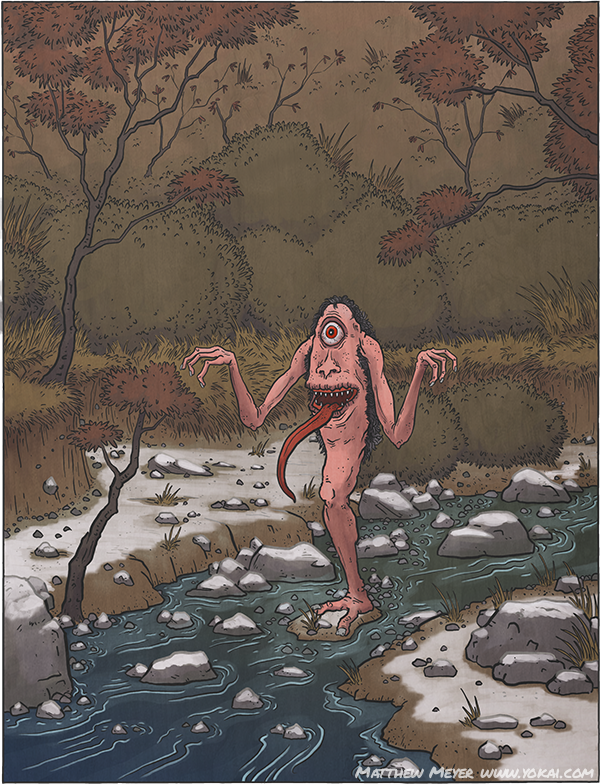
Another commonly recurring theme is having one eye. A number of yokai have this trait, ao bozu, hitotsume nyudo, hitotsume kozo, yamajijii, dorotabo, ippondatara of course… the list goes on and on. So where does this trait come from. Why are there so many one-eyed gods?

The most common theory is pretty interesting, and it is related to yesterday’s topic: just what makes a yokai a yokai and not something else? Scholars believe that many one-eyed yokai may actually be former mountain gods who were forgotten over time and corrupted into yokai.

You may have heard that Japan is the land of 8 million kami. That’s not really an exaggeration either. There are kami everywhere. Every river, every tree, and yes, even every mountain has its own local kami. Of course beliefs change, populations move, and oral traditions evolve, so those kami may change over time, or be forgotten, or be replaced by other kami brought in by migrants. And what happens to the old kami that get demoted? Maybe they turn into yokai.

Ippondatara’s story is particularly interesting because not only is he attached to a very specific place (a mountain range located between Nara and Wakayama) but he is also attached to a very specific time (December 20th). Why this day? Well, it is very close to the winter solstice, when fall ends and winter begins. Perhaps that was a holy day related to some long-forgotten god of those mountains between Nara and Wakayama… In that area, children are warned to stay out of the mountains on that day, and it is considered unlucky. Why? Maybe the change from bountiful fall into cold, dead winter was associated with death or misfortune in some old local superstition? Changes in the season are also strongly associated with yokai and evil spirits. In some area, kappa are said to transform from water spirits into mountain spirits (maybe even gods?) during the change from fall to winter. Perhaps that day was associated with kappa migrations? Perhaps ippondatara picked up parts of that legend over time?

All of this is purely speculation. Nobody knows for sure, and that is part of the appeal of folklore. There is this hint, just a faint whiff of a truth buried in there somewhere. We can look at the oral traditions and remnants of ancient legends passed down, with all of the changes, additions, and subtractions applied over the centuries, and try to figure out what, if anything, it means. But looking at all of these points; the date, the one eye, and the similarities between other yokai, it seems impossible that there isn’t some connection doesn’t it? Ippondatara must fit in there somewhere. Of course, we probably will never know… but then, that’s the fun of it! If we knew for sure, he wouldn’t be a yokai would he?

Ippondatara

A-Yokai-A-Day: Yamata no Orochi

Today’s yokai is really fun because not only is it imposing and awesome, but it is one of the rare creatures with a longer legend behind it, instead of simply a few sentences in one of Toriyama Sekien’s books. But first, an interesting question: what exactly is a yokai?

I ask this because invariably, when a famous creature like Yamata no Orochi, or kirin, or tatsu, etc. are brought up, someone is going to say, “I thought XX was a bakemono, not a yokai!” or “Wow, XX is a yokai? I had no idea!”

It’s a strange question, because how do we really classify made-up creatures? Where is the line between yokai and yurei, or yokai and kaiju, or even yokai and monster? And even though it seems strange to pick nits over imaginary creatures, it is something that we have been doing for a long time—at least as long as we have been classifying real creatures! Even back when Toriyama Sekien was writing his books, he was developing something like a Linnaean taxonomy for them.

Generally, if you ask any number of yokai-ologists (is that a thing??) to define a yokai, you will get as many definitions as you have people. Most of the time, the similarities are just too vague to truly iron out. One story might seem to draw a clear distinction between certain characteristics of a particular yokai, but then another story might blow those distinctions to pieces.

For example, some people might argue that a kirin is a kami, not a yokai… but then in some places, kappa and hyosube (to name a few) are worshiped as kami and even have their own shrines. Does that mean kappa are kami as well? Many ghosts are also worshiped as kami, such as the famous Tenjin-sama, who is the god-version of the yurei Sugawara no Michizane. So is he not a yurei? Some might say that yurei are the spirits of people, but then are onibi ghosts or yokai or something else? The vagaries are endless, and it becomes impossible to pin down a truly authoritative definition.

And then, of course there are the similar terms bakemono, mamono, mononoke, and so on… where does it end?

So what most foklorists do is use the term “yokai” as a very vague descriptor. Is a kirin a kami? Yes, and it is also a yokai. Same goes for yurei. Sugawara no Michizane is a yurei, a kami, a yokai, and a person. Some people, like Mizuki Shigeru for instance, will even go so far as to say that Dracula, the Wolf Man, even hobgoblins and bugbears are kinds of yokai!

Personally, I prefer to put a few limits on my use of the word. I don’t include Western monsters in my definition of yokai. I also tend to exclude Asian monsters that don’t have a strong Japanese character to them. For example, many many yokai were imported to Japan from China. Plenty were even just copied out of Chinese bestiaries. I would consider them to be yokai; however, I would not consider their native Chinese versions to be yokai. There is a similar term in Chinese—yaoguai (which is pretty much the exact same word)—which might decribe them perfectly well, but I try to keep a strictly-Japanese definition.

I also don’t include modern pop-culture creatures as yokai. Pikachu, Usapyon, Godzilla and other kaiju, and so on do not fit my definition of yokai. This is a much more arbitrary decision, as it is hard to draw a line. After all, I consider kuchisake onna, hanako-san, and teketeke to be yokai, even though those are very modern urban legends—younger than Godzilla, even. But they are missing something… a “folk” quality to them. Even though plenty of yokai were created by Edo period illustrators for commercial purposes, something feels different about those. There is a quality to them that is different from Pikachu and Godzilla. Perhaps one day, in a few decades, kaiju and pokemon will join the ranks of yokai… but not for a while in my book anyway.

I also tend to exclude a lot of kami. Animal kami I feel fit the description of yokai very easily. Plenty of people consider kitsune, for example, to be kami. But they are also yokai… However, gods like Amaterasu or Izanagi certainly don’t feel like yokai. There is a more official, ceremonial, or even mythical aura to them as opposed to a vengeful ghost-god like Sugawara no Michizane. Gods that were part of the early mythology of Japan don’t have the same essence as the later additions. This area is much harder to draw the line at… The gods that tend to be “yokai-like” are the gods that have a strong folk lore to them. For example, yokai that were enshrined in a local village, or folk heroes that were deified like Taira no Masakado.

So what does that leave us? My broadest definition of yokai would be “a creature or phenomenon from Japanese folklore.” Not very descriptive… But to clarify it a bit further, it can include gods, ghosts, unexplained occurrences, and monsters. It can also include foreign imports, as long as they pick up a uniquely Japanese identity. Gods/kami can be yokai, but usually are not. Legendary beasts straddle the line between kami and yokai, but I think they can be safely included in both.

Yamata no Orochi is a good character to bring up because he straddles many of these definitions. He is a mythological beast. Some even call him a god, and he interacts with gods in the creation myths of Japan. Yet he is also truly monstrous, and a lot of folk lore surrounds him. (He doesn’t really fall into the yurei sphere at all, so we’ll have that be.) I think that we can safely say that he is all of the above; legendary beast, monster, god… and definitely a yokai.

Of course, there is no “right” answer to this question. I take some comfort in the fact that most of the professors and yokai-ologists I have heard tend to agree with my own definition, more or less. But I have no real argument with those who disagree either. At most, it can become a fun dinner-table discussion. If you are having dinner with the right people, of course!

Click on the image below to read about Yamata no Orochi. Or, get my book The Hour of Meeting Evil Spirits and keep Yamata no Orochi on your bookshelf!

yamata no orochi

A-Yokai-A-Day: Abura akago

Today let’s look at another child yokai, though this one isn’t nearly as creepy as last night’s. This yokai is quite interesting because it fits a few different themes: 1) it is a child, 2) it is a fireball, and 3) it is related to oil.

All three of those are very common recurring themes in Japanese folklore. Children, because why not? Children can be creepy, and if there is one thing Japanese horror knows how to do it is creepy children. They have a charm that most people quickly fall for, so how would you know if a child were evil? It would be very difficult, because most people would just refuse to see it out of natural love for children.

Fireballs are another very common theme. Hi no tama is one of the broadest genre of yokai, containing a huge number of varieties. Perhaps this is because there are a lot of natural phenomena that are create eerie lights; bio-luminescence from fish, decaying plant matter, fireflies that blink on and off. And of course we notice these lights at night, when the shadows play tricks on us and our imaginations go wild.

Oil is not as common as the other two, but it is a recurring theme in yokai. We see it in abura sumashi, cats which drink oil and become bakeneko, rokurokubi which like to lick oil… Oil was a very precious commodity in old Japan. It had to be collected from fish or whales, or else pressed from plant seeds. It was very hard work, and with such a small amount of oil to be collected, it was extremely valuable. Many of the oil-related yokai were turned into monsters because they stole oil, or drank it up. The wasting of precious resources has long been frowned upon in Japanese culture, and oil is no exception.

Click below to read about the story behind today’s yokai. He comes from The Hour of Meeting Evil Spirits, available on Amazon.com.

Aburaakago

Abura akago

A-Yokai-A-Day: Kekkai

I mentioned at the start of the month that I like to start out with a few cute yokai and gradually move in to the scarier ones. We’ve seen a couple of cuter yokai now, so today I thought it was time for a scary one. And this one definitely ranks up there with the scarier yokai!

This painting is brand new, and has not been featured in any of my books yet. It is thanks to my Patreon backers that I am posting it tonight. In fact, it was a request which came through my Patreon project. So if you like it, please consider joining for $1 or more per month. Backers get various rewards, like doodled postcards from me, art prints, having a say in what yokai I paint next, and you get to see the process that goes into making these yokai. In essence, it’s like having A-Yokai-A-Day happen year-round! So if you like yokai, you should definitely become a backer!

I won’t give away the story behind this creepy yokai on this blog. Just click on the creepy picture to read its entry on yokai.com:

Kekkai


A-Yokai-A-Day: Sesshō seki

Like yesterday’s yokai, today’s yokai has been featured once before on this site, years ago. I re-imagined the illustration and made a new writeup on it for The Hour of Meeting Evil Spirits, mainly because it would be impossible to include Tamamo no Mae without including Sesshō seki, the stone which her spirit haunted for many years.

I also think it forms a really nice little capstone on the Tamamo no Mae story—and fortunately for me, this one is totally canon, so there is no question over whether it is “real” folklore or not (as much as I cringe when I describe folklore as real or not…)

Speaking of whether certain aspects of folklore are “real” or not, tomorrow is somewhat of a big day for yokai in the US. Tomorrow, the yokai-themed TV show that has taken taken Japan by storm, Yo-Kai Watch, hits American shores via the Disney channel. Yo-Kai Watch (I hate that they hyphened it, but oh well… I’m sure the hyphen will fade over time as people get used to the seeing word) has become so popular in Japan that it has totally devoured Pokemon. Jibanyan has overtaken Pikachu as the most popular character in Japan, so I’m wondering what the reception will be like over here. Since Pokemon itself is very yokai-like, and a lot of Pokemon even came directly from yokai, it seems like Yo-Kai Watch was invented just to eat into that particular market. And so far it has done a great job.

But you “real” is Yo-Kai watch, really? There are a lot of cute characters, that’s for sure. But while Jibanyan is a nekomata and a few other characters are also recognizable yokai, there is also a large element of artistic license. Usa-pyon, for example, is something completely made up for the show. Will Yo-kai Watch end up changing the definition of the word yokai by adding new characters to the already enormous list of yokai?

While part of me is glad that the word yokai is about to become a household word in America, part of me also grumbles that these are not “real” yokai. But then, I have to ask myself why I really say that… After all, so many of what we consider “real” yokai were just creations by Toriyama Sekien and other Edo period artists. In fact, so many of these were created solely for the purpose of selling books, so you can’t even make the argument that TV shows are purely commercial in nature rather than literary, because so are many of the old yokai! I suspect that after a character has existed for a generation or two, it takes on an air of authenticity. Maybe a few decades from now, characters like Pikachu and Jibanyan will be considered just as authentic yokai as Tofu kozo and Mikoshi nyudo. So I tell myself that I grumble for no reason at all. It is a great thing that a popular TV show will be introducing children over here to the world of yokai, and if it causes them to gain an interest in history and traditional folk tales, all the better. So here’s to Yo-Kai Watch and the soon-to-come yokai explosion in the US!

As always, click on the photo below to learn about today’s yokai. It can can also be found in my new book The Hour of Meeting Evil Spirits. Order it now from Amazon.com.

Sesshō seki