A-Yokai-A-Day: How Sandayū From Chikuzen Province Slept With a Ghost

Tonight’s story deals with a yūrei, or a ghost. We’ve seen a few horrific monsters so far, but, while there is no shortage of terrifying ghost stories, tonight’s story is more on the eerie side than the scary side. Sandayū is quite lucky, in fact, because just two days ago we had another story about a man sleeping with a ghost, and that one turned out poorly for the main character…

How Sandayū From Chikuzen Province Slept With a Yūrei

There was a merchant from Chikuzen Province named Sandayū. Every year he brought goods to Ōsaka to sell, and he would stop at Amagasaki and stay at an inn called Akitsuya.

One of the servants at Akitsuya was a girl named Sasa, and the innkeeper always sent her to Sandayū’s room to be his companion for the night. This continued for several years, but then for some reason Sandayū did not visit Amagasaki for a long time.

Several years later, he went to Ōsaka and once again stayed at Akitsuya. The innkeeper served him a variety of foods and sake, and then jokingly said, “If only Sasa were here…” Sandayū figured that Sasa must have gone out on an errand, and since it was getting late, he hung his mosquito net and went to bed alone.

In the middle of the night, he thought he saw a person climb into the mosquito net; it was Sasa. Sandayū was delighted and said, “It’s been such a long time! Where were you during the day?”

Sasa replied, “I don’t work here anymore. You must never tell anybody that I came here tonight.”

Sandayū wondered if she quit because she did not like it there anymore, or if she maybe got married. He asked her all sorts of things, but she would not give him any details. So, they spent the night in heartfelt conversation, reminiscing about the past and imagining the future, and before long it was almost dawn.

“It is time for me to go,” said Sasa, and she got up to leave. Sandayū, sad to see her go, gave her a white, single-layer kimono as a keepsake. Sasa thanked him, cloaked herself in the kimono, and then went out the front door.

Sandayū, filled with concern, followed afterwards, and saw her heading west out of Amagasaki. He thought she was headed towards Nishinomiya, but instead she went towards Naniwa, and then by the banks of a river she vanished into thin air.

That morning, Sandayū asked the innkeeper, “Where is Sasa living now?”

“That’s the thing…” replied the innkeeper. “Sasa died of a light illness this past spring. On her deathbed, you were all that she talked about.”

Sandayū was shocked. “Well now, I have a strange story…” he said. And he told the innkeeper what happened the previous night.

The innkeeper was also shocked and said, “Take me to where you saw Sasa disappear!”

So Sandayū took the innkeeper along the same route, and they found the graveyard where Sasa was buried, and the white kimono hanging from her grave. The two men felt a sense of wonder, and they made offerings for her spirit.

Afterwards, Sandayū inherited his father’s position and became a servant of Lord Kuroda Uemon. Nowadays, everybody knows about this.

A-Yokai-A-Day: How Tanba Sarugaku Was Caught by a Henge

The yokai in tonight’s story is only referred to as a henge. Like bakemono from a few days ago, henge is a fairly generic term for a monster and doesn’t really reference anything specific. The word comes from the word for “transform,” and it is frequently used to refer to monstrous apparitions created by tanuki or kitsune, but is not strictly limited to those either. The licking reminds me of shitanaga uba, but this yokai is a young girl, not an old hag.

Whatever it is, I really like this yokai. It totally creeps me out.The plain and simple way the creature is described as licking the baby away to nothing, like a tootsie roll pop, gives me the shivers. It doesn’t over-describe, where many English-language authors would take the the time to describe in exceeding detail. The way the horror is just limited to one brief sentence leaves so much to the imagination. This one and the bone-sucking monster are perhaps my two monsters in this book.

Also, the ending to this tale is just horrible. It’s so sudden, and so meaningless. Why did this happen? And how do you recover from an experience like this?

Terrifying.

How Tanba Sarugaku Was Caught by a Henge

Tanba Sarugaku, along with twenty or so people including his wife, children, and disciples, were on their way to Kyōto. One night the sun set while they were in the mountains, and they had no choice but to spend the night there. His wife was in the month of childbirth, and that night she gave birth to their child, so they were busy taking care of many things until dawn broke.

As the night gave way to dim light, a woman of around twenty years old passed by. Seeing her, Sarugaku called her over to him: “I don’t know who you are, but your timing is perfect. I hate to ask, but could you please help hold this child for a while?”

She replied, “That would be no problem.”

She took the child in her arms, and everyone was able to get some sleep. The woman began slowly licking the child’s head. When Sarugaku woke up, he gazed closely over at the woman, and noticed that she had completely licked the child up.

Sarugaku was shocked, and he woke up his disciples. All twenty of them got up immediately, but no sooner had they done so when something grabbed each of them out of nowhere and dragged them up into the sky. Sarugaku was left there alone. Then a raspy voice came from the sky: “Take that last man too!”

The woman replied, “I thought I should take him too, but I can’t because he is carrying a fine sword.”

Then the voice from the sky said, “If you can’t take him, then help me! Help me!”

The woman vanished into thin air, and Sarugaku was left dumbfounded. He waited around for dawn to break, but by the time it did, it was already 4 pm.

A-Yokai-A-Day: How the Power of Sake Overcame a Bakemono

Greetings yokai lovers!

October has arrived and Spooky Season is upon us! Welcome to another year’s season of A-Yokai-A-Day! Every day this month I will translate, illustrate, and post one spooky Japanese folktale on this site. Feel free to join me in sharing yokai online using the #ayokaiaday hashtag!

This year continues where last year left off: the Edo period story collection called Shokoku hyakumonogatari, or “100 Tales from Various Provinces.” This book was published by an anonymous author in 1677, and thus lies in the public domain. Scans of the book are available online, but the old script and archaic language is difficult to read, so I am also making use of digital OCR tools to transcribe the text, as well as a modern Japanese translation of the book by Shimura Kunihiro.

As far as I am aware, Shokoku hyakumonogatari has never been translated into English, although some of the stories have appeared in other publications. So this may be the first time at least some of these stories have been read outside of Japan!

Tonight’s story takes place at a very famous site in Kyoto, which visitors to Japan may be familiar with: Sanjūsangendō.The story pattern is a famous one, and there are many variations of this one all over Japan, so you may have heard another version of this somewhere else. There are a few words I chose not to translate in tonight’s story, because they don’t have good English equivalents (or I just prefer them in Japanese):

bakemono – a generic term for a monster; tonight’s story never specifically names what creature is responsible for the haunting

rōnin – an unemployed, landless member of the warrior caste; generally not a very respectable thing to be

chigo – an adolescent page boy or acolyte, often dressed and made up to look like a beautiful girl, and often kept in a pederastic relationship with an older man

How the Power of Sake Overcame a Bakemono

People do not go to the Great Buddha of Sanjūsangendō after 4 pm because of the presence of a bakemono. When the emperor heard of this, he put up a public notice declaring that if anyone defeated the monster, they would be granted anything they wished.

A certain drunkard rōnin went before the emperor and declared, “I shall subdue this monster.” Then he filled a bottle gourd with sake, went to Sanjūsangendō and waited in a corner of the hall. Sure enough, in the dead of night, a nearly three meter tall priest, with eyes shining like the sun and moon, reached out and tried to grab the rōnin with its rake-like hands.

The rōnin immediately lowered his head to the floor and said, “Are you the bakemono-sama that I have heard so much about? Please allow me to introduce myself.”

Hearing this, the bakemono let out a dreadful laugh: “Well, well, aren’t you a funny thing. I was going to eat you in one bite, but I’ll hold off for a moment. So, why did you come here?”

The rōnin replied, “I came here for some reason; but Master Bakemono, I have heard that you are able to transform into many things. Would you show me by transforming into a beautiful noblewoman?”

“You are a clever one. I will transform as you wish, and then I will eat you in one bite,” said the bakemono, and then he transformed into a giant noblewoman.

The rōnin replied, “Well now, this is interesting! Could you also transform into a chigo?” And the monster transformed into the form of a beautiful chigo.

“Well that is just wonderful!” said the rōnin. “Next could you transform into an oni?”

The monster became a three meter tall oni and waved his horns around in the air.

The rōnin said, “Master Bakemono, you are a skilled artist! You can transform into anything you wish. But, how about turning into something small like a dried plum?

The bakemono said, “If I turn into a dried plum, will you let me eat you already?”

“You don’t even need to ask!” replied the rōnin.

“Then I will show you,” said the monster. And he transformed into a tiny dried plum and rolled around on the floor.

“What a marvelous transformation! Climb up onto my hand!” said the rōnin, putting out his hand. The plum rolled onto the palm of the rōnin’s hand, and he popped it straight into his mouth, chewed it up, and washed it down with seven or eight drinks from his bottle gourd. Then he scurried away in a drunken stupor.

“I subdued the bakemono!” the rōnin declared to the emperor. The emperor was overjoyed, and he awarded the rōnin a generous fief to rule over. This is truly the power of sake.

Summer Exhibitions & Events

Hey readers! It’s been a long time since my last post, and there’s been a lot of things keeping me busy. For most of this year I’ve been focused on finalizing The Palace of the Dragon King and preparing the rewards for Kickstarter backers. Rewards like posters and ebooks have already shipped out, while physical books will begin shipping out in just a few weeks.

Although I’ve been posting my activity regular on social media and my Patreon, I neglected to update my events on this blog. But here are a few exhibitions I’ve been involved in this summer:

Yokai exhibit at Shikura Gallery in Echizen City:

Fukui Yokai Fes and Mononoke Ichi in Fukui City:

Summer may be over, but I have more exciting events coming up very soon! I’ll be posting about them soon here, over on yokai.com, and on social media. So check back soon!

A-Yokai-A-Day: How Genshin of Mt. Hiei Saw Hell and Came Back

Greetings yokai lovers, and happy Halloween!!! 🦇🦇🦇

Tonight’s is the final story in this year’s A-Yokai-A-Day. Thank you all for reading along! I hope you enjoyed these stories and paintings (and my wife’s paintings, when my broken arm held me back).

If you’re reading this and not yet a patron, you should know that starting tomorrow most of my new posts will go back to being patrons-only, instead of being publicly visible. So if you’d like to keep reading my newest stories, learn even more about yokai, and keep up with what I’m working on (including news about when my next Kickstarter will launch…) there’s never been a better time to become a patron!

If you want more stories and art, you can also order my books from Amazon, or even get the special collector’s editions from Yokai.com’s web shop. (Books ship from Japan, so order soon if you want them in time for Christmas!)

Tonight’s story features another famous historical figure: Genshin. One of his claims to fame is a book called The Essentials of Rebirth in the Pure Land, in which he describes in graphic detail the Buddhist hells and urges Buddhists to aim to be reborn in the Pure Land, a cosmic realm not unlike heaven, free from pain and suffering, filled with the sweet music of karyōbinga and gumyōchō, where anybody at all can strive to attain buddhahood without the distractions that are found in any of the other realms of existence. After reading this story, it seems no wonder that Genshin is an expert on hell!

There are two yokai named in tonight’s story. One is an oni, which we are all familiar with. The other is a rasetsunyo. Rasetsunyo means “female rasetsu,” and rasetsu is the Japanese word for the Sanskrit rakshasa (the females of which are called rakshasi). Rasetsu are powerful evil spirits which live on earth and feed upon human blood. They can fly, change their shape, and even become invisible. They have vampire-like fangs, and are especially good at seducing humans. But from this story, it appears they are no match for the power of an oni.

The purple cloud at the end of the story is a symbol of the Western Pure Land of Amida Nyōrai. When a devout practicioner is on their death bed, it is said that Amida comes to them on a purple cloud and takes them away to Gokuraku Jōdō. The final scene demonstrates the salvatory powers of Genshin’s prayers.

—-

How Genshin of Mt. Hiei Saw Hell and Came Back

During the reign of Emperor Ichijō, a virtuous teacher named Genshin lived on Mt. Hiei. One time, while traveling down the mountain to the capital, it suddenly started to rain, and a beautiful woman came running up to him from behind and cried in anguish. When Genshin asked her what was the matter, she replied:

“I am a rasetsunyo. I serve an oni who commands me to deceive humans, by taking the form of a woman when approaching a man, or the form of a man when approaching a woman, and bring them to the oni to eat. The oni said that if I don’t catch anyone, it will eat me instead. I haven’t caught anyone today, so I will surely lose my life. I pray that by your dharmic power I might be saved. I humbly beg you. If you think I speak falsely, then follow me and see.”

She went away, and Genshin went after her. They reached a mountain ridge, and night fall. Genshin followed her deeper into the mountains, and they came to a gate. The woman knocked on the gate, and the terrifying voice of an oni was heard. The gate opened, and the oni was furious at her lack of prey. Many oni gathered around her, spitting flames from their mouths. They tore off the woman’s limbs, ripped them into pieces, and devoured them in a dreadful scene.

Genshin took pity upon her. He returned to Mt. Hiei, and he recited scriptures and performed a solemn memorial service for her. That night, the woman came to him in a dream, riding on a purple cloud, with a beatific expression on her face. She turned to Genshin and said:

“Thanks to my teacher’s dharmic power, I was reborn in heaven, and I became a buddha.”

She bowed three times, and then went off into the west.

A-Yokai-A-Day: How Hashii Yasaburō Ferried a Ghost

Greetings yokai lovers!

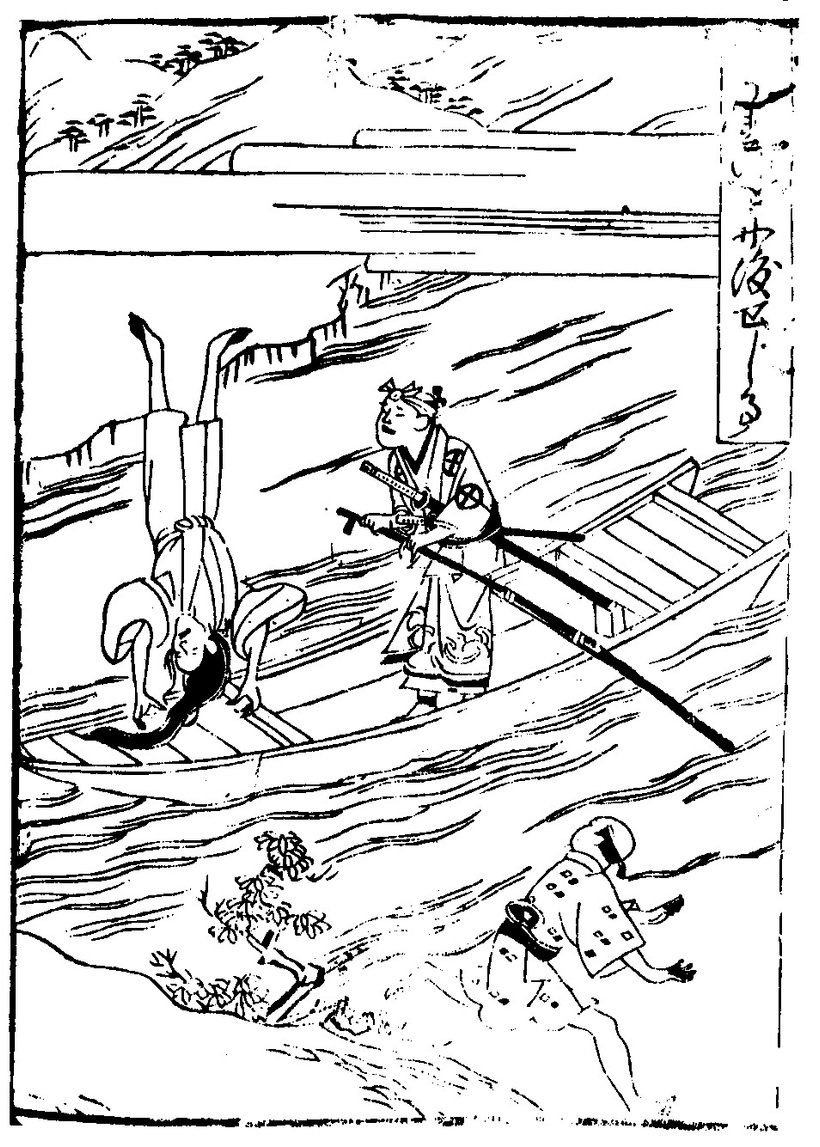
Tonight’s story is one of my favorites in Shokoku hyakumonogatari. Something about the ghost being upside-down is so creepy and visually striking. Not only that, it’s part love story, part revenge story, and the ghost is both sympathetic and terrifying. Good stuff!

Upside-down ghosts are no stranger to Japanese folklore. In fact, there’s even a name for it–sakasa yūrei–and one appears in 1853’s Kyōka hyakumonogatari as well. As for upside-down yokai, sakabashira also comes to mind, and carries the same notion of being placed upside-down as a method of torture. Another famous example is the upside-down woman’s head from Inō mononoke roku. The upside-down position kind of mirrors the position of those suffering in mugen jigoku, the endless hell from which there is no redemption; falling, head first, into the pit for all of eternity.

There’s only one day left of A-Yokai-A-Day, so I hope this one gives you sufficient chills!

Oh, and here is the original illustration:

—-

How Hashii Yasaburō Ferried a Ghost

Among Lord Oda Nobunaga’s retainers was a samurai named Hashii Yasaburō who was well-versed in both the literary and military arts. Later, while in Kiyosu in the service of Lord Bingo, he maintained a deep romantic relationship with Lady Inuyama’s son, to whom he traveled eleven kilometers to see every night.

One night after his night watch was over, he went to Inuyama, when it suddenly started pouring rain. The night was terribly dark and lonely. Along the way there was a river ferry. He called out for the ferryman, but he must have been sleeping downstream, as he did not answer. Yasaburō stood resting by the water’s edge and gazing up and down the river, when a fire appeared upstream. He watched it get closer and closer, and he saw a woman with long, disheveled hair, flames billowing from her mouth, walking upside-down on her head. Yasaburō drew his sword and called out, “Who’s there!”

The woman let out a painful cry and said, “I am the wife of the headman from Yamura across the river. My husband conspired with his mistress, and strangled me to death, and then buried me upside-down so that my spirit could not come back upstream to get him. I want to avenge my death, but it is difficult to cross the river upside-down like this. Ah! I hoped to meet a person brave enough to take me across the river. I have been watching the people who cross here, and there is none as brave as you. Please, show me compassion and take me across the river!”

Yasaburō agreed, and he called the ferryman. “Take that woman across to the other bank in your boat,” he said. But upon seeing the woman, the ferryman threw down his oars and fled.

Yasaburō retrieved the oars, picked up the woman and put her in the boat, and then rowed to the opposite shore. Then the woman pointed towards Yamura and flew towards it. Yasaburō followed her to the village headman’s house. He stood at the gate and listened, and he heard a woman’s scream, “Agh!”

Shortly after, the woman came out of the house, the mistress’s head dangling in her hand. She turned to Yasaburō and said, “Thanks to you, I easily took care of my nemesis. I am grateful.” Then she vanished without a trace.

Afterwards, Yasaburō went to Inuyama and stayed until dawn. On his way home, he stopped at Yamura and asked, “Did anything happen here last night?”

One of the residents told him, “The village  headman recently took a wife, but last night, for some reason, somebody ripped off her head and left.”

Yasaburō was mystified. He told Lord Bingo everything that happened, then he went to the upper reaches of the river and dug. Sure enough, he dug up the remains of a woman who had been buried upside-down. It was an unprecedented scandal, and the village headman was executed for it.