A-Yokai-A-Day: How the Obsession in Love Letters Became an Oni

Greetings yokai lovers!

Tonight’s story features another oni and another chigo. The chigo here is presented as a sex symbol, the embodiment of the ideal male youth. The oni is born from the strong, obsessive attachment of the long-distance admirers, and the bored apathy of the uninterested chigo.

An interesting part of this story is that it stars Ikkyū, a character who is only somewhat known in the West but is extremely famous in Japan. Ikkyū was a real person, but there are so many stories about him that he has become a legendary figure as well. He’s beloved for being a mischievous monk who breaks all the rules but still always winds up on top. He does everything a monk is not supposed to do; he eats meat, he drinks sake, visits brothels; but he is also able to perform miracles, and shows those who criticize him how their perception is wrong. One of my favorite stories about him is when he meets the courtesan Jigoku tayū.

In tonight’s story, true to form, Ikkyū does the opposite of what most monks would do. He fearlessly enters a haunted temple when any normal person would run away. When the oni tries to kill him, he does the opposite of what any priest would do; he neither prays nor recites scripture, nor screams. He just sits there, chill, and watches. I love it.

—-

How the Obsession in Love Letters Became an Oni

In a place called Kūhachi in Iga Province, there were sixty temples. Ikkyū had gone there to train. When the sun set, he searched the temples for a place to stay, but there was not a single person around. Ikkyū thought this was odd, so he checked every last temple, and at one of them, all alone, there was a beautiful chigo.

Ikkyū approached him and said, “Please let me stay here.”

“Certainly. But every night a monster comes to this temple and takes a person,” the chigo said.

“I am a monk, so that does not bother me,” replied Ikkyū.

“Very well then, please stay the night,” said the chigo. And he let Ikkyū into the reception hall, while the chigo slept in the next room. Around midnight, several flames the size of temari came out from under the veranda of the chigo’s room, floated towards the chigo’s heart, then suddenly transformed into a six-meter-tall oni and came into the reception hall.

“Where is the monk staying in this temple tonight? I’m going to catch and eat him!”

The oni searched around the room. Since Ikkyū neither prayed, nor chanted, and just sat there unfazed, the oni was unable to find him. Before long, dawn broke, and when the oni looked like it was about to return to the chigo’s room, it disappeared.

Ikkyū was mystified and said to the chigo, “Show me underneath the veranda where you slept.”

Under the veranda, Ikkyū found countless blood-stained letters. When he asked about them, the chigo told him that people from all over had fallen in love with him and were sending him love letters, which he never replied to but just tossed them all off of the veranda. The obsession of the writers of those letters had piled up more and more, until it became the oni which visited the chigo every night.

Ikkyū retrieved all of the letters, piled them up and burned them away, then recited scripture. After that, there were no more strange occurrences.

A-Yokai-A-Day: The Arrogance of Ukita of Bizen Province’s Widow

Greetings yokai lovers!

Tonight’s story describes the workings of one of the most popular yokai there is: a tengu. But first, there’s a few cultural terms to talk about in this story.

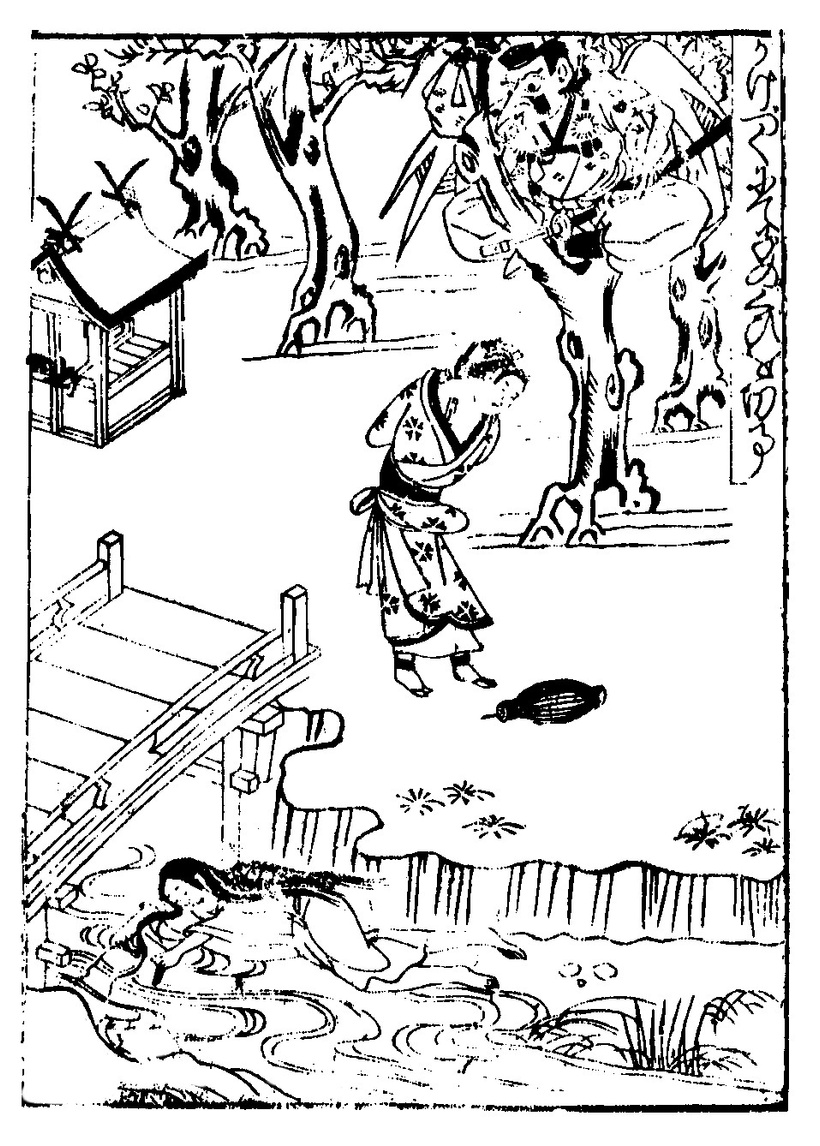
First, the subject of the illustration: a kamuro. Kamuro (also sometimes kaburo, as with the yokai ōkaburo) is a word that describes several things depending on the era; a hairstyle involving a mostly-shaved head that was common in the late Edo period; a hair style that was not shaven, but instead bobbed used until the middle Edo period; the children who wore such hairstyles; and young girls employed as handmaids in high end brothels. Since this book was written in the early Edo period, kamuro would have referred to a child, who would have had a bobbed hairstyle.

Secondly, the comment “They would never let Benkei do that all by himself.” This is a reference to a massively famous legendary warrior monk about whom many stories were written. One of his most famous legends is about how he died. After the Genpei War and the destruction of the Heike, the brothers Minamoto no Yoshitsune and Minamoto no Yoritomo fought with each other over who would be the ruler of Japan. Benkei was one of Yoshitsune’s retainers, and fought by his side at the Battle of the Koromo River. When Yoshitsune’s army was encircled and all but defeated, Benkei told his master to flee, then stayed behind and single-handedly held off the enemy army by guarding a bridge. Not one of Yoritomo’s men was brave enough to cross the bridge to fight the legendary monk. Instead, they rained arrows down upon him. When dust cleared and the arrows stopped falling, they looked out and saw Benkei still standing on the other side of the bridge. Eventually, they found the courage to cross the bridge, and they discovered that the brave monk had died standing up! Talk about epic.

Now on to the yokai… Although we don’t actually see the tengu in the story — we just see the results of its magic and its personality. Tengu are famous for their disdain of prideful people, just as was the case in the tengu story we saw earlier this month. Tonight’s story is no exception. Imagine having the pride and boldness to walk on top of a child and then use the toilet right in front of their face!

—-

The Arrogance of Ukita of Bizen Province’s Widow

In Bizen Province there was a certain woman who was known as the widow of Ukita. One night, to alleviate her boredom, she had some dancers perform for her. They performed “Takadachi,” and as she listened to them recite the part where Benkei makes his final stand, she chortled, “They would never let Benkei do that all by himself…” Then, laughing, she stepped out into the courtyard to use the outhouse.

When she opened the door of the outhouse, there was a kamuro about twelve or thirteen years old lying across the floor. The kamuro looked up at the widow and grinned. The widow was dauntless by nature, so without hesitation, she locked the door, trampled across the kamuro, and then leisurely relieved herself. Then she coolly left the outhouse and walked several meters, when she heard a dry cackle behind her that pierced right through her ears. She thought she was going to be pulled backwards, but she fell flat on her face right where she stood.

Everybody was surprised, and they ran outside to find the widow fainted. When they somehow managed to revive her, she came to her senses and told them what had happened. It is said that a tengu arranged this punishment because the widow was so arrogant.

A-Yokai-A-Day: The Elder of Saikōji in Bungo Province Who Was Attached to Gold

Greetings yokai lovers!

Tonight’s story is another example of a problem caused by attachment to material things — the core sin of Buddhism. That this story takes place at a temple, and to a temple elder, serves to underline that fact. Even priests are susceptible to this most basic of human faults, and can become undead monsters as a result of it.

The last part of the story points out that everyone slandered this elder after the money was found. But it’s not simply the fact that he was attached to the money that was the problem. The key lies in the amount: one thousand ryō. You don’t have to be an Edo period accountant to imagine that this is an obscenely large amount of money. One thousand gold coins is going to be worth a lot no matter what time period or country this takes place in. The value of gold fluctuated a lot over the Edo period, and it’s hard to place the exact time for this story, but since Shokoku hyakumonogatari was published in 1677, it’s safe to say this took place probably somewhere between 1600 and 1670. Currency Museum of the Bank of Japan, at the beginning of the Edo Period, one ryō was worth approximately 100,000 yen in today’s money. So this temple elder had a secret buried stash worth one hundred million yen. That kind of money isn’t something a priest is normally going to get his hands on, so there’s a strong implication that he was doing some immoral things to gather and hide that much gold. So the slander was almost certainly deserved, although the story never tells us just what this man did to get that money.

—-

The Elder of Saikōji in Bungo Province Who Was Attached to Gold

At a temple called Saikōji in Bungo Province, an elder who was about seventy years old fell ill, and said in his final days, “When I die, leave me as I am for seven days, and after that, cremate me.” After that, he died.

His disciples obeyed his last will, and had him washed and placed in a coffin. At around midnight on the third day, there was a rustling sound inside of the coffin. Then the lid of the coffin opened up, and the elder, wearing a black hood, crawled out of the coffin and walked into the tatami room. The disciples were amazed, and they watched to see what would happen. The elder went out to the veranda and pointed a finger towards the northwest corner of the garden. The disciples were so afraid that they ran away and hid in the kitchen. Eventually the elder went back into his coffin.

The following night, the elder did the same thing as the night before. The disciples held a meeting to discuss the matter. They dug up the northwest corner of the garden and they discovered an incredibly beautiful jar. When they looked inside, they found one thousand ryō in gold coins had been placed inside.

Afterwards, everyone disparaged the elder because of his lingering attachment to this gold.

A-Yokai-A-Day: The Bakemono of Iga Province During the Keichō Era

Greetings yokai lovers!

Tonight’s story is a short and strange collection of happenings that occurred at the house of “a certain samurai” in Iga Province during the Keichō era. Iga was located on the famous Tōkaidō highway running east-west linking Kyōto with Edo, and due to its location right on the border of the capital, it was a major thoroughfare and a gateway to the east. During the Heian period it was under control of the Taira clan, but in the middle ages it changed hands many times and was owned by several different families. In 1608, after Tokugawa Iyeyasu united the country, Iga was put under the control of Tōdō Takatora.

Takatora was a skilled and clever warrior who rose rapidly from the ranks of a mere foot soldier all the way to become a daimyō. He was also a brilliant engineer and is especially known for designing twenty different castles. So why would such weird hauntings take place under his rule? The storyteller doesn’t bother to speculate, but the question lingers on my mind. One …possibility… is that it was some kind of supernatural punishment/cause-and-effect. You see, Takatora was not just a great warrior, he was also politically smart. Over his career, he changed his allegiance often, serving under several different lords until finally remaining loyal to Tokugawa Iyeyasu for the remainder of his life. Swapping sides that often might be good politics (and certainly it’s better for your health!), but that’s the kind of treachery that might just get one’s lands haunted!

—-

The Bakemono of Iga Province During the Keichō Era

During the Keichō era (1596 – 1615 CE), strange things happened at the residence of a certain samurai in Iga Province. At dusk, a beautiful woman wearing a fine silk katsugi would walk by his front door, and sometimes she would be headless, and only her body would walk by. One time, at noon, the woman and a giant monk were up on the roof peeking out of the chimney. And once, four or five emaciated women, with disheveled hair and wearing thin white kimono, danced around.

There were so many dreadful things like this that nobody would live in this residence. Nowadays such things do not happen anymore, but people hear stories about the old days and still will not live there.

A-Yokai-A-Day: The Old Tanuki Disguised as a Samurai’s Wife

Greetings yokai lovers!

Tonight’s story features a tanuki, a yokai that is beloved by almost everyone. I have to wonder what the tanuki was thinking when it decided to do what it did… Maybe it saw how sad the samurai was and thought if it did something to cheer him up, it might get some food. Of course, as you can see by the illustration, even good intentions often end up in disaster when yokai and humans are involved.

—-

The Old Tanuki Disguised as a Samurai’s Wife

In Bishū, there was a samurai with an income of 2000 koku who lost his beloved wife, and every night he thought only of her. One night, when he put out his lamp to go to sleep, his dead wife came to his bedchamber, looking as beautifully dressed as ever, and nostalgically pulled back the bedsheets to climb inside.

The samurai was startled and asked, “Have the dead come back to visit me?” He took his wife, pulled her to him, and stabbed her with his sword. She vanished into thin air. His retainers rushed into the room, lit lamps, and searched everywhere, but found nothing.

When dawn broke, they looked again, and there was some blood on the door hinge. They followed the mysterious blood trail to a hole beneath some bushes in the northwest corner of the estate. When they dug up the hole, they discovered an old tanuki, dead from a sword wound.

A-Yokai-A-Day: The Mayoinomono That Was Afraid of the Go’ō of Nigatsudō

Greetings yokai lovers!

Tonight’s story features a great word that I haven’t heard in other stories: mayoimono! This is another word for ghost, and literally means “lost/wandering thing.” I love it. It reminds me of mayoibune, the wandering ghost ships on the Sea of Japan. While mayoimono is beautifully descriptive word, it’s also pretty undefined. Our ghost tonight resembles what is called a fudakaeshi, a ghost that asks strangers to remove protective talismans (fuda) from doors so that they can enter and cause mischief!

Two other words in the title also may be a source of confusion. First Go’ō. Go means cow and ō means king/lord. This is one particular way of saying the name of Gozu Tennō (“cow-headed celestial king”), a major Shinto-Buddhist god with the head of a cow. Gozu Tennō goes by many names besides Go’ō, and is believed to be a tatarigami who is an incarnation of the Shinto deity Susano’o and the buddha Yakushi nyōrai. The Gion district in Kyoto is named for him, and the Yasaka Shrine in Gion is one of his major shrines. It was created in 656 CE as a way to enshrine this hostile god of pestilence and disaster and to protect the city of Kyoto from it. Gods like Gozu Tennō are scary if you’re on their bad side, but great if you’re on their good side, which is why the ghost in tonight’s story was so afraid of his talisman!

Finally, Nigatsudō is a major temple that is part of the extremely famous temple complex Tōdaiji in Nara. Being such an important temple, the talismans sold here must be quite powerful. So its no wonder they held this ghost at bay.

The talisman in the painting tonight is the actual Go’ō talisman from Nigatsudō that is sold today. I don’t know if that is what it would have looked like in the mid-17th century when this story would have been written, but it’s a safe guess that it might not have changed too much.

—-

The Mayoinomono That Was Afraid of the Go’ō of Nigatsudō

At a certain graveyard, there was a burial mound that burst into flames three times every night and called out in a woman’s voice: “I’m so lonely! So lonely!” It was so eerie that nobody was willing to investigate it.

Three young men held a meeting and decided to go investigate. So one night at midnight, they went there together, and the bravest one of them sat down upon the mound. Sure enough, from within the mound came a terribly sad voice that seemed to lament, “I’m so lonely! So lonely!” Then, an icy hand strongly grabbed the man’s waist from behind.

The man was brave by nature, so he did not make any fuss, but merely called his two companions over and had  them check his back. The two of them were terribly surprised, and they ran home without looking back.

So the man said, “Who are you to grab onto my waist? Explain yourself!”

The voice in the mound replied, “Well, well, I have never seen a man as brave as you before. I am the wife of a blacksmith in Sanjō Muromachi, and I was poisoned by the woman next door. Moreover, not even three weeks after I was murdered, the woman next door married my husband. The more I think about it, the more angry I feel. Every night I go to their door, but a talisman from the Go’ō of Nigatsudō is affixed to the gate, and I am too scared to enter. And so I am lost in the darkness of my devotion. Please, please remove the Go’ō talisman from the blacksmith’s gate. If you do so, the flames of resentment for this world will clear away.”

The man took pity on her. He went to see the blacksmith’s house, and lo and indeed there was a talisman of Go’ō affixed to the gate. He tore off the talisman and stood off to the side to watch. Suddenly a mass of black clouds whirled up, then a light the size of a paper lantern appeared above the blacksmith’s house and flew inside.

Two voices screamed. Then, the ghost came out of the blacksmith’s house carrying the heads of the husband and wife.

She  turned to the man and said, “Well, well, thanks to you I am free from my obsession of so many years. I am grateful.” She handed him a sack. “This is in return for your kindness,” she said, and then disappeared into thin air.

The man was amazed. He opened the bag and looked inside to find ten gold coins. He used the money to purchase a new grave tablet and hold a memorial service for the woman, and nothing strange ever happened at the burial mound after that.

(My Wife Draws) A-Yokai-A-Day: The Man Who Had His Bones Pulled Out by a Bakemono

Greetings yokai lovers!

Today’s illustration was once again done by my wife, to give my arm a day’s rest while it heals. I’ll be back to painting again tomorrow though.

Tonight’s story is one of my favorites due to the descriptions of the final scene. The way the sound is described, and the ultimate reveal are so unique, twisted, and spooky that it sticks out in my mind as one of the best stories in Shokoku hyakumonogatari. This story is of course the basis for the yokai known as tenome, although that name was not invented until later. For now, it is just a bakemono.

Here is the illustration from the original book. Oddly, the grave on the left hand side looks like it has a face! I have no idea why.

—-

The Man Who Had His Bones Pulled Out by a Bakemono

There was a rumor that a bakemono lived in the graveyard at Shichijō Kawara in Kyōto. A group of young men gathered together and made a bet to test their courage.

One of them went to the graveyard at midnight and planted a stake in the ground and then pasted a piece of paper to it as proof that he had been there. As he was leaving, an old man of around eighty years, gray haired and standing about 242 centimeters in height, his face sickly white like a calabash flower, with eyeballs in the palms of his hands and two protruding front teeth, came chasing after him.

The man was so taken aback that he ran into a nearby temple and begged the monk to protect him from the monster. The monk opened up a long trunk and hid the man inside of it. The monk watched as the bakemono pursued the young man up to the temple, looked around for a while, and then left. There was a sound like a dog gnawing on a bone near the long trunk, and he heard someone groaning, but the monk was too frightened to move.

Then, after the bakemono had left, the monk went to let the man out of the trunk, but when he opened up the lid, he found that the young man had been stripped of his bones and was nothing but skin.