A-Yokai-A-Day: The Ōbōzu Bakemono at Lord Ogasawara’s House

After painting tonight’s yokai, I slipped on the stairs and broke my drawing arm… Which is pretty upsetting on top of being painful. It’s not a terrible break, but it’s enough that it will slow me down for the rest of the month. I don’t think it should outright prevent me from painting though. Maybe one day there will be stories about how an artist got punished by yokai for drawing too many of them…

Anyway, rather than dwell on unfortunate things, that’s look at something even more horrible: tonight’s yokai! This one is called an “ōbōzu bakemono.” Ōbōzu are common figures in yokai lore, although they go by many names, like ōnyūdō, ōhōshi, and others. All of these words mean “giant Buddhist priest.” And of course bakemono just means “monster.”

Why priests are such a common occurrence is a bit of a mystery, but there are several ways to look at it. One is that priests live outside of normal society, close to the realm of the supernatural, and they have that in common with yokai. Temples also had a lot of power in the middle ages and early modern Japan, and so in some ways they were a mysterious force to be reckoned with; just like monsters are. And of course, artists often liked to satirize what they saw around them, especially impious or dishonest priests who did not practice what they preach. Since artists were responsible for designing a lot of yokai, they had the means and motivation to invent all sorts of horrible priest yokai, and these were popular among commoners who also hated the dishonest priests. Even today we sometimes see priests driving porches, or televangelists with personal jet planes. This kind of corruption is universally hated, and its not easy to see how people could turn that into a monster.

I’m not sure why, but the ending of this story always makes me laugh. The climax of this story is brutally violent that it makes the final sentence, with its chilly crotch patting, seem tame and silly by comparison.

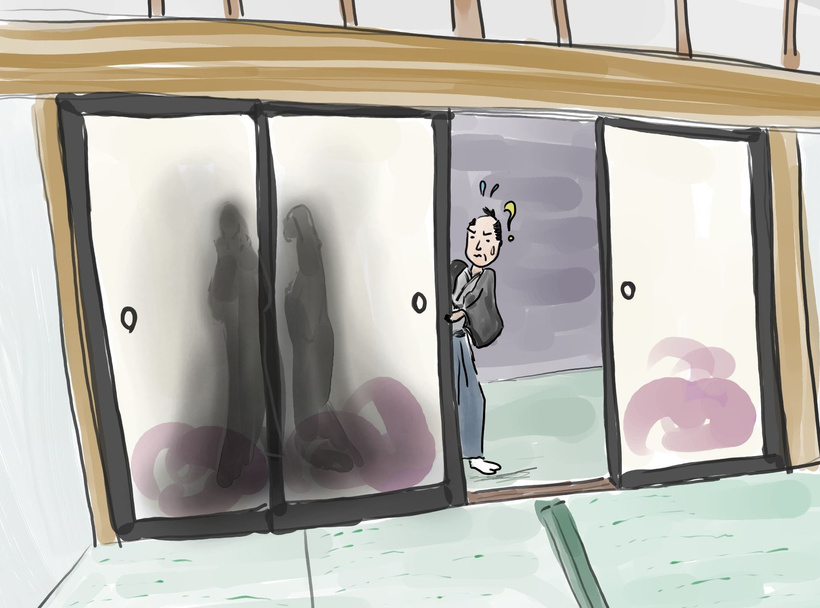
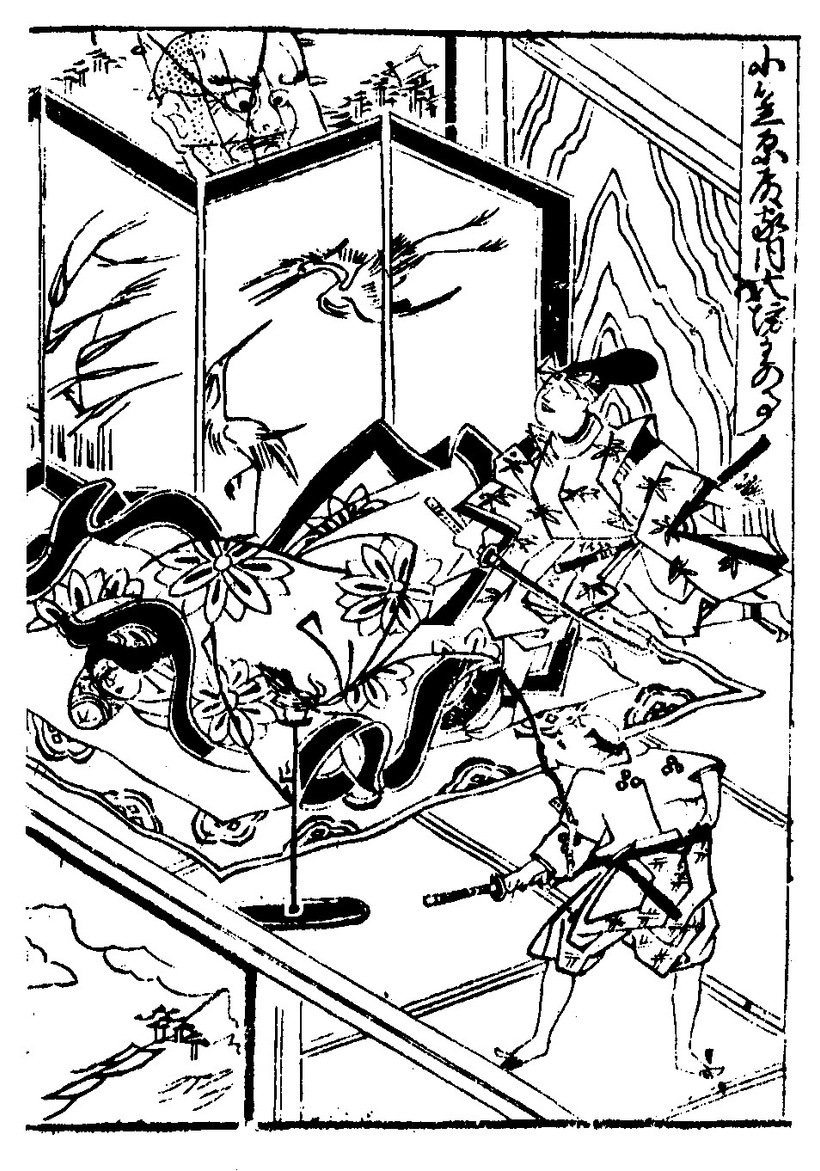
The Ōbōzu Bakemono at Lord Ogasawara’s House

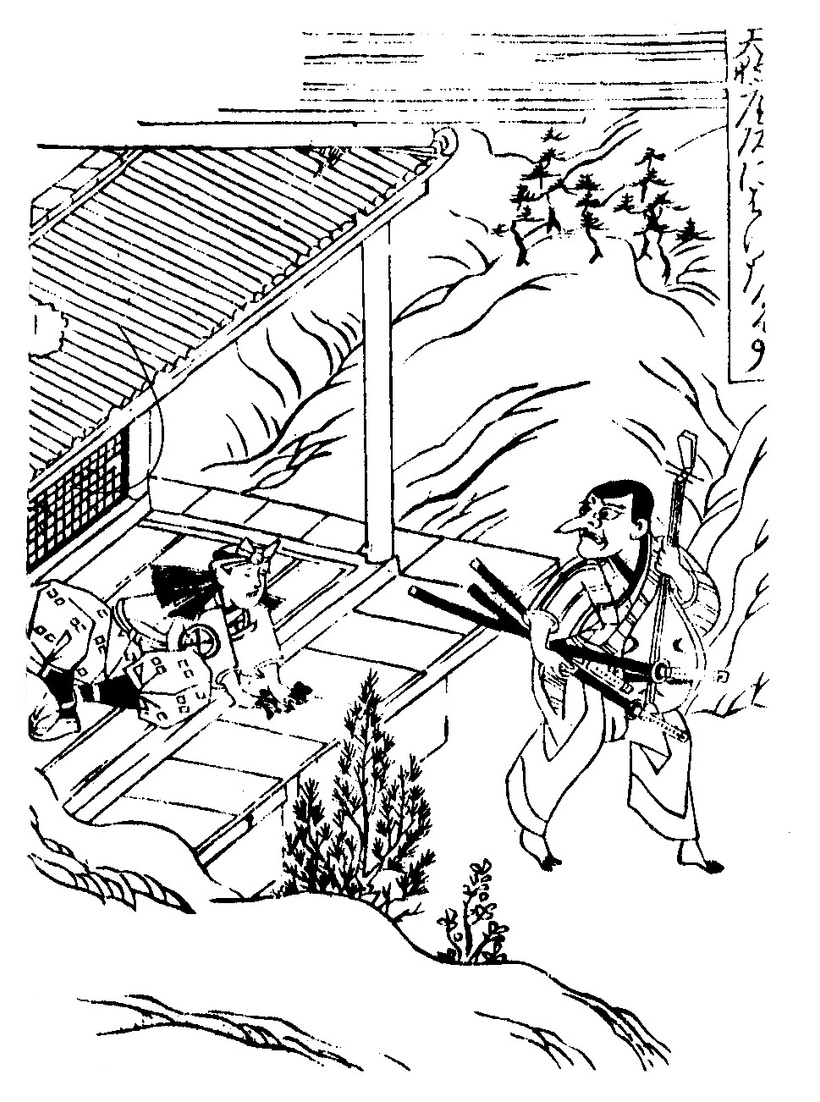
During the Keichō era (1596 to 1615), the wife of a certain Ogawasara contracted smallpox at around age 45 and was in critical condition. Lord Ogasawara was in the next room discussing medicine, when a number of ladies came running out of the back room shouting, “How terrifying!”

When Lord Ogasawara went inside to investigate, he saw a giant, black monk towering over the folding screen and laughing at his wife. Lord Ogasawara immediately drew his katana and slashed at it, but the monk vanished.

One night, thinking it would return, he called five or six samurai to stand watch. Just as expected, the monk’s head rose up from behind the folding screen again.

“What are you that can create such an apparition?” he demanded. Then the monk snatched his wife, kicked through the ceiling, and tried to climb out. The samurai grabbed onto her and tried to hold her back, while the monk tried to pull her up through the ceiling. They pulled with such force that the wife was ripped in two, and the monk took her head and left.

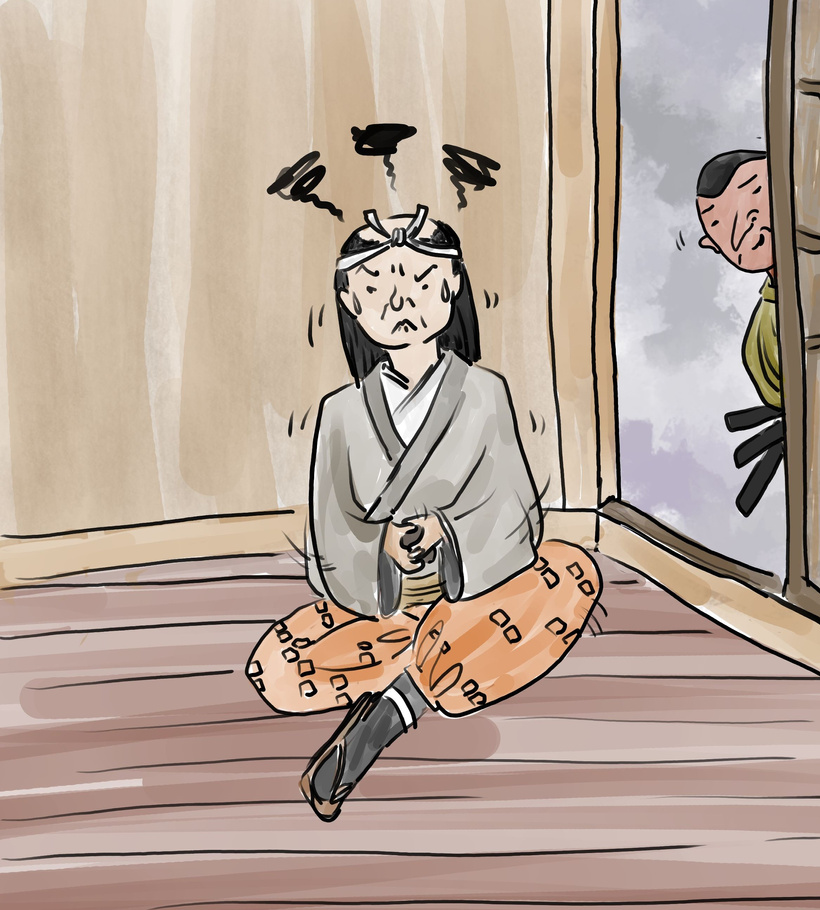
Afterwards, for about a year, whenever the lord went to the outhouse, he was often subjected to all sorts of terrible things, such as cold hands patting his crotch, or having the door latch locked from the outside.

a giant priest holds the bloody, severed head of a woman in one hand

A-Yokai-A-Day: How a Man From Gojō, Kyōto Was Punished For Scraping the Gold Foil Off of a Buddha

Tonight’s story repeats some common themes — namely, a problem caused by attachment to material wealth, and snakes being used to represent that attachment. This story is interesting in that the people involved have the chance to make their sin right. At first they try to “outwit” their own karma, which I find very interesting, because it’s such a human, believable thing to try. I love that they halfway doubt the fortune teller at first. And when that fails they ultimately make a sensible, rational decision and choose the lesser of two evils. It’s about as close to a happy ending as kaidan often get.

How a Man From Gojō, Kyōto Was Punished For Scraping the Gold Foil Off of a Buddha
There was a poor oil seller who lived near Aburanokōji Gojō in Kyōto. Somebody told him that there was a golden buddha among the buddha statues at Sanjūsangendō. The oil seller was delighted to hear such good news. He went to Sanjūsangendō, broke off the buddha’s hands and feet, and burnt them to ashes so that the foil on them hardened into lumps of gold. He sold these lumps here and there, and soon he made thirty gold coins. His family became rich, and lived in affluence from morning to evening.

One time, when the oil seller and his wife were sleeping side by side, they felt a strange sensation like something cold touch their bodies. They lit a lamp and saw there were two small snakes. The couple were so startled that they beat the snakes to death, but two more snakes crawled out, and night and day the two snakes refused to leave the couple’s side. They prayed and prayed, but they did not receive any sign.

The couple grew more and more uneasy, so they asked a diviner to tell them their fortune. The diviner consulted his reading, and he asked, “Have you ever made money off of a buddha?” Then the couple confessed everything that they had done, saying that yes, indeed, they had made money off of a buddha. Hearing this, the diviner said, “In that case, if you use the money that you made to create a buddha and donate it to the temple, your curse will end.”

And so, they used half of the money that they had earned to make a buddha and they donated it to the temple. When they did this, one of the snakes went away, but the other one coiled its body around them and would not leave. The couple decided that being alive was the most important thing, and so they used the remainder of their money to make another buddha and donated it, after which the other snake left them. Then they returned to their old life as poor oil sellers.

a snake coils around a golden buddha statue

A-Yokai-A-Day: The Bakemono of Komatsu Castle in Ōshū

Before we get to today’s yokai, I’d like to take a moment to point out that both this website and yokai.com are presented ad-free and paywall-free. That’s because I love these stories, and I love having the opportunity to share them with as many people as possible. If you enjoy reading about yokai and Japanese folklore, please consider subscribing to my Patreon, even just $1. It helps pay for web hosting and traffic, and it allows me to share Japanese folklore, year-found and full-time. Plus you can get a lot of cool rewards! Please check out my Patreon and help me continue my work!

Today’s A-Yokai-A-Day comes from Ōshū, another name for Mutsu Province, which is today Fukushima, Miyagi, Iwate and Aomori Prefectures, and a bit of Akita Prefecture. However, Ōshū also sometimes included Dewa Province (now Yamagata and Akita Prefectures), covering the entirety of Tōhoku. The castle in the story, Komatsu, uses the latter definition, and stood in what is today Nakakomatsu, Yamagata Prefecture.

This story is interesting because it features a number of common kaidan tropes: an outhouse; a severed head; and a female monster with ohaguro. The outhouse is a classic location because let’s face it; going to the toilet at night is scary enough, but imagine doing it in an age with no electricity and no plumbing, where wild animals can easily crawl into the toilet, and where weeds and plants spring up from it as well. In cities, you might have a properly boxed-off hut with a rudimentary sewage system in it, but in the countryside often all you had was a large, communal, clay pot out in the fields. Severed heads need no explanation as to why they are scary. As for monsters frequently being female, we can blame this on patriarchal society. It was believed that women were more emotional than men, and thus much more prone to becoming overly emotionally attached to things than men. And as I discussed in yesterday’s post, attachment is the reason people become monsters. So there is a logical, albeit sexist, reason that there are so many female monsters in Japanese folklore. And the black-toothed look of ohaguro is a bit frightening today, but it seems that Edo period readers also found it frightening, considering how often it shows up in monsters.

The story calls this monster a bakemono, which pretty much just means “monster.” It’s a generic term that doesn’t specifically point to any cause. Flying heads are sometimes called nukekubi or rokurokubi, although these necessarily have a body somewhere, and we don’t know if this bakemono does or not.

The Bakemono of Komatsu Castle in Ōshū
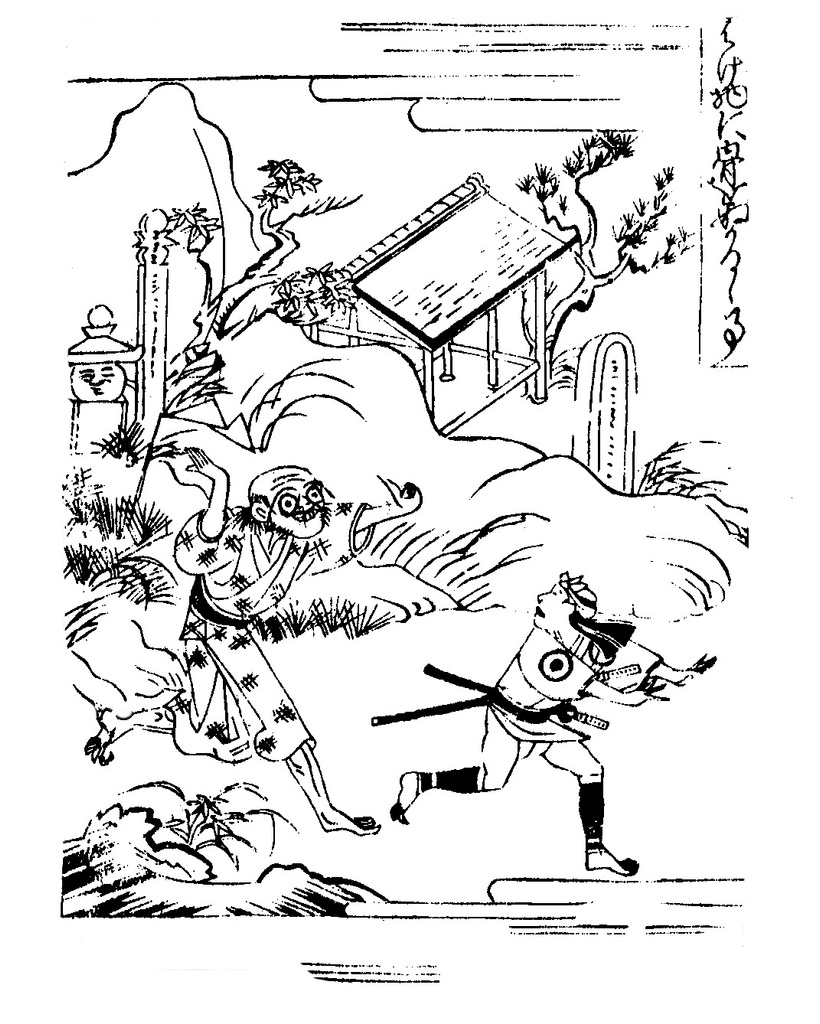
Not long ago, there was a samurai who was guarding a castle in a place called Komatsu, in Ōshū. His wife was the daughter of a certain Uwaki. One night, when she went to the outhouse, a woman’s head with blackened ohaguro teeth flew from across the way and grinned at her. She was horrified, but she knew that it would be bad to be defeated by such a thing, and so with her eyes open wide she glared back at the head. The head lost the staring contest, and then gradually flew away from her until it disappeared.

The woman was so happy that she left the outhouse and returned to her room, only to find that the lantern had gone out. She checked the next room, but the lantern in that room had gone out too, and it was pitch black. At that moment, she fainted.

When her husband returned home and searched for her, he found her in another room, lying flat on the floor, breathless and unresponsive. Everybody was astonished. They gave her some smelling salts, and finally she came to  her senses.

When they asked her what had happened, she told them the whole story. Afterwards, they built a new outhouse in a new location, and the monster never appeared again.

a woman's head with blackened teeth flies through the air

A-Yokai-A-Day: How Horikoshi From Tōtomi Province Was Infatuated With His Daughter-in-Law

Today is the first day of October, and that marks the start of A-Yokai-A-Day! I hope you’ll join me in sharing yokai on social media/blogs/wherever using the #ayokaiaday hashtag.

This month’s stories all come from an Edo period collection called Shokoku hyakumonogatari, or “100 Tales from Various Provinces.” It’s a collection of one hundred strange, scary, and silly stories collected from all over Japan and first published in 1677. As far as I am aware these tales have never appeared in English before. I’m translating them from Japanese and including a bit of cultural explanation beforehand, since some of the stories are not easy to grok without some understanding of Japanese history and culture. Be sure to come back every day this month for a new tale from Japanese folklore!

Today’s story revolves around a central theme in many yokai stories: attachment. Specifically, inappropriate attachment, obsession, or infatuation with worldly things. Often this ends up being money or people, but it could be anything at all. Those who die with lingering attachment in their hearts often come back as yokai — or sometimes the attachment itself manifests as a yokai — and cause harm to those they loved.

This idea comes from the Buddhist notion that all suffering in the world is caused by improper attachments to things. This makes sense even on a secular level; we all can imagine how being overly fond of money or being overly attached to a specific person might annoy others and harm your relationships. But Buddhism is talking about this on a cosmic scale — the attachments we form in life generate karma, and the karma we generate is what propels us into the next life after we die. If you cling on too much to things, instead of passing peacefully into your next life, you may be doomed to return as a yokai… (I like to imagine myself narrating this like the Crypt Keeper, so this is where I’d let out a big cackle, and segue into tonight’s story.)

A-Yokai-A-Day: How Horikoshi From Tōtomi Province Was Infatuated With His Daughter-in-Law

In Tōtomi Province there lived a certain man named Horikoshi. When he was sixteen his son was born, and before long his son became sixteen, and it was time for him to get married. Horikoshi was thirty at that time.

The new bride was beautiful, talented, and intelligent, but whenever Horikoshi saw her, he would not make eye contact or speak to her at all, and just looked at the floor. Everybody thought it was strange and asked him, “Do you hate your daughter-in-law?”

“No, as long as things are good between her and her husband, there’s no problem,” he replied. But for three years his condition seemed to grow steadily worse, and eventually he became gravely ill.

“We should pay him a visit,” the daughter-in-law said.

But Horikoshi said, “Visiting the bedside of an unsightly sick man won’t help anything.” And he did not permit anyone to visit him.

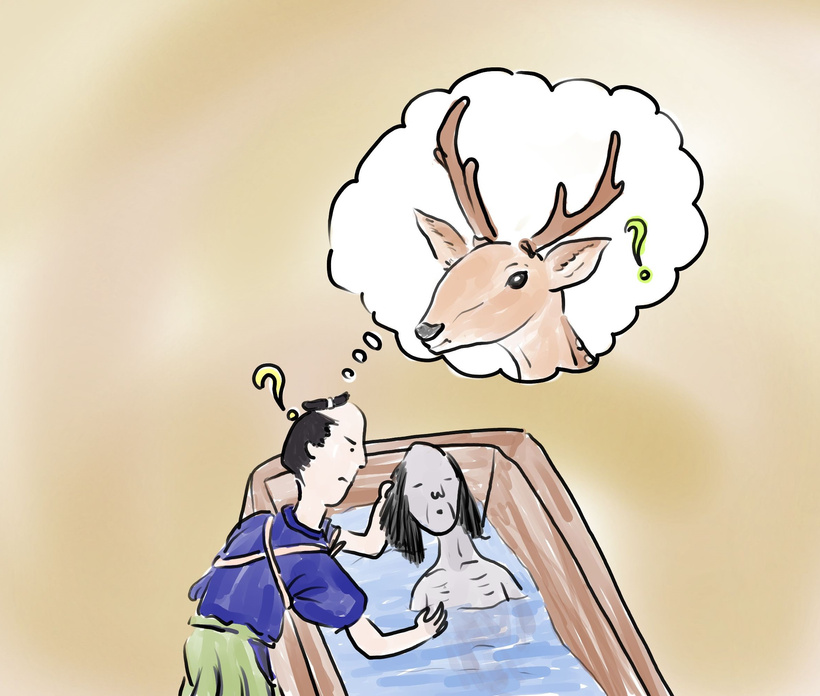
When Horikoshi’s dying hour came near, his daughter-in-law was finally able to come to his bedside and nurse him by rubbing his hands and feet. Horikoshi’s wife stepped out into the adjacent room to rest. After a while, there was a sound from his room like something hitting the folding screens and shōji. Everyone in the house wondered what it was, and when they went to investigate, they found that Horikoshi had turned into a serpent and had wrapped his body three times around his daughter-in-law. Water erupted from beneath the floor and the house sank into a deep pond. Horikoshi dragged his daughter-in-law down into the water with him.

It is said that until recently, on clear days the beams and other parts of the house could be seen in Horikoshi’s pond. Now the pond has become small and shallow, as if the serpent no longer lives there.

a huge horned serpent coils around a woman in a kimono

Video of a Shrine Ritual

I wanted to share this because usually every year during Golden Week I share a video with my Patreon backers of the “shrine battle” at one of the major local shrines. This year because of the pandemic, the festival was cancelled, but the shrine ceremony went on as it always does and has for over 1000 years. This year, the priests posted a video of the ceremony, which is really really cool.

This is Otaki jinja, a shrine to the goddess Kawakami Gozen. It’s a big shrine located in the far corner of a rural town in a rural prefecture. It’s essentially the last building before you enter the mountains. Legend has it hundreds and hundreds of years ago, she came down from this mountain and taught the locals how to make paper. Since then, Echizen has been an important center of traditional Japanese paper (washi). Incidentally, it has special meaning to me because it is the shrine where my wife and I got married.

In this above video, you can watch as the priests leave early in the morning from the shrine at the base of the mountain. They wear a little backpack like structure, which is a house for a god. Normally instead of a mini backpack, there is a massive and majestic golden palanquin carried by many people. But for social distancing, this year it’s just a priest with a backpack.

They travel to the top of the mountain, and take the goddess and her family out of the shrines where they live during the year. They then take her down, and re-enshrine here in the village for the day.

She visits each of the local shrines at that time, and the local villagers all pay their respects. (This is where the shrine battles take place, because each village doesn’t want the goddess to leave. They want her to stay with them for the year.) Obviously that is not part of this video, but it’s my favorite festival during other years.

Finally, at the end of the day, there is another long ceremony, and she is placed back into the palanquin (or backpack) and carried back up the mountain to her home at the top. Normally, this is done in the pitch black (lit only by hand held paper lanterns), up a dangerous mountain trail, by drunk villagers carrying a heavy golden palanquin. Even when I was not drunk or carrying a shrine, I was afraid of falling and breaking my neck, so I can’t imagine how they do this every year.

Anyway, it’s really cool to get a unique perspective of this ritual, even though it’s unfortunate that the festivals had to be canceled.

A-Yokai-A-Day: Ino Mononoke Roku, Day 21

This year for #ayokaiaday we are looking at the bizarre occurrences which took place at the Ino residence in Miyoshi, Hiroshima, during July of 1749. These occurrences all revolve around a young boy named Ino Heitaro. His story is collected in Ino mononoke roku, a collection of scrolls, books, and legends which collectively form the narrative of a supernatural phenomenon that took place 270 years ago.

It was now three full weeks since Ino Heitaro’s haunting began. Pretty much anybody would need a break by now. Even with all of his bravery, surely Heitaro must be starting to crack?

Heitaro decided to read a book to clear his mind. Unfortunately, there was no way he was going to read uninterrupted…

The shadow of a person appeared on the wall in the light from his lantern. The shadow was so clearly cast that Heitaro could make out every detail. It looked like a human reading a book out loud.

Heitaro watched the shadow’s mouth and tried to read its lips, but he couldn’t make out what it was saying…

December-January Japan Trip

My wife’s brother happened to get married in December, which provided us the perfect excuse to go back to Japan for a short trip. With the Christmas and New Years holidays around the corner as well, it made sense to extend the vacation a bit and spend the whole month in Japan. This was awesome not only for the wedding, but because I got to spend my birthday, Christmas, and New Years (the absolute BEST Japanese holiday) in Japan, as well as having the chance to tour around and do some yokai research and collect visual reference for my next book. Continue reading