A-Yokai-A-Day: Raiju

The Kickstarter topped 700% last night, which is amazing, considering we’re not even one week in! My previous two Kickstarters both managed to reach 900% on their final days, and it looks like The Book of the Hakutaku will reach that much earlier. It really is great to see that there are so many more yokai fans today than there were just a couple of years ago!

If you’re enjoying A-Yokai-A-Day, remember to become a backer for The Book of the Hakutaku on Kickstarter! Now, for today’s yokai:

Raijū
雷獣
らいじゅう

Raijū is an interesting yokai. Once upon a time it was one of the most well known and most feared supernatural creatuires in Japan. Yet today it is relatively minor, or even practically unknown to the average person. Why the sudden change? Science of course!

Japan’s history is filled with natural disasters. Earthquakes, tsunamis, typhoons, floods, and fires have done more than their fair share of destruction to the country. While we know much about the physical causes of natural disasters today, in earlier eras they were mysterious, considered to be the work of gods. Only gods had the power to move the earth, or send fire from the sky. Lightning, for example, occurs so fast and so randomly that it is all but impossible to observe. Only its aftereffects can be observed—the terrible sound that shakes the world, the weirdly shaped burns on the thing it strikes, and the fires that it starts. Particularly in old Japan when homes were all made of wood and closely packed together, a single lightning strike can cause a lot of damage!

The raijū was the personification (animal-ification?) and embodiment of lightning. They were seen as a kind of god, or at least akin to the thunder gods (raijin). They live in the sky, which was a world which was totally off limits to pre-flight humans. They rode bolts of lightning to earth. For seemingly no reason at all, they would strike buildings, start fires, and cause mass destruction. Nothing was known about them, and nothing could be known about them except that they were fast, merciless, and deadly. Whenever lightning struck, people believed that a raijū had been sent by the gods to punish them for some reason or another.

Raijū took on lots of forms over their history. Generally, they were thought to look like wolves, dogs, tanuki, or even weasels or cats. They had long, sharp claws and ferocious faces. Far more fanciful forms existed too. Sometimes raijū were said to look like little dogs, but with four rear legs and two tails. Sometimes they were said to look like insects or crustaceans. They would burrow into your belly button to hide from the angry thunder gods (which is where the Japanese superstition of covering your belly button when thunder claps comes from!). Others looked like miniature dragons. Even more exotic versions were chimerical monsters composed of many different animals, like the nue (who is really a kind of raijū when you think about it).

Because they were so scary, raiju were often presented in stories as beasts to be slain, just like oni. The nue, as mentioned above, is one such example. Another example involves the historical samurai Tachibana Dōsetsu. One night he was taking shelter from a storm under a tree. Lightning struck him, but he drew his sword just in time to strike the bolt, slaying the raijū who came with it. Afterwards, he named his sword Raikiri, or “lightning cutter.”

During the Edo period, “real” raijū were popular sideshow attractions, along with “real” kappa and mermaids. Mummified remains of cats, monkeys, and dogs presented as raijū were often toured around the country in traveling shows. People would pay a few coins to get a quick glimpse at the horrific corpses. Surely many must have realized that these were just man-made taxidermied monstrosities, but their popularity boomed anyway due to the sheer horror that they evoked.

During the Meiji period, with the rapid changes tranforming society thanks to the influx of foreign science and technology, yokai were one of the first victims. People were actively discouraged from bringing up “silly” superstitions because they were perceived as an embarrassment to the country—they were examples of how parochial and backwards the Japanese were in the previous era. New understandings about electricity and lightning, and the invention of the airplane made the raijū’s most important features—its life in the mysterious sky, and its attachment to lightning—suddenly no longer mysterious. Once those mysteries were gone, the raijū had nowhere left to live.

I’ve talked a lot before about how yokai are necessarily creatures of mystery. They live in the borderlands between life and death, light and shadow; they’re aren’t creatures of death, and they aren’t creatures of the night. They’re something intangible and unknowable. We can’t classify them the way we classify animals, because their very nature is that they are unclassifiable. Once we know too much about them, they cease to be interesting.

The raijū was a victim of probably the one thing that can truly kill a yokai: understanding.

Raiju, from The Book of the Hakutaku

A-Yokai-A-Day: Onihitokuchi

Today the Kickstarter breached 600% funding, and over 200 backers! It’s very exciting. New stretch goals will be announced on the Kickstarter page soon. In the meantime, it’s A-Yokai-A-Day:

Onihitokuchi
鬼一口
おにひとくち
“oni bite”

ouch!

Probably everybody reading this recognizes the “oni” in the name of today’s yokai. So you probably have a pretty strong idea in mind of what this yokai is going to be about. And you’d be right! “Oni,” the famous yokai, plus “hitokuchi,” the word for a single bite or a mouthful.

Onihitokuchi is not a creature, actually, but a phenomenon. While “yokai” is most often used to describe certain creatures, the word actually encompasses much more than just monsters and spirits; it also covers strange occurrences, like curses and illness, sleep paralysis, and people going missing. Onihitokuchi is an example of the latter.

Put simply, onihitokuchi is the word for when someone is gobbled up by an oni in one bite, and is never seen again. It’s somewhat related to the concept of kamikakushi (i.e. being “spirited away” by yokai), the main difference being that with kamikakushi the victim usually returns sometime later, having been changed somewhat. In the case of onihitokuchi, they’re never coming back.

Toriyama Sekien’s Onihitokuchi

The most famous example of onihitokuchi comes from the Heian period story collection Ise monogatari. Toriyama Sekien references this story in his illustration of onihitokuchi. Although the main characters are unnamed in the original version of Ise monogatari, popular interpretations placed well known historical figures in the roles of the main characters, putting the story in a historical and literary context which the Edo period literati would have been familiar with.

Long ago, Heian period poet and playboy Ariwara no Narihira lusted after Fujiwara no Takaiko, a beautiful and high ranking noble lady. Because of the difference in their social status, it was impossible for them to have a legitimate relationship. One night, Narihira snuck into Takaiko’s room and kidnapped her. He fled into the wilds with the girl, when a terrible storm struck. He found a run down old shack and they sheltered there, Takaiko in the far back end of the shack, and Narihira guarding the entrance with his bow and arrow. In the morning, when the storm had cleared, Narihira went to retrieve Takaiko from the shack, but she was not there. She had been gobbled up by the oni who was living in the shack, and there was no piece of her left. Even her death screams had been covered up by the thunder during the night.

Onihitokuchi – as it will appear in my Patreon project

A-Yokai-A-Day: Gumyocho

Hello everyone! Today a few new stretch goals were added to the Kickstarter: a few more options for yokai-themed bookmarks to go with my previous yokai books, as well as yokai t-shirts! Click here to visit the Kickstarter page.

Now, on to A-Yokai-A-Day!

Gumyōchō
共命鳥
ぐみょうちょう
“connected life bird”

the six birds of nirvana – note the human-headed gumyōchō

As a huge bird lover, I have a special spot in my heart for all bird yokai. The gumyōchō is one of six bird species which are said to inhabit nirvana—the others being white swans, peafowl, parrots, mynah birds, and karyōbinga (one of these things is not like the others…). I painted the karyōbinga a few months back, and she appears in a few places in The Book of the Hakutaku’s Kickstarter. The gumyōchō will take its rightful place by her side in the finished book.

The gumyōchō is a beautiful two-headed bird that resembles a pheasant. Occasionally it is depicted as having two human heads instead of two bird heads. Like the karyōbinga, it is said to have an exceedingly beautiful voice. It and the other heavenly birds sing the holy scriptures in nirvana, and those who listen to them can achieve enlightenment. Gumyōchō is interesting not only because it is beautiful and has an amazing voice. Its story is also an important Buddhist parable.

Long ago, a gumyōchō lived in the snowy mountains of India. It had two heads and one body. One head was named Karuda, and the other head was named Upakaruda. The bird’s two heads had different personalities and desires. When one head was sleepy, the other one wanted to play. When one head was hungry, the other one wanted to rest. Eventually, the two heads began to resent each other.

One day while Upakaruda was sleeping, Karuda feasted on delicious fruits and flowers until he was stuffed and could eat no more. When Upakaruda woke up, he wanted to eat too, but he was already full because they shared one stomach. He could not enjoy any of the food.

Upakaruda decided to punish Karuda. While Karuda slept, Upakaruda found a tree with poisonous fruit. Because they shared a stomach, Upakaruda ate the fruit in order to make Karuda sick. Sure enough, when Karuda woke up, the poison had already taken effect. Karuda writhed and suffered, and then died. Of course, because they shared one body, Upakaruda also became sick, felt the agony of the poison, and then died.

Just before dying, Upakaruda  realized his foolishness. All the while that he had resented his other head, he failed to recognize that his own life depended on it. Just the same, by harming his other head, he was also harming himself. Upon realizing this, he understood one of the core tenets of Buddhism—interconnectedness—and was reborn in nirvana.

The gumyōchō is of course a metaphor for humanity. Our own selfishness often blinds us to the fact that our wellbeing and happiness is dependent on the wellness and the happiness of others. Sometimes we don’t care about what happens to those who we don’t know personally, or we want to hurt those who bother us. But we are acting as foolishly as Upakaruda. When we hurt someone else, we are hurting ourselves; when we refuse to help someone else, we are hurting ourselves. It’s only through caring for others that we can really take care of ourselves.

Although the story is ancient, it seems even more relevant today in the context of globalization. It’s easy to forget about the well-being of others and focus only on ourselves, or our friends and families. But when the food we eat is grown in different states, and the products we use every day are made in foreign countries, by people we will never meet, it’s important to keep in mind how interconnected we are. Our lives really do depend on each other, just like Karuda and Upakaruda. When people ignore global warming, the threat of nuclear war, mass shootings, natural disasters, and other problems that are affecting millions of lives today, they are missing the truth that those lives are the same as their own.

Gumyōchō – to appear in The Book of the Hakutaku

A-Yokai-A-Day: Okikumushi

Well, the Kickstarter blew up! In less than twenty four hours we passed 400% funding, and we are now approaching 500%! That’s much faster than my two previous Kickstarters. I think it goes to show that yokai are becoming more and more well known around the world, and that more and more people want to learn about and share this fantastic folklore!

Now, on to A-Yokai-A-Day!

Okikumushi
於菊虫
おきくむし

Toriyama Sekien’s Sarakazoe

Today’s yokai is an interesting one because of its relation to a yokai we looked at recently as part of my Patreon project. In August, we looked at the Three Big Ghost Stories of Japan. One of these, Okiku, is so famous that she spawned a number of other yokai. While Okiku has appeared on A-Yokai-A-Day before, the new painting of her will appear in The Book of the Hakutaku, along with the other ghosts we looked at in the Patreon project.

Toriyama Sekien included a yokai based on Okiku in his book Konjaku gazu zoku hyakki: the sarakazoe, or “dish counter.” Sarakazoe doesn’t really differ much from the original tale of Okiku, so it may have just been Sekien’s attempt at “classifying” the type of ghost that Okiku became when she died, rather than calling it an “Okiku ghost” or something like that.

Okikumushi from Ehon hyaku monogatari

The other famous yokai derived from Okiku is the okikumushi, or “okiku worm.” This yokai appeared in the Ehon hyaku monogatari, published in 1841.

Okikumushi is sort of a post scriptum to Okiku’s story. In most versions of her story, her ghost is laid to rest when a priest shouts, “TEN!” after she counts her ninth plate and before she can unleash her death scream.

In the story of okikumushi, it is said that after her death, her spirit came back as a type of bug, which could be seen crawling around the well where she drowned. Apparently this bug had features that resembled her, and were spawned by whatever part of her grudge remained on this world.

Interestingly, the okikumushi is a real insect. It’s a nickname for Byasa alcinous, or the Chinese windmill. Apparently in the late 18th century this nickname caught on. The chrysalis of this insect was thought to look like a tied up woman’s body. Since legend has it that Okiku was tied up and thrown down the well of Himeji castle, and because these caterpillars were seen in large numbers around the castle’s well, the name stuck. For many years, these bugs were even sold as souvenirs to tourists at shrines near the castle!

Although it’s a bit of a weird tale, it’s not unprecedented. The idea of the souls of the dead having an effect on the shape of living animals was already well circulated. A famous species of crab—the Heikegani—was named for its shell which resembles like a scowling samurai’s helmet. Legend was that the spirits of the slain Heike soldiers turned into these crabs, giving them their remarkable appearance.

No doubt whoever came up with the idea of okikumushi was well aware of her tale’s popularity. Maybe he or she sought to cash in on that and came up with this unofficial sequel to her story. The tourists liked it so much that the name stuck, and okikumushi became an indelible part of yokai folklore!

okikumushi

Okikumushi – from The Book of the Hakutaku

If you liked this story, you’ll definitely want to join my Kickstarter! Not only can you get The Book of the Hakutaku in paperback, ebook, and hardcover collector’s editions, you can also get yokai postcards, bookmarks, and other awesome stretch goals. Don’t miss out!

A-Yokai-A-Day: Minobi

Greetings yokai lovers!

Today marks the start of A-Yokai-A-Day for the Month of October.

Every day this month, I will post a new yokai description along with a piece of artwork. Some of them will be sketches, some of them will be digital ink line art, and some of them will be completed digital paintings.

This project is running concurrently with the Kickstarter project for The Book of the Hakutaku, my third yokai encyclopedia. Most of the yokai featured this month during A-Yokai-A-Day will end up in that book. So while you’ll see sketches on the blog this month, if you back the Kickstarter project you will get to see the artwork develop from sketch, to line art, to finished painting as the book is completed.

So without further ado, today’s yokai:

Minobi
蓑火
みのび
“raincoat fire”

蓑火

蓑 – mino

In the old days, Japanese raincoats were made of straw and looked like the picture you see on the right. You’ve probably seen these before, either in old-timey photographs or else in woodblock prints (like those of Hiroshige, who depicted every day people in his artwork).

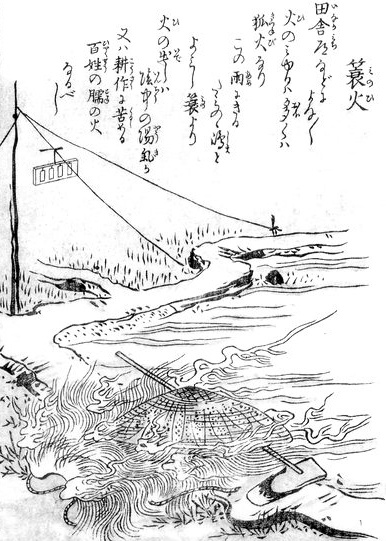
Minobi is a type of supernatural phenomenon called a kaika, or “strange fire.” You’ll find lots of these on yokai.com, but it includes other fireball-type yokai like onibi, hitodama, kitsunebi, sogenbi, ubagabi, and so on.

Minobi is said to appear during tsuyu, the Japanese rainy season, which usually comes in mid to late June. It appears in rural areas, particularly rural roads, lakes, and rivers. It’s found all over Japan, but it is particularly well known around Lake Biwa in Shiga Prefecture.

Toriyama Sekien’s Minobi

Minobi is easily confused with other types of yokai fires. It starts out as a collection of tiny orbs of fire, like kitsunebi. It tends to be attracted to people, and on rainy nights it gathers around the legs of farmers wearing straw raincoats. The orbs of fire gather in greater and greater numbers, until the straw raincoat is glowing as if covered by hundreds of tiny fireflies. If you panic and try to brush it away, that’s when things get strange: unlike regular fire, trying to pat out the minobi actually causes it to spread! On the other hand, if you have the presence of mind to quickly take off your raincoat and throw it on the ground, the fires will go out.

There are a lot of theories as to what causes minobi. In some areas, it is said to be a kind of kitsunebi—that is, fires caused by magical foxes. In other areas, itachi—trickster weasels—are said to cause minobi. In some areas it is blamed on minomushi (the bagworm moth) or fireflies. Here in Fukui Prefecture, it is said to be caused by tanuki.

Minobi sketch which will eventually be part of my Patreon project

If you liked today’s yokai, be sure to join my Kickstarter for The Book of the Hakutaku, an encyclopedia with over 100 yokai, fully illustrated!

Get Ready for A-Yokai-A-Day and a New Kickstarter!

September is almost over, and you know what that means: Halloween is just around the corner!

As usual, this blog will be celebrating Halloween the same way it does every year: with A-Yokai-A-Day for the month of October. Every day during October, I will introduce a different yokai on this blog, with an explanation based on Japanese folklore.

In addition, I will be launching my third Kickstarter project. This goal for this Kickstarter is to produce a new yokai encyclopedia, entitled The Book of the Hakutaku. It will be my third volume, after The Night Parade of One Hundred Demons and The Hour of Meeting Evil Spirits—but you don’t need to have read those books in order to enjoy it. Since it’s an encyclopedia, it’s totally enjoyable on its own as a stand alone book.

The yokai featured on this blog during A-Yokai-A-Day will include upcoming yokai from The Book of the Hakutaku, and from my Patreon project.

Among them will be some inked line art drawings as well as pencil sketches of yokai which have not been painted yet. If you become a backer of either my Kickstarter or Patreon projects, you will get to follow the production of those yokai from sketch, to line art, to completed painting. Just like in the image below:

Donotsura transition

sketch -> line art -> painting

So get ready for Halloween, and get ready for A-Yokai-A-Day and The Book of the Hakutaku! It’s going to be a great month for yokai lovers!