Oh My Kami! Fujin | 風神

Those of you familiar with Mortal Kombat might have heard of today’s kami before, although the game version is quite different from the real one. This is Fujin (風神), the god of the winds. He’s said to be one of the oldest gods, present at the time of Creation when he opened up his bag of winds to clear the morning mists and fill the void between Earth and Heaven.

His appearance is that of a fearsome demon, and in Chinese mythology he and his buddy Raijin (we’ll meet him later) were evil demons who opposed Buddha, but after being defeated by his army, they join his side and have been working as gods since.

While the god of the winds has probably always been a part of Japanese mythology, the imagery we see of Fujin can be traced back to the ancient Greek god of the North Wind, Boreas (from whom we get the words boreal, aurora borealis, and Hyperborea). Boreas carried a magic cloak in which he carried the wind, and he was a very popular god. When Alexander the Great formed his empire, he brought Greek gods and imagery all the way to India’s doorstep, and the cultural reverberations were tremendous. The Greco-Bactrian culture that sprang up in present-day Afghanistan preserved those Greek images long after the dissolution of Alexander’s empire, and eventually merged them with Buddhist iconography, which traveled along the Silk Road to China and then Japan. Pretty cool, huh?

Fujin

Fujin

I won’t be posting a kami tomorrow or the next day, as I will be traveling to Yokohama for a friend’s wedding. So have a nice weekend and Coming of Age Day (here in Japan), and when I get back I’ll post a new kami very soon. Maybe I’ll get some nice wedding photos too.

This print is available on my Etsy store. If you’re interested in buying the original, please email me. Thanks for reading!

風神は風の神様です。

大きい袋を持っています。この袋から風が出て来ます。

風神の風袋はどこから来たと思いますか?実は、昔のギリシアの神様から来ました。ギリシアでは、風の神様は4人いました。北、南、西、と東。北の風の神様はボレアスと言いました。ボレアスは、大きいマントを持って、マントから冷たい風を出しました。アレクサンドロス3世がインドまで来た時には、ギリシアのアートと文化がシルクロードからインドと中国に行きました。人気なボレアス神様のイメージも行きました。ボレアスのイメージはインドと中国の神様とまざって、その神様も風のマントを使うようになりました。そして、仏教が日本に来た時には、風の袋を持っているイメージは日本の風神に入りました。

面白くないですか?

この絵のプリントは私のEtsy storeか問い合わせフォームから買う事ができます。

One More Painting Before the Year Ends

I painted this commission many weeks ago but haven’t been able to post it until now, because it was a surprise birthday gift. A good friend came to visit me in Japan last year, and for her birthday her mom asked me to paint a memory of her Japan trip. The background in this painting is Tojimbo, one of my favorite places here (you can see those same cliffs in a number of my paintings, including the Umibozu). The sky and water patterns are borrowed from Hokusai’s Great Wave over Kanagawa, one of the most famous Japanese images. The painting is acrylic on Japanese washi paper board.

My wife and I will be going back to Takefu, to her parents’ house, for a traditional Japanese New Year’s. I spent New Year’s there back before we were dating and had a great time, so I’m looking forward to it again very much this year. And we’re expecting to have a huge snowstorm that night too, which will be fun.

Expect lots of new things here in January! Going back to the A-Yokai-A-Day theme, I’ll be working on another series of paintings of Japanese kami, or gods. I won’t be doing one a day — I have a lot of things to juggle right now, so I can’t devote 100% of my time to a single project — but I’m aiming for 4 to 5 per week. These will also be painted in acrylics and gouache on shikishi like the yokai, and will also be available for purchase as originals or prints. So please check back here soon after the new year rolls in! And have a safe and fun New Year’s holiday!

これは私の友達(エンジェル)のお母さんから注文があって、彼女の誕生日のプレゼントのために描いた絵です。

エンジェルは去年日本に私を訪ねて来てくれて、私と妻とエンジェルとで色々な観光地をめぐりました。この絵は福井の観光名所(東尋坊)での一場面です。私たちは東尋坊の美しさに心を打たれました。

北斎の「神奈川沖浪裏」から影響を受けて空と海を描いています。

Bonus Near Year’s Yokai: Byakko | 明けましておめでとうございます

Here’s a special holiday treat for you: a bonus yokai!

This is Byakko, the white tiger. It’s got a lot of cultural significance in Chinese astrology (which was imported to Japan from China, like many things). I’m not familiar with any particular stories or myths about Byakko, other than that it represents the west in Chinese astrology.

This picture will be our New Year’s card, or nengajo. It seemed a sin, being an artist, to just buy ordinary New Year’s card, particularly because nengajo are kind of the equivalent of the “Christmas letter” which many families in the US send. They’re not as long, being a postcard rather than many sheets of printed out paper on corny stationery, but they often have photos of the kids or the family, updates, and things like that. So ours will be entirely void of valuable information and instead just be a giant white tiger. Oh yeah, and 2010 is the Year of the Tiger, which is why I picked Byakko. So there you go.

Byakko

Byakko

ハッピーニューイヤー!

今月、もう一枚妖怪の絵を描きました。来年は寅年なので、白虎を描きました。

皆さん、良いお年を迎えて下さい!

来年の一月に、日本の神様の絵を描く予定です。

来年もよろしくお願いします。

Seasons Greetings!

Well I said I was working on a Christmas piece, though I suppose this might come as a surprise to those who weren’t expect it.

The wonderful thing about Christmas is that, despite what the fundamentalist nutjobs and the Republican party want you to think, it’s truly a multicultural holiday. In fact, almost nothing we associate with Christmas today has anything to do with Christianity, except for the name. The winter solstice has, of course, been important since the first civilizations arose, but our Christmas season of greenery, lights, and feasting, and the concept of “eat drink and be merry,” come from a Roman winter festival Saturnalia. The idea of a god-son born in midwinter comes from the later Roman holiday Dies Natalis Solis Invitci, the birthday of the unconquered son. Sun worship in the form of the infant-god-incarnate motif was very popular in the later empire, and many of the customs of Christmas come from the celebration of Mithras’ birthday. Other traditions, like gift-giving, christmas trees and wreaths, and traditional foods come from Northern European pagan religions (even our word “Yule” was the name of the Germanic winter solstice festival). We always hear that Jesus was born in the spring, during the Roman census, but the early Catholic church wanted to eliminate these pagan traditions, and so set up Christmas on the 25th as a way to subvert these native customs. However, even with the loss of their original meanings, the traditions carried as Christmas was popularized in Victorian England, and then later in the US. Even Santa Claus has a very diverse origin. He is a blend of Father Christmas, an English character whose origin and outfit go all the way back to Roman Saturn, and Sinterklaas, a Dutch character who evolved out of the much earlier story of Saint Nicholas. These two folk figures were merged together in the US in the 19th century, and the character Santa Claus was born. Later the Coca Cola image of Santa Claus, combined with the short stories of Washing Irving and Clement Clarke Moore cemented the American commercialized concept of Santa Claus in our hearts and minds. The Christmas Card was started in 1875, and the rest is history.

And that’s why I say the Republicans and the so-called “traditionalists” can shove it up their turducken when they complain about the commercialization of Christmas and the “War on Christmas” and other bullhonkey like that. Christmas was never a very important or big holiday in the church until the 19th century, when it became commercialized. Its origin has less to do with Jesus than it does with pagan bacchanal, and the true meaning of Christmas is whatever you want it to be, because there is so much tradition wrapped up into it that no one culture can claim ownership of the holiday. (And most of the popular Christmas songs were written by Jews, so they get a piece of the pie, too!)

Anyway enough of my little history lesson. I wanted to show you the painting. Remember the Dutch Sinterklaas who is half of the origin of our Santa Claus? Well he didn’t travel alone. In most of Europe, Saint Nicholas had one or more companions who traveled with him, helping him out. In some cultures, they are based on the original stories of Nicholas of Myra (who, by the way, was from Turkey), like the French Père Fouettard. In some, they are medieval additions to the already mythologized tale, like Knecht Ruprecht, or the Dutch Zwarte Piet. In others, they are remnants of the pagan past — former gods who were either demonized or diminutized when Christianity took over — like the German Belsnickel, the Austrian Klaubauf, Swiss Schmutzli, and others: Rumpelklas, Hans Muff, Bellzebub, Drapp, Bartel, Cert and Andel, Hanstrapp… and the list goes on and on beyond that. This painting is of one of the more well-known Christmas monsters: Krampus.

There’s a decent article in Wikipedia about Krampus, but in short, he’s a scary monster that “birches” the bad kids, while Santa gives them presents (makes you wish for coal instead, doesn’t it?). I find Krampus pretty interesting, because (as you’ll see on the Wikipedia page) he survived the Christianization of the solstice fairly well, and lived on in festivals and even Christmas cards and illustrations. Boy, I would love to get a Krampus card one year…

So here is my Christmas Krampus/Krampus Kard/Merry Krampmass? All I know is if I were raised in the Alps, I would probably not look forward to Christmas nearly as much as I do now.

Krampus

So be good for goodness sake!

NMP Issue 1: The Desire

Back in the summer and early fall, if you remember, I was doing a lot of work with an RPG company, Nevermet Press. Their first PDF was published this month, and my artwork is on the cover! I also designed a good chunk of the PDF layout as well. Click on the image below to go to the Nevermet Press page for the product.

Nevermet Press Issue 1: The Desire

Nevermet Press Issue 1: The Desire

If you haven’t heard about NMP, it’s a RPG blog that creates community content non-specific to any game system. Kind of drag-and-drop game ideas. The Desire is the product of a number of writers and artists working together, everyone creating their own content based on a central theme — in this case, a villain named The Desire. The cool thing about the project is that, unlike a lot of RPG products that present a linear script with a beginning, middle, and end — severely limiting the GM’s ability to modify the adventure — NMP’s articles develop locations, encounters, items, and characters around a central concept. As a game master, I think it’s a refreshing take on the “modular” concept of game modules, and is easier to plug in to an existing game. Finally, as each writer and artist presents their own vision which stems from the original article, there’s a wider variety of stories to tell. Just like if 10 artists painted the same scene, you’d still get 10 different paintings. (Admittedly, I’m biased because I worked on the project.)

Fukui Shimbun

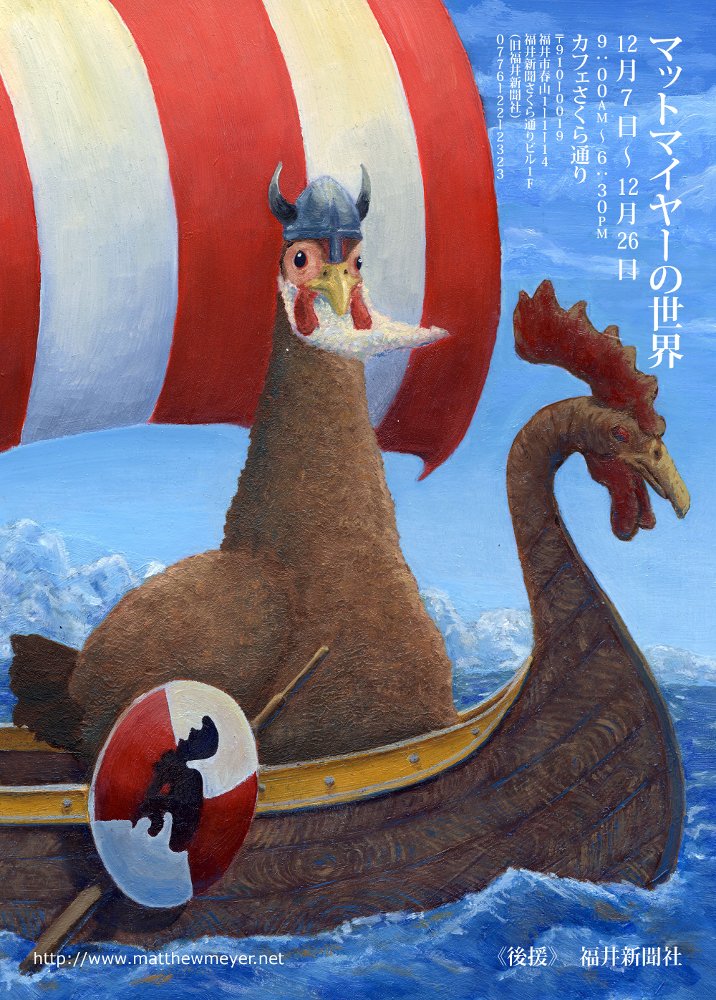
On the first day of my gallery, I was interviewed by Fukui Shimbun (the newspaper owns the cafe, which means the added benefit of free publicity for me). Today’s newspaper had the blurb about my show in it, plus a color picture! It’s not a beautiful scan (sorry, it’s newsprint after all), but here it is:

Fukui Shimbun Scan

Here’s a rough translation: This is the exhibition of paintings of chickens in various cultural wear, by an American illustrator. An American living in Fukui, illustrator Matt Meyer’s exhibition is showing at Cafe Sakura-dori from 12/7 to 12/26. Mr. Meyer did a homestay in Kanazawa and became interested in Japanese art and culture, and later moved to Japan. There are 16 paintings, painted between 2005 and now. All of them are chicken-themed. The reason the the chicken theme is that there are many variations in a chicken’s facial expression. They are wearing costumes from various countries in Europe, Asia, etc. There is even a Japanese shogun and geisha. Mr. Meyer will continue paintings chickens, as well as work on his Japanese yokai series.

It’s a very rough translation… Doing a sentence-by-sentence translation between English and Japanese is almost impossible to make natural-sounding, so that’s why it’s kind of a funny paragraph in English.

Nemurenai Yoru Ni

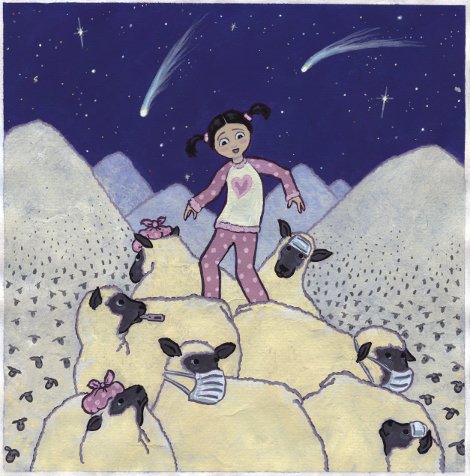
I mentioned the other day that I was doing an illustration for Fukui Shimbun’s New Year’s edition. They do a bunch of children’s stories and illustrations by local artists and authors, and I was lucky enough to be asked to do one of them. The title of my story is 「眠れない夜に」”Nemurenai Yoru Ni.”

The story is about a girl named Miki who can’t sleep so she starts to count sheep. However, all the sheep have come down with influenza, so she can’t count them. Instead she goes to a magic dream world and is transformed in a sheep herself. She offers to help the sheep by helping another young girl fall asleep, so in sheep form, she rides a shooting star to another house. The other sleepless girl turned out to be her classmate, whom she had gotten into a fight with earlier that day. The girl couldn’t sleep because she was upset about fighting with Miki. So sheep-Miki told her it was okay, and in the end everything worked out.

In any case, it’s a simple but cute story. And I hope my illustration goes well with it.

Nemurenai Yoru Ni

Nemurenai Yoru Ni