A-Yokai-A-Day: Ōishi Matanojō and the Blessing From the Chijin

I’ve recovered enough movement in my arm to start painting again, which is a much more pleasant way to spend the day than sitting around and doing nothing.

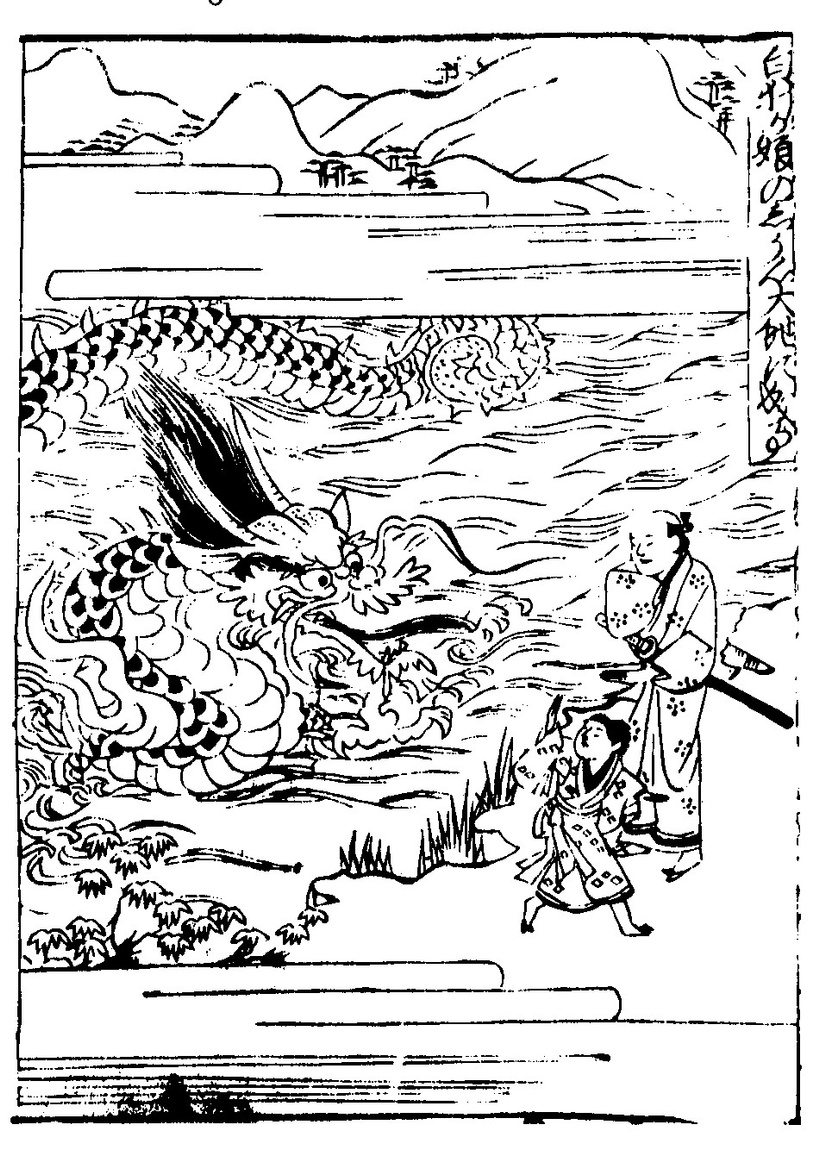
Tonight’s yokai presents itself as another ōbōzu, but it becomes clear later that is just a form that it takes to scare Matanojō. Its actual identity is a chijin. These are local spirits that serve as tutelary deities of a specific area. Chijin are both the protector spirit and the spiritual representation of the land they rule over. It can be anything from a small plot of land, to a mountain, to even as much as an entire country. When their home is in disrepair, they may appear as angry monsters, but when their homes are well taken care of and they are worshipped and honored, they will be benevolent protector gods.

Since Matanojō was an educated, valorous, and logical samurai, he was not afraid of the ōbōzu, and was able to learn its true identity. One part of this story may be confusing to readers: There’s a scene where the ōbōzu tells him, “I am pleased that you worshiped me and vowed to enshrine me as your tutelary god for many years to come.” We don’t actually see this scene in the story, however we know that Matanojō was a properly educated and pious samurai, and we know that he repaired the house. So we can also assume that he took the time to fix up the small shrine on his property, remove the weeds, and once again pray to the spirit enshrined there. I’m not sure if this was omitted because it would be obvious to an Edo period reader, or if it was omitted because that is how the original editor heard the story and they wanted to reproduce it faithfully… But it does feel like there’s a couple of missing sentences there.

For my illustration, I chose to paint the happy chijin rather than the ōbōzu.

Ōishi Matanojō and the Blessing From the Local God
At the time of the Battle of Sekigahara, there was a rōnin called Ōishi Matanojō. He was a samurai well-versed in martial arts, especially the literary arts, devoted to Confucianism, with the heart of a poet, and with a discerning knowledge of logic and reason.

He was appointed to a military post in Izumo and given an estate by the lord, but this house had been inhabited by a bakemono for a long time, and there was nobody who could spend even one night there. Whenever somebody happened to go there, the monster would snatch them and take them away. Because of this, his friends urged him to decline this estate and request a different residence.

Ōishi replied, “As a samurai, it is no easy thing to request a change of residence out of fear of monsters. This is the type of estate that a true samurai would prefer to go to.” He took his men to the house, had them clean it up and perform repairs, and then chose an auspicious day to officially move in. After that, he decided that he would first stay overnight at the house as a test to gauge the bakemono situation, and after that he would move his wife and children in. He fortified the front gate, readied his bow, gun, spear, and his naginata, then he laid out his books on his desk and kept watch while studying.

Around midnight, a knock came at the front gate. Ōishi thought this was suspicious, and he went outside to check. There was a six-meter-tall ōbōzu, and it said, “Open this door.”

“So, this must be the bakemono,” thought Ōishi. He answered, “Who are you to tell me to open the door? Tell me your name, or I will not open the door.”

“Whoever I am, if I say ‘open this door,’ then open this door! If you don’t open it, I will stomp through it! Even if you think to strike me, I cannot be harmed by tachi or katana. Now, open this door!” replied the ōbōzu.

Ōishi felt uneasy, but he also thought it curious, as a monster should be able to get inside even without opening the door. So he opened the gate door, and a young monk of about eighteen or nineteen stepped inside.

“I see that you are concerned that I am some kind of monster. There is no need to be so anxious. I am the god who lives in the northwest corner of this estate, in front of the study. Since ancient times, all who have lived in this house have treated me with disrespect and tried to drive me away. I hated them and cursed them. This is your first time coming here. I have come to tell you that I am pleased that you worshiped me and vowed to enshrine me as your tutelary god for many years to come. From now on, I will guard your family so that your descendants will prosper. Now, my shrine is in terrible condition. You must repair it. There is a pine tree and some bamboo in front of my shrine. If you dig these up, you will find gold,” he explained kindly. Then he vanished into thin air.

Ōishi felt grateful, bowed three times, and shortly after that the dawn broke. His men and his friends all came to check on him, and as he had nothing to hide, he told them everything that happened. When the lord heard what had happened, he declared that Ōishi was a samurai favored by the gods, and he increased his salary from 300 koku to 500 koku, and made him an important advisor in the government.

Afterwards, when Ōishi dug up the spot the god told him, he found 100 gold coins. He used this gold to rebuild the shrine, and due to this great reverence, his household also flourished.

a guardian spirit appears in front of a shrine in disrepair

(My Wife Draws) A-Yokai-A-Day: The Bakemono of the Outhouse in Kasamari, Ōmi Province

Greetings yokai lovers!

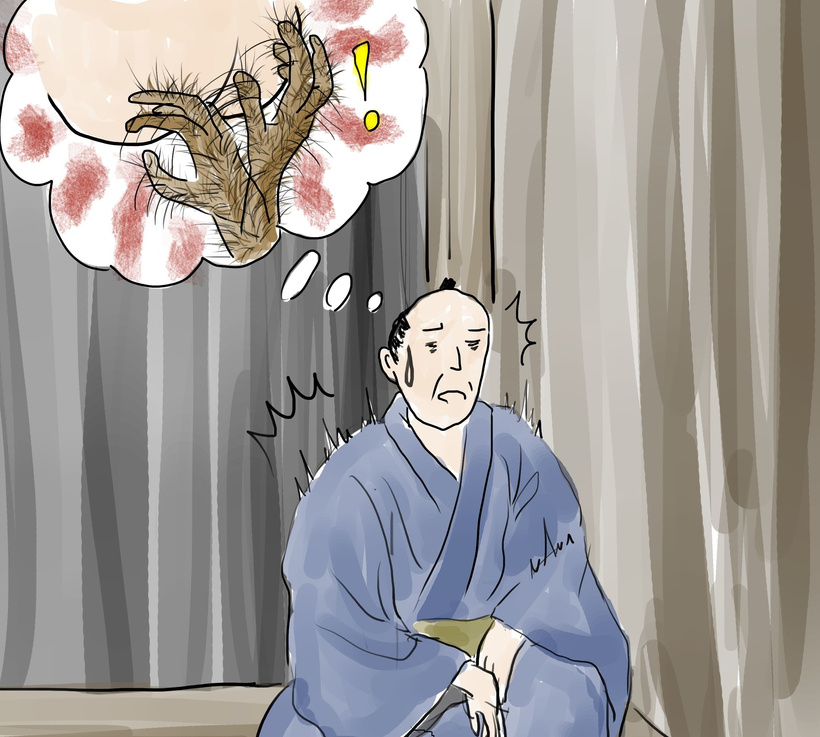
Tonight’s story is a tale that pops up time and time again in almost every prefecture. It’s the story of kurote, or the hairy hand that reaches up out of the toilet to stroke your butt while you do your business. Clearly Edo period people enjoyed potty humor as much as modern people!

I particularly enjoy this story because of the logical, even sarcastic tone it treats the monster with.

Once again my wife was kind enough to do the illustration while my arm is broken. I will have an illustration for you tomorrow, however!

—-

The Bakemono of the Outhouse in Kasamari, Ōmi Province

In a place called Konse in Ōmi Province, there is a rural village called Kasamari. In the outhouse at a certain somebody’s house in this village, a bakemono supposedly lived, and nobody would go there. Whenever the wind blew, a hairy hand would stroke their bottom.

One person heard about this and decided he would go and see this monster for himself. He went into the outhouse and positioned himself above the toilet. Just when as the wind blew, sure enough, the bakemono’s hairy hand eagerly stroked his bottom. The man immediately thrust his hand down into the toilet to seize it, but it was a plume of pampas grass.

Because it was the countryside, pampas grass grew beneath the outhouse. When the wind blew, the plumes fluttered the wind and everybody thought that what they felt on their bottoms was a hairy hand caressing them. After that, the pampas grass was trimmed, and the stories about the bakemono stopped.

A-Yokai-A-Day: How the Mistress of a Certain Man in Kii Province Died and Obsession Brought Her Back

How the Mistress of a Certain Man in Kii Province Died and Obsession Brought Her Back

A certain man was caretaker of the castle at Matsuzaka in Kii Province. He had a mistress, and every night he would call for her by way of the alley side door. This woman always came to him wearing wooden shoes, but after a few years she fell ill and finally died. Afterwards, the man stayed awake at night, remembering what he and the woman had talked about over the months and years.

Then, late at night, he heard the sound of the woman walking in her wooden shoes from the alley side door. He grew suspicious, and he raised the curtain to see the woman, emaciated, with disheveled hair, entering the tatami room from the alley. He looked at her and rebuked her: “Well, well, what a cowardly creature!” The woman briskly came up to the tatami room and glared at him severely. She was about to cross the curtain into the room, when the man drew his sword and slashed at her, and she disappeared without a trace. After that, the man too fell ill and died.

—-

Greetings yokai lovers!

Tonight’s yokai is another ghost. However, while yesterday’s was described as a yūrei due to being faint and eerie, this one is much more violent. The story never uses a specific word to describe the ghost; it only refers to her as “the woman” and “the mistress.” Bōrei or shiryō would certainly be appropriate words to describe this ghost, as it is literally a spirit of the dead. Her attachment to her lover brought her back from the dead to be by his side, and he, none to pleased by this, insulted her and tried to kill her. Perhaps if he had treated her more kindly, would he have escaped unscathed?

But we already know this man is a scoundrel, for he has the audacity to bring a mistress into his own house night after night by the side door, with no thought whatsoever to his wife. So perhaps he was doomed from the start…

A-Yokai-A-Day: The Yūrei of the Kirishitans

Tonight’s yokai is a yūrei, or simply, a ghost. There are lots of ways to say “ghost” in Japanese. Yūrei literally means “faint spirit,” and it is used for ghosts that are dim or hard to see, and tend not to be overtly violent but instead create an eerie atmosphere. Bōrei is another common term which shows up in Shokoku hyakumonogatari a lot, and this just means “dead spirit,” i.e. a spirit of a deceased person, and it is used much in the same way as yūrei.

The subject of this story is a Kirishitan, or a member of the Japanese Catholic community during the 16th and 17th centuries. (The term Kirishitan only refers to Japanese Christians from this era, and is not used to refer to Christians in Japan today.) This sect was eradicated in the 17th century when Christianity was outlawed (the “edict from Edo” mentioned in the story), and the Kirishitans who did not renounce their religion were tortured and executed in extremely brutal ways.

One of the ways in which Kirishitans were executed is alluded to in the story: “hanged upside down.” This is referring to a horrific form of torture in which a narrow, 2 meter deep hole was dug and the victim was suspended by their feet in the hole, so that the tops of their feet were at street level and their heads were deep underground. Normally, in this claustrophobic position, the pressure of the blood pooling in the head would damage the brain and bring unconsciousness in a matter of hours, then death shortly after that. Realizing this problem, the torturers found that if they pierced the temples or just behind the ears, the victim would bleed constantly and the excess pressure would be relieved, allowing them to suffer much, much longer. After death, the victims would be burned and buried in mass, unmarked graves, causing extra suffering for their families by making it impossible to give them a proper funeral.

The yūrei in this story are searching for bones — perhaps their own, or perhaps those of a loved on — to try to help them rest in peace. It’s eerie and sad, and the historical setting (and especially the rare subject of Kirishitans) makes it very interesting among kaidan.

The Ghosts of the Kirishitans

There was a Kirishitan sect in Tsu, Ise. By an edict from Edo, these people were hanged upside down, executed, and afterwards their bodies were burned in a place called Otobe.

Two or three days later, at dusk, a few samurai were passing by a place called Furukawa when they saw a beautiful woman dressed in a kazuki accompanied by a maidservant carrying a bag. Women like her were never seen in Ise, so the samurai wondered where she had come from, and quietly followed her. The woman headed towards Otobe, and when she reached the pit where the Kirishitans had been burnt, she solemnly picked out the bones. Two or three more women appeared out of nowhere and also began collecting bones, and then after a while they all disappeared.

a ghostly woman dressed as a Kirishitan in kimono

A-Yokai-A-Day: The Attachment of Saigō Iyo’s Wife

Greetings yokai lovers!

Tonight’s tale takes place in Gōshū, which is another name for Ōmi Province, or what is today Shiga Prefecture. Sawayama is in what is now Hikone City, however the castle in this story is not the famous Hikone Castle, but a different one known as Sawayama Castle. It no longer stands today, but you can visit its ruins.

The last sentence of this story threw me for a loop, and I struggled with how to translate it. It talks about the son of a concubine and “his mother.” However, in this case, the son’s “mother” refers not to the concubine (his biological mother), but to the wife of his father. Technically she would be something like a stepmother, but the original text does not use the word for stepmother, and instead uses just the word mother. This is because after the son was named Iyo’s heir and inherited his name and title, Iyo’s legal wife became the son’s legal mother. Edo period inheritance, familial relations, and even naming conventions are often confusing. Rather than translate it as stepmother, I decided to leave it as mother as per the original text and explain it here.

Another question is why did praying to Benzaiten fix the problem? Sawayama is near Chikubu Island, home to one of the three most famous Benzaiten temples in Japan. Benzaiten is a powerful goddess in both Shinto and Buddhism. While Benzaiten is a goddess of water and music, she is also said to be a jealous goddess with the power to break up relationships and sever even deep romantic ties. By associating his mother, whose spirit was consumed by attachment and jealousy, with Benzaiten, he was able to exorcise the curse of jealous attachment that was haunting the house.

The Attachment of Saigō Iyo’s Wife

In Sawayama, Gōshū, in the household of a certain Ii, there was a man named Saigō Iyo. For three years he lived and worked on the Ii estate, where he enjoyed fooling around with young women. His wife was a deeply jealous person, profoundly wrathful and always burning with jealousy over this fact, and in the end she died of these feelings. She always said, “Where will my longtime passion go? If I die, surely it will come for Master Iyo within a day or two. If it doesn’t, then everybody will scorn and laugh at me.” She kept some white medicine under her mirror. “When I am in my final days, give me this medicine,” she said, and she died not long after that. As was her wish, she was given the medicine.

When Iyo returned home from the Ii estate, he gave his wife an intimate funeral. Afterwards, his household shook with the crying of all who were overcome with grief beyond description, and everyone’s faces were pale with sadness.

Three days after his wife’s death, Iyo went to the outhouse. After a few moments the sound of something falling came from within. Everyone was startled, so they opened the door of the outhouse. They found Iyo lying there, killed, with his eyeballs gouged out.

Iyo was succeeded by his son from one of his mistresses. His house was constantly haunted by shaking and rattling, the doors and shōji coming loose and being flung across the rooms by themselves, and other strange things. So the son prayed for his mother to Benzaiten, and afterwards the haunting subsided.

Coming Soon: A-Yokai-A-Day 2023!

Hello readers and yokai lovers!

It’s been nearly a year since I’ve posted here, as I’ve been more active on various social media sites, Patreon, and yokai.com these days. This site, however, still remains the faithful home of A-Yokai-A-Day, even if that’s makes October the only month I post regularly. With the way social media is fragmenting further and further these days, I miss the old days when a blog was all you needed and RSS would do the rest. Maybe with the rise of the fediverse we might see a return to something like those days… but it’s hard to be optimistic about social media with the way it has been trending this past decade.

Anyway, exciting news: A-Yokai-A-Day will return as scheduled in just 10 more days!

Last year I began sharing tales from an Edo period story collection called Shokoku hyakumonogatari (“100 tales from various provinces”). It’s a fantastic collection of tales about yokai, ghosts, hauntings, etc., and as the name implies, there are 100 tales. Last year I shared 31 of them, and this year I will share the next 31 stories from this book during A-Yokai-A-Day.

I started A-Yokai-A-Day in 2009 as a personal project, but it became a lot more popular than I expected, and soon other people were sharing their own daily yokai posts during October. I love it! I will be sharing these posts on social media (Facebook, Instagram, Twitter/X/whatever-its-called, and Mastodon) using the #ayokaiaday hashtag, and I hope others will too! Every day during October, sketch or doodle a yokai; or share a favorite story or painting; or anything at all to celebrate Japanese folklore with me!

See you soon!