A-Yokai-A-Day: Watanabe Shingorō’s Daughter and Her Affection for a Chigo in Wakamiya

Greetings yokai lovers!

Tonight’s story is another one dealing with attachment. And once again, snakes are used as a symbol for that attachment.

One term that might be unfamiliar to some readers is chigo. This term pops up a fair amount of yōkai stories, and while it literally just means a child, it refers to young boys who were apprenticed to temples but too young to shave their heads and officially become monks. Chigo served as pages and attendants to elder priests, who often dressed them up and had pederastic relationships with them. This adds a layer of complexity to the situation between the boy and the girl in the story. Was the reason he was disinterested in her that he simply did not like her that way? Was it because he was still too young to see this girl as a romantic partner? Were her affections towards him so strong that they made him uncomfortable? Or was he maybe being pressured by an elder lover at the temple to break things off with her? The ambiguity in the story means each reader will probably see it slightly differently.

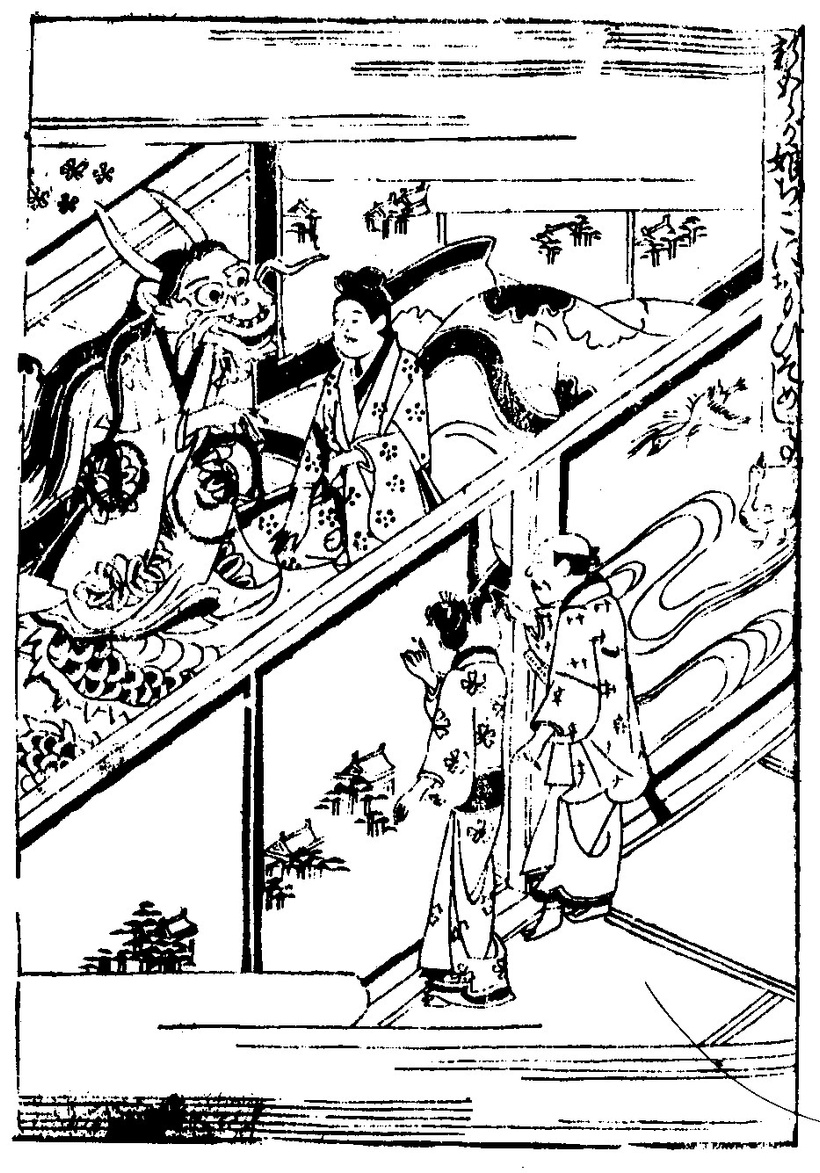
Here is the original illustration that goes with this story. You can see that the “snake” is once again depicted as a dragon.
—-

Watanabe Shingorō’s Daughter and Her Affection for a Chigo in Wakamiya

There was a man named Watanabe Shingorō in Kamakura. He had a fourteen year old daughter. One day she went on a pilgrimage to Wakamiya, and when she first laid eyes upon the priest’s chigo, she fell so deeply in love that she became gravely ill from lovesickness.

The girl confided her feelings to her mother, and so her father, who had been worried about her illness, sought out a good intermediary and contacted the chigo’s parents. The chigo’s parents gave their permission for the girl to begin seeing the boy.

However, as the chigo was still very young, he did not have very deep feelings towards the girl, and the idea of marrying her disinterested him. The girl’s spirit grew ever weaker, and finally she died. Her grieving parents had her cremated, and placed her bones in a box in a certain room with the intention of interring them in Zenkōji in Shinano.

Later, the chigo also became ill, and although various remedies were tried, they had no effect. Afterwards, he did not like to be near other people. His mother and father were perplexed, and so they spied on him through a crack in the door to discover him sitting across from a giant serpent and speaking with it. His parents were so grieved and saddened by this that they asked priests and yamabushi to pray for his protection, but these had no effect either, and finally he died.

When they buried the chigo in the mountains west of Wakamiya, a giant serpent was found in the coffin entwined around the chigo’s corpse, and they had to bury it together with the chigo. Later, when the daughter’s remains were taken to Zenkōji to be interred, the mother discovered that all of the bones had either turned into or were currently transforming into tiny snakes.

How terrifying a thing it is that the daughter’s attachment possessed and finally killed the chigo.
(My Wife Draws) A-Yokai-A-Day: How Hating a Stepdaughter Backfired in Shimōsa Province

Greetings yokai lovers!

I’m resting my broken arm today to make sure I don’t over-stress it, so my wife has kindly taken over for the illustration again.

I’m resting my broken arm today to make sure I don’t over-stress it, so my wife has kindly taken over for the illustration again.

Tonight’s story features a daija—aka a giant snake or dragon. This daija is called the “lord of the swamp.” The Japanese word used here is nushi, which translates as lord or master of a particular location. A head of a household is a nushi, a ruler of a land is a nushi, and a supernatural monster that claims dominion over a particular area is the nushi of that place, and is often treated like a deity. Snakes and dragons in particular, but also giant yōkai fish or animals, often show up in folklore as the nushi of small local geographical features.

When the wife offers her stepdaughter as a bride to the lord of the swamp, what she really means is that she is offering her up as a human sacrifice. The daija will be free to do whatever it wants with the girl—eat her, tear her to shreds, turn her into a dragon and make her rule by her side… All of these have precedence in folklore. So while it sounds bad enough to be married off to a giant snake, it’s actually far worse, and the father’s reaction at the end is far more understandable than if it were just an awkward supernatural marriage.

—-

How Hating a Stepdaughter Backfired in Shimōsa Province

In Shimōsa Province there was a man named Matsumoto Genpachi. He had a daughter who was twelve or thirteen years old. After her mother passed away, Genpachi remarried, but his new wife hated her stepdaughter. One day the stepmother brought her stepdaughter to a nearby swamp and said, “I offer this girl to the lord of the swamp. Come and be her husband!”

She did this five or six more times. Once, when they went back to the swamp, the sky suddenly became cloudy, a terrible wind blew, and heavy rain fell incessantly. They were frightened and went back home.

When the daughter told her father everything that her stepmother had done, Genpachi was furious. He was about to kill the girl’s stepmother when a daija around 500 meters long came. It raised its head and flicked its red tongue, and then turned towards the girl.

Genpachi said, “Hey, serpent, this girl is my true daughter. Even if her stepmother consented to it, you cannot take my daughter without my permission. In her place, I offer you her stepmother.”

The daija turned towards the stepmother and flicked its tongue. Meanwhile, Genpachi took his daughter and fled.

The daija coiled its body around the stepmother seven or eight times, then summoned a rainstorm. As lightning flashed around them, it took her down to the swamp. The stepmother hated her stepdaughter, but in return, retribution came to her.

A-Yokai-A-Day: The Illness of Lord Ikeda Sanzaemon of Harima Province

Greetings yokai lovers!

Tonight’s story is based on events that took place in 1611 in one of the most haunted locations in Japan: Himeji Castle. But first, two vocabulary words that appear in the story:

kijin: We’ve seen oni already during A-Yokai-A-Day. Kijin is written with the character for oni plus the character for a god. So kijin can be translated into something like “demon god.” The word can be used for any spirit that is extremely powerful and fearsome. Some kijin are good, acting like defenders of the faith and use their wrath and ferocity to protect the weak. Others are thoroughly wicked. And some are just excessively proud, and punish those who insult them.

gongen: This refers to any god in Shinto-Buddhist syncretism. When Buddhism was spreading throughout in Japan, Shinto kami were interpreted as incarnations of various buddhas and figures from Buddhist cosmology. Due to this, virtually every Japanese god has an Indian counterpart. This can be confusing, but for the purposes of story a gongen is the same as a god.

Now, a little background on the story:

Ikeda Terumasa (referred to in the story as Ikeda Sanzaemon) was the first daimyō of Harima-Himeji Domain, and a rich and powerful ruler. After basing his clan in Himeji City, he set about renovating and expanding the castle, transforming it into the grand fortress and icon of Japan that it is today.

The castle’s renovations were completed in 1608, and almost immediately afterwards, strange things began happening there. They were blamed on the fact that, during the castle’s expansion, Lord Ikeda dismantled the shrine to a local god called Osakabe, which was located on the castle grounds, and had it re-enshrined on the outskirts of town in a large, communal shrine housing many gods. Osakabe’s wrath was said to be the source of these hauntings.

In 1611, Lord Ikeda fell gravely ill. This, too, was said to be the work of the vengeful Osakabe. In order to appease the god, Ikeda relented and re-enshrined Osakabe in the castle. You can still see her shrine today, on the top floor of the keep in Himeji Castle.

If that name sounds familiar to you, it’s because I’ve written about Osakabe before. She is an extremely famous yokai. Though she is not named in the story, the figure appears in the guise of a strange woman in the main keep of Himeji Castle and refers to herself as “the famous gongen of this land.” That can be none other than the god of the land Himeji Castle is built upon: Osakabe.

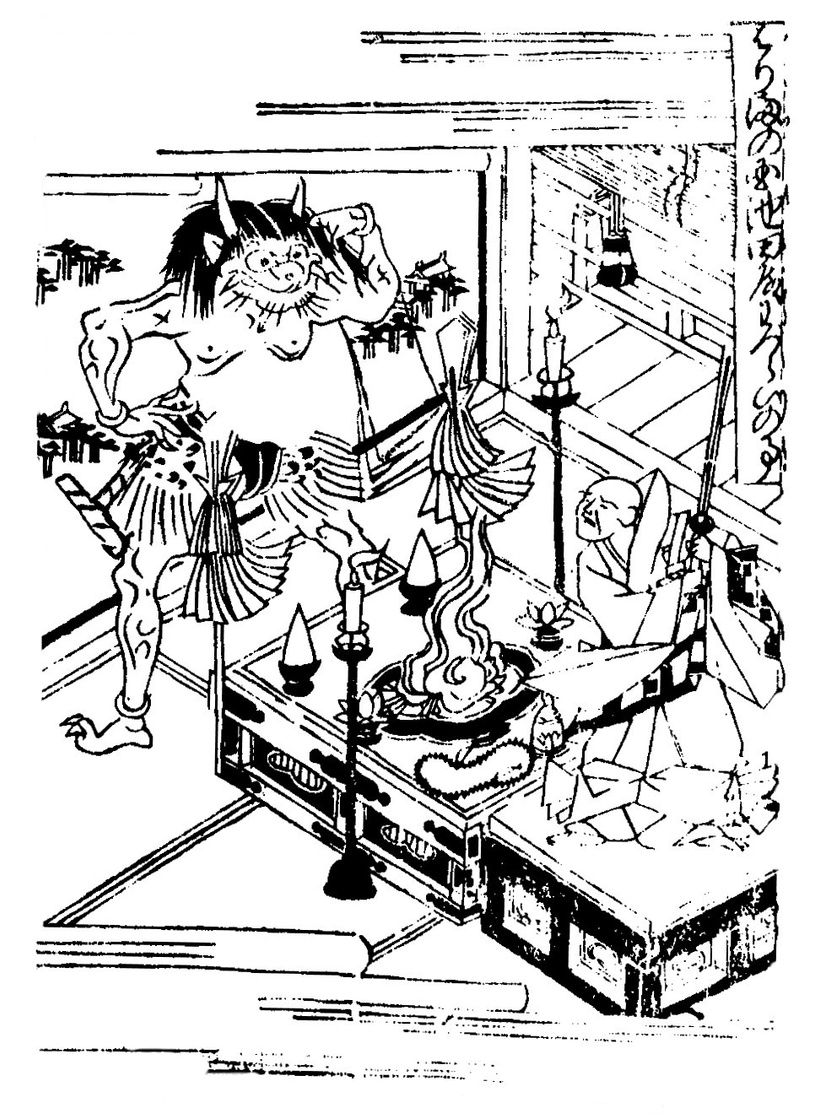
Here is the original image for this story:

—-

The Illness of Lord Ikeda Sanzaemon of Harima Province

When Lord Ikeda Sanzaemon, ruler of Harima Province, became ill and was in critical condition, a high priest was called from Mount Hiei to perform various prayers for seven days and seven nights. At midnight on the seventh night, a woman of about thirty years of age, wearing light makeup and a fine silk kimono, turned to the high priest and said, “Who do you perform such prayers? He cannot be helped. Stop this immediately.” Then she stepped up onto the altar and stood glaring at the high priest.

The high priest, by nature a noble monk, said, “Who are you that speaks to me in the form of a woman?” And he asked her several questions. Suddenly the woman revealed her true form: a six meter tall kijin. The high priest grabbed the sword that was beside him and tried to stab her.

“I am the famous gongen of this land!” said the kijin. Then she kicked the high priest to death and disappeared into thin air.

This story is told by the samurai of the Ikeda clan.

A-Yokai-A-Day: The Ao Oni of Kaga Province

Tonight’s story is rather brief, but it’s rather funny. The idea of all the bravest samurai from the three provinces of Kaga, Etchū, and Noto (comprising all of today’s Ishikawa and Toyama Prefectures) were gathered together and yet all they could do was scream is worth a chuckle. But can you really blame them? Oni are terrifying, and a six meter tall one is definitely not something to trifle with.

Tonight’s oni is specifically described as an ao oni, or a blue oni. It’s not often that the color is explicitly stated, which makes this story a bit intriguing. Why blue? What is the meaning?

According to folklorist Yagi Tōru, oni come in five colors, which are specifically related to Chinese philosophy and the five hindrances of Buddhism. Blue oni are related to the element wood and the hindrance of antipathy. Red oni are related to the element fire and the hindrance of avarice. Yellow oni are related to the element earth and the hindrance of disquietude. Green oni are related to the element metal and the hindrance of sloth. Black oni are related to the element water and the hindrance of doubt. These hindrances are problems because they disrupt both meditation and daily life.

Since this was a blue oni, it must have been born out of feelings of hostility and bitterness. The man who died is not actually named in the story, but he is called the chūnagon of Kaga Province. That refers specifically to Maeda Toshinaga, the first lord of Kaga Domain and the second head of the powerful Maeda clan of Kaga. Toshinaga suffered from syphilis late in his life, and he withdrew from society. He died in 1614 either from syphilis, or from suicide by poisoning. The intense aversion he felt due to his terrible illness, which caused him to withdraw from society, is surely responsible for causing the ao oni to appear.

—-

The Ao Oni of Kaga Province

Long ago, when the chūnagon of Kaga Province died, all of the samurai from the three provinces of Kaga, Etchū, and Noto were packed in a great hall. That day, at dusk, an ao oni about six meters tall came out of the back room and  into the hall. Then it went to the front entrance, pointed at the front gate, and left. All of the samurai from the three provinces were brave men, but all they could do was scream. Only when the oni had left through the front door did they finally put their hands on their swords.

A-Yokai-A-Day: The Three-Way Magic Contest in the Presence of Michinaga

Greetings, yokai lovers!

Tonight’s story features several famous figures from Japanese history: Fujiwara no Michinaga (966 – 1028), Kanshū (945-1008), Abe no Seimei (921 – 1005), and Tanba no Shigemasa (946-1011). Not much background on these figures is really necessary to understand the story, but it’s worth knowing that all three of them were established and well-regarded men of their time. Michinaga was a powerful statesman of the Fujiwara clan and the power behind the imperial throne. Kanshū was a Tendai monk  from Mt. Hiei who was appointed as a high priest under Michinaga’s reign. Abe no Seimei was an onmyōji of such fame that his name is practically synonymous with the art. Tanba no Shigemasa was a doctor, acupuncturist, and court physician to Emperor Ichijō. So this is a story about the real big names of the Heian period, and serves as a testament to how masterful their skills were—Seimei’s gift of foresight, Kanshū’s power of prayer, and Shigemasa’s surgical technique.

—-

The Three-Way Magic Contest in the Presence of Michinaga

During the Chōtoku era (995-999 CE), high priest Kanshū of Mt. Hiei, Abe no Seimei, and the doctor Tanba no Shigemasa sat together before Minister Fujiwara no Michinaga. Some melons were served as refreshment.

Seeing them, Seimei prophesied, “One of these melons is poisonous.”

Upon hearing this, Michinaga said, “If that is the case, use your magic to tell which one of these melons has the poison.”

Kanshū faced the melons and gestured with his fingers and incanted. One of the melons moved, and that melon was immediately removed.

Shigemasa produced a needle from his pocket and stabbed the melon, and it stopped moving.

When Michinaga cut the melon open, inside was a snake. The needle had pierced the snake’s eye, and it was dead.

Michinaga was highly impressed by how well-versed all three men were in their skills.

A-Yokai-A-Day: How Okushima Kengyō Climbed the Bureaucracy Thanks to a Mountain God

Greetings yokai lovers!

Tonight’s story doesn’t feature a yokai, but a yama no kami (mountain spirit/god) instead. Well, that sort of begs the question of what is a yokai vs what is a god, and honestly that question isn’t easy to answer — but I’d say in general that if a supernatural figure is worshiped and respected, it gets to be a god, while if it’s not, it gets to be a yokai. Of course there are exceptions, but that works as a good rule of thumb. Anyway…

There’s a few other terms in this story that probably need some cultural explanations. This contains spoilers, so if you want to read the story first, skip this part now and come back afterwards.

First, sekihan, which is a kind of sticky rice mixed with azuki beans. It is considered a special dish, to be made on celebratory occasions like birthdays, holidays, and so on. In the case of this story, it is made as a religious offering.

Next, the kosode, which is a short-sleeved kimono that has evolved over the centuries, but in the time of this story it was used as an undergarment, worn directly on the skin under a kimono. This is significant, because the zatō is able to wear the same garment that a person with smallpox wore without getting sick himself. Smallpox was highly contagious, so the fact that the zatō is able to wear this kosode without contracting smallpox himself serves as a testament to his divineness in the eyes of the villagers.

And lastly, kengyō. In this story it is used like a name, but it is actually a title. Since the middle ages, certain types of work were controlled by an organization called the Tōdōza — a guild made up solely of the blind and visually impaired, which served as sort of social welfare to ensure that they could earn an income without competition from the sighted. The Tōdōza had a monopoly on several professions, including massage, playing the biwa, acupuncture and moxibustion. The Tōdōza had a very hierarchical ranking system. The highest ranking members were kengyō, followed by bettō, then kōtō, zatō, shibun, ichina, and han. At the very top was a single individual who was the sōroku kengyō (“chief administrator”). Beneath him were ten administrators called the jūrō kengyō (“ten elder administrators”), ranked from one (lowest) to ten (highest). (Often, any person in this guild was referred to as a zatō, a term we’ve seen in many yōkai stories, regardless of actual rank.) High ranking zatō could be quite powerful, serving feudal lords as doctors, scholars, administrators, and even spies. Ranking up in this system was not really a question of skill — it was a question of money. Each rank cost a certain amount of money, and you had to buy your way up the ladder. This story starts off talking about how Okushima Kengyō never ever held a single official rank; this is because he was a poor man and not due to any other reason. But due to the money he received by acting as an intermediary of this mountain god, he made enough money to rise from no rank at all at age 60, to kengyō at age 73, all the way up the the jūrō before the end of his life. In other words, he skyrocked to the 2nd highest rank of zatō in just a few years!

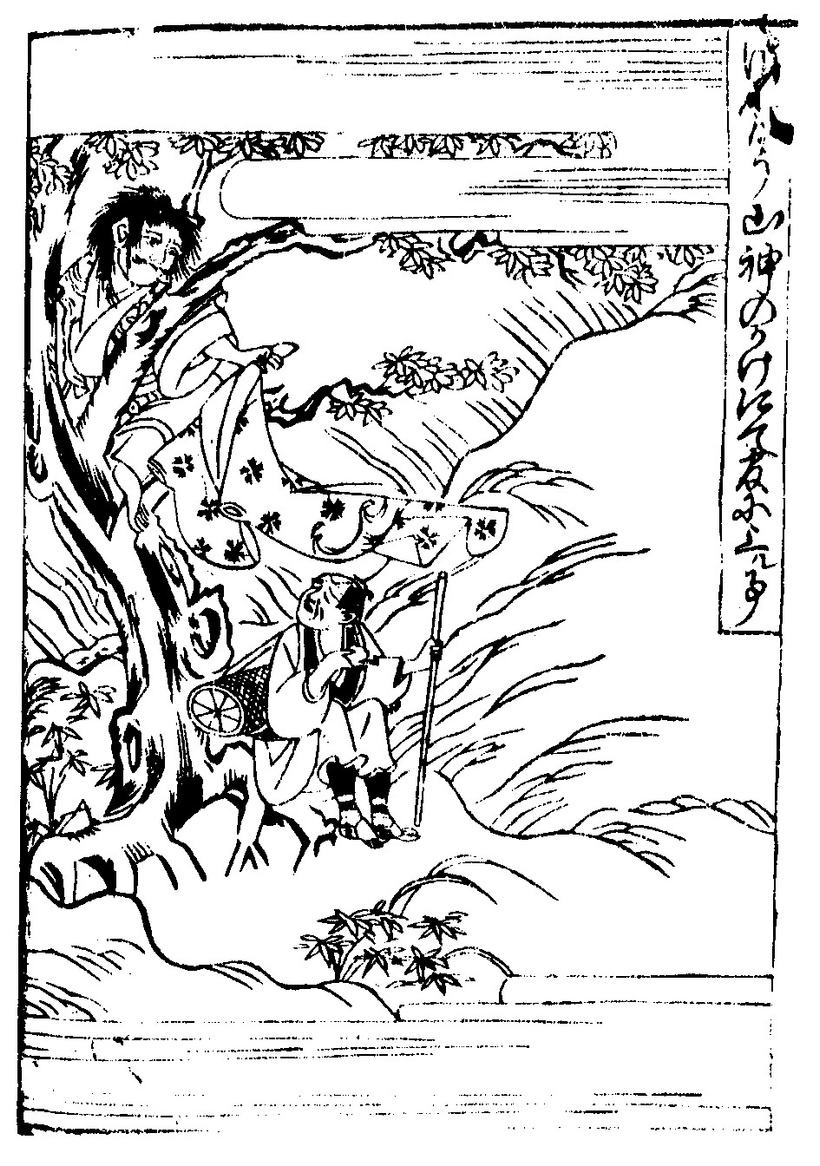
Here’s the illustration that accompanies this story in the original text:

—-

How Okushima Kengyō Climbed the Bureaucracy Thanks to a Mountain God

For his whole life until he was sixty years old, the man called Okushima Kengyō had never held a single official rank. He made his living doing this and that, walking place to place.

In Kumano he got lost on a mountain path, and he stopped in the shadow of a large tree to rest for a while. Then a loud voice came from the sky above the tree: “Zatō! Zatō!” it called. Okushima was startled. He lowered his head to the ground in fear.

“If you are hungry, eat this,” came the voice. And it gave him a bowl of warm sekihan.

Okushima wondered what kind of person this was, but he was so hungry and tired that he just expressed his gratitude and ate. Then the voice came again:

“Zatō, if you are cold, wear this.” And a kosode came down from the sky above the tree. Okushima took the kosode and wore it underneath his own kimono. Then the voice came from above the tree again:

“Zatō, if you want to get to the village, I will show you the way. Follow my voice.”

Okushima was grateful, and he followed the voice as it directed him here and there. At first, when he was alone, it was very difficult to walk on the boulders and stones; but when he followed the voice it was like walking on tatami mats. Before long he arrived at a village.

“Take a room at that house,” said the voice.

Okushima requested a room at the house he was shown, and the master served him a several dishes, starting with sekihan. Okushima thought it was strange that he was served sekihan again, and the master asked him, “Master Zatō, why do you seem puzzled? Tell me the reason.”

“Well, it’s just that before, when I got lost on the mountain path, I had some sekihan, and it tasted exactly the same as this sekihan.” He explained everything that happened, and showed the kosode that he was wearing under his kimono.

The master was astonished and said, “Well, this is a strange thing! My daughter will turn fifteen this year, and she recently was sick with smallpox, so I prayed to the mountain god, and then she recovered completely. So last night I made some sekihan and offered it along with the kosode that my daughter wore on her skin to the mountain god. It seems that the mountain god took a liking to you, Master Zatō.”

He then prepared a great feast and announced to the village, “Anyone who wants to pray to the mountain god should visit Master Zatō!” And so as the villagers vied with each other for his favor, Okushima was showered with silver and gold, and at the age of seventy-three he was made a kengyō, eventually rising to the rank of jūrō kengyō. He lived until the age of ninety, and he died in the 14th year of Kan’ei (1637).

A-Yokai-A-Day: The Onryō of Abe Sōbei’s Wife

Greetings yokai lovers!

Tonight’s story features an onryō, the most terrifying of all Japanese monsters. (Yes, even more terrifying than the toilet stroker!) The fear of ghosts that come back from the grave to enact supernatural revenge on the living has been a deep part of folklore since ancient times, and as such onryō stories make up a large portion of the kaidan stories from the Heian through Edo periods, and even to today with modern horror movie ghosts modeled after these centuries-old patterns.

These stories are deliciously violent and cruel, and they really make me feel like Halloween is just around the corner. The descriptive imagery that comes forth even in these very short stories is chilling, from the description of the ghost herself, to specifically what she does. And it somehow is even more so when the ghost’s victim seems to deserve their punishment, like in tonight’s story!

I will be taking a painting break tomorrow to rest my arm, so my wife will once again pick up the slack for tomorrow’s story!

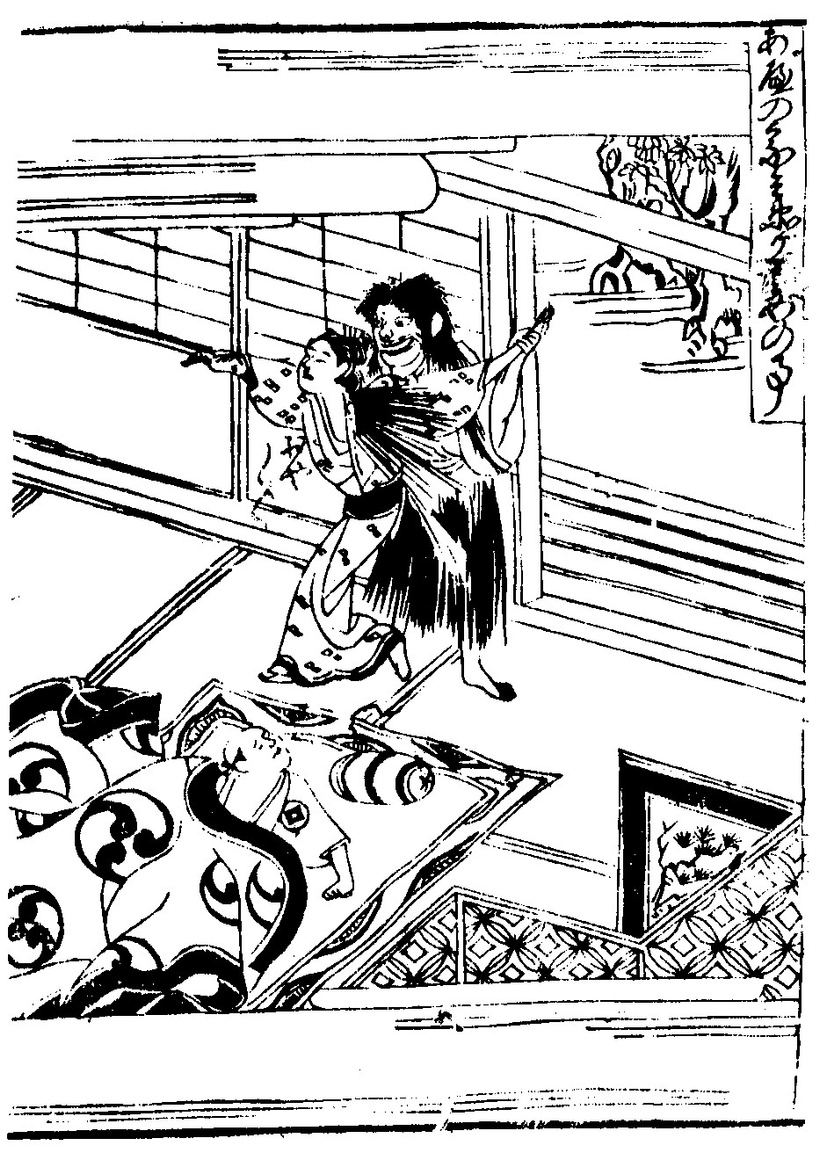
In the meantime, here is the very creepy illustration from Shokoku hyakumonogatari for tonight’s tale:

—-

The Onryō of Abe Sōbei’s Wife

In Hayami, Buzen Province there was a man called Abe Sōbei. He was always cruel towards his wife, and would not allow her to eat. He wife was so frustrated by this that she fell ill, but her husband would not give her medicine, and she grew even worse. She died in the spring of her nineteenth year.

In the final moments of her life, she turned to Sōbei and expressed the malice she had built over so many years. “I will never forget what you have done, no matter how many lives I live. You will soon understand,” she said, and then died.

Sōhei discarded his wife’s corpse in the mountains and did not hold a funeral. At midnight on the seventh day from her death, his wife came to his bedchambers. From the waist down she was stained with blood, her long hair loose and disheveled, her face a sickly pale green, teeth blackened, eyes glaring wide like bells, and her mouth split open like a shark’s.

She stroked Sōbei’s sleeping face with her icy hands, and as Sōbei shrunk back, his wife cackled. Then she tore the body of the woman sleeping next to him into seven or eight pieces, pulled out her tongue and tucked it into her bosom and said, “I’m leaving now. I’ll come back tomorrow night, and I’ll show you my years-long grudge.” Then she disappeared.

Sōbei was so startled that he asked a high priest to recite the Great Perfection of Wisdom Sutra and perform an exorcism. The following night he set up bows and guns at all of the house’s entrances and exits, fortified his position, and waited. At midnight, Sōbei’s wife came up behind him out of nowhere and watched him intently. Sōbei thought he felt a chill at his back, and when he turned around, she glared at him.

“Well, well, aren’t you very cautious,” she said, and she moved to stroke his face, but then suddenly turned into a terrifying figure, tore Sōbei in two, kicked all of the maidservants around her to death, kicked through the ceiling, and rose up into the empty sky.