Coming Soon: A-Yokai-A-Day 2024!

Hey everyone! It’s the end of the September, and that means Halloween season is almost upon us! Personally I think that all of September should just be called Halloween Eve, but I’ll make do with a month-long celebration of horror as I do every year, with A-Yokai-A-Day!

For those of you unfamiliar with A-Yokai-A-Day, it’s a project I started in 2009 to celebrate traditional Japanese horror, yokai, ghost stories, kaidan, etc. Early on, I introduced specific yokai on this blog — a project which eventually evolved into yokai.com and my own yokai encyclopedias. In recent years I’ve translated longer epics, Edo period supernatural comics, and short ghost story collections. For the past two years I’ve translated stories from Shokoku hyakumonogatari, a collection of spooky and weird tales (kaidan) published in 1677.

This year I’ll be continuing Shokoku hyakumonogatari, and by October 31st I’ll have translated 93 out of 100 of the stories in this book! You can catch up on stories 1 through 62 in my blog’s A-Yokai-A-Day archives here: 2022, 2023.

And if you feel so inclined, please feel free to join me in celebrating Japanese folklore this Halloween season by sharing your own yokai stories, sketches, paintings, and anything else using the hashtag #ayokaiaday!

Don’t Miss the KaiKai Yokai Festival!

Exciting news!

This fall, I’ll be part of the KaiKai Yokai Festival at Toei Kyoto Studio Park in western Kyoto! I’m both serving as an advisor to the event, as well as participating as a vendor during several weekends this fall, and I am super excited to be part of this festival!

One of the most common emails I get both here and at yokai.com are questions about yokai-related events, festivals, or locations to visit while people are touring Japan. Usually I have to give the unfortunate answer that, while yokai are everywhere in Japan, unless you go to one or two specific museums, or come at precisely the right time for one of a handful of specific festivals, you’re not likely to get to experience yokai culture in such an exciting or flashy way. It’s especially painful for people who want to see the big Kyoto Mononoki Ichi night parade, but will only be in Kyoto on the wrong weekend for the event.

This fall, however, you don’t have to worry about that, because every weekend is yokai weekend at the Edo period samurai film theme park! If you love yokai, and want to participate in the world’s most exciting yokai festival, this is your chance!

Uzumasa film studio is one of my favorite places to visit hands down, just because I love walking through the actual movie set that the theme park is built on. The atmosphere is wonderful, and the actors are entertaining. Afterwards you can go watch old samurai flicks and see the very set pieces you just walked through!

This collaboration between the film studio and Kyoto’s incredible yokai art group Hyaku Yō Bako is a dream come true for yokai lovers. So if you’ve got any plans to visit Japan this fall, make sure the KaiKai Yokai Festival is on your must-do list!

Check out the official website for more details: toei-eigamura.com/yokai

See you there!

Summer Exhibitions & Events

Hey readers! It’s been a long time since my last post, and there’s been a lot of things keeping me busy. For most of this year I’ve been focused on finalizing The Palace of the Dragon King and preparing the rewards for Kickstarter backers. Rewards like posters and ebooks have already shipped out, while physical books will begin shipping out in just a few weeks.

Although I’ve been posting my activity regular on social media and my Patreon, I neglected to update my events on this blog. But here are a few exhibitions I’ve been involved in this summer:

Yokai exhibit at Shikura Gallery in Echizen City:

Fukui Yokai Fes and Mononoke Ichi in Fukui City:

Summer may be over, but I have more exciting events coming up very soon! I’ll be posting about them soon here, over on yokai.com, and on social media. So check back soon!

New Kickstarter!

Hey everybody! I am launching a Kickstarter in just a few days!

Coming soon to Kickstarter!The Palace of the Dragon King is my fifth illustrated yokai encyclopedia. Following in the footsteps of my previous four books, it features over 100 illustrations and descriptions of yokai, mythical, and folkloric creatures from Japan — with a special focus on sea monsters and the servants of the dragon king who lives at the bottom of the sea!

Visit the Kickstarter preview page now and sign up for a notification when the project launches!

A-Yokai-A-Day: The Tanuki Who Transformed into an Old Woman at Nabari, Iga Province

Tonight’s story is another one featuring a tanuki, and like the one from last week, it has a bloody ending. This time, though, the yōkai is a lot more dangerous.

The ending of this story matches a pattern that is seen in several yokai stories from all around Japan. Aside from a wild animal disguising itself as an old woman, discovering the pile of bodies underneath the floorboards seems to have been a popular folklore trope. We see it in story patterns like senbiki ōkami, although that is with wolves and not tanuki.

Anyway, this story serves as a reminder that even the furry little critter yōkai are sometimes vicious man-eaters!

The Tanuki Who Transformed into an Old Woman at Nabari, Iga Province

In Iga Province, there is a mountain village to the southeast of a place called Nabari. In this village, every night, one by one people were disappearing. Nobody knew who or what was responsible. One person had their child taken, another person had their parents taken, and the crying and grieving was too painful to watch.

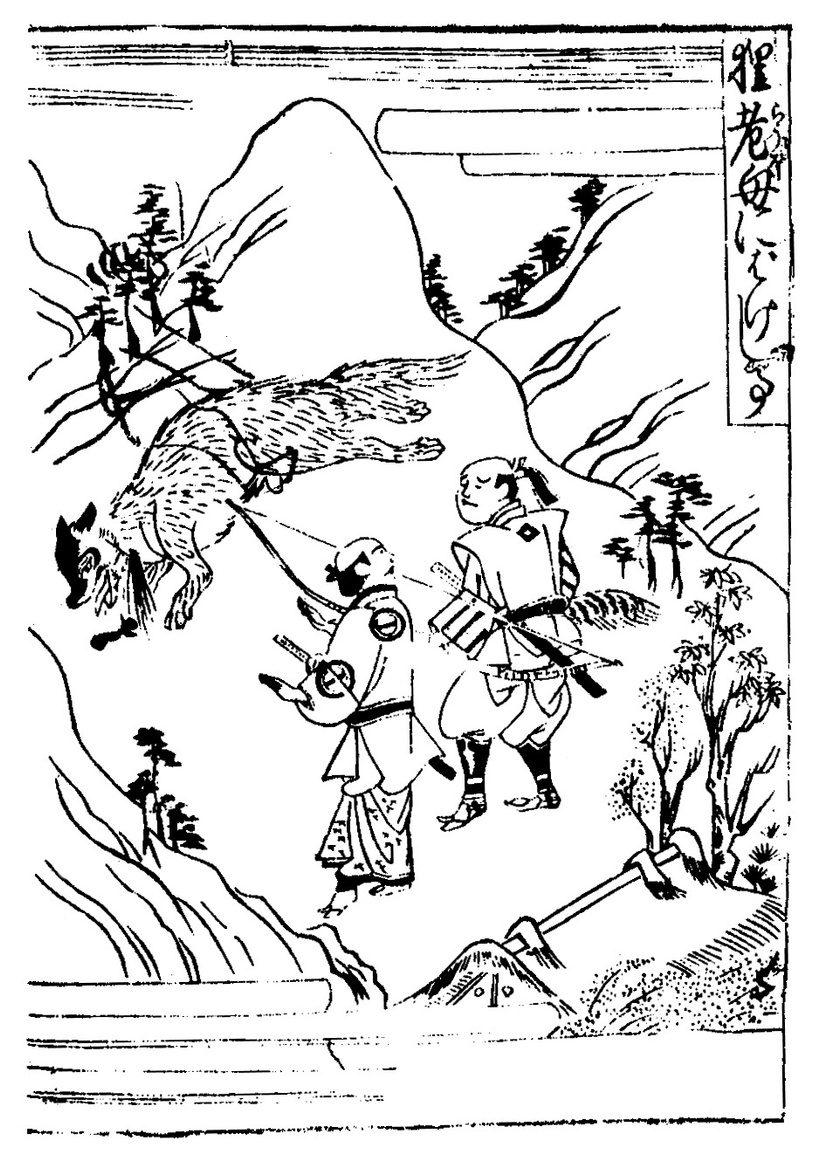
One day, a hunter from that village went into the mountains at dusk. A person came at them from out of the mountains, and when he looked to see who it was, it was a hundred-year-old woman, with disheveled white hair scattered in all directions, and shining eyes. Her appearance was inhuman, so the hunter immediately nocked a crescent-headed arrow and recklessly fired it with a loud twang. It looked like he hit, but the woman got away.

In the morning, the hunter went back to that spot and found a trail of clotted blood that went here and there among the mountains. He followed the trail of blood back to his village, to a small hut behind the village headman’s manor. The hunter was mystified. He asked the village headman, “Who lives in the small hut behind your house?”

“My mother lives there,” he replied. “She is retired. She hasn’t been feeling well since last night, and she won’t eat or let anyone near her.”

The hunter replied, “Well, I have a strange story about that…” And he told the headman everything that had happened.

The headman was also mystified. He went to the small hut, but his mother realized out what was going on, and in an instant she tore through the wall of the hut and ran off. They looked into the bedroom and found a pool of blood the size of a rug. When they looked under the floor, they found countless human bones, including the hands and feet of a child, which had been chewed up and discarded there.

After that they searched the mountains and found the corpse of an old tanuki whose chest had been pierced by an arrow. The headman’s mother had earlier been eaten by this tanuki, which then disguised itself as her and took her place.

a small hut in the forest with a blood trail leading to it and bones underneath the flooring

A-Yokai-A-Day: Watanabe Shingorō’s Daughter and Her Affection for a Chigo in Wakamiya

Tonight’s story is another one dealing with attachment. And once again, snakes are used as a symbol for that attachment.

One term that might be unfamiliar to some readers is chigo. This term pops up a fair amount of yōkai stories, and while it literally just means a child, it refers to young boys who were apprenticed to temples but too young to shave their heads and officially become monks. Chigo served as pages and attendants to elder priests, who often dressed them up and had pederastic relationships with them. This adds a layer of complexity to the situation between the boy and the girl in the story. Was the reason he was disinterested in her that he simply did not like her that way? Was it because he was still too young to see this girl as a romantic partner? Were her affections towards him so strong that they made him uncomfortable? Or was he maybe being pressured by an elder lover at the temple to break things off with her? The ambiguity in the story means each reader will probably see it slightly differently.

Watanabe Shingorō’s Daughter and Her Affection for a Chigo in Wakamiya

There was a man named Watanabe Shingorō in Kamakura. He had a fourteen year old daughter. One day she went on a pilgrimage to Wakamiya, and when she first laid eyes upon the priest’s chigo, she fell so deeply in love that she became gravely ill from lovesickness.

The girl confided her feelings to her mother, and so her father, who had been worried about her illness, sought out a good intermediary and contacted the chigo’s parents. The chigo’s parents gave their permission for the girl to begin seeing the boy.

However, as the chigo was still very young, he did not have very deep feelings towards the girl, and the idea of marrying her disinterested him. The girl’s spirit grew ever weaker, and finally she died. Her grieving parents had her cremated, and placed her bones in a box in a certain room with the intention of interring them in Zenkōji in Shinano.

Later, the chigo also became ill, and although various remedies were tried, they had no effect. Afterwards, he did not like to be near other people. His mother and father were perplexed, and so they spied on him through a crack in the door to discover him sitting across from a giant serpent and speaking with it. His parents were so grieved and saddened by this that they asked priests and yamabushi to pray for his protection, but these had no effect either, and finally he died.

When they buried the chigo in the mountains west of Wakamiya, a giant serpent was found in the coffin entwined around the chigo’s corpse, and they had to bury it together with the chigo. Later, when the daughter’s remains were taken to Zenkōji to be interred, the mother discovered that all of the bones had either turned into or were currently transforming into tiny snakes.

How terrifying a thing it is that the daughter’s attachment possessed and finally killed the chigo.

a pair of hands holds a bone urn containing ashes, bone chunks, and white snakes

(My Wife Draws) A-Yokai-A-Day: How Hating a Stepdaughter Backfired in Shimōsa Province

I’m resting my broken arm today to make sure I don’t over-stress it, so my wife has kindly taken over for the illustration again.

Tonight’s story features a daija—aka a giant snake or dragon. This daija is called the “lord of the swamp.” The Japanese word used here is nushi, which translates as lord or master of a particular location. A head of a household is a nushi, a ruler of a land is a nushi, and a supernatural monster that claims dominion over a particular area is the nushi of that place, and is often treated like a deity. Snakes and dragons in particular, but also giant yōkai fish or animals, often show up in folklore as the nushi of small local geographical features.

When the wife offers her stepdaughter as a bride to the lord of the swamp, what she really means is that she is offering her up as a human sacrifice. The daija will be free to do whatever it wants with the girl—eat her, tear her to shreds, turn her into a dragon and make her rule by her side… All of these have precedence in folklore. So while it sounds bad enough to be married off to a giant snake, it’s actually far worse, and the father’s reaction at the end is far more understandable than if it were just an awkward supernatural marriage.

How Hating a Stepdaughter Backfired in Shimōsa Province

In Shimōsa Province there was a man named Matsumoto Genpachi. He had a daughter who was twelve or thirteen years old. After her mother passed away, Genpachi remarried, but his new wife hated her stepdaughter. One day the stepmother brought her stepdaughter to a nearby swamp and said, “I offer this girl to the lord of the swamp. Come and be her husband!”

She did this five or six more times. Once, when they went back to the swamp, the sky suddenly became cloudy, a terrible wind blew, and heavy rain fell incessantly. They were frightened and went back home.

When the daughter told her father everything that her stepmother had done, Genpachi was furious. He was about to kill the girl’s stepmother when a daija around 500 meters long came. It raised its head and flicked its red tongue, and then turned towards the girl.

Genpachi said, “Hey, serpent, this girl is my true daughter. Even if her stepmother consented to it, you cannot take my daughter without my permission. In her place, I offer you her stepmother.”

The daija turned towards the stepmother and flicked its tongue. Meanwhile, Genpachi took his daughter and fled.

The daija coiled its body around the stepmother seven or eight times, then summoned a rainstorm. As lightning flashed around them, it took her down to the swamp. The stepmother hated her stepdaughter, but in return, retribution came to her.

a giant serpent wiggles its tongue at a man who is pointing at two woman, saying yes to one and no to the other