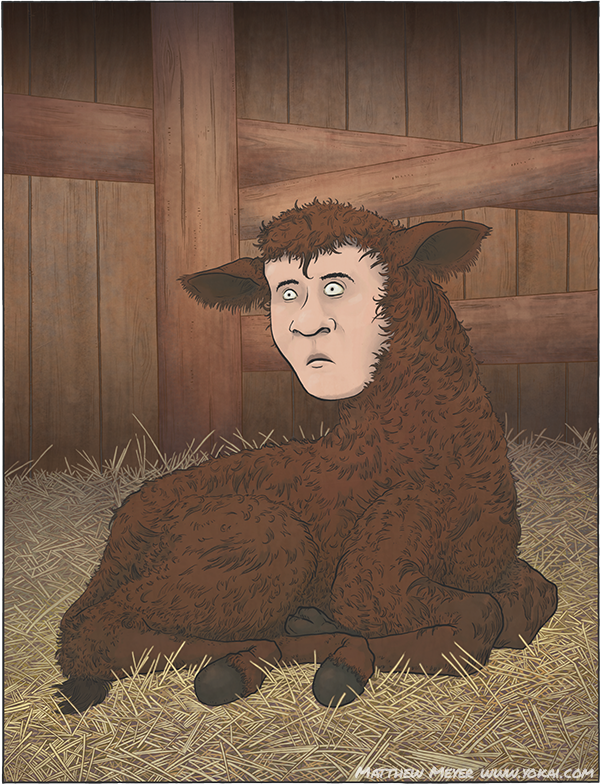
Sunekosuri

Greetings Patrons!

It’s been a long two weeks since the last yokai, but today I bring you sunekosuri, one of the sweetest and cutest yokai there are! I’m sharing it here with you first, and it will go live on yokai.com later this evening.

脛擦り
すねこすり

TRANSLATION: shin rubber
ALTERNATE NAMES: sunekkorogashi, sunekkorobashi, sunekajiri
HABITAT: inhabited areas
DIET: omnivorous

APPEARANCE: Sunekosuri are small, mischievous spirits from Okayama Prefecture. They appear on rainy nights in streets and alleys where people travel. They are most often described as dog-like in appearance, though they are also occasionally said to resemble cats.

INTERACTIONS: Sunekosuri run up behind people walking on dark, rainy nights. They rub against their shins, weave in and out of their legs, nuzzle against the knees, and otherwise make it difficult to walk. They do not intentionally cause any harm to humans, although occasionally their rubbing is strong enough to make a person stumble or even knock them down.

A few local of the local variations are slightly more aggressive than the sunekosuri. The sunekkorogashi and sunekkorobashi both mean “shin toppler.” The sunekajiri means “shin biter.” Although not as violent as other kinds of yōkai, these spirits are blamed for the occasional bruise or bloody nose.

ORIGIN: Sunekosuri is a relatively modern yōkai. It did not appear in writing until the 1935 yokai encyclopedia Genkō Zenkoku Yōkai Jiten, although it is impossible to tell how far back oral traditions go. Despite its relative recentness, it is a fairly well-known and well-loved yokai, most likely due to its cute depictions and manga and film.

Ōnamazu

Howdy, Patrons!

Tonight I bring you oonamazu, the giant catfish! I hope you enjoy the illustration and writeup. As usual, I will post the hi-res files for the $5+ backers in a separate post.

This will be the last yokai of September. Over the next few days I am going to crack down and begin work on A-Yokai-A-Day, which will start October 1st. I don’t usually get to sleep much in October, so these last few days of September are vital for preparation!

大鯰

おおなまず

TRANSLATION: giant catfish
ALTERNAtE NAMES: jishin namazu (earthquake catfish)
HABITAT: rivers, seas, oceans, and subterranean caverns
DIET: omnivorous

APPEARANCE: As their name suggests, ōnamazu are gigantic catfish which live in the muck and slime of the waterways around Japan. They also inhabit large caverns deep underground.

BEHAVIOR: Ōnamazu behave much like their smaller cousins. They dig in the muck, and thrash about when disturbed or excited. Due to their titanic mass, the thrashing of ōnamazu is considerably more violent than ordinary catfish, to the point where they are dangerous to humans. When these monstrous fish get excited, they shake the earth with their violent thrashing, causing devastating earthquakes in the areas near where they live.

INTERACTIONS: Ōnamazu do not normally interact with people, however during the Edo period they were popularly depicted in newspaper illustrations. Usually these pictures showed a huge, grotesque catfish being subdued by a large number of people, gods, or even other yokai, desperately trying to calm its thrashing.

ORIGIN: Long ago, common belief was that earthquakes were caused by large dragons which lived deep in the earth. During the Edo period, the idea of catfish causing earthquakes gradually began to displace dragons in popular lore as the origin of seismic activity. By the 1855 Great Ansei Earthquake, the ōnamazu had become the popular culprit to blame for earthquakes. This was due mostly to the hundreds of illustrations of thrashing catfish which accompanied newspapers reporting the news of that disaster. They were so popular they spawned an entire genre of woodblock print: namazu-e (catfish pictures).

The reason catfish came to represent earthquakes was due to a large number of witnesses observing catfish behaving oddly—thrashing about violently for seemingly no reason—just before the earthquake. Rumor quickly spread that that catfish had some kind of ability to foresee the coming disaster. Since then, the catfish has regularly appeared as a symbol for earthquakes—either as the cause or as a warning sign of the coming disaster. Recent studies have shown that catfish are in fact very electrosensitive and do become significantly more active shortly before an earthquake hits—showing that there is more to this myth than meets the eye!

LEGENDS: The Kashima Shrine in Ibaraki prefecture is the source of a famous story about ōnamazu. The deity of the shrine, a patron deity of martial arts named Takemikazushi, is said to have subdued an ōnamazu. He pinned it down underneath the shrine, piercing its head and tail with a sacred stone which still remains in the shrine today—the top of the stone protrudes from the ground. Earthquakes that take place during the 10th month of the lunar calendar—”the godless month,” when the gods all travel to Izumo—are said to be due to Takemikazushi’s absence from the shrine.

During the 2011 Tōhoku disaster, the Kashima Shrine was badly damaged by an earthquake. The large stone gate was destroyed, stone lanterns were knocked down, and the water level in the reflecting pond changed. The gate was rebuilt in 2014.

Gangikozō

Greetings patrons!

Tonight I bring you the finished painting of gangikozō! He is our second water-based yokai for the month of September! He is a slightly grotesque, yet somehow endearing cousin of the kappa. You’ll note below that he is often believed to change into the kappa during different seasons. If you read my books or yokai.com, you will also be familiar with yamawaro and hyousube, who are also both cousins of the kappa and often considered to be transitional forms of Japan’s most well-known yokai! Gawappa is another kappa-type yokai. There are lots of these, and each one has its own unique little bits.

Enjoy!

岸涯小僧

がんぎこぞう

TRANSLATION: riverbank priest boy
HABITAT: rivers and riverbanks
DIET: fish

APPEARANCE: Gangikozō are hairy, monkey-like water spirits which inhabit rivers. They live along the riverbanks, where they hunt fish. Their bodies are covered in hair, and the hair on their head resembles the the bobbed okappa hair style once popular among children in Japan. Their most notable features are their webbed hands and toes, and their long teeth which are sharp and jagged like files. They are close relatives of the much more well-known kappa.

BEHAVIOR: Gangikozō are not encountered outside of the riverbanks, and there may be a good reason for this; according to one theory, they are a transitional form of kappa. According to many legends, kappa transform from river spirits into hairy mountain spirits when the seasons change. The specific details differ quite a bit from place to place. However, in Yamaguchi prefecture, there is a hairy mountain spirit called a takiwaro which transforms into a water spirit called an enko (a variety of kappa). Some folklorists believe that the gangikozō is a kind of takiwaro, and thus is merely a transitional form of a kappa. This would explain why so little is known of them.

INTERACTIONS: Gangikozō normally stay away from people, but occasionally encounter fishermen along the rivers they inhabit. When meeting a gangikozō, fishermen often leave their largest, cheapest fish on the riverside as an offering.

ORIGIN: Gangikozō do not appear in any local legends, though stories of very similar-looking yokai do. The first and only written record of them is in Toriyama Sekien’s yokai encyclopedias. It is therefore possible that gangikozō was made up by Toriyama Sekien based on the numerous legends of transforming kappa.

According to Mizuki Shigeru, the name gangikozō can be written with another set of kanji, 雁木小僧. These characters can mean “stepped pier” or “gear tooth” depending on the context. This writing reflects both the habitat of the gangikozō as well as its mouth full of sharp teeth, which resembles a toothed gear.

Wani

Hello everyone! This painting took a bit longer than I expected due to the vast amount of detail, but I think it turned out nicely!

As before, I will post the high resolution images for the higher level backers in a separate Patreon post. The entry will be available for the public to see later today at yokai.com, but you guys get to see it first! I hope you enjoy September’s first yokai!

This post was made possible by the generous support from my Patreon backers. If you like yokai and want to learn more, please consider pledging $1 per month to support my work.

Become a Patron!

Kudan

Ladies and gentlemen! I am proud to present to you the kudan, the very first yokai completed for my Patreon project! I hope the choice of kudan for this first entry proves to be an auspicious sign of good things to come!

In a few minutes (I am publishing it on Patreon first), you will be able to view the entry at yokai.com/kudan as well! I will post the high resolution images for the higher level backers in a post on Patreon.

This post was made possible by the generous support from my Patreon backers. If you like yokai and want to learn more, please consider pledging $1 per month to support my work.

Become a Patron!