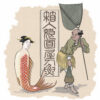
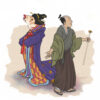
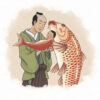
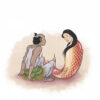
A-Yokai-A-Day: How Itagaki Saburō Was Killed by a Henge in Suruga Province

Hello yokai lovers!

It’s that time of the year again: A-Yokai-A-Day is  here! In celebration of Halloween season, every day this October I will  post a translation and an illustration of a yokai story on this website  & social media.

You can follow along by checking back every day for a new story &  art, or participate along with me and many others by posting your own yokai-themed doodles, paintings, or anything on social media using the  hashtags #ayokaiaday or #ayokaiaday2022.

This year, I am sharing stories from an Edo period book called Shokoku hyakumonogatari (“One Hundred Tales From Various Provinces”). This collection of spooky  stories was compiled and published in 1677. It contains five volumes,  each with 20 stories. The author and editor are unknown, but it was one of the forerunners of the ghost story boom that took place during the  Edo period, and thus its influence can be seen in countless later works.

Perhaps because of its age, copies of this book are exceedingly rare.  The only remaining full set containing all five volumes is owned by the Tokyo National Museum. Fortunately, they have graciously made scans of the book available online. You can see the original book here, including the original illustrations contained within!

All of the translations I share this month are my own. I don’t know of any English language translations of Shokoku hyakumonogatari, although I’m sure at least some of the individual stories have been translated before. Some of them appear in the articles on yokai.com as well, so you may be familiar with some of the stories I share this  month. Hopefully, some, many, or even all of them will be new to you,  and help you develop a deeper appreciation for Japanese folklore!

Note that I will not be translating the names of the monsters in  these stories, for I believe they work better as loanwords. However I will do my best to explain unfamiliar terms found in each story.

Our first story deals with a henge (pronounced hen-geh).  This is a generic term for monsters and doesn’t refer to a specific  type of creature. Henge is written 変化, which literally translates to  “changed thing.” It frequently refers to a shape-changed tanuki, mujina, or kitsune, but can mean pretty much any ghost, spirit, or monster. These days, yōkai is the more common catch-all term for Japanese monsters, but before the  20th century, henge and mononoke were the main terms used for monsters  in Japanese.

How Itagaki Saburō Was Killed by a Henge in Suruga Province

In Suruga Province there lived a man named Yoshimoto. One night, overcome with boredom, he gathered all of his family and servants together for a night of feasting and merrymaking. Then, he said, “Is there anyone amongst you who is willing to climb to the shrine on top of Mount Asama this night?”

Normally, there were many people who boasted about their bravery, but this was a place rumored to be inhabited by evil spirits. Thus, nobody readily stepped forward and volunteered to go.

There was one man, Itagaki no Saburō from Kai Province, whose family had a reputation for bravery and his skill with the bow and arrow going back several generations.

“I will go,” he said.

Yoshimoto was moved by this display of bravery that he immediately gave the warrior a token to use as proof of his visit. Itagaki, being a man of great courage, left for Asama without so much as another word.

It was mid-September. The full moon shone bright through the forest canopy. A strong wind howled, and the sound of the blowing leaves was dreadful. The mountain road was forlorn, but Itagaki passed through it and planted the token in front of the shrine at the top of the mountain.

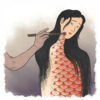
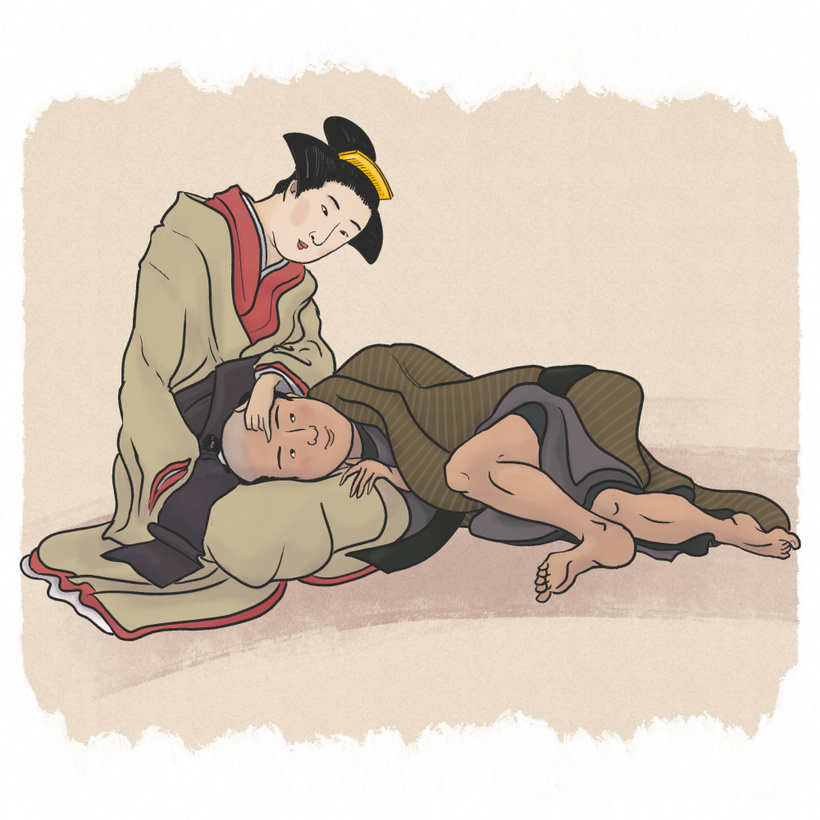
As he was returning, a woman wrapped in a white traveling robe suddenly came out of nowhere. Itagaki thought this must be the henge who lived on Mount Asama, trying to test him. He ran towards the woman and tore away the white cloth covering her face. Underneath it was a single eye, and countless horns sticking out from beneath her parted hair. She wore light make up and her teeth were blacked. No words can describe how dreadful a sight she was, yet Itagaki was not scared.

“What are you?” he shouted, and put his hand on the sword at his waist. But the figure suddenly vanished.

Itagaki completed his journey and returned to Yoshimoto’s party.

“I have placed the token and returned, my lord,” he reported.

All of the men praised him, saying that only a man such as Itagaki could return safely from such a place.

“And did anything unusual happen to you?” they asked.

“No, nothing at all,” he replied.

Then, although the moon had been bright, suddenly the sky grew dark. It started to pour, and thunder roared. All of the men at the party including Yoshimoto turned white with fear. Then, from the sky, a hoarse voice shrieked:

“Itagaki! Tell them! Tell them!”

All of the men present cried to Itagaki: “If you saw something, you must tell Master Yoshimoto! Tell it exactly as it happened!”

Thinking he might lose his life if he did not speak the truth, Itagaki told the whole story of what had happened on Asama, leaving nothing out. However, the wind and rain did not let up, and lightning thunder continued to crash around them. No words can convey how terrible it truly was.

“If we don’t do something, Itagaki will not survive this!” the men cried. “Hurry, hide him in a trunk!”

The men shut Itagaki in a heavy wooden chest, then took up arms and stood watch over it.

Eventually the storm subsided, and morning came. The men decided to let Itagaki out, however when they opened the trunk, it was empty!

The men were terrified and asked each other and Yoshimoto what was going on.

Then, they heard a noise like two or three thousand voices bursting out in laughter. When they ran outside to investigate, Itagaki’s severed head fell from the sky. It rolled underneath the veranda, then disappeared forever.
Yokai: Cataloging the Unknowable

Greetings yokai fans!

Last year I did a free virtual talk with the Museum of International Folk Art in Santa Fe, New Mexico. They just posted the talk online, so I can finally share it with everyone.

I gave a brief history of yokai and the tradition of collecting and categorizing them which has existed for hundreds of years and continues to this day. I also talk about the challenges that arise from even attempting to catalog something that is, by definition, unknowable. I also tell a few yokai stories, then take questions from the audience.

It was a really fun talk, and I hope to do it again some time! You can view the talk here on Patreon or directly on youtube here: https://www.youtube.com/watch?v=SKH61_D42SY

I hope you enjoy it!

Mononoke Ichi Report

Greetings yokai lovers!

This past weekend (4/20) was the grand Mononoke Ichi Night Parade, a Kyoto-based event that yokai lovers across Japan look forward to.

The daytime art market event takes place several times a year, and I usually post photos and videos when I visit. But the night parade version is a relatively new one; it only started several years ago, and it quickly grew to such popularity that they had to shut it down for a year and reorganize in order to close off streets and provide paid security guards. The event was started almost 20 years ago by Kono Junya as an experiment to see if yokai and folklore could be used to revive a struggling business district and turn it into a tourist destination. And the past few events have proven that it is very possible. The last few Mononoke Ichi festivals have appeared on national TV here, and this year I even saw the first foreign language news reports about the event! I’ve believed for years that yokai are only growing in popularity, both here and abroad, and events like this really serve as proof of that.

Although I attend as a vendor, in past events I’ve had free time to move about and take photos & videos of the events to share here. This time I did not even have one free moment to sit and catch my breath; that’s how busy it was! So I’m sorry to say I don’t have any good photos and videos that I personally took to share with you. (I did take some, but as you can see from the photo above, the crowd was so packed that you can barely see the yokai from my vantage point.

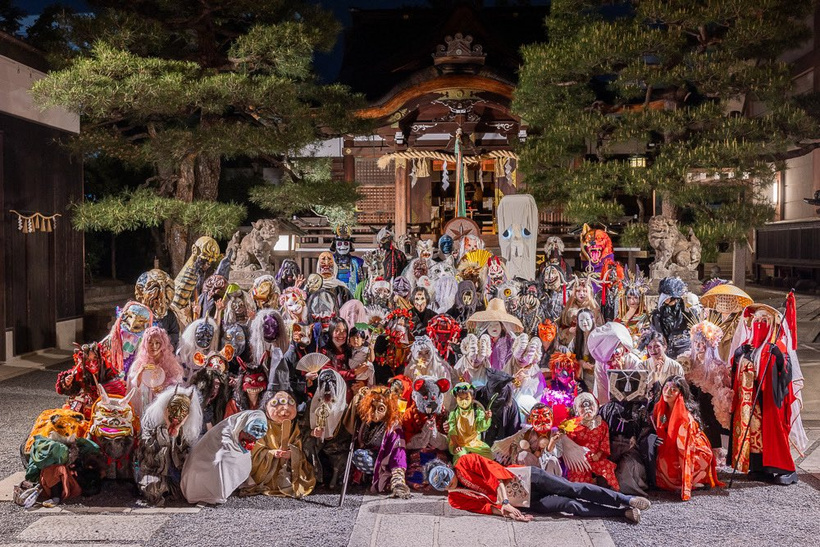
This photo here that I stole from Twitter user @usalica shows off the great costumed yokai, many of who came from across the country to participate:

How many of these can you identify and name?

Even though I couldn’t take good photos or videos, many other people did! So I hope you’ll browse the Twitter tag #モノノケ市 to get a feel of what the event looked like.

And while up until now this event has been a Kyoto staple, I am really happy to announce that this summer, for the first time ever, Mononoke Ichi will be coming to my home of Fukui City; in a festival showcasing my own artwork and the work I’ve done on Echizen Kidan for the past year nonetheless! It’s been a dream of mine for many years to bring a big yokai event like this to Fukui, and getting to do so in partnership with Kono-san’s yokai and the expertise of (my collaborator on Echizen Kidan) Nagano-san of the Prefectural Archives makes it all the more exciting. I think Fukui has the potential to become the next big “yokai spot” in Japan!

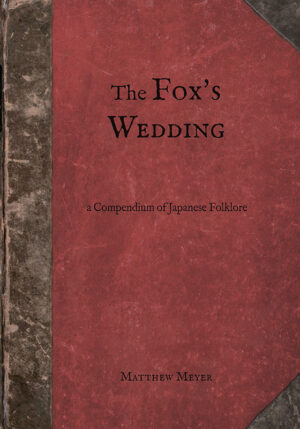
The Fox’s Wedding (limited release) on Amazon

Readers have been asking me for some time now about the status of my 4th yokai encyclopedia, The Fox’s Wedding: A Compendium of Japanese Folklore.

book cover of The Fox's Wedding

The book was funded on Kickstarter in December of 2020, and finished development in 2021. It was originally slated for release in 2021, however, the launch has been delayed several times. Here’s what happened:

Protective measures against coronavirus essentially slowed production down at every step. Smaller staffs working at printing facilities and a reduced number of truck drivers  and warehouse workers added several months of delay to production. Then, the global logistics crisis caused delivery of Kickstarter rewards to be delayed by about half a year while trying to secure space on board a freight ship to the US delivery site. On top of that, the outbreak of war in Ukraine caused parcel systems from Japan to Europe to shut down entirely, so delivery of books to Europe has been halted again.

My intention has been to release The Fox’s Wedding on Amazon once all of the Kickstarter rewards are fulfilled. Thus, while the book has been ready since fall of 2021, the inability to deliver rewards to backers has kept me from doing any kind of general release as well.

If you’ve been following the Kickstarter page, you’ll know that some progress has finally been made on delivering rewards. Space on a freight ship has been secured, and the books will be making their way to the US distribution center later this month.

That is why I am doing a limited release of The Fox’s Wedding in ebook format only. All backers have received their ebooks, and so The Fox’s Wedding will become available on Amazon in DRM-free ebook format next week!

Paperback, hardcover, and collector’s editions will be available at a later date, once all backers have received their rewards.


A-Yokai-A-Day: Hakoiri musume (page 30)

Greetings yokai fans, and Happy Halloween!

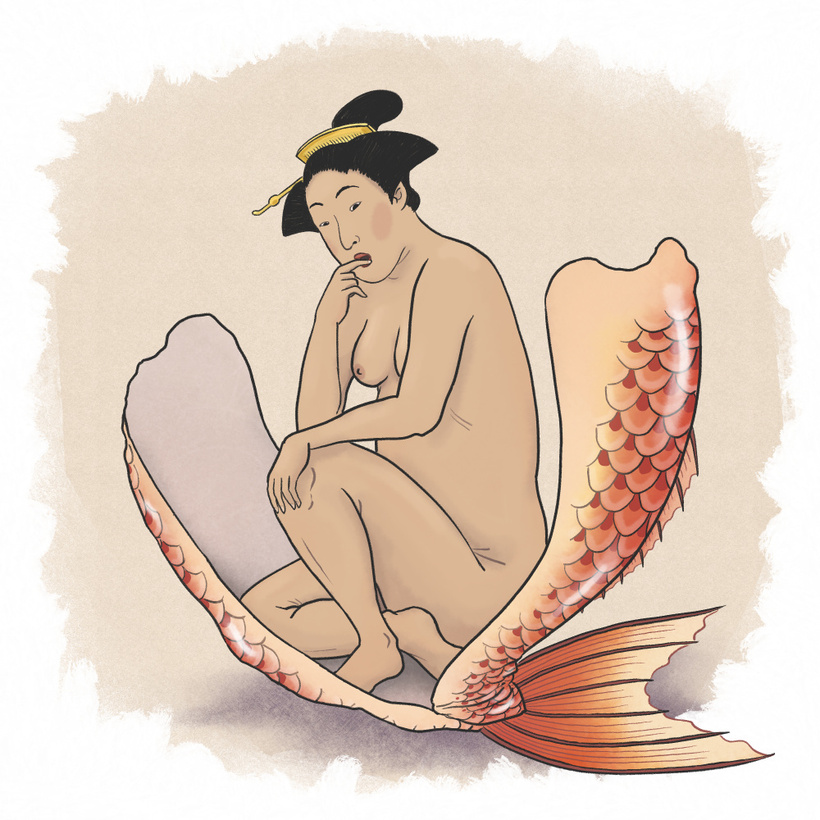
All good things must come to an end, and so today, Halloween, I present the final page of Hakoiri musume menya ningyo. Kyōden is well known for a number of books; this is not one of them. But I still think it is a fantastic book, not only for its sense of humor and its wonderful illustrations, but for its unique insight into the Edo of 1791.

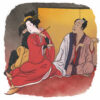
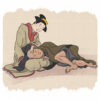
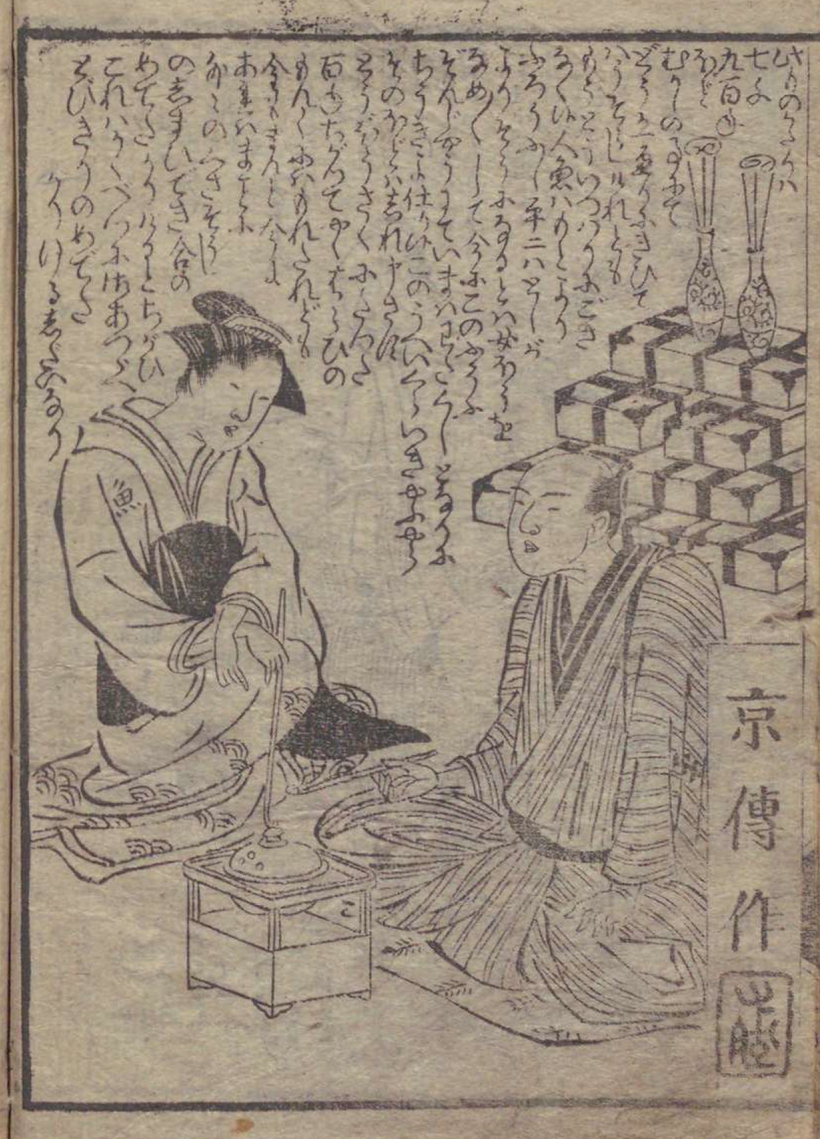
In Kyōden’s illustration, Heiji and the mermaid are pictured happily married, enjoying some tobacco together. Behind the couple are stacks of boxes containing 1000 ryō, showing how incredibly rich they have become. On top of the stack are two tall bottles of holy sake. The mermaid’s eyebrows are plucked, denoting her married status.
Embiggen: https://pulverer.si.edu/node/443/title/3/6 

This story took place about seven thousand nine hundred years ago¹. While it sounds like a lie when you hear it at first, it’s all true!

Mermaids are immortal to begin with, and Heiji just recovers his youth by licking his mermaid whenever he gets old, so the couple is still alive and well to this day. In fact, they live next door to the author of this book. I wonder how much longer they will live… They are only one hundred years younger than Tōhō Saku², and they’ve saved up quite a bit of money, so while it’s traditional to end a book with “happily ever after,” this time it truly is a the happiest of endings.

By Santō Kyōden³

  1. Counting from Kyōden’s perspective in 1791. So more than eight thousand one hundred years ago counting from today.

  2. On New Years Day, beggers would go from door to door offering blessings in exchange for money or rice, and one of the songs they would sing was about how Tōhō Saku lived for eight thousand years. Tōhō Saku is the Japanese name for Dongfang Shuo, a legendary Chinese wizard who attained immortality by stealing and eating the peaches of immortality from the Queen Mother of the West.

  3. Kyōden leaves one final joke at the bottom of the page. Beneath his name there is a printed seal which reads “stinky.” It’s a final apology for the mermaid’s fishy smell.

A-Yokai-A-Day: Hakoiri musume (page 29)

Greetings yokai fans!

If you thought the story couldn’t get any weirder after yesterday’s scene, you might be surprised by today’s page. It’s a Halloween miracle! It looks like the story will have a happy ending after all!

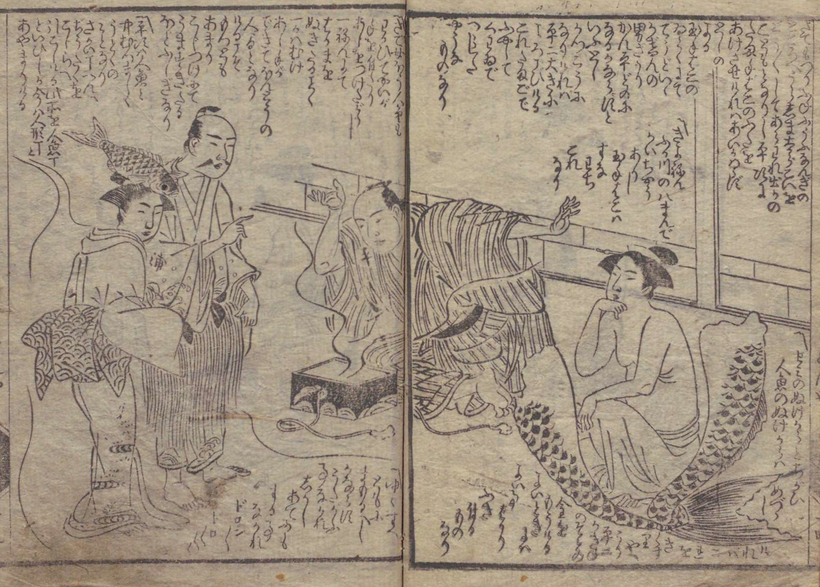
In Kyōden’s illustration you can see Urashima Tarō, now with a stately mustache (since this takes place some 17 years or so after we last saw him) and Orino, wearing a regular kimono instead of an oiran’s kimono. It seems that they stayed together all this time (I wonder what Otohime thinks about that). They are riding a cloud, which implies that they didn’t walk to Heiji’s place, they just magically teleported in and then teleported away. It’s lucky for Heiji and the mermaid that she has such magical parents!

Zoomable version: https://pulverer.si.edu/node/443/title/3/5 

Heiji’s mermaid wife, as if in response to her young husband’s wish for her to have hands and feet¹, shed her skin just like someone takes off their pants, and underneath were human arms and legs! This is almost too miraculous of a story!

Heiji and his formerly-mermaid wife lived happily and prosperously together. They built a house in Sakaichō, which came to be known as Mermaid Town, but has now come to be mistakenly called Ningyōchō².

Ah yes, and since mermaid skins–unlike cicada shells–are rare, they sold her skin to an apothecary and became even richer! When things are good, good things happen one after another!

  1. This has a double meaning. To “put hands on” someone is slang to have sex with them. Now that Heiji is young and handsome again, he wishes that he had a wife he could sleep with; and subsequently she literally puts on not only hands, but feet as well!

  2. A pun based on ningyo and the town of Ningyōchō, a neighborhood in Tokyo. Kyōden swaps ningyo (mermaid) for ningyō (doll). This pun is reminiscent of the book’s title, Hakoiri musume menya ningyo, as Menya was an actual famous doll shop in Ningyōchō.