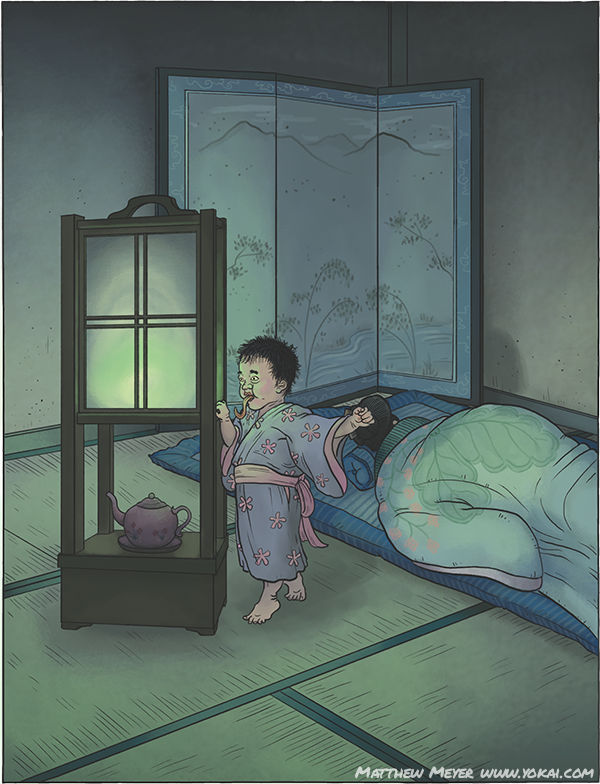
It’s been deathly quiet on this blog since the start of my 2nd Kickstarter. The reason for that is that I have been posting all of the progress and updates on the book work on the Kickstarter page for backers’ eyes only. Since the book has been taking up all of my time for the past year and a half or so, matthewmeyer.net has been suffering from a bit of neglect.
More Yokai
Well, Halloween is over (sadly), and we have to wait 364 days until the happiest day of the year again. However, just because A-Yokai-A-Day is over doesn’t mean that I am finished painting yokai! I’ll continue posting my new paintings on Facebook, Twitter, and Google+, but you’ll have to wait for the book to read all about them. So make sure that you are following me on social media, and you’ll get to preview some of the artwork from my upcoming second yokai encyclopedia: The Hour of Meeting Evil Spirits.
A-Yokai-A-Day: Taira no Masakado & Takiyasha-hime
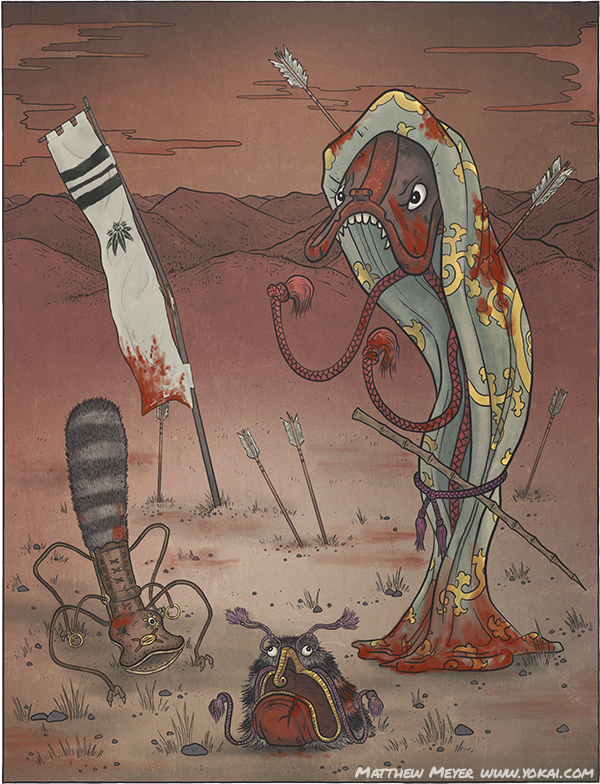
Happy Halloween, yokai fans! The best day of the year is finally here! Is anyone dressing up as a yokai for Halloween? I have a kappa costume, and my wife is dressing up as a shishimai (which the mujina is wearing in this illustration).
Because Halloween is the whole purpose of A-Yokai-A-Day, I always save the most special yokai of the project for the final day. Today’s yokai is actually a pair of yokai; a father-daughter team, straight out of the legends. Taira no Masakado is one of the most famous figures in Japanese history, feared as a terrible ghost, and worshiped as a god to appease his anger. His daughter, Takiyasha-hime, was a powerful witch herself. What is more fitting for Halloween than a vengeful ghost and a witch? I don’t know!
These ones are bit long, too, so they should make for interesting reads. To read on, click the illustrations below!
…and don’t forgot, there are still a few hours left to buy my book, The Night Parade of One Hundred Demons, for only $1!
A-Yokai-A-Day: Goryō
Greetings everyone! It’s October 30th! That means it’s Mischief Night for all of you living in and around New Jersey, and just an ordinary day for all of you other folks. (I only recently learned that this is not a country-wide thing… how odd!)
I just got back from Night of Terror, a haunted hayride nearby, and boy was it fun! It also really put me in the mood for Halloween. There’s nothing at all like a good old fashioned haunted hayride. Aside from that though, the next best thing is of course ghost stories! And after watching a few of my favorite ghost movies, I am very much in the mood to post a ghost for today’s A-Yokai-A-Day. So here you are, for the day before Halloween, a ghost:
A-Yokai-A-Day: Ōkaburo
Today’s yokai comes by request again. This one is another truly, truly bizarre one.
It cracks me up, it really does. There’s little else I can say about it. It is so bizarre, and so out there, and the intricate story that Toriyama Sekien wove when he created it is just mind-boggling.
I have spoken at length about Toriyama Sekien, and his amazing ability to write puns, as well as his amazing ability to poke scathing fun at things he considered immoral in his time: prostitution, religion, and homosexuality. This piece is of course no different. But I think it speaks for itself, so I will let you go on to read the article itself.
Oh, one more thing that fans might find interesting: the painting on the byobu in my illustration is actually taken from Toriyama Sekien’s second book, which serves as the inspiration for my second book. The illustrations you see there are “omagatoki” (i.e. the hour of meeting evil spirits) and “hinode” (sunrise) which are the opening and closing entries in my next book. Just a little fun fact for those of you who like tiny details as much as I do!
Anyway, read on:
Oh, one more thing! From today until Halloween, you can get my first book, The Night Parade of One Hundred Demons, for just $1! Click here to get it!
A-Yokai-A-Day: Kosenjōbi
Today’s yokai was a special request via Facebook: kosenjōbi.
There are lots and lots of fireball-type yokai. Collectively, they are called hinotama. Taking a step back futher, there is a special word in Japanese for supernatural fires: kaika. While researching for this book, part of what I covered was the etymology of the words used to describe evil spirits in Japan. (It also may be partially because I am a word geek and etymology draws me like a moth to a flame) As you might guess, there are countless words!
I’m reminded of the story about how Eskimos and Inuit peoples have dozens and dozens of words for snow because they are surrounded by it. I can only imagine that the reason Japanese has so many words for supernatural creatures is because they have played an important part in Japanese culture for thousands of years. (As a word geek, I am also aware that the Eskimo thing is a myth, but it does support the point I am trying to make so I’m just going to go with it.)
Anyway, here is today’s kaika. Click to read more:
A-Yokai-A-Day: Itsumade
Yesterday we saw a creepy bird, today let’s look at another creepy bird. I like creepy birds… especially ones with legendary ties to actual historical events.
One of the really fun parts about choosing the yokai for The Hour of Meeting Evil Spirits was looking for yokai that were somehow related to each other. Although there isn’t really a narrative or any sort of continuity in the books (being encyclopedias) there is something particularly interesting when different entries reference the same things. It puts the history and the folklore into perspective, and makes it a little more tangible. This is especially helpful when dealing with Japanese history, because it is very complex and for the most part, Americans never really hear much about Japan prior to the 1850s or even World War 2…
While it’s not necessary to understand Japanese history to enjoy yokai, I think it really really helps! So many yokai are tied to historical events and figures that when you don’t know the history, you’re only getting half the story. Or maybe it’s more like when you do know the history, you’re getting double the story! This is coming straight from the mouth of a history buff, so you can take that with a grain of salt. In any case, I tried to introduce bits and pieces of relevant Japanese history in the book in ways that are easily digestible and flesh out the background of some of these yokai more so, as non Japanese history scholars, readers will be able to get a fuller understanding of the circumstances surrounding certain yokai.
Read on below: