Although the written version of today’s story from volume five of Mimibukuro is rather short, I believe an Edo period reader would not have needed much explanation to understand what it is talking about; however, modern day readers—especially non-Japanese readers—might miss a lot of the cultural information buried in this story. So let me briefly introduce a few of the cultural terms that will help make this story more interesting:
Kōyasan — a very famous holy site in Japan that is associated with the supernatural because of its ties to Shingon; strongly associated with yamabushi, ghosts, tengu, and other spirits. The tale mentions that women are forbidden from ascending beyond the Nyonindō (literally “Women’s Hall); this is a common feature of old Japanese mountain worship. Women were regarded as spiritually unclean, and thus were not permitted to access the most sacred parts of holy sites.
Jayanagi — literally “Snake Willow,” a type of willow tree (Salix eriocarpa) known for its long and snaking roots, but here refers to the title of a kabuki play which premiered in 1763 but was lost some time after that. The story dealt with a snake willow that once stood on Kōyasan in one of the mountains darker secrets: an ancient execution ground where criminals were buried alive. The ghost mentioned is something from the kabuki play, and deals with a priest who was possessed by the spirit of a girl and forced to commit crimes—presumably readers would have been familiar with it at the time.
Kōbō Daishi — (774 – 835) the posthumous name of Kūkai, the monk who introduced Shingon to Japan from China. The main point of Shingon is to undergo arduous spiritual training in order to achieve buddhahood in one’s own lifetime, rather than the many, many lifetimes of dedicated practice it normally is supposed to take to achieve enlightenment. Presumably the “wicked monks” mentioned here is also a reference to the play.
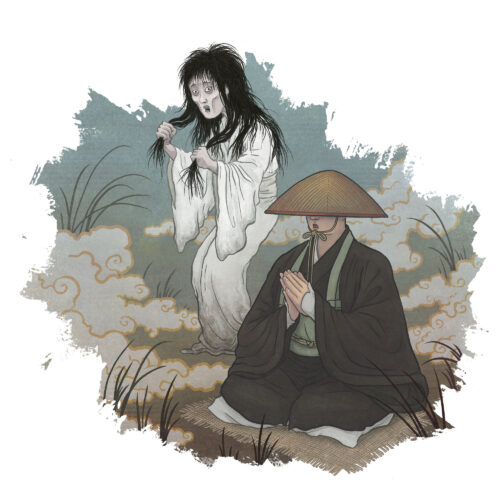
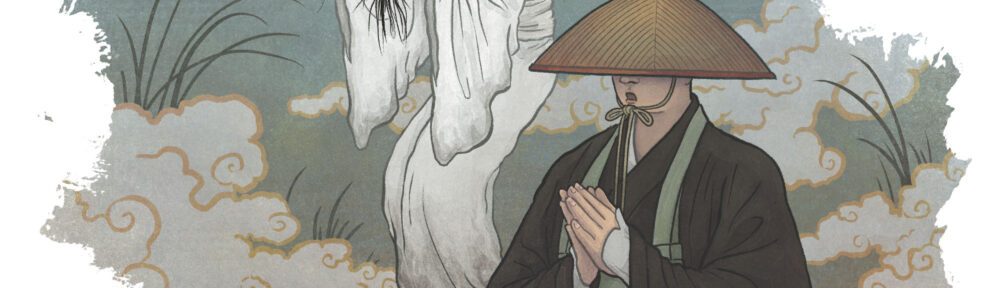
yūrei (ghost) service at Kōya — the description in the story is basically one of a con artist. A wicked priest, or a fake priest, would pose as a shaman and offer to pilgrims at Kōyasan the opportunity to commune with a lost loved one or something like that. Then their partner would appear, either performing the part of the medium whom the spirit would inhabit, or playing the part of the ghost itself. Considering the popularity of Kōyasan as a pilgrim’s destination, and the highly spiritual nature of the mountain, there must have been a lot of people duped into hiring fake mediums.
So, all of that explained, this story doesn’t really tell a tale by itself, but it paints a really vivid picture of a time and place abundant with stories. For that reason, I find this tale particularly interesting. I also really like Negishi’s skepticism at the end. I hope you enjoy it!
Yūrei Service
Kōyasan in Kii Province is a sacred site, known for its unwavering devotion to purity. Women are forbidden from ascending the mountain beyond the Nyonindō hall. The ghost of the Jayanagi is a story widely known among the general public, but perhaps in later generations there were shameless, wicked monks who violated the teachings of the founder, Kōbō Daishi.
Around the eighth year of the Kansei era (1796), there was a woman in the service of a certain man named Hanamura. She had an extremely pale complexion, and since she was not from the Kantō region, her fellow female servants asked her where she was from.
“I used to work in yūrei service at Kōya,” she replied.
This was a job in which one turned themselves into a ghost and deceived laypeople—a trick that wicked monks reportedly used to earn a living. Although this may well be nothing more than a tall tale, I do not dismiss it as entirely implausible, so I have recorded it here.