Even though this is called “A-Yokai-A-Day,” so far this month we’ve only looked at strange phenomena, ghosts, and one fake ghost… So I am happy to share an actual yokai story today—or one on in which it is at least hard to say that a yokai was not there.
I love today’s tale, from the non-committal title to the skeptical nature of the story itself, and Negishi’s detailed commentary about the places and people around him. The description of the yokai is not gratuitous or overdone, and the story is so grounded in reality that it makes it easier to accept the possibility of the supernatural.
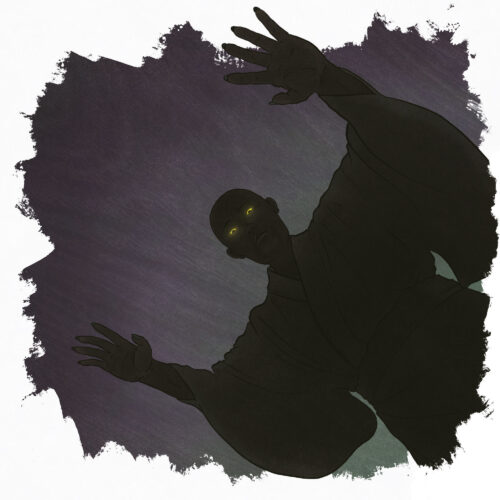
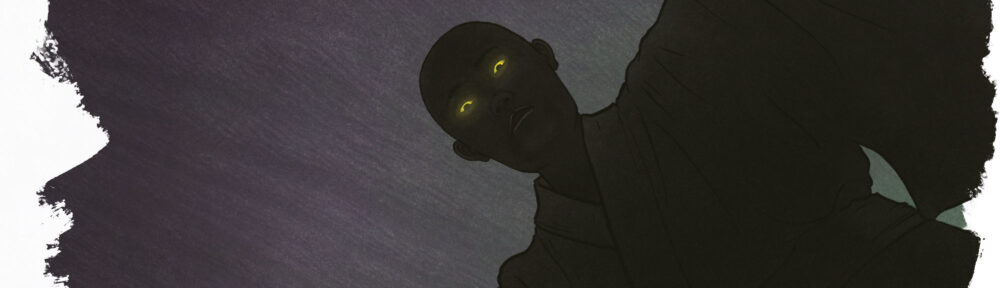
It also depicts a scenario that sounds very much like sleep paralysis. Many people, myself included, have had the terrifying experience of a failed awakening—your body still paralyzed but your eyes and mind awake. And it’s common to hallucinate dark, demonic figures looming over you at these times. The description of this sounds exactly like that, so imagining a visual for this story was not difficult at all.
For anyone unfamiliar with the term, zatō are people who turn up frequently in yokai stories. There is no shortage of zatō tales on this site! The term refers to a profession reserved by the shogunate for blind people, so that they would be guaranteed some form of employment. Zatō were often employed as biwa players or masseuses, and because of the nature of their work they often wandered the country. Thus, they were almost always strangers wherever they went, which probably contributed to their association with strange things like yōkai and kidan.
I hope you enjoy tonight’s tale!
A Matter in Which It Is Hard to Say There Was No Yōkai
From the winter of the ninth year of An’ei (1780), the Year of the Rat, through the following spring, I (Negishi Yasumori) was assigned to official duties concerning river engineering in the six provinces of Kantō, and traveled throughout those six provinces.
I was accompanied by Ōnuki Tsugiemon and Hanada Jinbei, and we traveled together from village to village. Hanada was in his fifties and had become accustomed to civil engineering work over the preceding several years. He was, above all, of sound mind and an utterly fearless disposition.
In the spring of the tenth year of An’ei (1781), The Year of the Ox, while touring the villages along the Tama River, we arrived at Oshidatemura, where I stayed at the home of the village headman, a man named Heizō. The others found lodging at nearby private homes.
Usually, Tsugiemon, Jinbei, and the others would come to my lodging together early in the morning, and we would move on to the next village.
One day, Jinbei arrived later than usual.
“Is something the matter?” I asked.
“No, nothing in particular,” he replied.
The following day, when everyone had gathered at my lodging to discuss official business, Jinbei said to me, “Something bizarre happened at the place I was lodging in Oshidatemura, and I couldn’t sleep all night. That is why I was late the following morning.”
“What happened,” I asked.
Jinbei replied, “That day we left the inn at Hamura. It was drizzling, and I was going up and down the embankments wearing my straw leggings and sandals, and I became utterly exhausted. After leaving your lodging, I decided to return to my lodging and go straight to bed.
“The room I was staying in was built slightly apart from the main house, connected by a corridor, and also a bit distant from where the servants slept. It appeared to be a place where nobody usually lived—the doors and fences were sparse, and behind it was a tall overgrown thicket. It seemed like a rather insecure place.
“I made sure that the doors were all shut and then went to sleep—but just as I was drifting off, I was awakened by a sound from above the ceiling, as if a large stone had been dropped. I sat up and looked, and sitting beside my pillow was a zatō wearing a dirty, striped, single-layered kimono, with his hands resting on the floor.
“Startled, I was about to ask, ‘Are you a zatō?’ but then I wondered if he might reply that he was not a zatō after all, or if he was merely a figment of my imagination. In any case, I got up and grabbed the wakizashi that was beside my pillow, and the zatō who had been there a moment ago vanished. Assuming it was just my imagination, I made sure that the official documents I was carrying were securely tucked inside my robe, checked again that the door was locked, and lay back down.
“However, it continued to bother me. I thought I had better not fall asleep, but the day’s fatigue must have overcome me and I dozed off.
“After some time had passed, I looked next to my pillow. That zatō appeared once more. This time, his arms were spread wide and he was looming over me. I could not bear it. I threw off the blanket and grabbed the wakizashi next to my pillow—and he vanished again.
“Then I kindled the lamp and checked the room, but I could find no sign of where he had entered. I thought of waking one of the servants, but their quarters were far away, and I wondered what I would say anyway. So I lay back down, but it continued to trouble me and I could not sleep.
“The zatō did not come back again. Surely this must have been the work of a fox or a tanuki…”