The title of tonight’s tale is similar to last night’s, and I like it very much. It doesn’t say definitively that there was a ghost, or there wasn’t a ghost—just that it is difficult to establish that there was not one. A beautiful example of logical reasoning from over 200 years ago.
This matter-of-fact, skeptical attitude is one of my favorite things about Japanese folklore, and one that appears frequently in Mimibukuro. It seems to be a common feature in stories recorded by samurai who, like Negishi, served in roles related to administration and government. Many of the tales in my most recent book, Echizen-Wakasa Kidan (co-authored with Nagano Eishun), were recorded by samurai in government positions and who treat incidents with a similar level of skepticism. It’s just my guess, but I suspect that taking such tales of ghosts and yokai seriously would have been incompatible with holding an administrative job under the shogunate.
A Matter in Which It Is Difficult to Establish There Was No Yūrei
In the early summer of the second year of the Tenmei era (1782), the daughter of a merchant family living just outside of Atarashibashi in Asakusa had been placed by her parents into a relationship with a man—either another townsperson or perhaps a samurai. She lived in his household as a concubine and she bore him a child.
After the delivery, she fell ill with a blood disorder, and the child was sent to be fostered at a nearby townhouse that was not particularly well-off. The woman never recovered, and before very long she died.
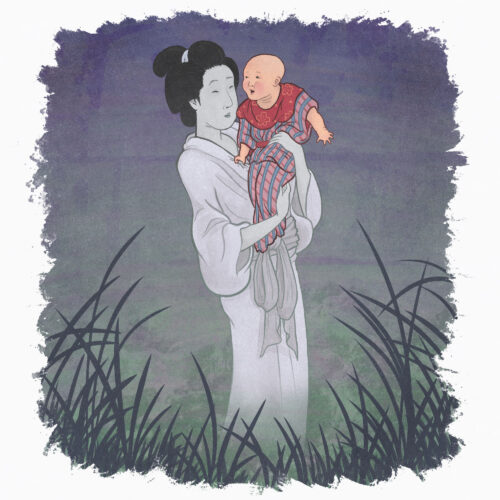
One night, the woman appeared at the gateway of the home where her child was being fostered and bowed her head. The foster family was putting the child to bed at the time, but seeing the woman, they welcomed her and held up the child for her to see.
“Oh my, look how plump and healthy he has grown,” she said, taking the child in her arms and cuddling him.
“It is such a pity to have to leave such a lovely child behind,” she said.
The foster parents grew suspicious and thought to themselves, “We had heard this woman was gravely ill—how strange this is…”
But it was already time to light the lamps, and people’s faces were growing difficult to make out clearly. So they lit a lamp, and when they did, the woman returned the child, said her goodbyes, and left.
The following day, a message arrived from the woman’s family informing them that she had died of her illness the previous night.
A physician named Tawara from the same town came and explained that this was a poignant example of deep affection and lingering attachment, and the difficulty of severing the bond between mother and child.