Tonight’s story refers to a Lord Nanryō (南陵) (Nanryō-in being how he was referred to posthumously) of Kii Province, however Mimibukuro writes his name incorrectly. It should be Nanryū (南龍)—this being the Buddhist name of Tokugawa Yorinobu. I decided to leave it uncorrected, and just explain the error here.
The other name, Andō Sōtai, refers to Andō Goemon Koretoshi, another shogunate administrator who was a friend and a colleague of Negishi Yasumori. His name frequently turns up in Mimibukuro. After the Great Fire of An’ei 4 (1775), he aided the victims of the disaster by distributing food and funds. However, this was done without permission, and as a result he was made to commit seppuku in 1782. There is still a small monument to him in Saitama City.
A Matter About Which It Is Difficult to Determine That There Was Not a Past Life
Before the death of Lord Nanryō-in of Kii Province, he left instructions that, should he die, he was to be buried at a place called Okanoyama. This place was said to be near Wakayama Castle.
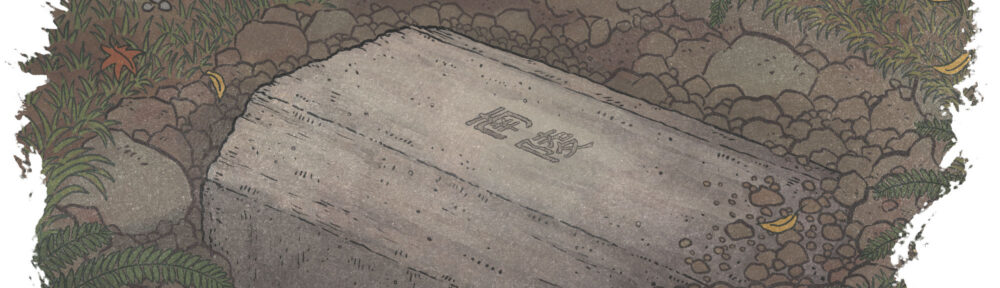
Upon his death, they began digging a grave at the site; however, after digging down one jō (about 3.03 meters), they discovered a stone burial chamber. Inside of this burial chamber were a bowl and a staff, and nothing else. On the cap of the burial chamber, the two characters for “Nanryō” were clearly inscribed.
Since the posthumous Buddhist name that had been proposed by his family temple before his death was “Nanryō-in,” people at the time marveled at how well everything fit together.
This story is still passed down in Kii Province today, according to Andō Sōtai.