I am away at an event this weekend, so instead of doing a new painting from Mimibukuro, I am sharing a tale from my newest book, Echizen-Wakasa Kidan. I’ll be back on Monday with a new tale from Mimibukuro.
The Lord of the Pond
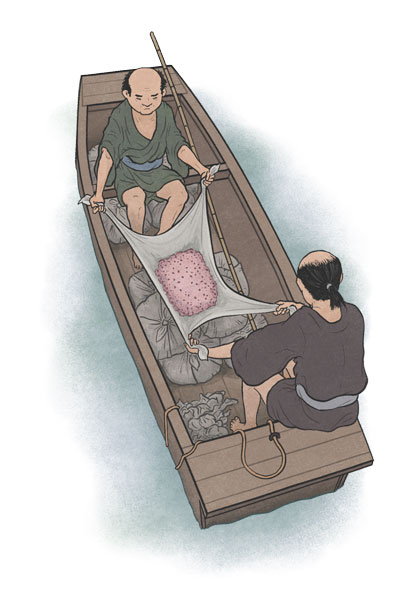
from Kaishū yakō no tamaAbout five ri (about 20 km) along the road from the castle town of Fukui in Echizen Province lay the villages of Kakuzen and Futaomote. Between these two villages was a large pond. It was about two chō (about 220 m) in circumference and had a desolate air. In the center of the pond was an area of clear, blue water roughly three shaku (about 90 cm) square. Every year on the third day of the third month, both villages would prepare one koku of sekihan and cast it into the center of the pond. This was an ancient custom, and if neglected for even a single year, both villages’ fields and paddies, which normally yielded three thousand koku, would not produce even a single grain.
One day, a young samurai from Fukui Domain, accompanied by five or six others, came to this area on an excursion. One of the samurai remarked, “They say that a nushi has lived in this pond since ancient times. Making sekihan offerings every year puts a burden on the two villages. Surely it would not be too hard to go down into the pond and kill whatever strange thing is down there? Why doesn’t one of us—someone who’s a good swimmer—go down into the pond and investigate?”
Upon hearing this, one of the samurai, named Urakami Senzaemon, replied, “I was just thinking the same thing. I will go and see for myself.”
After that, they all boarded a boat and went out to the center of the pond. “First let’s measure the depth,” they said. They attached a stone to a rope and dropped it into the pond, lowering it deeper and deeper, but the stone did not reach the bottom. After a while, when the stone finally stopped sinking, they drew it up and found the depth to be 192 hiro (about 345 m).
“Perhaps the rope got twisted in the water,” they said, and measured again, but the depth was exactly the same as the first time.
Senzaemon declared, “Very well, I shall dive in and investigate.” Stripping off his clothes, he took his sword, tied a rope to his loincloth, and said, “If anything happens, I will tug this rope. Then pull me back up.” With that, he plunged into the water.
A short time later, the water turned scarlet, and blood began to rise to the surface. Those aboard the boat cried out in alarm, “Then has Senzaemon failed? Let us go and find out.” Three of them dove into the water.
After a while, Senzaemon and the three men who went in after him surfaced unharmed. Senzaemon called out to the men on the boat, “At the bottom of this pond there is a space about one ken (about 1.8 m) square covered in white pebbles. The water is clear and refreshing beyond description. The only thing there was something resembling a piece of driftwood about two shaku (about 60 cm) long. Nothing else seemed out of the ordinary, so I tried to pick it up, but it was too heavy to lift. When I tried cutting it, it bled profusely. This is what that wood-like thing was.”
The object he produced was hard like a turtle’s shell on top, while beneath it hung a frilled substance like a jellyfish.
Everyone found it strange, but thinking that there would be no more trouble, they summoned the people from both villages together. They explained what had happened and declared that it was no longer necessary to cast sekihan into the pond.
The following year, when the villagers did not put sekihan into the water, the crops failed just as before, and not a single grain of rice was harvested. Since then, to this very day, they have continued without fail to place one koku of sekihan into the pond every year.