This weekend I will be at all-day-long events, so I won’t be able to paint anything on Saturday or Sunday. I will still queue up some A-Yokai-A-Day posts for those days; they will be stories not from Mimibukuro, but from my newest book Echizen-Wakasa Kidan, which will be available to order from the yokai.com web shop later this year, after copies have shipped out to all Kickstarter backers.
Tonight’s tale comes from a member of the Hino clan (the same Hino clan that the hitodama story from a few days back originated from) however this tale takes place during the reign of Hino Sukeyoshi, who lived from 1618 to 1698—more than 100 years before volume 8 of Mimibukuro (written somewhere around 1808).
The Strange Tale of Komai Zōsu’s Wandering Spirit
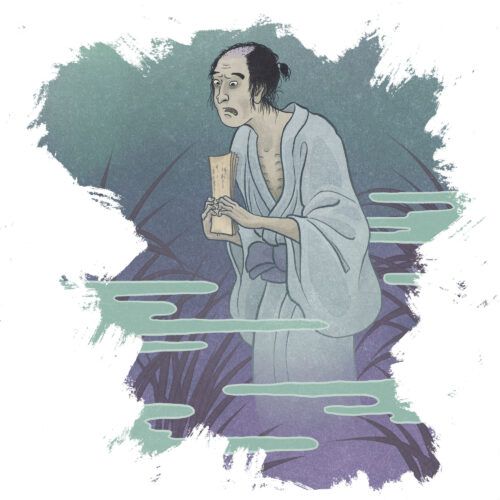
The man known as Hino Iyo no Kami Sukeyoshi, who served for a time as a kōke, had a retainer named Komai Zōsu, who lived on Hino’s estate.
He had been serving faithfully in Edo, and a time came when he needed to establish a family temple there. He attended to the temple affairs diligently, but since his family already had a temple in his home province of Jōshū, he explained to his lord and his peers, “If I should die, I would like to be buried at the temple where my ancestors have been laid to rest. But as I am serving here in Edo, I have no choice but to designate a temple here as well.”
His friends and peers said, “That should be no problem to arrange.” And some time passed without incident.
Recently, Komai had begun feeling as though he caught a cold, and he was bedridden. Even during his illness, he repeatedly told his relatives and fellow retainers that he wished to be buried at the temple in his home province. And before long, he died.
His relatives and fellow retainers expressed his last wishes to his lord, who said, “Since he has already designated a temple in Edo as his family temple, there may be complications back in his home province unless the temple provides a letter authorizing his transfer. What should we do?”
So, a monk was dispatched from the Edo temple to Komai’s home province with a letter of authorization.
When the monk went to the Edo temple, they told him that they had already prepared the transfer letter that Zōsu himself had requested. So he brought it with him. However, the day that Zōsu was said to have visited the Edo temple was the day after his death.
Such things often happen due to one’s strong intentions, according to Lord Hino—so I have recorded his tale here.