A-Yokai-A-Day: The Attachment of a Goze at an Inn in Mitsuke, Tōtōmi Province

The title of this story refers to a goze. Goze were a female counterpart to zatō, who we looked at earlier this month. The women were traveling entertainers who told stories, sang, and played the drum, biwa, or shamisen. They were usually blind women, although some goze had varying levels of sightedness.

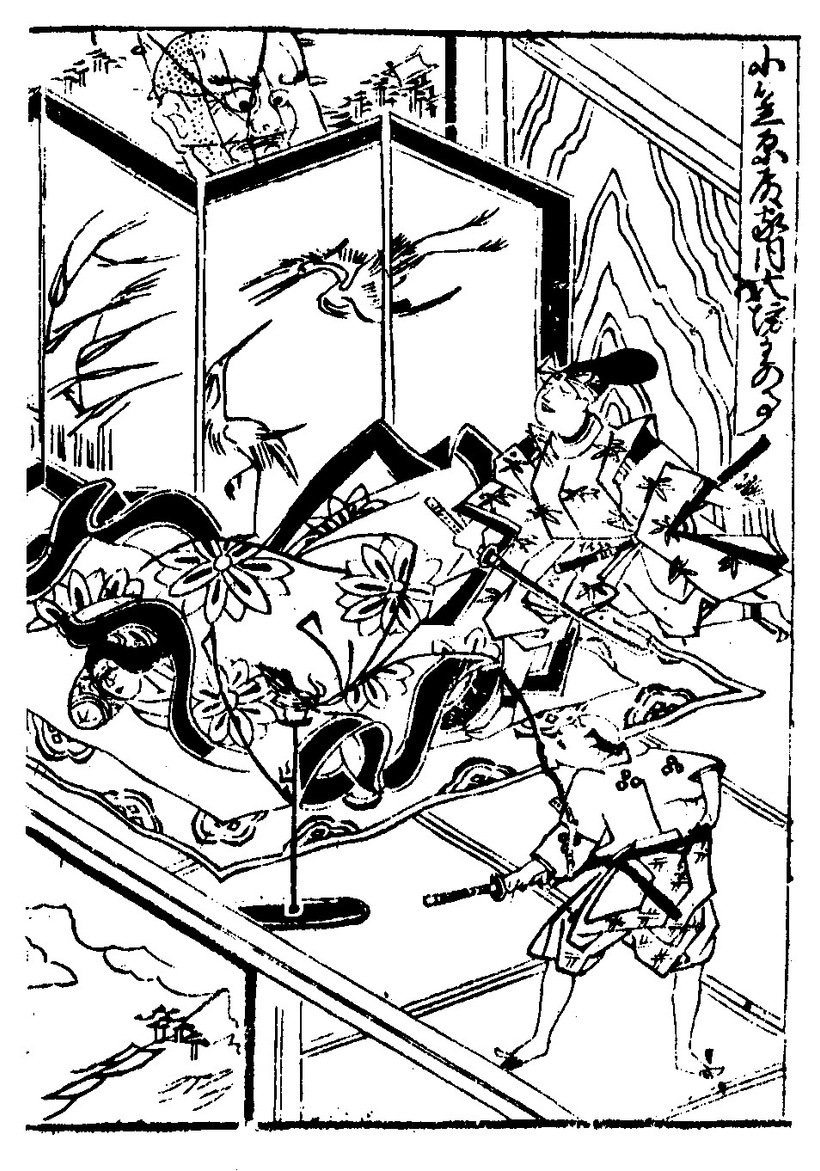
It’s not clear whether the woman in this story was an actual blind goze. The title calls her a goze, but in the story and the illustration found in the original book she seems to be sighted. She may just be an ordinary woman who is being compared to a goze for her singing and playing.

The Attachment of a Goze at an Inn in Mitsuke, Tōtōmi Province

A man traveling from Kyōto to the east stopped at an inn in Mitsuke, in the province of Tōtōmi. Late at night, he heard a woman’s voice singing a ballad and playing the shamisen in the adjacent room. The song was so beautiful and tender that he could hardly bear to listen to it. Overcome with feelings of nostalgia, the man slipped into the adjacent room to see the singer. However, the room was unlit. Thinking this terribly strange, the man called out:

“What kind of person is staying in this room? I am a man from Kyōto, but I have never heard such music even in the capital. I could no longer contain myself, so I crept into this room. Isn’t this truly a meeting brought about by the gods and buddhas? Please allow me to sleep with you and let us talk throughout the night.”

The woman replied, “How could one as lowly as I appear before a guest from the capital?”

Her reply was so sweet and so humble that the man’s yearning for her grew even stronger.

“Why do you hold back? I am not yet married, but I would pledge myself to you for my next two lifetimes!”

The woman replied, “If you truly feel that way, and if you swear to the gods that you will take me as your wife for the rest of your life, then I will do whatever you say.”

The man swore by the names of all of the gods across Japan, speaking terrifying oaths in order to persuade the woman. She was so moved by his words that she opened her heart to him, and they spent the night together as if it were one thousand nights.

Soon dawn broke. When the man looked at the woman’s face and saw how ugly she was, he was so shocked that he ran out of the inn without even paying the innkeeper. He ran towards the east, but thinking that she would probably follow him, doubled back and returned to the capital. When he reached the ferry at Tenryū, he looked back and saw that the woman was chasing him.

The man was desperate. “Please, kill the woman following me and dump her in the river!” he asked the ferryman. Then he handed the ferryman a sword and 10 ryo in gold coins. The ferryman was so pleased with the money that he stabbed the woman and then drowned her in the depths of the water. The man was so pleased that he hurried back to the previous inn to spend the night.

In the dead of night, an unknown person knocked violently on the inn’s gate. The innkeeper went outside, and he saw a woman who looked very different from most people.

“I want to see the man from the capital staying at this inn!” she demanded.

The innkeeper was so started that his hair stood on end. He replied, “There is nobody staying at this inn.” Then he closed the door and let the traveler hide in his storehouse, then he pretended not to know he was there.

The woman kicked open the front gate and went inside. She searched all over for the man. At one point the innkeeper heard a scream coming from the storehouse, but he was too scared to investigate.

In the morning, the innkeeper checked inside the storehouse. He found the man torn into two or three pieces. He was shocked and appalled, and completely at a loss for words.

A-Yokai-A-Day: How Denzaemon from Amagasaki Met a Bakemono at a Hot Spring

Today’s yōkai is another generic-sounding “bakemono.” It may have been a shapechanged kitsune or tanuki, although they often prefer to play tricks rather than outright kill their victims. It could have been a ghost, although ghosts usually give off a creepier vibe before they do their thing. The fact is that many yōkai simply do not have names, and their victims never know what they are until it is too late—just as we readers will never be able to know what they are. Enjoying yōkai means embracing the ambiguity and accepting that not knowing is part of what makes them so enticing.

Day 20: How Denzaemon from Amagasaki Met a Bakemono at a Hot Spring

It a placed called Amagasaki in Settsu Province there lived a man named Denzaemon. One day he went to the hot springs at Arima, when a beautiful woman came out of nowhere.

“Please met me join you in the bath,” she said.

Since she was a woman, Denzaemon let her enter the bath.

Then she said to Denzaemon, “Let me clean your back for you.”

The woman scrubbed and scratched Denzaemon’s back so pleasantly that he soon dozed off. Before he knew it, there was not one bit of flesh left on his back. The woman had scratched him all the way down to his bones, and then she disappeared.

Well, even hot springs have bakemono, as the old saying goes.

A-Yokai-A-Day: The Bakemono Called Shunoban at the Suwa Shrine in Aizu

These days shunoban is commonly known as shunobon. It appears as shunobon on yokai.com and in The Fox’s Wedding. The reason for the spelling change is that it’s how this yōkai was written by Mizuki Shigeru, the comic artist whose work introduced yōkai to most of Japan’s population. Mizuki fell in love with yōkai as an adult, and decided he wanted to preserve these stories and share them with others.

I can definitely relate to that desire. My goal has always been to share yōkai with the world. When I moved in Japan over 15 years ago, there were virtually no books written in English on the subject of yokai. Since the time of Lafcadio Hearn and Yei Theodora Ozaki, 100 years ago, the subject has barely been touched. This shocked me as a lifetime lover of folklore, especially when I saw just how expansive the world of yōkai is. I thought there must be others out there who want to know more about yōkai, but for whom the subject is “locked” behind the Japanese language. And I was right. Yōkai have exploded in popularity all over the globe in the past decade. It seems as awareness in other languages of Japanese folklore increases, the demand increases as well. It makes me happy to contribute in some way to that.

The Bakemono Called Shunoban at the Suwa Shrine in Aizu

At a shrine called Suwa in Aizu there was a fearsome bakemono called Shunoban.

One evening at dusk, a young samurai about 25 or 26 years old passed by Suwa. He had heard there was a bakemono there, and so he felt uneasy.

Another young samurai of about 26 or 27 was also passing by. Thinking he would make a good traveling companion, the first samurai joined the second.

“There is a famous bakemono called Shunoban who lives here. Have you heard this legend?” he asked.

The second samurai replied, “Does the monster look like this?”

His face suddenly changed. His eyes became as round as saucers and a horn sprouted from his forehead. His face became scarlet, and his hair became like wire. His mouth split from ear to ear, and his teeth gnashed with the sound of thunder.

The samurai took one look and fainted. For about hour he lay as if dead, but then he gradually recovered. Looking around, he saw he was right in front of the Suwa Shrine. He managed to get up and walk to a nearby house to beg for a sip of water.

A woman greeted him. “Why do you need water?” she asked.

The samurai told her all about his encounter with Shunoban.

After listening, the woman replied, “Now then, that is a terrifying thing that you encountered! Did this Shunoban look like this?”

As she spoke, her face transformed into the same bakemono that the samurai had just met. The samurai blacked out once again. He woke up after some time, but on the third day after that he died.

A-Yokai-A-Day: How Killing Turned a Man’s Hair White

Tonight’s story may seem a bit weird to Western readers with its focus on “killing.” What may seem to some as simple hunting or fishing, whether for fun or for sustenance, is considered by others to be a grave sin. The Japanese word used in this story is sesshō (殺生), which literally means the destruction of life. It’s a Buddhist word, and it is used throughout this story as a reminder that all killing, no matter how insignificant it may seem to us humans, is an obstacle to spiritual growth.

In Buddhist cosmology all beings reincarnate forever. Thus, any creature you kill, whether it is a fish, a chicken, or even a mosquito, could potentially have been your own mother in a past life. Any time you kill a living being, it is like killing your own mother. And although it may be impossible to go through life without killing anything at all (How many ants have we unknowingly stepped on?), one should refrain from the conscious act of taking life whenever humanly possible. Taking joy in it, even something as seemingly harmless as fishing, is like taking joy in killing one’s own mother.

That is why this story’s phrasing may seem odd or even hyperbolic when describing the samurai’s love of fishing as “killing.” It’s referring to the sin of sesshō, and the storyteller clearly has a religious message in mind with this story.

How Killing Turned a Man’s Hair White

In the area of Takada in Echigo Province lived a famous samurai named Higuchi Mokuzaemon. He was a man of both martial and literary prowess. However, he had a fondness for killing.

Several miles from his estate there was a temple to Benzaiten. In front of the temple there was a large pond. Every night Mokuzaemon and his servants would visit this pond with nets in hand and catch and kill fish.

One night, Mokuzaemon went to the pond without a single companion, to kill fish by himself. A young woman of about sixteen years approached the samurai from across the pond.

Mokuzaemon felt suspicious, and called out, “Who goes there?”

The girl replied, “I am a servant just across the pond from here. I came this way to use a nearby kitchen, but I forgot something. I’m sorry, but would it be alright if I asked you to watch something for me while I go retrieve what I forgot?”

Mokuzaemon thought it was a strange request, but he replied, “It’s no problem.”

The woman took out a round, white object and placed it in Mokuzaemon’s hand.

Mokuzaemon was baffled. He looked over the object. It gave off an overpowering fishy stench. He could not make any sense of what it was, but it just smelled fishy. But before long the woman returned and took back the mysterious object, thanked Mokuzaemon, and then left.

Although Mokuzaemon was trained in both literature and warfare, he was left unsettled by the whole experience. He left his nets and went straight home.

Mokuzaemon got back to his house, and when he tried to enter, his wife brandished a naginata and tried to stab him with it.

Mokuzaemon called out, “What are you doing? It is I, Mokuzaemon! How dare you attack me!”

His wife was started. She replied, “What is the meaning of this?”

She pulled out a mirror and showed it to Mokuzaemon. His hair, beard, and sideburns were as white as snow. Mokuzaemon became even more puzzled, and he told his wife about everything that had happened that evening.

“The woman from this evening was a servant of Benzaiten! She must have been upset that I was catching fish in that pond, and that is why she did this to me. From now on, I will stop killing!”

After that, Mokuzaemon followed the Buddhist path. Today, his descendants are serving in various public roles all over the place, as we all know.

A-Yokai-A-Day: The Ghost of Honnōji Shichibyōe’s Wife

One thing I love about the stories in Shokoku hyakumonogatari is that they are so specific about the locations these stories take  place. Some of them go right down to the neighborhood, street, and even  extremely specific places. It makes them feel more real and close to us  when you can literally visit and stand in the spot these events are said  to have happened in.

One question I am frequently asked is for suggestions on locations to  visit when looking for “yokai sites.” This is actually a very hard  question to answer. The fact is that while there are so many places  connected to folkloric legends, very few of them have signs or obvious  markers pointing them out. With few exceptions, you don’t find bronze  plaques saying things like, “On this spot in 1604, the ghost of Honnōji  Shichibyōe’s wife appeared to some monks and asked for a glass of  water.” But if you’re interested in making that kind of pilgrimage, you  can use books like Shokoku hyakumonogatari as a guide.

The Ghost of Honnōji Shichibyōe’s Wife

At the temple of Honnōji in Kyōto there was a prominent monk who was a great physician and a healer. Among his parishioners there was a man named Shichibyōe. One day, Shichibyōe’s wife became very sick. They asked the monk for help. He came to their house and treated her as best as he could, but her illness was a fatal one, and his ministrations had no effect.

Several days before she died, the monk visited Shichibyōe’s wife again. This time her hair was standing up on end and her face had turned scarlet red. Her visage was frightful beyond description. The monk returned home astonished. Three days later, she finally died, and her body was immediately taken to Honnōji.

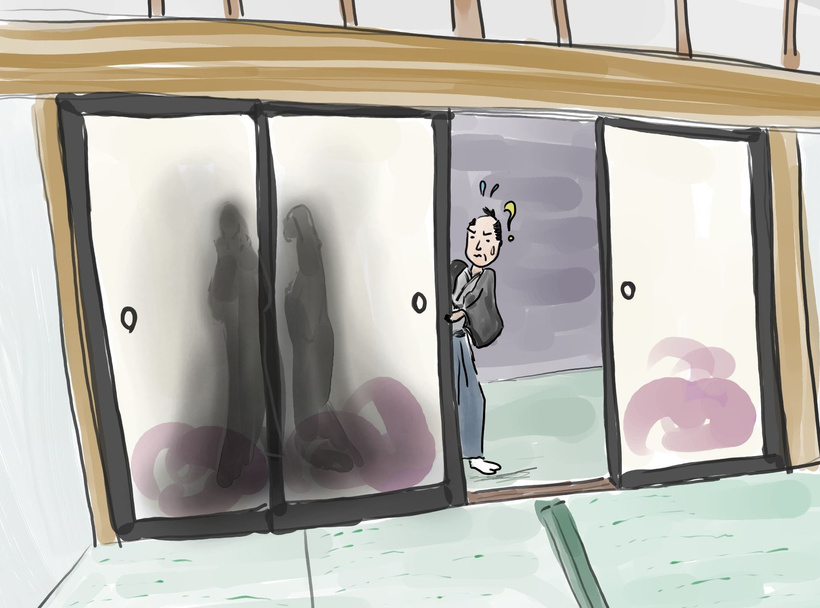
Three more days after that, the monk and his younger brother were studying in the room adjacent to the woman’s remains, separated by a sliding door. Around midnight, the monk’s younger brother heard the sound of footsteps coming from just outside the back door.

“I heard a thief!” he said.

The older monk heard it to. He said, “I’m ready for them!” and he drew his sword and waited.

The intruder tried to open the shoji doors, but they would not budge. Then it sounded like the intruder was going around to the back door. A few moments later, the brothers heard the voices of two servants, who had been sleeping in the kitchen, cry out, “Oh no! How terrible! How terrible!”

The brothers ran in to the kitchen. “What happened?”

The two servants were covered in sweat. “It was the most terrifying thing!” they said. “Shichibyōe’s wife came in here and said she was thirsty and asked for some water! We were so scared, so we told her there was some water over there that she could drink. She went to the sink and drank some water out of a ladle. After that we don’t know where she went!”

Thinking this was strange, the older monk went to investigate. He found the water was running, and a ladle had been left in the sink. What a dreadful thing!

A-Yokai-A-Day: How Kurita Genpachi Slew a Bakemono

As I mentioned, the Mononoke Ichi yokai market and hyakki yagyo night parade was yesterday in Kyoto. This was the first night parade since the covid pandemic, and it was the first Mononoke Ichi since Japan’s borders reopened to tourists last week, so it felt like a major milestone. I had an awesome time meeting many yokai fans from around the world, so thanks to everyone who stopped by!

The night parade was truly a spectacle. It felt like a traditional matsuri parade, with drums, bells, and flutes—except that it was populated by the most amazing yokai costumes ever. If you’d like to see what it looked like, I strongly recommend looking at the photos and videos on Twitter posted under the #モノノケ市 hashtag!

How Kurita Genpachi Slew a Bakemono

In a village called Tomo in the province of Bingo there was a man named Kurita Genpachi. One day, while he was playing a grassy field behind his house. Perched up in the branches of a large chestnut tree, he a woman of about 60 years of age, with blackened teeth and disheveled white hair flying in all directions, was looking at Genpachi and grinning at him. Genpachi was startled and quickly walked away, feigning indifference.

That night was bright, and the moon shone everywhere, so Genpachi went out onto his veranda to gaze at the sky. For some reason, something made him feel uneasy, so he went inside and closed the shoji doors. He lay in bed in a daze, not quite a sleep but not quite awake, when he saw the figure of the old woman from earlier in the day silhouetted on the shoji in the moonlight. Words cannot describe the unsettled he felt.

Genpachi was startled, and readied to draw his sword and strike down the woman if she came into the room. She was already opening the shoji doors and started to enter the room, when Genpachi shouted “I’m ready for you!”

He drew his sword and slashed at her. The bakemono seemed to weaken a bit when it was slashed, but Genpachi also fainted and fell as if dead.

When Genpachi had swung with his sword he screamed, “Agh!” Several people heard this and came out to see what happened. They found Genpachi lying on the floor breathless. They administered some medicine and revived him. When he came to his senses, he told them everything that had happened.

A-Yokai-A-Day: The Bōrei of Tsuruga Province

Today I am in Kyoto attending the Mononoke Ichi flea market and hyakki yagyo night parade. It’s been 3 years since the last time this event took place and the last time I went; coronavirus put it on hold. So it’s great to finally be back and attending one of the coolest yokai-themed festivals in Japan!

Tonight’s story takes place in Tsuruga, which is only about one hour from my home. In fact, I drove through Tsuruga on the way to Kyoto to get to this festival. I made sure not to use the toilet though, just to avoid any bōrei or henge.

The Bōrei of Tsuruga Province

A traveler staying at in inn in Tsuruga Province went to the outhouse late one night. Looking out the window, he saw a woman in a white kimono hanging around the back door, looking dejected in the hazy moonlight.

The traveler grew suspicious and watched her for a while, but she did not go inside. He grew even more suspicious. He left the outhouse and approached the woman, but then she utterly vanished. Surely she was a henge of some sort, he thought. He went back to his room without telling anyone and went to sleep.

When dawn broke, the traveler saw the innkeeper kneeling before an altar and making an offering of incense. He turned to the traveler and said, “Today is the anniversary of my wife’s death. And last night in my dreams, I vividly saw her come here and loiter at the back door!” Then he burst into tears.

The traveler told me that he didn’t have the heart to tell the innkeeper what he had seen.