A-Yokai-A-Day: The Nekomata of Echigo Province

Animal yōkai are always popular with readers, both abroad and in Japan. I found that with the reaction to my latest book, The Fox’s Wedding! Tonight’s story is not about a fox, though. It’s about a cat!

As many cat owners will tell you, cats seem to live entirely separate lives when humans aren’t watching. Just look at the cat episode of Sandman, or the video game Stray, or even the musical Cats. Supernatural felines seem to exist in every culture and art form across the world. This makes sense considering that cats and humans live in close proximity to one another. Monster cats are no small subject in Japanese folklore. Bakeneko and nekomata are two fairly well-known animal yōkai, and today’s story just happens to feature one.

The Nekomata of Echigo Province

There was a wealthy man living in the province of Echigo. One day there was an extremely gorgeous woman standing outside of his front gate.

“I wish to serve your house,” she said.

When the lady of the house heard this, she said, “What excellent timing. You will be our daughter’s new chamber maid.”

This woman was skilled in many arts, from painting, to flower arranging, and even calligraphy. The man and his wife were both very pleased to have found such a person, and so they treated her very kindly.

One day, the lady of the house walked past the woman’s room and, noticing that a light was lit, peeked inside. The woman removed her own head and placed it on the dresser, applied makeup and tooth black to it, then placed it back on her body and acted like it was totally normal.

The lady of the house was terrified. She summoned the servant woman and made up some excuse to fire her. When she did so, the woman’s countenance changed.

“I thought I made be able to serve here forever, but all of a sudden you fire me… Did you perhaps see something?” she said.

“No, nothing like that. In any case, you are let go. When it is time for my daughter to get married, I will call upon you again,” the lady of the house replied.

“Ah, what a wretched thing to say!”

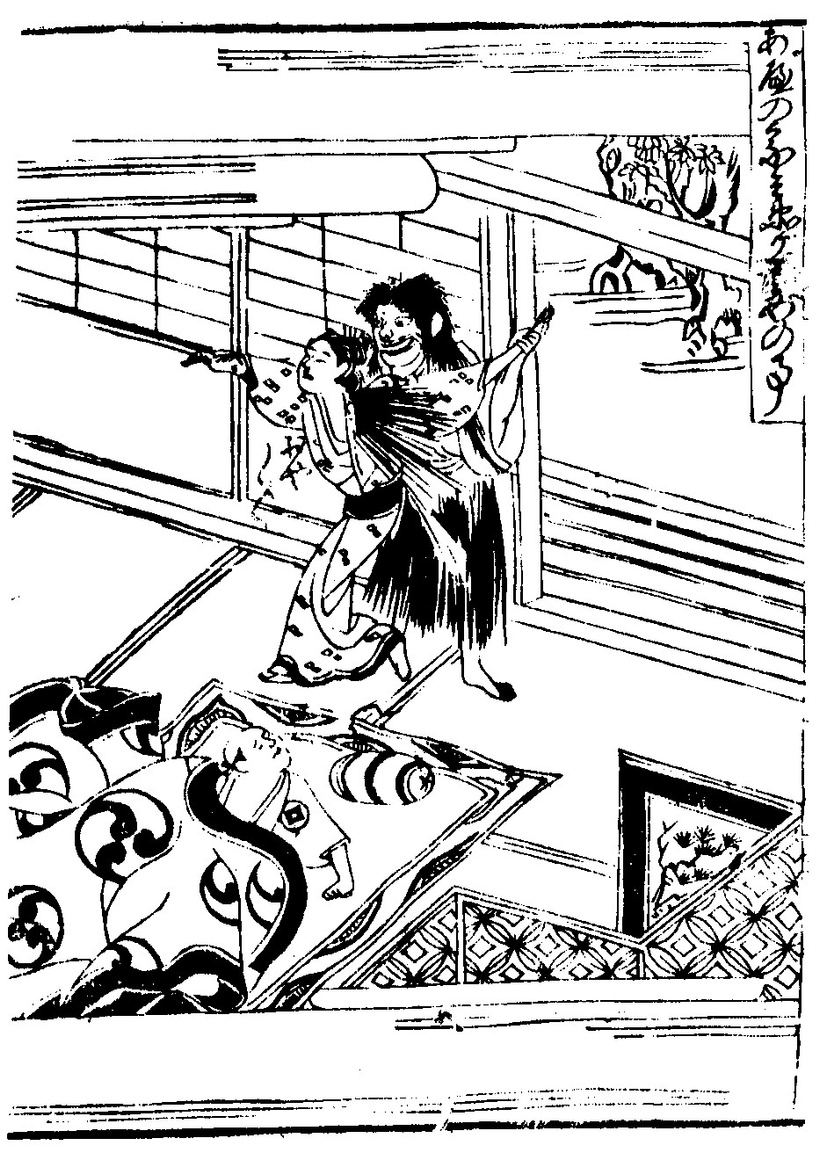
As soon as she said this, the woman leapt at the lady of the house and bit into her throat. That instant, a servant heard this, drew his sword and slashed at the woman. She collapsed, dead, and the servant sliced her side open. The woman’s once beautiful form transformed in an instant into that of an old cat, with a mouth that split from ear to ear, horns, and two tails. It was the pet cat which had lived in that house for a long time but had gone missing one day. It had transformed into a nekomata.

The lady of the house suffered from her wounds for fifty to sixty days.

A-Yokai-A-Day: How a Tsuchigumo Turned into a Woman in Kaga

Tonight’s yōkai is a tsuchigumo:  an interesting term with a lot of history. Literally it means “earth  spider,” and they are depicted in scroll paintings as gigantic monster  spiders who can shape-change (often into women), and who are hunted down  by heroic samurai. And by the Edo period, this was largely the public  conception of tsuchigumo.

However, tsuchigumo was originally a derogatory term for certain  tribes that resisted subjugation by the ancient country of Yamato. Those  who did not willingly submit to the emperor were forcefully subjugated  or exterminated. When the first histories of Japan were written down,  the stories of these conquests were recorded as stories of heroic  samurai traveling off into the wilderness to slay monsters. The  “monsters” were actually populations of people made into demons via  storytelling. Tsuchigumo is one famous example of this. Another is Akuru, and some scholars say that Yamata no orochi may be one too. I find these windows into history one of the most fascinating things about studying yōkai.

One more note: this story references a poem about “an ama from Shinobu no Ura.” This is a phrase that will probably not be  familiar to most readers today. It is a reference to a line in Tsurezuregusa.  To roughly sum up the idea behind this line and the reference, it talks  about how a public relationship, such as a formally arranged and  publicly-acknowledged marriage, is far less sweet than a relationship in  which you sneak off to make love, even though others might be watching  you.

Edo period views on sex were quite different than they are today, in  the West and in Japan. Marriages were made for practical/political  purposes, while sneaking around and having sex out of wedlock was the normal way to find love. In the story below, the woman loves  the man, but she is still shy enough that she doesn’t want others to see  her sleeping with him.

How a Tsuchigumo Turned into a Woman in Kaga

A certain man had the opportunity to become a public official, so he journeyed from Kyōto to Kaga Province and rented a room in a townhouse. The owner’s daughter was so beautiful that when the man saw her, he fell in love instantly, and he became heartsick for her. The man called for his servant, a samurai, and confessed his strong feelings for her to him.

The samurai took pity on the man and offered to act as an intermediary for him. He courted the girl, and she, being a compassionate woman, soon opened her heart to the man. Even though she was not, as the poets say, a “diver from Shinobu no Ura,” she was uncomfortable with the idea of being seen by others. So night after night, past dark, she snuck into the man’s room to sleep with him.

One nights, she visited the man and he was as delighted as ever to see her again, but while they were exchanging deep vows of love, the samurai servant heard the woman’s voice coming from the kitchen. He wondered what was going on, and so he went to investigate and found the house owner’s daughter was actually in the kitchen. The samurai was so surprised that he quietly called out to the man and told him what he had seen.

“In that case it must be a henge which is trying to seduce my heart!” the man said.

The man went back into his room, grabbed the girl, and stabbed her with his sword.

“Ah!” she screamed and then disappeared from sight.

When dawn broke, they followed a blood trail leading out of the room. It led to the mountains about 4 kilometers away. They searched deeper and deeper into the mountains, and they found another blood trail that ended at a rocky cavern. Inside, they found the girl’s dead body.

The man was even more bewildered. He took the girl’s corpse back to the townhouse and watched it for a few days, but her form never changed. It just remained as the daughter and withered away.

Meanwhile, the house owner’s daughter remained healthy and unharmed, it is said.

It is a story strange beyond words.

A-Yokai-A-Day: How Rokutan no Genshichi Saved an Adulterous Woman

While yesterday’s story was quite Halloween-ish and creepy, today’s is a bit more amusing. It still has plenty of creepy elements though. Since Shokoku hyakumonogatari is written as a collection of stories told by different people around a lamp on a spooky night, it’s fun to have stories that vary in length, mood, and humor. It really gives the impression that there are different speakers telling each tale, and each storyteller has their own style.

How Rokutan no Genshichi Saved an Adulterous Woman

In the capital of Kyōto there was a famous gambler called Rokutan no Genshichi. One day he decided to travel to eastern Japan in search of a good opponent. While he was on the road it grew dark, and he stopped at a certain village and asked around for lodging to rent.

Somebody told him, “In this village it is forbidden to rent rooms to people. You can find a room about 10 kilometers down the road from here.”

Genshichi had no choice but to go there, but there was no house to be found. He searched here and there, and as the night grew darker, he came across a shrine in a forest, with just a few candles for light. Feeling lucky to have found such a place, he decided to spend the night there, and lay down beside the shrine.

Just after midnight, he saw a faint firelight coming from the east. Genshichi wondered what it could be, and as he watched the direction of the fire, it came closer and closer to the shrine. Eventually, a man of about 30 years carrying a large sword and a paper lantern came to the shrine and entered it.

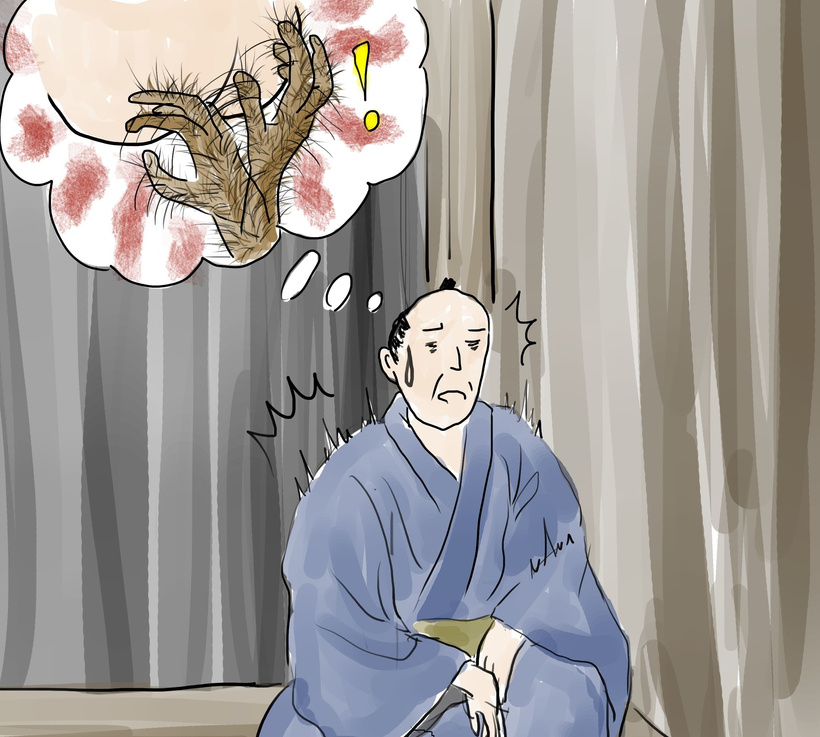
Genshichi’s hair stood on end, and he shrunk back in fear. The man looked around the shrine, and then climbed up to the 2nd floor. Genshichi became even more afraid and wondered what was up there when he heard a woman scream from the second floor of the shrine. A short time later, the man came back down carrying his paper lantern, and went back the way he came.

Genshichi began to worry who was on the second floor. He lit a light from the shrine’s candles and went upstairs to see. He discovered a beautiful woman of about 20 years, covered in wounds and tied up. Genshichi was horrified.

“Who are you?” he asked.

“I am no henge. I am ashamed to say this, but I am a woman who has cheated on my husband. Because of this, he punishes me every night by doing this to me. I’m sure he will kill me soon. Please have mercy on me. If you cut these ropes and save me, I will never forget it for all of eternity.” The woman cried in anguish.

Genshichi wondered about the situation, but he felt such pity for her that he cut her bindings. The woman was so overjoyed that she clasped her hands together.

“Well now, I am so grateful! I would leave here immediately, but I cannot walk even a single step. Would you please carry me on your back? My parents’ house is about 5 and a half kilometers from here, so please take me there.”

Genshichi felt he had no choice, so he hoisted her up onto his back and carried her down and out of the shrine. After carrying her about five or six hundred meters the woman said, “I forgot something back at the shrine. Please take me back there.”

Genshichi felt sorry for her, so he took her back to the shrine and placed her back inside the shrine. Then the woman crawled underneath the veranda. As Genshichi was seething with the feeling that he had been deceived, the woman crawled back out from under the veranda carrying a package wrapped in paper. So Genshishi put the woman back on his back and they continued their journey.

Before long they arrived at her parents’ house. Genshichi explained what happened to her parents, and they were overjoyed. “You are a savior!” they said and treated Genshichi to many things.

As Genshichi was saying his farewells, the woman came out after him, politely bowed, and then presented the paper-wrapped package.

“This is my lover’s head. Please turn it over to a temple somewhere.”

She handed the package as well as 30 ryo in gold to Genshichi.

Genshichi accepted the package and left. About two kilometers away, he dumped the package into a river and kept the gold for himself. Instead of heading east, he turned back to towards the capital. He told everybody that he was able to acquire so much money because he was a brave man.

A-Yokai-A-Day: The Samurai’s Shiryō from Sendai

The creature in tonight’s story is referred to as a shiryō. This is essentially identical to the term bōrei, which we’ve seen several times so far this month. The word literally means “death ghost.” The significance of that is that this is the spirit of a human who has died, as opposed to the spirit of someone still living (called an ikiryō) or another kind of monstrous spirit or demon altogether.

I feel like this story is a pretty classic spooky tale, and it has some great visual language. As Halloween is a mere one week away, it’s great for a story that really fits the Halloween horror mood.

The Samurai’s Shiryō from Sendai

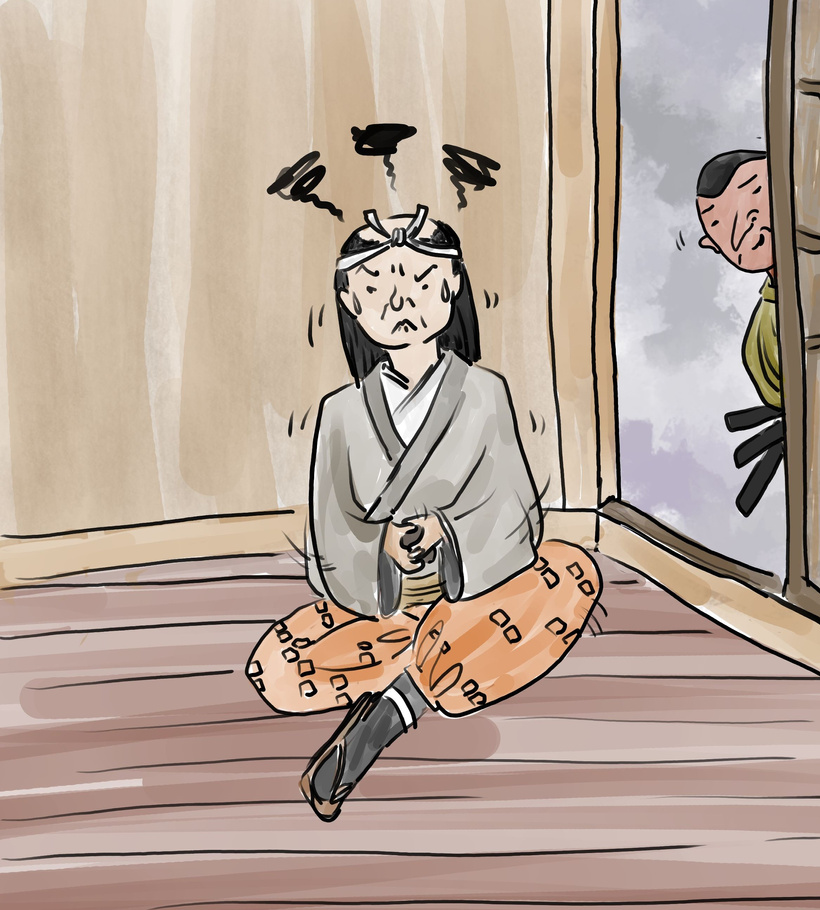
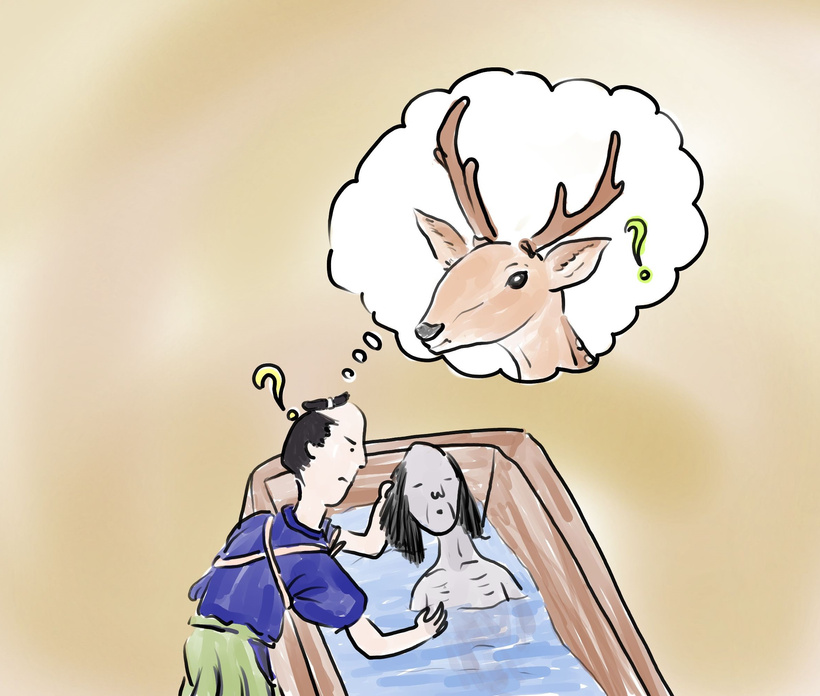
A samurai from Sendai in Ōshū disobeyed his master’s orders and committed seppuku at a temple called Tōganji. During the samurai’s funeral, his body was placed in a coffin and attended by ten monks. As the night grew late, all of the monks went to sleep around the coffin.

While the two lowest ranking monks had not yet fallen asleep, the corpse crawled out of the coffin and went over to a lamp. It tore the paper covering off the lamp and twisted it into a paper wick. Then, using the wick, it first licked up the lamp oil out of the oil jug. Then it crawled over to the highest-ranking monk, dipped the paper wick into his nose, and licked it. One by one the corpse did this to each of the monks in descending rank, until finally it came next to the lowest ranking monks.

The two monks were so surprised that they ran away to the kitchen and told everyone what had happened. Everyone was suspicious, so they went to investigate. They found all of the monks lying just as they were, dead. The coffin was still there, but the corpse was gone.

What a strange and unique occurrence.

A-Yokai-A-Day: The Rokurokubi of Fuchū, Echizen Province

The first place that I lived in Japan was Fuchū, Echizen, so this story is very special to me. Although I never encountered any yōkai when I lived there, it’s nice to know that I was that close to one.

The yōkai in today’s story is called a rokurokubi, however based on the description and the illustration in the original Shokoku hyakumonogatari, it is more accurate to call it a nukekubi. The main difference being that with a nukekubi the head actually detaches and flies around, while with a rokurokubi the neck stretches as far as it needs to go, but still connects the head and body—a minor difference that very likely did not exist back when this was written.

The Rokurokubi of Fuchū, Echizen Province

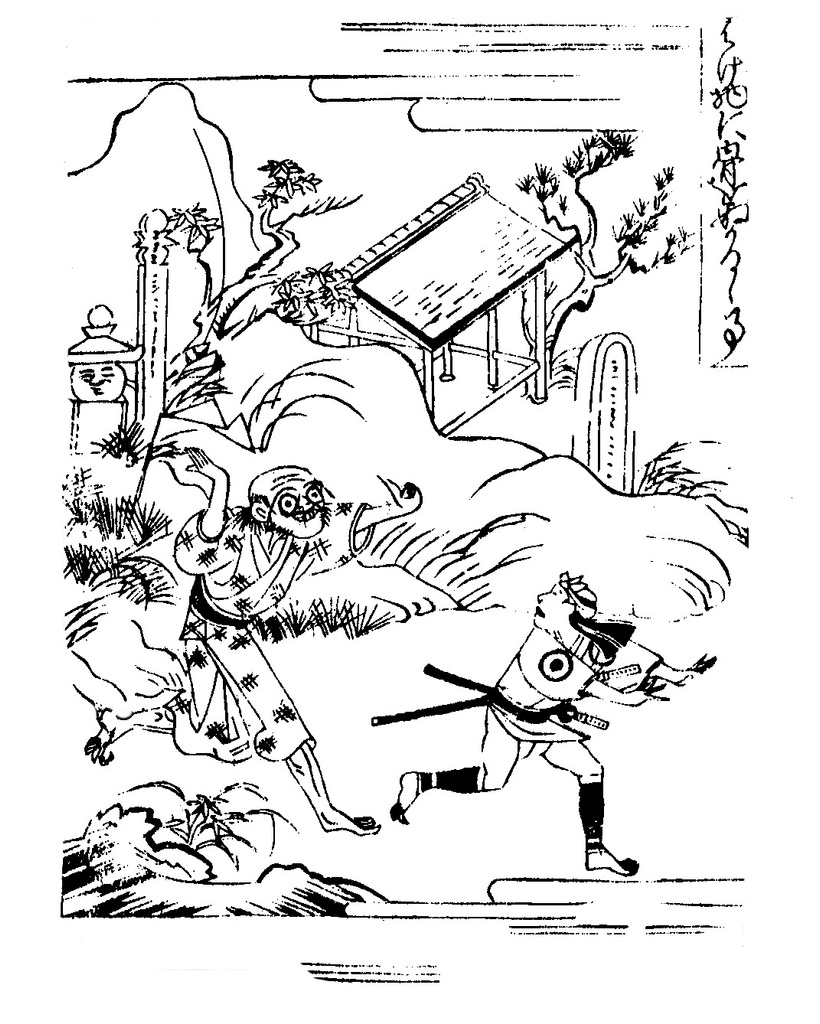
A man from Kita District in Echizen Province had urgent business in Kyōto. He traveled even through the night, and when he was passing through a field known as Sawaya there was a large stone pagoda. A chicken came out from behind the pagoda and blocked the road. When he took a closer look, it wasn’t a chicken, but a woman’s head.

The head looked up at the man and smiled at him. The man kept his cool, drew his sword, and slashed at the head. The head flew away southwards, and the man chased after it. The head entered the window of a certain house in Kamiichi, Fūchū.

The man was suspicious, so he stood at the front gate for a while. He peeked inside and listened what was going on. He heard the voice of a woman speaking to her husband: “Oh my, how terrifying! I just dreamed that I was passing through the field of Sawaya, and a man attacked me with a sword! I ran from him and somehow managed to make it back here.”

When the man heard this, he knocked on the door and entered the house.

“I don’t mean to be rude, but just now I came from Sawaya and encountered a creature which I chased all the way back here…”

The man told the whole story in detail.

“Is that so? I am so ashamed of my sins!” the woman exclaimed. Shortly after, she left her husband and journeyed to Kyōto, cut off her hair, and entered a hermitage in Saga to pray for her soul.

And so people say, “There really is such thing as a rokurokubi.”

A-Yokai-A-Day: The Bakemono of Onoderamura in Sagami Province

The yōkai in tonight’s story is unnamed, but it is referred as both a  bakemono and a henge. The assumption, then, is that it is probably a  shapeshifted animal of some kind.

The story mentions the “hour of the ox.” The hour of the ox was the  deepest, darkest part of the night. It was around 2 am or so. In olden  times, Japan did not use the same clock that we use today. The days were  divided into 12 “hours” roughly 120 minutes long, based on the 12  animals of the Chinese zodiac. The hour lengths varied depending on the  seasons and the amount of sunlight. The hours were anchored around  sunrise, high noon, and sunset. In the summer, due to the increase in  sunlight, the 6 daytime hours were longer while the 6 nighttime hours  were shorter. And in winter, the daytime hours grew shorter and the  nighttime hours became longer.

The hour of the ox was the time when evil spirits were at their strongest. The name also evokes the famous ushi no koku mairi curse, and has long been associated with yōkai and the supernatural. So  it’s no wonder that tonight’s bakemono happens to come out at during  the hour of the ox.

The Bakemono of Onoderamura in Sagami Province

In the village of Onoderamura in the province of Sagami there was a house in which bakemono lived, and in which no human was willing to live. One day, a traveler came from the capital and stayed in this village. The innkeeper owner spoke with him about many things, among them the house with the bakemono.

The traveler was a brave warrior, and so he said, “This is a rare thing. I will see what kind of bakemono it is, and then I will have a great story to bring back to the capital.”

The innkeeper tried to stop him. “There’s no reason to do such a thing!” But the traveler did not listen.

Around midnight, the traveler entered the house. He closed the door tightly and locked it from the inside, taking up a strategic position. He waited in a room 8 tatami mats in size, with a window in the eastern wall. About 110 meters past the window there was a thickly wooded grove.

That night, at around the hour of the ox, something flashed like a bolt of lightning from the grove. The traveler thought, “Oh my!” and drew his sword and waited.

After some time, the grove lit up like it had before. The room also lit up as bright as noon. The traveler looked around and saw a man of about 40 years old. He was shimmering like hot air, emaciated, and had a pale, lifeless face. He was clinging to the window, breathing heavily, and starting at the traveler inside. The horror was beyond description.

But the traveler was a military man, and so with a smooth motion he drew his sword and waited, ready to slay the man if he came inside.

The bakemono said, “There is no door here. I will enter through the kitchen.”

He easily kicked down two, then three doors, and entered the house. The traveler thought it would be hard to slay this man if he were some kind of henge, and so he decided to try and grab him. He jumped at the bakemono, but it kicked him in the chest. The traveler was knocked unconscious by the kick, and the creature got away.

The next morning the innkeeper and several villagers were worried about the traveler and went to the house to check on him. The found him fainted in the floor. The villagers were astonished and gave the traveler medicine to revive him. The tried to restart his breathing, and finally the traveler came to. When they asked what had happened, the traveler told them the whole story. The villagers checked the doors that the bakemono had kicked in, but the latches were all in place just as they had been the night before. There was nothing anyone could do but say how strange it all was.

Afterwards, people were even less willing to live in that house.

A-Yokai-A-Day: The Attachment of a Goze at an Inn in Mitsuke, Tōtōmi Province

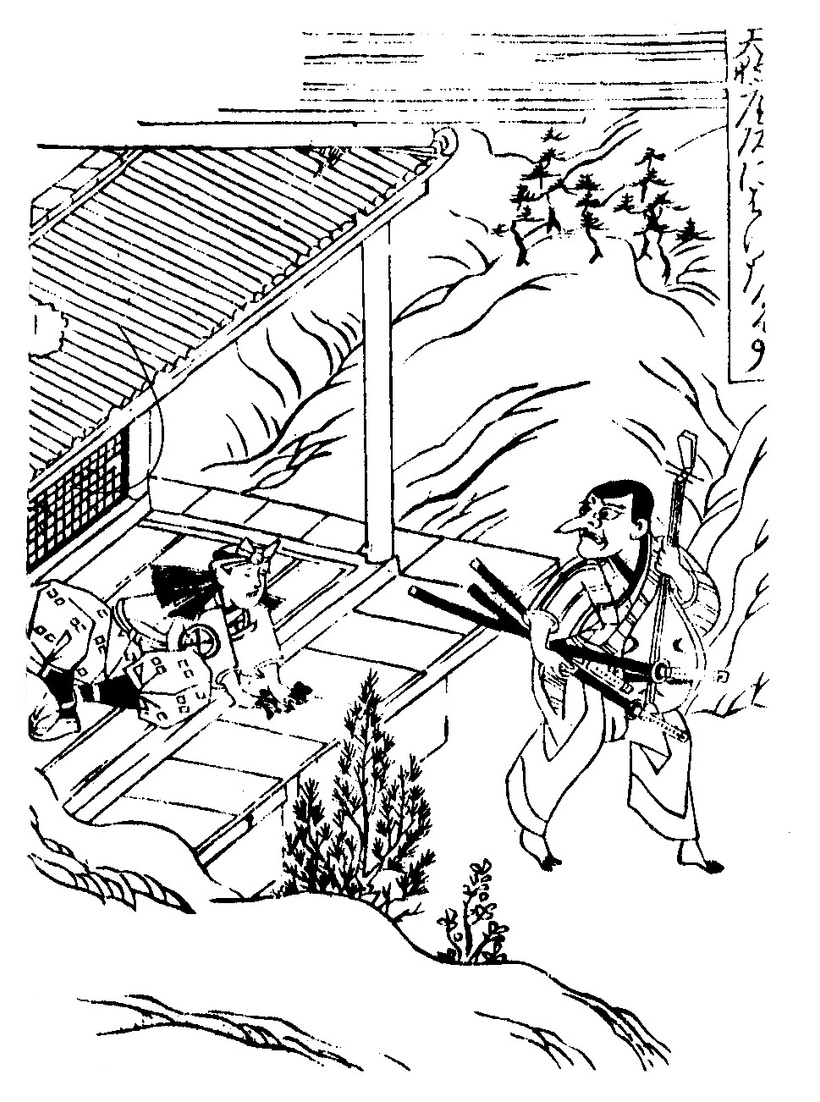
The title of this story refers to a goze. Goze were a female counterpart to zatō, who we looked at earlier this month. The women were traveling entertainers who told stories, sang, and played the drum, biwa, or shamisen. They were usually blind women, although some goze had varying levels of sightedness.

It’s not clear whether the woman in this story was an actual blind goze. The title calls her a goze, but in the story and the illustration found in the original book she seems to be sighted. She may just be an ordinary woman who is being compared to a goze for her singing and playing.

The Attachment of a Goze at an Inn in Mitsuke, Tōtōmi Province

A man traveling from Kyōto to the east stopped at an inn in Mitsuke, in the province of Tōtōmi. Late at night, he heard a woman’s voice singing a ballad and playing the shamisen in the adjacent room. The song was so beautiful and tender that he could hardly bear to listen to it. Overcome with feelings of nostalgia, the man slipped into the adjacent room to see the singer. However, the room was unlit. Thinking this terribly strange, the man called out:

“What kind of person is staying in this room? I am a man from Kyōto, but I have never heard such music even in the capital. I could no longer contain myself, so I crept into this room. Isn’t this truly a meeting brought about by the gods and buddhas? Please allow me to sleep with you and let us talk throughout the night.”

The woman replied, “How could one as lowly as I appear before a guest from the capital?”

Her reply was so sweet and so humble that the man’s yearning for her grew even stronger.

“Why do you hold back? I am not yet married, but I would pledge myself to you for my next two lifetimes!”

The woman replied, “If you truly feel that way, and if you swear to the gods that you will take me as your wife for the rest of your life, then I will do whatever you say.”

The man swore by the names of all of the gods across Japan, speaking terrifying oaths in order to persuade the woman. She was so moved by his words that she opened her heart to him, and they spent the night together as if it were one thousand nights.

Soon dawn broke. When the man looked at the woman’s face and saw how ugly she was, he was so shocked that he ran out of the inn without even paying the innkeeper. He ran towards the east, but thinking that she would probably follow him, doubled back and returned to the capital. When he reached the ferry at Tenryū, he looked back and saw that the woman was chasing him.

The man was desperate. “Please, kill the woman following me and dump her in the river!” he asked the ferryman. Then he handed the ferryman a sword and 10 ryo in gold coins. The ferryman was so pleased with the money that he stabbed the woman and then drowned her in the depths of the water. The man was so pleased that he hurried back to the previous inn to spend the night.

In the dead of night, an unknown person knocked violently on the inn’s gate. The innkeeper went outside, and he saw a woman who looked very different from most people.

“I want to see the man from the capital staying at this inn!” she demanded.

The innkeeper was so started that his hair stood on end. He replied, “There is nobody staying at this inn.” Then he closed the door and let the traveler hide in his storehouse, then he pretended not to know he was there.

The woman kicked open the front gate and went inside. She searched all over for the man. At one point the innkeeper heard a scream coming from the storehouse, but he was too scared to investigate.

In the morning, the innkeeper checked inside the storehouse. He found the man torn into two or three pieces. He was shocked and appalled, and completely at a loss for words.