A-Yokai-A-Day: Haka no hi

There’s just a week left of daily yokai, and I wanted to let all the readers know of an upcoming event. This Wednesday the 28th, I will be giving a talk at 3pm at Villanova University. The topic is yokai and Japanese ghosts. Anyone in the area, please come on down to Villanova and show your support for yokai! For more information, visit Villanova’s event calendar here.

I will also have copies of both of my books available, as well as postcards and bookmarks featuring yokai. I will be signing the books with my special brush pen which I got at the Abe no Seimei Shrine in Kyoto—the perfect pen to sign a yokai book with!

If you already bought the books, bring them in and I will sign them. Or, you can buy them there and I will sign them for you.

villanova-poster-791x1024Okay, on to today’s yokai!

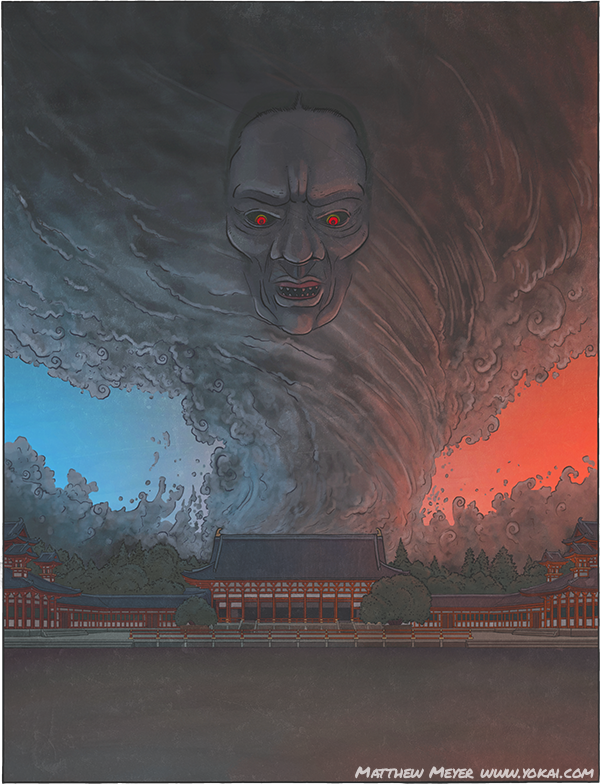
Haka no hi is one of those yokai for which almost no information at all exists. I’ve mentioned a number of times on my blog and in my talks how for most yokai, all that exists is a short tale of a few sentences. And then there are yokai even shorter than that—for which all that exists is a single illustration or a one sentence description; not even a story. Haka no hi is one of these super minimalistic yokai.

This yokai was introduced by Toriyama Sekien and given an illustration with just the description of what it does. Very minimal. No legends, no references, nothing. It’s very likely he invented it just to pad his books. However, that said, it is not entirely without folklore. I actually met some priests in Japan who told me that late at night they saw mysterious fires coming from underneath the graves in their temples. They had a more (pseudo)scientific explanation—they explained it off as gases escaping the decaying bones in the graves causing some phantom illumination. But whatever the explanation is, many people report claiming some kind of mysterious phosphorescence around graveyards. So even though there are no ghost tales about it, it is not a totally unknown phenomenon, and it is very much a weird mystery. And that is the essence of yokai.

Click below to read the (very short) entry on yokai.com!

hakanohi

A-Yokai-A-Day: Kosodate yurei

Today’s yokai is a little bit late! It takes a while to do the writeups in addition to the illustration, so I won’t say too much on the blog here about it. I do like this ghost, as it is both creepy and sad at the same time, yet a little heartwarming too. It’s similar to an ubume, but not nearly as scary.

This was done by request of my Patreon backers, who love Japanese ghosts! I hope you guys enjoy it. Remember, you can become a Patreon backer too! $1 per month helps support the creation of yokai and the maintenance of yokai.com!

Click below to read today’s yokai!

kosodate yuurei

A-Yokai-A-Day: Kanbari nyūdō

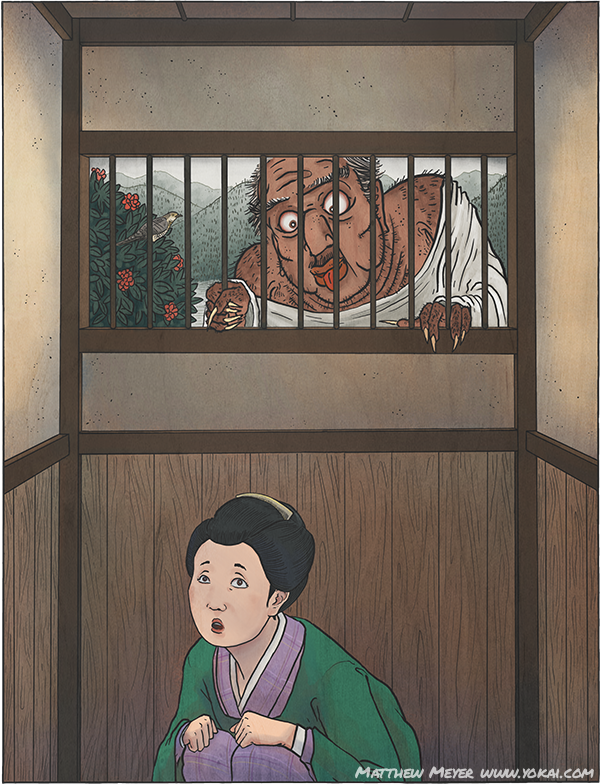
Today’s yokai is one of the scarier ones to be sure, but it is not scary like the previous ones. This is a special kind of scary; a creepy kind that gets under your skin, but also makes you laugh. Like a B-horror movie, maybe?

Japan does seem to have a fascination with toilet monsters, and today’s is an example of one of these. Unlike Hanako-san or Aka manto, Kanbari nyudo doesn’t slice you open or strangle you or kill you… he just watches you. And a big hairy priest watching you on the toilet is definitely a scary thing!

Interestingly, this was one of the hardest yokai to research for my book. Like Tamamo no Mae, his history has a lot of strange connections to China, and also like Tamamo no Mae, it is based on misinterpretations by Japanese authors long ago. The details of kanbari nyudo:s Chinese connection are written on yokai.com, so I won’t go into them here, but needless to say it took some effort to uncover the invented history behind the yokai, untangle it from the actual Chinese history it was based on, and then present it in a manner that makes sense.

I hope you enjoy reading it, and be careful when you use the toilet!

Kanbari nyuudou

Click the above link to read about kanbari nyudo, and get the book on amazon.com!

A-Yokai-A-Day: Gaki

Today’s yokai also comes to us from Indian folklore, brought to Japan with the coming of Buddhism, just as the ashuras were. In fact, you could almost consider this yokai to be the opposite of an ashura.

In Buddhism, there are 6 “realms” of rebirth: heaven, ashura/asura, humans, animals, gaki (or hungry ghosts), and hell. When you die, you will be reincarnated in one of these realms.

Where you are rebord depends on the karma you earn during your life. The ranking changes from tradition to tradition—some put humans above ashura—but this is one commonly accepted ranking of the favorability of the realms. Some of these realms are familiar to us; the gods in heaven and the suffering denizens of hell are no stranger to us, even though the Buddhist versions of them differ slightly from Western customs. (I did a writeup on hell a while back which can also be found The Hour of Meeting Evil Spirits.) The realm of humans and animals are pretty easy to understand, of course. And we learned about ashura yesterday. Today, I’ll tell you a bit about gaki. But first…

Of all of these realms, heaven is of course the most pleasant. Gods have nearly unlimited power and live lives of sheer pleasure. They live for uncountable aeons and enjoy so much. However, the downside to being a god is that eventually, when your time is up, you are almost guaranteed to go waaaay down to hell for the next life. Gods have very little concept of justice, you see. They get whatever they want whenever they want. Life goes so well for them that they earn an awful lot of bad karma, which comes back to bite them in the butt.

Ashura are similar to gods. They are super powerful, and have subjects to rule over. They are kind of like demi-gods. But, like gods, they are not able to concentrate on the better things in life. They are constantly jealous of the power that gods have which they don’t. They are always fighting and destroying and overcome with feelings of wrath and jealousy. So when they die, they tend to go to hell as well.

Hell, of course, is the worst place of all to be. Unlike in Western cosmology, Buddhist hell is not eternal. It may last for trillions of years… but you will get out eventually, after you have burned off all your bad karma. Then you get a respin at the wheel of reincarnation for a chance at something a little milder.

The realm of animals isn’t so bad… you get a fairly decent life. However, you are constantly at the mercy of the weather, of other animals, of lack of food and water… you don’t get to enjoy much, but you don’t suffer like those in hell either. Ultimately, though, the animal realm is not the best place for reincarnation.

The human realm is considered by Buddhists to be the best place to be reborn. It’s not the most pleasurable, of course; heaven is far nicer than the human realm. However, the human realm has just the right amount of pleasure and pain that humans can have a shot at controlling their karma. The gods have too much pleasure, the denizens of hell have too much pain, ashura are too violent, animals are too dumb… It is believed that only in the human realm can one succeed at finally producing no karma, and thus no longer being reborn; i.e. ascending into Buddhahood.

Lastly, there is the realm of gaki. This is commonly known in English as the realm of hungry ghosts, or by its Sankrit term, preta. These are lost spirits that didn’t have enough karma to be reborn into the animal realm, but were not bad enough to go to hell. It’s not a pleasant place. They are constantly hungry, and forced to eat excrement, blood, dirt… anything, as they try to sate their hunger. However, they can never be sated, and always suffer. A gaki is not tortured like a hell-being is, but a gaki is always suffering from the most basic life instincts, and lives its entire life in misery. Obviously, also not a good place to learn how to become a Buddha.

One question that often comes up is where do yokai fit in in all of this? Are they gaki or ashura, or something else?

Yokai are not Buddhist, and so there is no official ruling on what exactly they are. I’m sure some priests would say they exist somewhere in these realms. Certainly yurei are strongly connected with Buddhism in Japan… but yokai? Not so much. In fact, most folklorists say that yokai don’t fit in at all. They don’t live in a realm of reincarnation. Yokai live in ikai, the “otherworld,” and do not reincarnate, or maybe don’t even die. I haven’t really heard any Buddhist doctrine on yokai, except for one example:

Did you guess tengu? If so, good job! Tengu have long been considered the main enemies of Buddhism in Japan. Tengu are one kind of yokai which there is a direct path to becoming: a human that is so wicked, so evil, that they do not even deserve hell can become a tengu. They are reborn in Tengu-do, or the realm of tengu—a place outside of the wheel of reincarnation from which there is no escape. Tengu never get a chance at becoming a Buddha or being reborn in a better world. They are stuck there forever, as a yokai, forever apart from happiness and barred from enlightenment.

So even while the gaki seems like an awful existence, remember that it could be worse. You could be a tengu!

Gaki

Gaki – http://yokai.com/gaki/

Click on those miserable gaki to visit yokai.com and read all about them! And pick up your copy of The Hour of Meeting Evil Spirits to read about gaki, ashura, the underworld and hell!

A-Yokai-A-Day: Ashura

Today’s yokai is a pretty cool one. It came to Japan from Indian mythology, which is probably quickly obvious by looking at it.

Religion in Japan is a very interesting thing. Ask a Japanese person what religion they follow, and they will most likely tell you they are some form of Buddhism. Ask a non-Japanese person what religion is followed in Japan, and they will tell you Shinto. In fact, most Japanese don’t really use the word “Shinto” although it is a part of their everyday lives. It’s an odd thing that Westerners have a set definition of Japanese religion that Japanese people don’t really follow…

The reason for this is that Buddhism formed a syncretic religion by merging with local traditions when it came to Japan. This is why you often see shrines and temples occupying the same land, and why Japanese kami are often interpreted as incarnations of Buddhas. Shinto doesn’t really have much in the way of doctrine, and so there hasn’t been much conflict between the two religions when compared with other parts of the world (that’s not to say that there has never been any… just that there has been less).

Unlike some imports from other cultures, ashura came over with very few changes from their Indian counterparts, which is why they still resemble the asura of Vedic mythology. Something that I find totally fascinating, however: historians and linguists who study the proto-Indo-European culture (the theoretical precursor to the languages and religions of most of the land between Europe and India) have suggested a link between the asura of Indian tradition, Ahura Mazda of Zoroastrianism, and the aesir of Norse mythology. Besides the obvious linguistic similarities, there are a lot of similarities behind the myths associated with these beings, including a war between the gods and demons. In Norse mythology, the aesirare the gods we know as Odin, Thor, and so on. Ahura Mazda is the principle god of Zoroastrianism, and asura are a kind of demon in Vedic mythology. In other words, it is possible that the same mythical character eventually evolved into all three of these beings!

When you take that a little bit further, remember that Odin, and aesir, is often said to be the origin of Santa Claus. So, if we really stretch the imagination, could we say that Santa Claus is actually an ashura? Of course, that’s quite silly, but the fact is that you can trace a direct line between the two characters’ histories. As different as European and Japanese traditions are, it’s comforting to know that, when you strip back the layers of time, many of the things that we think make us unique, actually share a common link.

Incidentally, if you’re interested in other cross-cultural connections between Japanese myths and Western myths, I wrote about one much earlier on my blog.

Click below to read about ashura on yokai.com!

Ashura

A-Yokai-A-Day: Amanojaku

I mentioned at the beginning of the month how I like to start out with the cuter/tamer yokai and move on to the scarier ones near Halloween. Well, the month is getting into its final third, and today’s yokai is definitely one of the more grotesque and creepy ones! The story of Uriko hime, which is included on the yokai.com page, is downright horrifying! From here on out, the yokai will start to get creepier. 🙂

Amanojaku are a fun yokai because they are so downright nasty. I mean, there are so many kinds of yokai which are nasty to a point, but the amanojaku is so evil and so unpleasant that they rival tengu and oni for all-time villains of Japanese lore. They kind of remind me of gremlins or goblins, in that they are nasty, wicked, and yet in a way somewhat weak and pathetic.

It’s not terribly rare to see Buddhist statues in Japan of a great god stamping on demons, using them as a pedestal. Those are usually representations of Bishamonten—chief of the four heavenly kings and a sort of god of war in Japanese Buddhism. As the amanojaku are symbols of pure evil, he is depicted as crushing and defeating them, in true warrior-king fashion. It’s enough to make you feel a bit sorry for them, as they are rather small and pathetic under his boot… but when you read the stories about how nasty they are, that pathetic facade quickly fades away!

Read on, and let me know what you think in the comments!

Amanojaku

You can find amanojaku in The Hour of Meeting Evil Spirits, available now in Kindle and paperback!

A-Yokai-A-Day: Amanozako

Today we are looking at another tengu yokai. This one is a bit different than Sojobo and the other tengu you see on yokai.com for a few reasons: she is a female, she is a god, she has a son. Her nicknames reveal how rare those things are: metengu (woman tengu) and tengu kami (tengu god) refer specifically to her; i.e. there aren’t really other female tengu or tengu gods besides her.

I also think she is interesting because while most tengu are considered to be malicious demons lurking in the forests, she is actually revered as a goddess. While it isn’t terribly uncommon to see shrines dedicated to tengu or small tengu cults (think of Sojobo from a few days ago), Amanozako’s story is special in that she interacts with the other gods in heaven. Her myths are not self-contained stories, but play off of the larger pantheon. She was supposedly born out of a chunk of spit and gall that the temperamental storm god, Susanoo, vomited up. Most tengu don’t have that as a claim to fame!

And the fact that there aren’t other female tengu is notable as well. The long tengu nose is often considered to be a phallic symbol, and that may be a reason why most tengu are depicted as men. But for the tengu god to be a female is interesting! Not only that, but she bore her son without the need of a male partner. Truly a powerful woman!

Read more about her on yokai.com, and pick up a copy of The Hour of Meeting Evil Spirits to always have her on your bookshelf!
Amanozako