A-Yokai-A-Day: Yamachichi

Welcome back for day 3 of A-Yokai-A-Day 2014 edition!

Today’s yokai is quite funny, though you wouldn’t think so if you were on the receiving end of its attack I suppose…

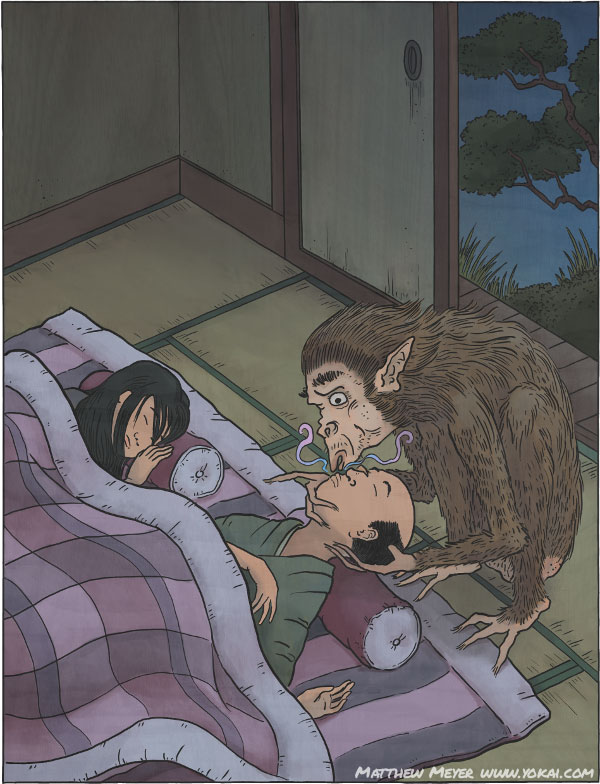
I say it’s funny because of mostly how it looks, but also because the idea is just so bizarre! A soul-sucking vampiric monkey which is actually a transformed bat who kisses people in the night to steal their life force… while I can’t say it doesn’t get any weirder than that (these are yokai we are talking about, after all) this does rank pretty high on the strangeness scale.

Researching animal yokai is always quite fun. Many animals in Japanese folklore will actually evolve into other animals as they age, and eventually into yokai, but it is rare that one yokai evolves into another. It shows that in old Japan there really was not much of a difference between what constitutes a yokai and an animal—these were all believed to be living things inhabiting the same world as people. Some of what we see today as the “magic powers” that some of these yokai had were not really considered magical at all. In many cases, they were considered completely natural phenomena.

What makes this animal/yokai so particularly interesting is that, while transforming from one creature into another is not uncommon, transforming multiple times into such different monsters is fairly rare among yokai. That is why I say that this is truly one of the most “Pokemon-like” yokai out there.

Anyway, here is the painting. Click for the full description on yokai.com!

Yamachichi / 山地乳 / やまちち

Yamachichi / 山地乳 / やまちち

A-Yokai-A-Day: Nobusuma

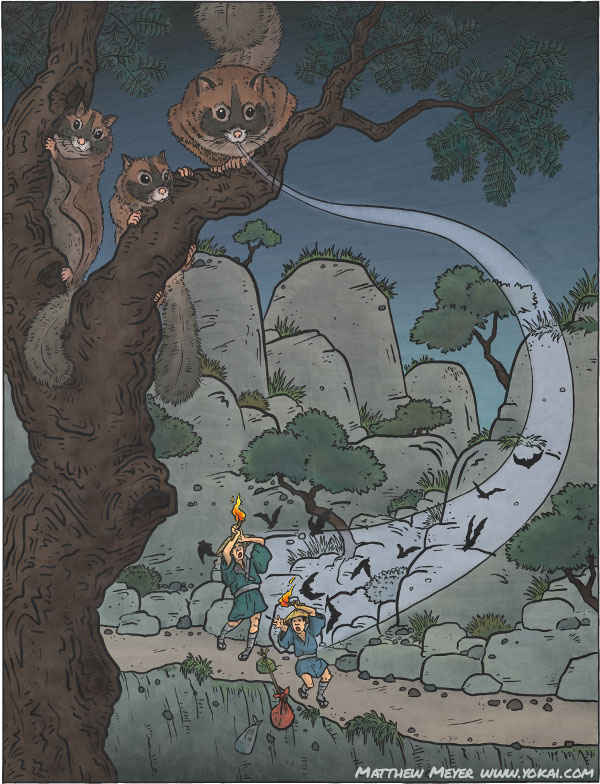
Today we continue A-Yokai-A-Day with another cute-yet-creepy yokai. Though similar-looking to yesterday’s nodeppou, today’s nobusuma has very different origins and slightly different behavior.

The most fascinating thing about today’s yokai is that not only does it evolve from a regular animal into a yokai, it evolves again and again into more powerful yokai forms! Does that sound familiar? If you are at all interested in Japanese pop culture, it should!

Though not a direct ancestor of Pokemon, there is no doubt that Pokemon were deeply influenced by the yokai tradition. In fact, some Pokemon are direct copies of certain yokai, though with newer-sounding names tacked on. The nobusuma, being one of the most dynamically changing yokai over its lifespan, really evokes the feeling of Pokemon or other video game characters morphing into a new form when they reach a certain power level. Today you get to see its first yokai form (evolved from a wild bat), and later this week we will look at some of its more advanced yokai forms!

Nobusuma / 野衾 / のぶすま

Nobusuma / 野衾 / のぶすま

To learn more about nobusuma and other awesome yokai, visit yokai.com/nobusuma. And if you haven’t yet, don’t forget to check out my book on Amazon.com, in paperback and Kindle formats!

A-Yokai-A-Day: Nodeppou

Greetings readers! Long time no blog! I have been busy painting yokai for my upcoming book, The Hour of Meeting Evil Spirits, and I haven’t spent much time posting because of that. If you’ve been following me on Facebook, you’ve probably seen a few previews of the illustrations for the book. No doubt you have been wondering what some of the yokai are and wanting to learn more about them! Well never fear, because A-Yokai-A-Day is here back!

As in past years, I will be revealing a new yokai each day of this month. As I am hard at work on the new book, this year each yokai will be an entry from the book in progress. This means that those of you who are Kickstarter backers may already have seen some of these yokai, but I only have so many hours in a day to paint, so that’s the best I can do. I hope you enjoy them all the same! For those of you who missed the Kickstarter, these will be new yokai for you, so I know you will enjoy them!

I will be posting the yokai entries on yokai.com, while here on MatthewMeyer.net I’ll be talking about the yokai and the process of making them in a more casual manner. Sort of a behind-the-scenes of the making of the book and of the entries on yokai.com. I will be posting the illustrations on both sites.

As usual, I will be starting off with some softer, tamer yokai and moving towards the more grotesque and scary ones as we get closer to Halloween. Today’s yokai is pretty darn cute, but you wouldn’t want to cuddle this vampiric flying squirrel!

Nodeppou / 野鉄砲 / のでっぽう

Nodeppou / 野鉄砲 / のでっぽう

To learn more about nodeppou and other awesome yokai, visit yokai.com/nodeppou. And if you haven’t yet, don’t forget to check out my book on Amazon.com, in paperback and Kindle formats!

December-January Japan Trip

My wife’s brother happened to get married in December, which provided us the perfect excuse to go back to Japan for a short trip. With the Christmas and New Years holidays around the corner as well, it made sense to extend the vacation a bit and spend the whole month in Japan. This was awesome not only for the wedding, but because I got to spend my birthday, Christmas, and New Years (the absolute BEST Japanese holiday) in Japan, as well as having the chance to tour around and do some yokai research and collect visual reference for my next book. Continue reading

Yokai Museum

One of the reasons that I wrote The Night Parade of One Hundred Demons a few years ago is that there are so few books in English that deal with Japanese monsters, and of the ones that do exist there are so few that really give them the treatment that they deserve. Fortunately, yokai have been growing in popularity over the last couple of years, and finally some very interesting English-language books have begun to come out. Yokai Museum is one of these, having just been released in the US last month. I got my hands on a copy the other day, and I thought I would introduce it on my blog.

Yokai Museum

Yokai Museum is just what it sounds like: a museum of yokai-themed artwork spanning hundreds of years of history, condensed into book format. All of these works come from the vast collection of Yumoto Koichi — yokai researcher, professor, and former curatorial director of the Kawasaki City Museum. The Yumoto Koichi collection is the world’s largest collection of yokai-related art, and while Yokai Museum doesn’t come close to covering the 3,000 items in the Yumoto Koichi collection, it does cover an impressive selection of more than 161 pieces, detailed in high quality full color photos. The 288 page book is bilingual, featuring English translations side-by-side with the Japanese text, making it doubly useful as a language study tool for anyone looking to practice their Japanese (or English, for that matter). The descriptions are written with people who are not intimately familiar with yokai in mind, so they don’t require much foreknowledge to enjoy (and it is primarily a picture book, with only small written parts, like the tags you would see at a museum on the wall next to a piece).

Yokai Museum is divided into six chapters covering various formats of yokai art that appeared over time: picture scrolls, books, woodblock prints, games, everyday items, and religious items. Chapter 1: Picture Scrolls – A Cast of Colorful Yokai begins with the oldest known piece of true yokai art: the Hyakki Yagyō Emaki scroll attributed to Tosa Mitsunobu. It then shows a large number of other scrolls, including detailed close ups, and goes over the history and development of the styles used in these paintings. Chapter 2: The World of Yokai Books starts with Toriyama Sekien’s Gazu Hyakki Yagyō and moves on to the “yellow cover” books and other kusazoshi printed material from the Edo period. Chapter 3: Nishiki-e – A World of Gorgeous Color features the beautiful and colorful woodblock prints from the golden age of ukiyoe. Images by Hokusai, Yoshitoshi, and other masters are included alongside other less well-known pieces. Pictures of Edo period color newspapers, large format tryptichs, advertisements, and other old images are beautifully reproduced here. Chapter 4: Yokai Games is full of toys and games of all kinds from the Edo period up until the Showa period. There are illustrated board games, card games, fold-up paper models, kamishibai, and beautiful, strangely crafted mechanical wooden toys that would probably give any kid today nightmares! Chapter 5: Yokai Lurking in Everyday Life contains pictures of everyday items including kimono, obi, and other clothes, dishes, bottles, netsuke, even knife handles and sword guards. Chapter 6: Yokai and Prayer features a large number of votive cards that feature illustrations of various yokai on them. There are also works of art with religious significance which once belonged to various temples.

scrolls

prints

I was surprised at just how pervasive the yokai influence actually got to be. While I have long been a fan of the old prints and paintings from the Edo period, this was the first time I had ever seen yokai-themed kimonos, and that just blew me away! And while I had seen yokai paintings, prints, and netsuke, before, the votive cards and toys that were created over a hundred years ago (and look like they could have been made today) were amazing.

clothes

votive cards

My next book won’t be out until late next year, so if you are looking for some great yokai material to tide you over until then — particularly if you are interested in the artistic origins of yokai imagery — this is the book to get! Grab it on Amazon.com!

Yokai Museum is published by PIE International.

A-Yokai-A-Day 2013 Line-Up

A-Yokai-A-Day is over, and sadly you will have to wait 11 more months until fresh new yokai illustrations appear on this blog again. In the meantime, though, you can enjoy the A-Yokai-A-Day archives from past years (2012, 2011, 20102009) as well as this year’s selection of yokai. Here is the grand list of all of the yokai posts from this year’s edition of A-Yokai-A-Day: Continue reading

A-Yokai-A-Day: Shiryō

Happy Halloween!

Today marks the final day in this year’s A-Yokai-A-Day, as well as the final day in The Hour of Meeting Evil Spirits Kickstarter project. Starting tomorrow all of the Kickstarter updates will be private to backers only, so now is your last chance to get in, even at the $1 level! Just over an hour left to join! Don’t miss out!

Shiryō (死霊, しりょう)

Shiryō means “dead ghost” and stands in contrast to the ikiryō, or living ghost.

Shiryō can be considered synonymous with yūrei (“faint spirit”), as they are both words for the classic Japanese ghost. However while yūrei can be creepy some times and beautifully mysterious at other times, shiryō is only used to refer to scary, nasty ghosts. The inclusion of the kanji for “death” in the name is the clue that this ghost is not to be romanticised.

Shiryō can act in similar ways as ikiryō, appearing to relatives or close friends of the deceased. While ikiryō usually appear in the moments just before death, a shiryō appears in the moments just after death. When they appear, it is most often to give one last goodbye to their loved ones before departing… however, when a shiryō appears it is not always to say goodbye, but instead to take their loved ones with them into the world beyond…

Shiryō belief goes back into the mists of unrecorded history in Japanese folklore, and has long been a staple of folk superstition. One famous account is recorded in the Tōno Monogatari, a 1910 collection of folk beliefs which gave birth to the field of academic folklore research in Japan. In this story, there was a young girl who lived together with her father. After her father died, his shiryō appeared before the young girl and tried to take her with him into the world of the dead. The girl narrowly escaped and fled from the house to ask for help. Every night, various friends and distant family members agreed to stay overnight in the house with her and watch over her, and every night without fail, her father’s shiryō came looking for her, to try to take her away. Finally, after a month of sleepless, terrifying nights, the ghost stopped appearing, and the girl was left in peace.

Shiryou