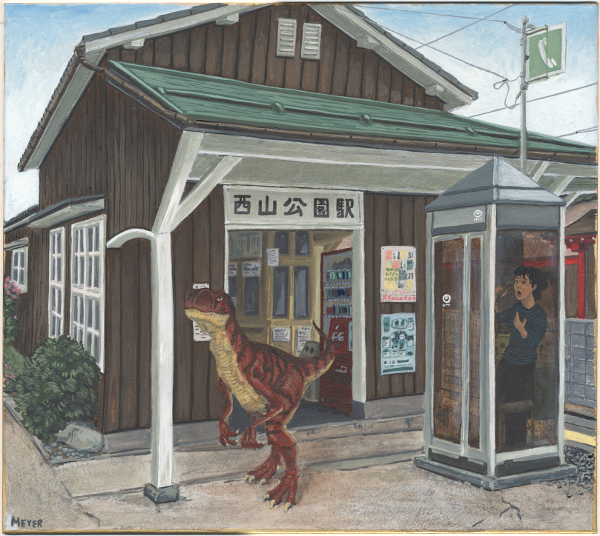
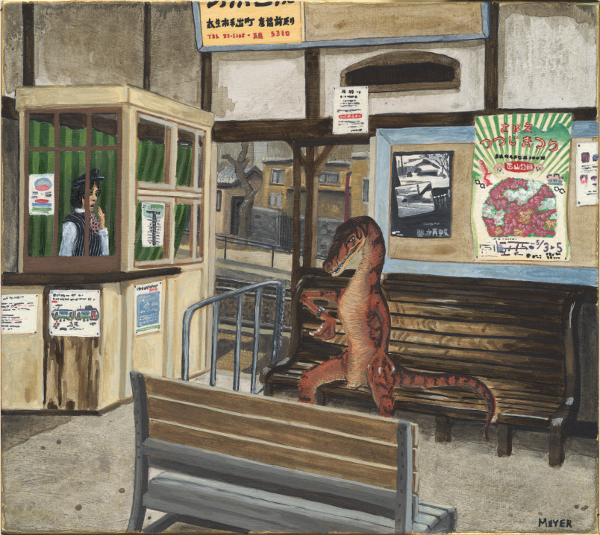
I’ve been pretty quiet on this blog recently, due to the fact that I haven’t been up to any thing particularly interesting recently. I’m working on a handful of projects, but I generally don’t post anything about a project until it’s finished. Well, not today!
I thought it would be fun to post my next Fukuiraptor painting at the stage it’s in now. Have a gander!
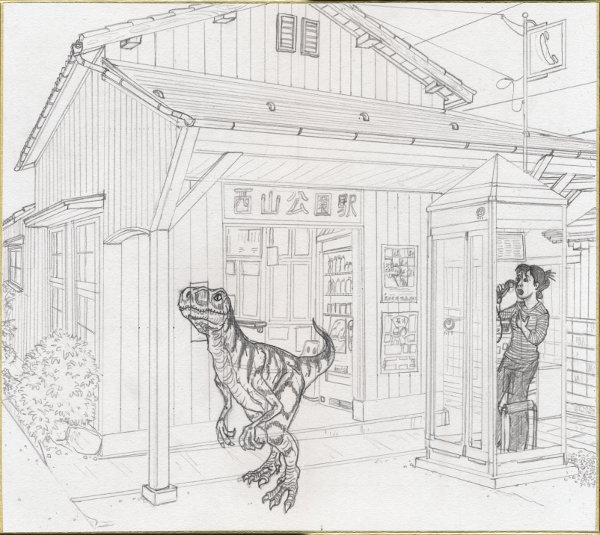
WIP – Fukuiraptor at Nishyama Koen Station
Last October when I was working on the A-Yokai-A-Day project a lot of people said I was insane to paint a new one every day. That may be true, and I did lose a lot of sleep that month, but the fact is that monsters are easier to paint than real things. The anatomy is made up, and our eyes can’t really tell the difference. Plus, the yokai were basically one monster on a fun textured background.
Realistic pictures (or at least semi-realistic) are a lot harder to fool the eye with. As you can see by the sketch, I have to take a lot of time drawing all the linework on the architecture with a ruler, and though you can’t see them now there are also many guide lines all over that board helping me to measure accurately. With buildings, you can’t fake the perspective by much or else our eyes will tell us something is wrong. Maybe we can’t identify what it is, but our brains and eyes work together to tell us it’s not natural. Dinosaur anatomy is a bit easier to fool people with, but it still does involve lots of study. I have a ton of dinosaurs toys that I use as reference, and for movement ideas I watch the crows in the rice paddies outside my window — I always imagine that is how dinosaurs would watch. And finally, human beings! They’re the hardest thing of all to draw, because even the slightest anatomical mistake and your character will look like a diseased or disabled person. Perhaps it’s part of our genetic heritage that we are able to read emotion, intention, even health in even a single glance at another human being — but this is also the artist’s greatest challenge. There are two ways to go with this problem: you can either spend years and years practicing until you can produce anatomically perfect figures like masters of painting and illustration, or you can simplify the character until it’s an abstract human form, like cartoon or anime characters. I tend to prefer a slighty-cartoonish but still anatomically human character, which isn’t as taxing as painting a realistic human but still requires a lot of anatomical work.
My process for these goes like this. First, I gather my reference materials. In this case, going to the local train stations and gathering photo references. After I have an angle/viewpoint that I like I do thumbnail sketches to decide the forms, then a larger rough sketch to confirm how everything fits on the paper. Then I do separate sketches of the dinosaur from my toys, and the human from other reference shots (in this case my wife). Then I scan the 3 sketches and blend them together in GIMP on my PC. Then I use a ruler and basically very carefully lay out the architecture and then the figures onto the final board, spray-fix it, and put a layer of matte medium on it for a little texture. After that I’m ready to paint.
There you go! That’s how I generally work with most of my paintings, thought sometimes I do more or fewer steps depending on time and purpose. This process takes a bit of extra time and preparation in the beginning, but it means that the final stages of the painting are a lot less stressful, and it usually pays off in the end. It takes a while for the paint to dry, but I’ll post the final version of this once it’s complete.