A-Yokai-A-Day: Wara ningyō

Another day, another yokai! Today we continue wizard week with another type of doll. While we looked at paper dolls yesterday, today’s is a straw doll called wara ningyō.

Like other dolls, wara ningyō can be used as purification objects. They can also be used for curses. There are a number of famous Japanese curses, and a good number of them involve very specific materials, such as a wara ningyō. Wara ningyō are particularly interesting because their popularity as curse dolls continues even today. There are even websites (1, 2, 3) where you can buy all the materials you would need to perform a specific curse (since it’s not like you can walk down to your neighborhood curse store and just pick up a curse pack). Click on those links at your own risk—I won’t be held responsible if someone looks at your browsing history and sees you shopping for curses!

Today’s entry is also from The Hour of Meeting Evil Spirits, which includes a whole chapter on black magic and onmyōdō. Pick it up at Amazon or your local bookstore today! Click on the wara ningyō to read the entry on yokai.com!

waraningyou

Waraningyo

A-Yokai-A-Day: Katashiro

Today we continue with our “wizard week” theme. While we saw Japan’s most famous wizard last night, for the rest of the week we will be looking at a number of magical spells. Today we’ll start with a common type of magical charm, the katashiro.

Anyone who is a fan of anime has probably seen something like this before—the flying paper dolls in Spirited Away, for example. Magical paper dolls that protect people are a very common sight in magic-themed anime and manga, and they have always been a staple in folklore dealing with magical spells, onmyōdō, and curses.

Not just paper dolls, but all kinds of dolls have been important tools in worship and ritual for centuries. Some examples: the prehistoric clay figures called haniwa which have been found in burial mounds, straw doll figures call wara ningyo which have been used in magical rituals, and hina dolls which are displayed during the annual Dolls Festival. Dolls could be used as objects of transference, representing a specific person for either good or bad magic. They were also used in purification rituals; people believed that sins could be transferred into dolls, which were then discarded into holy rivers where the water would wash the sins (along with the dolls) away.

While dolls today are seen mostly as decoration or as toys, it’s interesting to think about the different ways they were used in the past, and how deeply they were connected to religion and spirituality. It kind of forces you to think about all of the things we have in our houses; toys, dolls, stuffed animals, figurines, and other little objects that we take for granted. Would these have been viewed as containers for souls long ago? Certainly there was a greater respect for all objects before the age of mass production, but might your Barbie dolls or G.I. Joes be considered to have souls? As for me, I am a big fan of tabletop games and I have hundreds of little plastic and metal warriors… I wonder how that would be viewed by an onmyōji?

Tonight’s entry is from The Hour of Meeting Evil Spirits. To read more about katashiro and how they are used, click on the image below:

katashiro

Katashiro

A-Yokai-A-Day: Abe no Seimei

Owls and cats are of course staples of Halloween lore, but what about the people who use them? That’s right, I’m talking about wizards, witches, and warlocks! This week I will be detailing the most famous Japanese wizard and some of the magic that he used.

Japanese folklore has no shortage of magic users, and I’ve detailed quite a few of them on yokai.com. Today’s yokai is not a yokai at all, but a man—an actual historical figure who really lived, and who has entered the realm of folklore due to the sheer number of legends surrounding him and his life. I sometimes describe him to people who are new to Japanese folklore as “Japan’s Merlin” because he plays a somewhat similar role in literature and folklore; although those kind of East-West comparisons are only good for the most superficial connections, and I feel like it’s better to avoid them once you’re past the introductory stages. In any case, Abe no Seimei is a name that anyone delving into the realms of Japanese magic and superstition will run into sooner or later.

Abe no Seimei was an onmyōji, which is kind of like a court wizard in the classical period of Japanese history, about 1000 years ago. The onmyōji studied Taoism, Buddhism, Wu Xing (Chinese elemtantal theory), astrology, and other forms of esoteric knowledge. They were in charge of organizing the calendar for the imperial court, making sure important events fell on auspicious days and so on. They tried to read the future for the emperor and his family. They provided spells to protect the royals. They were so important that they even had an entire bureau of government, and at times wielded considerable influence. Abe no Seimei was the most powerful and famous onmyōji that ever lived, and he is one of the reasons that the onmyōji became as powerful as they did. There are tons of stories about him and his adventures, but I tried to condense them into a digestable readup. Click the image below to learn all about him!

This entry comes from my book The Hour of Meeting Evil Spirits—which came out last year—and has no yet appeared on yokai.com yet. One of the nice things about A-Yokai-A-Day is that it gives me a chance to share some of my entries which haven’t yet appeared outside of paper and ink. If you like today’s entry, you’ll love The Hour of Meeting Evil Spirits, as it contains an entire chapter on magic and onmyōdō

abenoseimei

Abe no Seimei

A-Yokai-A-Day: Maneki neko

While we had owls yesterday, today I want to showcase another Halloween staple: cats!

Although this cat is not bad luck like a black cat, but instead is a symbol of very good luck. In fact, you’re probably already familiar with this by its common English name, “lucky cat.” If you’ve ever been to a Japanese restaurant or store, chances are you’ve seen these in statue-form near the entrance. These days, it’s not even uncommon to see them Chinese and other non-Japanese Asian stores, but they are original Japanese creatures. (It’s so rare that you get to see folklore that was invented in Japan make its way to China, because usually it’s the opposite!)

Today’s A-Yokai-A-Day is another request from Patreon from a backer who really wanted to see the maneki neko covered. It was a fun request, because this is one of those creatures that hardly seems yokai-ish. Indeed, while its certainly folklore, it doesn’t seem to have anything strange or eerie about it, and those are hallmarks of yokai-ish-ness (whatever that is!). And while I think most Japanese would not include these in their definition of yokai, some of the folklore around the origins of these lucky idols is clearly square in the realm of eerie, and I think it’s quite fair to say that these fall within the realm of yokai as it is loosely defined.

There are actually quite a few famous stories about the maneki neko, and a few of them claim to be the “original” story that started the entire trend. What’s interesting is that we really can trace the maneki neko back to a certain point (1852) before which there were no maneki neko, and after which they seemed to be everywhere. Wherever it came from, I hope you’ll enjoy the strangeness of the story included, and the art as well!

Click below to read about the maneki neko! And if you want to help me make more of these paintings and translations, become a Patreon backer for just $1 per month and support my yokai work!

Maneki neko

Maneki neko

A-Yokai-A-Day 2016: Tatarimokke

Hello everyone! Tonight is the first of October, and for this site that means it’s time for A-Yokai-A-Day! Every day this month I will highlight a different yokai on this blog.

Our first yokai comes as a request from my Patreon backers. I get yokai requests every day from people who want me to do this yokai or that yokai, and if I had infinite time I would happily paint every single yokai everyone asked for. But I don’t have infinite time, so sadly I have to turn down most requests. I do try to make it a point to paint all of the yokai requests made by my Patreon backers, so (hint, hint) if you have a yokai you’d really like to see me cover, becoming a backer is a great way to make that happen!

When I first started A-Yokai-A-Day, the purpose was to showcase how Japanese people view ghosts and monsters during the month of October. Halloween is only recently becoming a thing in Japan, so it didn’t really have much to do with Halloween from a Japanese perspective—just the fact that I love Halloween and Halloween season, and these happen to be Japanese monsters. I often tried to pick out the strangest and most original creatures I could find. Well, today’s request was for an owl yokai, and I think that is an awesome way to start the Halloween season, because the owl is such an iconic staple of Halloween that to have an owl yokai seems to be a perfect way to yokai (which normally have nothing at all to do with Halloween) to the holiday.

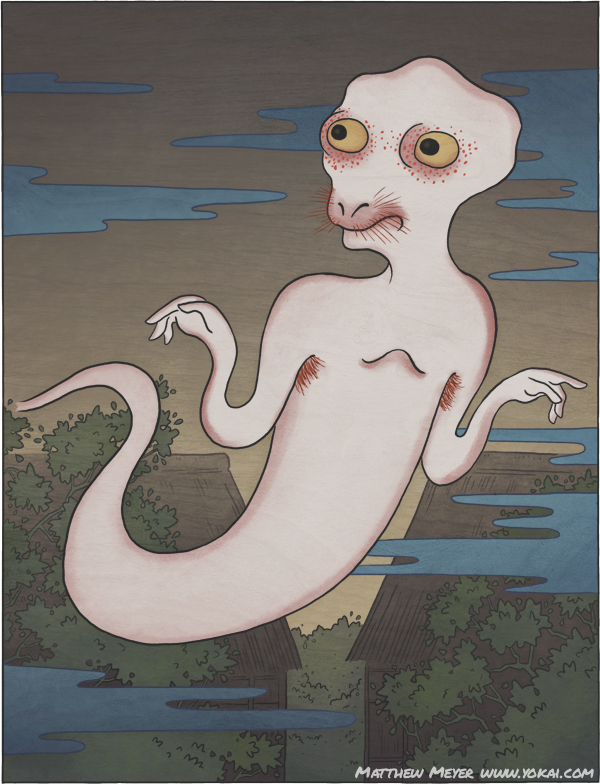
There aren’t all that many bird yokai out there… As a bird lover I have looked quite a bit, and while of course there are some, comparatively there are fewer birds represented than other animals. The owl seems like such a perfect candidate for a yokai though; it has a creepy facial expression with its enormous, unmoving eyes; it flies around at night; it gives off a strange call; it rarely interacts with humans except for people who go into the woods… All of these are the perfect recipe for a good yokai. So I was happy when I did find a somewhat obscure owl yokai from Aomori Prefecture. Click on the illustration to see the entry on yokai.com:

Tatarimokke

Tatarimokke

Also, I’d like to give a special thanks to everyone who came out and visited my booth at the Collingswood Book Festival today (and a welcome to first-time readers of this blog!). I love meeting my readers face-to-face, and I hope that a few new yokai fans were made today.

If you like today’s yokai, thank my Patreon backers! If you want to see more like it, support my Patreon project, and you’ll get first-look access as well as behind-the-scenes info about how all of my paintings are created, and how I do my work on these illustrations and translations.

Are You Ready For Yokai?

It’s almost October, and if you’re a long-time reader of this website, you know what that means: A-Yokai-A-Day!

A-Yokai-A-Day is my project where, during the entire month of October, I feature a different yokai illustration on my website each day and tell you a little bit about it. I started this project in 2009 as a way to celebrate Halloween while living in Japan, and to share a little bit of the folklore of the country I was living in with the internet.

Since then, the project has spawned two books (The Night Parade of One Hundred Demons and The Hour of Meeting Evil Spirits), a Patreon project, and yokai.com. It’s been a wonderfully fun project every year, and I love the challenge of introducing so many new yokai to people in such a short time during Halloween season.

Over the years the project has evolved a little bit. Instead of posting all of the yokai descriptions here on matthewmeyer.net, in recent years I have been posting the yokai writeups on yokai.com and go into a meta discussion here on this blog. So on this site I’ll post about my research and translation process, the creation process of the image, why I selected certain yokai to do, and other stories about the creation of each entry. On yokai.com I’ll post the actual entries for each yokai, so for those of you who want to go straight to the meat of the substance without the appetizer, you can head straight to yokai.com to read.

I’m really excited for the project and I hope you are too. There’s only a few more days to go! And remember, you can help support this project year-round by becoming a backer of my project on Patreon!

Baltimore Comic Con

Thanks to everyone who came by my booth at Baltimore Comic Con! The convention was totally awesome! It was great to see so many new and familiar faces, and to chat about yokai with all of you.

I realized too late that I have been posting all of my updates on Facebook rather than my blog (shame on me!). I should have made a post before going, and I definitely should have done one back during Wizard World Comic Con in Philadelphia earlier this year. I forget that not everyone seems my Facebook and Twitter posts, so I am forcing myself to do this quick update first thing after getting back home and unpacking the car.

Baltimore Comic Con

One of the most common questions I get at conventions and fairs is if I have such-and-such print. I try hard to bring extra copies of all the popular prints, but I have so many yokai painted that I can’t be prepared with everyone’s favorite yokai. Sadly there are always a few people who come to me after I’ve sold the print they want, or they want one that doesn’t normally get requested, so I don’t have a copy with me. It’s sad, because I absolutely love it when someone comes up to me and asks for a yokai that nobody ever asks for! They are all so unique, and it warms my heart when one of the less popular creatures is called out by name by someone who wants it. So I try, and I wish I could be prepared for every request, but logistically that’s not possible. (The reason I don’t use Etsy much anymore is the same—I have well over 200 yokai paintings and it’s impossible to keep them all available all the time.)

So if you’re one of these folks who couldn’t get the print you wanted, you can email me to let me know which one you want, and I can ship it to you. I can make prints of any of the illustrations on this website, or yokai.com, or in my books. If you know exactly what you want, you can send me the link the yokai.com page, or if you can’t remember which one it was you can describe it to me and I’ll help figure out what you’re looking for.

Thanks again for a great convention weekend!