A-Yokai-A-Day: Furaribi

Today’s yokai is another bird-like one. I kind of want one as a pet… except for the whole flames and vengeful curse thing…

Furaribi (ふらり火, ふらりび)

Furaribi appears in a number of old yokai picture scrolls as well as in Toriyama Sekien’s Gazu Hyakki Yagyō. It appears as a bird-like creature wreathed in flame, floating about aimlessly in the night sky. While it has the body of a bird, its face resembles a mix between a dog and the Hindu god Garuda. It is a type of hi-no-tama, or fireball yokai, and is said to be born from the remains of a soul which has not properly passed on to the next life, most likely due to not receiving the proper ceremonial services after dying. In Japan you don’t just get a funeral, you have a number of services commemorating your death and praying for your soul which repeat on certain days, months, and years after your death — missing even one of these could spell doom for your soul (so the priests tell us…).

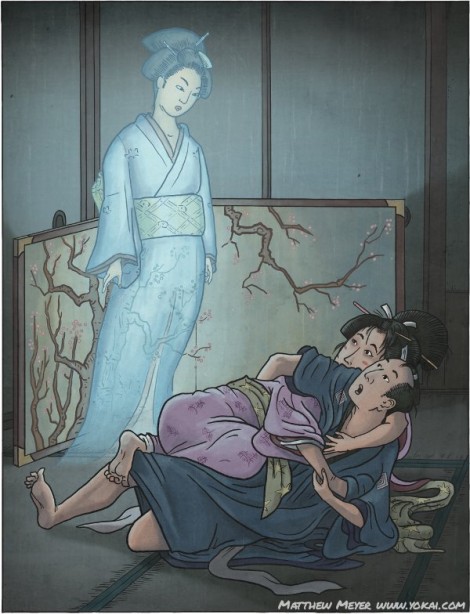
One legend about Furaribi comes from Toyama city in Toyama prefecture. In the late 16th century, this area was ruled by a samurai named Sassa Narimasa. Narimasa had very beautiful concubine named Sayuri, who was not well liked by the other female servants in Narimasa’s innermost circle. One day, these women conspired against Sayuri and started a rumor that she had cheated on Narimasa with one of his men. Narimasa, in a fit of jealous rage, murdered Sayuri, then took her down to the Jinzū river, hung her corpse from a tree, then proceeded to carve it into pieces with his sword. On top of that, he captured Sayuri’s entire extended family, 18 people in all, and executed them in the same manner. Afterwards, their tortured souls aimlessly wandered the riverbanks every night as furaribi.

It is said if you go down to the riverside and call out “Sayuri, Sayuri!” late at night, the floating, severed head of a woman will appear, pulling and tearing at her hair in a vengeful fury. As for Sassa Narimasa, he was later defeated by Toyotomi Hideyoshi. Some have attributed his defeat by Hideyoshi to the vengeful curse of Sayuri’s ghost.

Furaribi

If you liked this yokai and want to see more, please become a backer of my Kickstarter projectThe Hour of Meeting Evil Spirits!

A-Yokai-A-Day: Shirime

Today’s yokai is so wonderfully silly that it speaks for itself. There is no wonder it is counted among the most beloved yokai in Japan…

Shirime (尻目, しりめ)

Literally, “butt eye,” this yokai is practically self explanatory.

It first appeared in a picture scroll by Yosa no Buson, an Edo period poet. Most likely it was made up by him, as no other folklore exists. It’s one of those yokai that literally has two sentences to its name, and yet those two sentences seems to be enough:

京、かたびらが辻ぬっぽり坊主のばけもの。 めはなもなく、一ツの眼、尻の穴に有りて、 光ることいなづまのごとし。

“In Kyoto, at the Katabira crossroads, there is a monster called nuppori-bōzu. It has no eyes or nose, but a single eyeball, located in its butthole, which shines like lightning.”

There you have it folks, the making of a legend! The passage refers to it as the “nupperi-bōzu,” so this yokai is certainly a kind of noppera-bō, a kind of faceless yokai which is a popular form taken by mujina (shapeshifting badgers).

Mizuki Shigeru expanded upon the story a little bit in his yokai anthology Mujara, and has this to say:

Long ago, a samurai was traveling on the road to Kyoto, and a man in a kimono stepped out in front of him and blocked his path.

“Who goes there!” cried the samurai.

“Excuse me, sir, do you have a moment?” replied to man.

Before the samurai could reply, the man shed his kimono and bent over. His butt opened wide, revealing a huge, glowing eye which shone with a strange light.

The samurai screamed and fled…

You can’t make this stuff up, folks!

Shrime

If you liked this yokai and want to see more, please become a backer of my Kickstarter projectThe Hour of Meeting Evil Spirits!

A-Yokai-A-Day: Hahakigami

When we associate Halloween with broomsticks, we are usually talking about witches riding them in front of the moon at night. Japan, on the other hand, ditches the witches and leaves the broom all to itself. Today’s yokai is another tsukumogami — this time it is made from a haunted broom!

Hahakigami (箒神, ははきがみ)

OnusaLiterally translated as “broom spirit,” hahakigami is not the ordinary broom that you and I use to clean the house. Long, long ago in Japan, the broom was not a tool for cleaning trash and brushing dust out of houses; it was a holy instrument used for purification. If you have ever seen a Shinto purification ceremony where they shake an ōnusa (a stick covered in strips of paper), that may be somewhat of spiritual successor (no pun intended) of this ancient broom tradition. The shaking of the ōnusa purifies the space around a shrine (and makes a beautiful sound!), and long ago a broom would be used in much the same way. Although today brooms are pretty much entirely used for cleaning dirt.

A hahakigami is not simply an animated broom, however. It has specific meaning. One is as a charm for safe childbirth. Because brooms are used to “sweep out” evil energy from the air and purify a room, the hahakigami is used as a sort of totem to “sweep out” the baby from the mother safely.

They are also supposedly charms to keep guests from overstaying their visit. Again, when someone has overstayed their welcome, you just want to “sweep them out” don’t you?

Finally, even though old Japanese brooms were not used for simply cleaning, it seems that the hahakigami does, in fact, enjoy running around chaotically on windy days in late autumn, sweeping the dead leaves around.

Hahakigami

If you liked this yokai and want to see more, please become a backer of my Kickstarter projectThe Hour of Meeting Evil Spirits!

A-Yokai-A-Day: Shōgorō

One popular request I’ve been getting since Night Parade came out is “more tsukumogami!” For those who do not know, a tsukumogami is a kind of yokai born from common household things. The name means “99-year god,” and the idea is that an object which has been in use for 99 years (or else a very very long time) grows a soul and takes on a life of its own. Also, an item which has long stopped being used may sometimes grow sad or resentful that it is collecting dust in some closet somewhere, and develop a soul of its own.

This folk belief has led to all kinds of neat yokai based on shoes, broken umbrellas, kimonos, broken dishes, dirty kitchen rags, antique instruments, and just about anything else you can think of. They are often silly and cute, and sometimes can be scary too. Today, let’s take a look at a tsukumogami:

Shōgorō (鉦五郎, しょうごろう)

Shōgorō is an animated shōgo (鉦吾), a kind of miniature gong which is used in Buddhist services. If you’ve ever visited a temple in Japan, you have no doubt heard their distinctive ring. They are also sometimes called kane, as we will see later in our story.

A shōgo gets a lot of use, being used multiple times every day. They are made of metal, and so can last a long time. And they belong to temples, so there is a likely chance they will stay with the temple for many years. It is pretty easy to see that shōgo are ideal candidates for turning into tsukumogami. Perhaps a gong has long worn out and stopped playing its note pleasantly, and gets put into storage until it is forgotten… or perhaps one is the witness to some horrible crime, and that awakens it into a yokai.

There is a famous story of a shōgo turning into a shōgorō in Osaka in the early 18th century. Back then, there was a merchant family known as the Yodoya living in Osaka. For many generations, they were the kings of the rice trade, and raked in unbelievable amounts of cash. In fact, the 5th generation boss, Yodoya Tatsugorō,  had so much money that his wealth attracted the attention of the bakufu (the regional shogunate officials, something like military police).

The bakufu decided that the Yodoya family had accumulated enough wealth — too much wealth in fact. They were only a merchant family, after all, and it was improper for them to hold so much wealth. It was above their station in life. And so, the bakufu stripped Yodoya Tatsugorō of everything he had: his rice, his business, his house, his every last rich possession. The Yodoya family fell into ruin, and Tatsugorō became destitute. The straw that broke the camels back, so to speak, was the loss of his favorite possession: an unbelievably rich and indescribably splendid golden chicken called Kogane no Niwatori (金の鶏, literally “golden chicken”). The loss of his precious golden chicken caused Tatsugorō so much grief that he died, and because of the unhappy circumstances of his death, his ghost lingered on.

Normally, when a ghost lingers like this, it attaches itself to the object of its desire — whether it be a person, a place, or (in this case) a thing. Tatsugorō’s soul was meant to attach itself to his precious kogane no niwatori. But as I said earlier, a shōgo is also called a kane, and because the words kane 鉦 and kogane 金 can both be written with the kanji for metal, 金, poor Tatsugorō’s ghost must have gotten confused, and it attached itself to a nearby shōgo instead, turning the instrument into an animated yokai.

From that day on, the shōgo was called Shogorō — a kind of portmanteau of shōgo and Tatsugorō. (The name can also be read as a portmanteau of shōgo and goryō, 御霊, which is the ghost of a high social rank or very rich person. Goryō play a large part in other ghost stories, such as the Tale of the Heike and Lafcadio Hearn’s famous Miminashi Hoichi.) Toriyama Sekien really loves his puns and wordplay!

Shougorou
If you liked this yokai, don’t forget to become a supporter of my Kickster project!

A-Yokai-A-Day: Tera-tsutsuki

There are lots of different animal-type yokai, and a great deal more bestial yokai that resemble animals in some way or another. Out of these, though, there don’t seem to be all that many bird yokai. As a bird lover, I thought I’d even the scales a bit today by introducing a bird yokai, specifically a great spotted woodpecker yokai. It comes with a free history lesson too. Enjoy!

Tera-tsutsuki (寺つつき, てらつつき)

Long long ago, back when Japanese historical records blur with legends and mythology, there was a man named Mononobe no Moriya. He lived in the 500’s CE, back when Japan was still called Yamato, and the capital was located in what is today Nara. Mononobe no Moriya was the leader of the a Mononobe clan and a Muraji, one of the two most high-ranking hereditary titles of nobility in old Japan. The Mononobe clan, along with a few other clans, had held their nobility since time immemorial, and were said to be descended from the gods. As a result, they were chief keepers of the old ways and supported Shinto when it was challenged by Buddhism, newly brought over from China in the 6 century CE. Buddhism was supported by the clans descended from the imperial line (and opposed by the clans descended from the gods). The leaders of these clans were called Omi — the other highest-ranking noble rank — and frequently came into conflict with the clans led by Muraji.

Mononobe no Moriya, the Ō-Muraji (great Muraji) of the Mononobe clan, had a powerful rival in Soga no Umako, the Ō-Omi (great Omi) of the Soga clan. These two nobles held considerable power in the imperial court. During the reign of Emperor Bidatsu (572-585), Mononobe no Moriya held higher favor with the emperor, who supported Shinto. When Emperor Yōmei took power in 585, Moriya’s favor fell and Soga no Umako’s rose, as the new emperor supported Buddhism over Shinto.

Whem Emperor Yōmei died in 587, the two rivals each tried their best to influence the succession of the imperial title. The two clans went to war with each other, and Mononobe no Moriya set out to purge Buddhism from Japan, setting fire to temples and throwing the very first statues of the Buddha brought to the country into the canals of Naniwa. The two clans finally met on the battlefields in Kawachi, at Mount Shigi. There, at the Battle of Mount Shigi, Soga no Umako and Prince Shōtoku killed Mononobe no Moriya, and nearly exterminated the entire Mononobe clan. Afterwards, the Soga clan rose to even higher prominence, and Prince Shōtoku, a devout Buddhist, began the construction many new Buddhist temples in Japan.

The story doesn’t end there. The spirit of defeated Mononobe no Moriya, as he lay dying in hatred and resent, transformed into an onryō. His ghost took the form of a woodpecker, and could later be seen at Hōryū-ji and Shitennō-ji temples in Osaka, pecking furiously at the buildings constructed by Prince Shōtoku, still trying to destroy the heretical faith even in death. Prince Shōtoku was finally able to defeat the tera-tsutsuki (“temple-pecker“) by magically transforming into a hawk and attacking it. After that, the tera-tsutsuki was never seen again.

TeratsutsukiIf you liked this yokai, don’t forget to become a supporter of my Kickster project! Only 22 days to go!

A-Yokai-A-Day: Te-no-me

Today’s yokai is something you may recognize from the movie Pan’s Labyrinth. I love this yokai so much, not just because it’s creepy enough to give me the shivers, but also because it is such a perfect example of yokai master Toriyama Sekien’s art for irony and symbolism. This is a pretty long explanation, but I really think it is worth going in to. Enjoy!

Pan's Labyrinth's Pale Man: A Te-no-me?

Pan’s Labyrinth’s Pale Man: A Te-no-me?

Te-no-me (手の目, てのめ)

Te-no-me first appears in Toriyama Sekien’s Gazu Hyakki Yagyo. Unfortunately, this is another yokai for which Sekien didn’t even write a single sentence about — just an illustration — and so his original intent is lost to the mists of time. However, other older stories exist which describe monsters fitting te-no-me’s description, and perhaps it was these stories which Sekien based his yokai on.

Te-no-me takes the appearance of a zato, a blind man. Back in the Edo period, it would have been very difficult for a blind person to find work if not for the shogun-designated guilds. The guild system formed a sort of social security system, and it restricted certain professions to certain groups of people. The guild for blind people held a monopoly on the professions of massage, accupuncture, and biwa (lute) practice. Therefore zato is often synonymous with “blind masseur” or “blind biwa tutor.” A number of zato yokai exist, and you may have heard of the legend of Zatoichi, the blind swordsman? Yep, same zato.

Anyway, as I was saying, te-no-me takes the appearance of a zato, except for one crucial difference: his eyes are located on the palms of his hands instead of in his skull. In the Shokoku Hyakumonogatari (100 Stories from Various Countries, a yokai volume written in 1677), one story tells of such a creature, although the name te-no-me is not used. Instead, the word bakemono, or “monster,” is used. The title of that story is “The Story of the Man Who Had His Bones Sucked Out by a Monster.” Spoiler alert, amiright?

This story takes place in Shichi-jo, Kyoto, in a graveyard by the riverbank. A young man entered the graveyard, taunted by his friends to prove his courage by visiting a graveyard at night. Out of the darkness, an old man who appeared to be in his 80’s approached the young man. When the elderly figure got close enough to see in detail, the young man realized that it was actually a bakemono with eyeballs on the palms of his hands, and it was coming to get him!

The man ran as fast as he could to a nearby temple, and he begged the priest for sanctuary. The priest helped the man to hide inside of a long chest, and then hid from the monster himself.

Shortly afterwards, the bakemono entered the temple and hunted around for the young man. The noises got closer and closer to his hiding place, until they stopped right next to the chest he was hiding in. Then, there was a strange slurping sound, like the sound of a dog slurping and sucking on a dinner bone. A little while later, the slurping sound vanished, and all was quiet. Later, when the priest opened the chest to let the young man out, all that was left was the limp skin of the young man. His bones had been completely sucked out of his body.

I love that story… I don’t know why but it really chills my spine like few other yokai stories do!

A similar legend goes into a little more detail about where these yokai come from. In this story, a man is attacked by a bakemono with eyes on its palms in a field, and he flees to a nearby inn for shelter. He tells the innkeeper about the monster he saw, and the innkeeper replies that a few days ago, a blind man was attacked and robbed out in that field. As the man lay dying in the grass, he cried out, “If only I could have had once glace at their faces! My eyes do not see, but even if only I had eyes on the palms of my hands…” The old blind man’s resent-filled death is what caused him to be reborn as a yokai — with eyes on the palms of its hands just as he wished.

Toriyama Sekien's Te-no-meIt doesn’t seem like this yokai became known as te-no-me until Toriyama Sekien dubbed it thusly in his encyclopedia. However, while te-no-me (literally, “eyes on hands”) seems like a painfully obvious name, Sekien had other reasons for attaching this name. They have to deal with Sekien’s unique sense of humor and his love of wordplay, and are rather difficult to translate into English, but let’s see what we can do:

We have to start with a few idioms in Japanese. “Bake no kawa ga hageru” (lit. “transformed skin falls off” or “one’s disguise comes off”) is roughly equivalent to the English concept of the “wolf in sheep’s clothing” being revealed. That same word “hageru” can also be used to mean “to shaves one’s head;” and shaving one’s head can also be expressed by the idiom “bouzu ni naru,” (lit. “to become a priest,” as priests customarily shaved their heads). However, the phrase “bouzu ni naru,” is not actually used literally used to mean that someone will join the priesthood, but it is used when someone loses big time, at gambling or games or some other vice. The idea is “I lost so bad that I will shave my head and join the priesthood.” Now — hold that thought…

There is another phrase “te me o ageru” (lit. “raise the eye hands”) which means to expose someone’s trickery, particularly if they were cheating at something like gambling. If you are gambling and you catch someone at cheating (“te me o ageru“), they will be exposed for the cheater they are (“bake no kawa ga hageru“) and they will probably lose all of their money (“hageru,” “bouzu ni naru“) i.e. “become a priest.”

So what’s the connection? The obvious one is that “te me o ageru” is a play on words with the name te-no-me, with the yokai literally raising his eye hands. The rest of the joke lies in themes that run constant through much of Toriyama Sekien’s work; Sekien’s yokai books frequently mock the subjects he really hated, the big three of which were prostitution, gambling, and religion. This yokai doesn’t have anything to do with prostitution, but the subtle references to those idioms relating to losing at gambling and become a priest would not be lost on his clever readers. Amazing how just the simple name of a yokai can evoke so much!

tsuki (hanafuda)

tsuki (hanafuda)

Sekien’s illustration of te-no-me also includes subtle jokes: we see this yokai wandering through the grass under the moon. This is evocative of hanafuda cards, specifically the card for moon and grass. In hanafuda, moon, or tsuki, can also be written bouzu, (which as you may have noticed above, also means “priest”). And hanafuda is, of course, a card game, which is another poke at gambling.

Sekien managed to squeeze one last joke into his illustration: the grass in the hanafuda moon card is specifically pampass grass, which in Japanese is susuki. This evokes another idiom: “yuurei no shoutai mitari, kare obana,” literally “seeing the ghost’s true form, dry pampass grass.” The idea behind this idiom is that when you see something horrifying like a ghost, you may be scared, but in reality it is only something as simple as dry grass blowing in the wind. Your mind is just playing tricks on you.

Toriyama Sekien was truly a brilliant man!

My te-no-me

My te-no-me

If you liked this yokai, don’t forget to become a supporter of my Kickster project! Only 22 days to go!

A-Yokai-A-Day: Tsurube-bi

Today we reached the 300% funding mark for The Hour of Meeting Evil Spirits! What a great milestone! Thanks for all of your support! We still have 24 days to go, so please share, tweet, like, pin, and whatever else it is you do to help spread the word! I hope to make this the best English-language yokai encyclopedia in existence!

Tsurube-bi (釣瓶火, つるべび)

Today’s yokai seems to be very closely related to another yokai with a very similar name: the tsurube-otoshi. Tsurube-bi is occasionally referred to as tsurube-otoshi or tsurube-oroshi, depending on the region, and they are considered by yokai researchers to be two species of the same yokai. From a casual glance, the chief difference seems to be that one is made of fire and the other is made of flesh, however they are actually much more different than they appear. They are considered to be a type of hi-no-tama, or fireball yokai, but more specifically they are said to be the soul of a tree lingering in the forest.

Tsurube-bi first appears in Toriyama Sekien’s Gazu Hyakki Yagyō. Sekien wrote no explanatory sentences, and it wasn’t until much later that a clear explanation of this yokai was developed.

Tsurube-bi are found in the Shikoku and Kyushu regions. They appear late at night in trees, usually conifer trees, as floating and bobbing blueish-white orbs of fire up in the branches. Occasionally they drop down and then float back up. Sometimes the vague shape of a human or bestial face can be seen in the flames.

Other than that, tsurube-bi do pretty much nothing at all. They do not hurt people, and their fire doesn’t even produce any heat or burn anything. Just an eerie, but somewhat playful and beautiful orb of light in the mountains and forests.

Tsurubebi