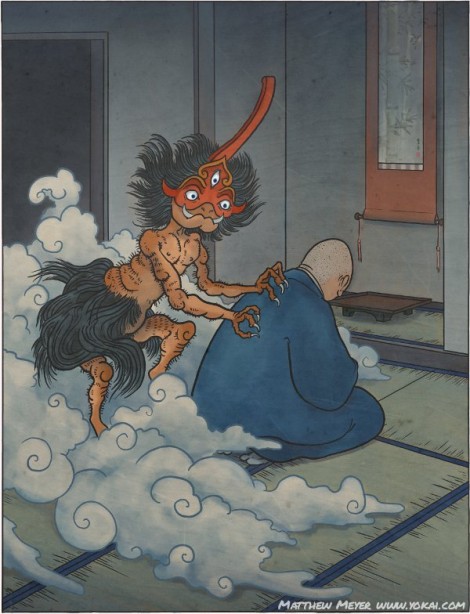
A-Yokai-A-Day: Tesso

You might recognized today’s yokai from his brief appearance in my Kickstarter video, where I referred to him tongue-in-cheek as “the original Master Splinter.” However, there is nothing tongue-in-cheek or silly about the true story behind this yokai. It’s a tale of trust, betrayal, and ultimate revenge (and would it be a Japanese ghost story with revenge?).

Tesso (鉄鼠, てっそ)

Tesso wasn’t born a yokai. In fact, he was a real person. Long ago, during the time of Emperor Shirakawa (reigned 1073-1087), there lived a man named Raigō. Raigō was the abbot of Mii-dera, a monastery in Shiga prefecture at the foot of Mount Hiei.

The history of this period was all very complex, with conflicting power bases, rival emperors, family rivalries and so on (if you are looking for a great primer on Japanese history, I would suggest The Mikado’s Empire by W.E. Griffis), so I won’t go into detail, but suffice it to say, the Emperor was desperate for a proper male heir.

Emperor Shirakawa approached Raigō and asked him to pray for a son to be born. Raigō prayed long and hard, and sure enough in 1074 a son, Prince Taruhito, was born. The Emperor promised to give Raigō anything he wished, and so in return for his prayers, the abbot asked that a splendid new building be built at Mii-dera so he could train new priests there. The Emperor gladly agreed… but as I said this was a time of conflicting power bases, and Mii-dera had a rival: Enryaku-ji temple, on top of Mt. Hiei, wielded great political power as well as having a powerful army of warrior monks at its disposal. Bowing to pressure from Enryaku-ji, the Emperor reneged on his promise to Raigō.

Raigō began a hunger strike in protest of Emperor Shirakawa’s broken promise, but the Emperor would not — or could not, rather — go against Enryaku-ji’s power. On the 100th day of his hunger strike, Raigō passed away, full of rage towards the unfaithful Emperor and the rival monastery of Enryaku-ji.

What happens next is where the true story takes a turn for the bizarre, and where different books range wildly in their accounts. Shortly after Raigō’s death, a ghostly vision of the abbot was seen hovering near young Prince Taruhito’s bed. So great was the grudge of Raigō that, upon his death, he was able to turn himself into an onryō, a ghost driven by pure vengeance. Shortly afterwards, the young prince died, leaving the Emperor heir-less once again.

Raigō did not come back as an ordinary ghost (if such a thing can be said to exist in Japanese folklore…). Instead, he used black magic to turn himself into a gigantic rat. His body was said to be as hard as stone and his teeth and claws as strong as iron, earning him the nickname Tesso, or “the iron rat.” Tesso summoned a massive army of rats, which poured through Kyoto and up Mt. Hiei, until they arrived at Enryaku-ji. There, Tesso wreaked his vengeance. The army of rats poured through the monastery complex. They chewed through the walls and doors, crawled into the roofs, and chased away the monks. They devoured the precious sutras, scrolls, and books of the temple, eating and despoiling everything they found. They even ate through the precious statues of the Buddha.

Nothing could stop Tesso and his army of rats until finally a shrine was built at Mii-dera to appease his vengeance. Raigō’s spirit is still enshrined there, and you can visit it today. One interesting footnote to the story: while Buddhist buildings are typically built facing the east, Raigo’s shrine is built facing the north; it points up Mt. Hiei, directly at Enryaku-ji.

Tesso

OMG, why haven’t you backed my Kickstarter project yet?? This and other great illustrated yokai tales could be in your hands in glorious paperback or hardcover, postcards, and fine art prints, if only you pledge to back the project before October 31st!

A-Yokai-A-Day: Yamajijii | 妖怪シリーズ:山爺(やまじじい)

Just a reminder to those who are coming here for the first time: A-Yokai-A-Day ends on October 31st, but you can keep on getting new yokai in your inbox past Halloween! Just join my Kickstarter projecteven if you only pledge $1! — and you can become a part of the making of The Hour of Meeting Evil Spirits! Your name will go into the book as a supporter, and you’ll get to view the entire process of making the book, including all of the yokai that go in it. For the time being, all of the Kickstarter updates are public (and viewable here), but come November 1st, once the magic of Halloween ends, all of future updates will be private for backers only, and you’ll have to wait a whole year for more yokai!

Now, on to today’s A-Yokai-A-Day:

Yamajijii (山爺, やまじじい)

Wow, look at all of those dotted i’s and j’s!

Yamajijii is a strange and reclusive yokai from Kochi prefecture and other parts of the island of Shikoku. It’s name means “mountain geezer,” but an alternative name for this yokai is yamachichi, which means “mountain father.”

Yamajijii takes the form of an eldery man about 3-4 feet tall, with only one leg and one eye. Well, actually, he has two eyes, but one of them is huge and the other one is so tiny that you can barely see it, so he appears to have only one eye. His body is covered in fine gray hairs, and he is just as often seen scamping about in his hairy birthday suit as he is in old clothes or rags. He has sharp teeth and powerful jaws — his bite is said to be strong enough to crush the bones of wild boars or monkeys. Because his bite is so strong, hunters used to try to tame yamajijii and use them to drive away wolves.

Yamajijii rarely appear before humans, but their tracks are easily recognizable. They leave deep, sunken footprints about 12 inches long every 6 to 7 feet (from their hopping about on one leg). They are most well known, however, for their powerful voices. The cry of a yamajijii is so powerful it blows the leaves off of trees, shakes branches and moves rocks, reverberates through the mountains, and shakes the heavens and the earth. People who are too close to a yamajijii’s call sometimes have their eardrums burst, or even die from the impact of the shout.

Yamajijii enjoy shouting contests with each other, and one legend from Shikoku tells of a brave hunter who challenged a yamajijii to a shouting contest. The hunter fired off his rifle when he shouted, winning the contest. Later on, the yamajijii realized he had been tricked, shape-shifted into a spider, and attacked the hunter in his sleep. In some versions of the tale, the clever hunter goes to the Ise Shrine on New Year’s Eve to prepare for the shouting contest, and crafts a special holy bullet with the name of the gods of Ise inscribed upon it. This bullet had special power, and when fired it would never miss its target. Because of its strong power, whenever the hunter carried it with him he would inevitably encounter yokai; however, any time a yamajijii came near enough to threaten him, the hunter would display the bullet, and the yamajijii would flee in terror.

Yamajijii also have the power to read peoples’ minds. Another tale from Tokushima tells of a group of woodcutters who were warming themselves by a fire in a cabin. A yamajijii suddenly appeared at their cabin, and the woodcutters were terrified. They all came to the same decision — to kill the yamajijii — and one by one the yamajijii read each one of their minds to know what their plans were. Suddenly one of the logs in the fire split with a loud snap! The yamajijii thought that there was a mind he could not read among the hunters, and he quickly fled the cabin in a panic.

Despite their tricky and sometimes dangerous nature, yamajijii can also be kind to humans. A story from Kochi prefecture tells of a yamajijii who gave a sorghum seed to a farmer as a gift. The farmer sowed the seed and had a great harvest that year. In the winter, the yamajijii returned and asked for some mochi to eat. The grateful farmer gave the yamajijii as much mochi as it could eat. The next year, another great harvest followed, and again the yamajijii came back to ask for mochi. Each year, however, it was able to eat more and more, until it was able to eat 3 huge barrels full of mochi. The farmer, fearing for his livelihood, gave the yamajijii a pile of burned stones and told him they were mochi. Upon eating them, the yamajijii felt sick and hot. The farmer offered the yokai a cup of hot oil, pretending it was tea. Surprised and hurt, the yamajijii fled into the woods, but died before it could get back to its home. Afterwards, the farmer’s family fell into ruin and was never rich again.

The moral of the story is as it always is: never f*ck with a yokai.

Yamajijii

You can read a little bit more about yamajijii at yokai.com!

Don’t forget to join my Kickstarter! | ご存じない方のためにもう少しA-Yokai-A-Dayの説明を補足しましょう。A-Yokai-A-Dayは10月31日に終わる(ハロウィーン月間)一か月間のプロジェクトです。私のKickstarter プロジェクトに参加いただけると(1ドル(約100円)から参加できます!)私の2冊目の本、The Hour of Meeting Evil Spirits(逢魔時)制作に共にサポーターとして参加することができます!

参加された方々は制作過程の全てを見る事ができ、掲載予定の妖怪全てを見る事ができます。今の時点で、私のKickstarter プロジェクトのアップデートは公に公開されています(こちら)から見る事ができます)が、ハロウィーンの魔法がとけた後(11月1日以降)はBackers(サポーター)のみが見られる限定公開になります!

それでは、今日の妖怪をご紹介しましょう。

Yamajijii (山爺, やまじじい)

山爺は人里から離れて過ごす奇妙な妖怪で、高知県や他の四国エリアにいるといわれている。その他の呼び名として、山父(やまちち)とも呼ばれている。

容姿は老人のようで、背丈は3~4尺程、一本の脚に一つの目を持つ(正確には2つの目をもつが、一つはとても大きく、もう一つは小さすぎてほとんど見えないとされている)。体は灰色の体毛で覆われ、時に衣やボロ布を纏っている事もあるという。鋭い葉と強靭な顎を持ち、イノシシやサルなどの骨を噛み砕くほど頑丈だといわれている。この強さを利用して、猟師たちは山爺を手なずけて狼を追い払うのに使っていたたとも言われている。

山爺は人の前に姿を現すことはほとんどないが、山爺の歩いた跡は容易に見つける事ができる。彼らは歩くたびに6~7尺おきに4寸程の大きな足跡を残すためである。山爺はとてつもなく大きな声を出すことでも知られている。その大声は木の葉をふるい落とし、木々や岩を動かし、また山中に響き渡るその音は地面をも揺れ動かすともいわれている。山爺の近くにいた者がその声を聴いてしまったために鼓膜が破れ、ついには死に至る者までいたのだという。

山爺は大声比べを挑むことがあるという。四国に伝わる伝説によると、一人の勇敢な猟師が山爺に対決を挑み、大声と共に銃声を鳴らして山爺に打ち勝ったという話があるという。しかし、後にだまされたと気づいた山爺は、蜘蛛に化けてその猟師の家に忍び込み、寝込みを襲ったとも伝えられている。また別の話では、知恵ある猟師が大みそかの晩に伊勢神社に参り、そこで作った銃弾に菩薩の名を刻んだとされている。この銃弾には不思議な力が宿っており、発砲すると必ず命中するのだとか。また、それを携帯していると必ず妖怪に出会ってしまうとも言われている。山爺に出会った際にはこの銃弾を見せて脅すと、恐れおののいて逃げ出してしまうのだとされている。

山爺は人の心を読み取る能力があることでも知られている。徳島県に伝わる伝説によれば、木こりが焚火で暖を取っている所に山爺が現れて次々に木こりの考え(山爺を殺してしまおう)を当ててしまったという。しかし、焚き木の火が弾け飛んだその時、山爺はそれを言い当てる事ができなかった事に驚き、去っていったとのことである。

時に危険な生態であるにも関わらず、山爺は人間に対して優しい行いもするといわれている。高知県に伝わる話では、山爺がある農民にモロコシの種を与えたとされ、その農民はその年大豊作に恵まれたという。山爺が後に再び現れ餅を欲しがったので、農民は餅をたらふく食べさせてやった。しかし、翌年も、またその翌年も山爺が現れ餅をせがみ、3斗もの餅をたいらげるようになったため、家計を心配した農民は山爺に餅と偽って焼き芋を食わせた。焼き芋の熱さに苦しんだ山爺に、さらに今度は熱い油を飲ませたという。山爺は山へ逃げたが、その道中で死んでしまう。その後、その農民の家は廃れ、二度と繁栄することはなかったという。

このお話では絶対に妖怪に悪さを働いてはならないというモラルを説いているようですね。

Yamajijii

もしこの妖怪が気にいられて、もっと日本の妖怪について知りたいと思われましたら私の本もチェックしてみてください。そして、今開催中のKickstarter プロジェクトでの第2弾の本の出版へのご協力も是非お願いいたします!

A-Yokai-A-Day: Hashihime | 妖怪シリーズ:橋姫、はしひめ

Today’s yokai is one of my favorites. Not only because she just looks fierce and awesome, but because of the history and legends surrounding her. She is one of the awesome yokai whose legends go back more than 1100 years, and she is found in many old books, such as The Tale of Genji and the Tale of the Heike.

Hashihime (橋姫, はしひめ)

“Upon a narrow grass mat laying down her robe only tonight, again — she must be waiting for me, Hashihime of Uji”

– the Kokin Wakashū, 905 AD

Hashihime first appears in a collection of ancient poems known, easily enough, as the “Collection of Japanese Poems of Ancient and Modern Times,” or the Kokin Wakashū. Her name means “lady of the bridge,” but she is a lot more fearsome than that sounds.

There are a few hashihime legends from various parts of Japan: the hashihime of Uji-bashi, Kyoto, the hashihime of Nagara-bashi, Osaka, and the hashihime of Seta-no-karahashi, Shiga are the three most famous ones — however, they can be found haunting most very ancient, very long bridges in Japan.

The details of each hashihime story vary, but the main idea is always pretty similar: they tell of a beautiful young maiden, waiting by the bridge for her lover to return, but he never does. Over time, her love turns into jealously, and then into mad rage, and she transforms into a horrible demon — sometimes throwing herself into the river to drown first, sometimes transforming while still living. So great is the jealousy of the hashihime that it is said if you speak good things about another bridge while walking across the bridge that they haunt, or if you recite Noh verses that deal with a woman’s jealousy as the theme, something terrible will happen to you.

Aside from being horrible demons of “feminine rage” (don’t get angry at me — I don’t make up these terms, only translate them) and raw jealousy, hashihime are also revered as guardian deities of the bridges they haunt. There is even a shrine dedicated to the Uji Hashihime located near Uji-bashi. They are believed to guard bridges from invading armies, and they also benefit people by acting as goddesses of separation. They can be invoked in order to cut oneself off from bad things, whether it be awful luck that is dogging you, or a nasty lover that you want to break away from. Such is their power of separation that by tradition in Uji, Kyoto, newlyweds never cross the bridge where the hashihime haunts for fear of ruining their marriage. Instead, when crossing the river, they go together underneath the bridge on a boat.

Her outward appearance has a special meaning as well: she wears white robes, has her face painted white, and wears a kanawa (an iron trivet) around her head, carrying five candles. This is the required outfit for performing a very nasty curse known as ushi-no-koku-mairi,* or the “pilgrimage of the hour of the ox.” In the Heike Monogatari, she wears this outfit because she was performing this curse on her ex-husband and his second wife. Fearing for their lives, the two consult the famous onmyōji Abe-no-Seimei, who uses his power to deflect the curse back upon the jealous girl. The power of the curse corrupts her soul and transforms her into a demon, after which she flees in shame back to the river, where she remains as a hashihime.

Hashihime

* Ushi-no-koku-mairi is so darn cool that I am devoting a separate entry to it in my new book, The Hour of Meeting Evil Spirits. It won’t appear in this year’s A-Yokai-A-Day, though, so make sure you back the Kickstarter project to learn more about this curse, Abe-no-Seimei, and Japanese black magic!

You can read a little bit more about hashihime at yokai.com! | 今日の妖怪はとても気に入っている妖怪の一つです。恐ろしくかつ魅力的な容姿だけではなく、彼女にまつわる伝説にも興味をかきたてられます。1100年以上昔から言い伝えられており、数々の古い書籍(源氏物語や平家物語など)にも登場しています。

Hashihime (橋姫, はしひめ)

″さむしろに衣かたしき今宵もや 我をまつらん宇治の橋姫″

-「古今和歌集」 905A.D

橋姫に関する記載のうち最も古いものは「古今和歌集」である。名前の意味は「橋の姫」だが、実際はその名前からは想像できないような恐ろしさがある。

橋姫にまつわる伝説は各地によって内容が異なっており、京都の宇治橋、大阪の長柄橋、滋賀県の瀬田の唐橋などがある。これらの橋はそれぞれ大変歴史のある長い橋としてしられている。

伝承されている橋姫伝説は細かい部分で異なる点はあるが、主なストーリーは共通している。美しい若い女が恋人を橋の上で待つが、男は二度と戻ってこない。女の愛情は次第に嫉妬へとかわり、すさまじい嫉妬心で女は鬼へと姿を変えるのである。

ある説によれば、女は川に身沈め、生きながらにして鬼と化したともある。

橋姫の嫉妬心の強さは、現在にも伝わる言い伝えからもうかがい知れる。―橋姫の祀られた橋の近くで他の橋を褒めてはいけない・・・などである。もし「能」バージョンの橋姫を見る事があれば、その恐ろしい嫉妬心がテーマとなった演出が見られることでしょう。

これらの恐ろしい嫉妬心による鬼の話とは別に伝えられているのが、橋の「守り神」としての橋姫である。京都の宇治橋の近くには神社(橋姫神社)も祀られており、橋を守るとされている他、縁切りの神としても知られている。

夫婦、または恋人同士で橋を渡ってはいけないとの言い伝えもあり、川を渡らなくてはならない時には船を使って向こう岸に行かなくてはならぬという話もあるという。

橋姫の姿には特別な意味がある。白い衣を羽織り、白塗りの顔と頭には鉄輪を乗せたものであり、鉄輪の脚には3本の松明を燃やしていたという(これは伝統的な丑の刻参りの装束と通じている)。平家物語では、橋姫がこの格好をしたのは彼女の元夫とその妻を呪うためであるとされている。この話では、その夫婦が安倍清明に祈祷を依頼し、橋姫を退散したとされている。

Hashihime

丑の刻参りはとても興味深いため、本の中では別に取扱い、「呪い」についての話をしようと思います。A-Yokai-A-Day(今日の妖怪)では登場しませんので、是非私のKickstarter プロジェクトのBacker(サポーター)になって、呪いや安倍清明、日本での黒魔術などの世界を覗いてみましょう!

もしこの妖怪が気にいられて、もっと日本の妖怪について知りたいと思われましたら私の本もチェックしてみてください。そして、今開催中のKickstarter プロジェクトでの第2弾の本の出版へのご協力も是非お願いいたします!

A-Yokai-A-Day: Sōgen-bi | 妖怪シリーズ:叢原火(宗源火)、そうげんび

Today’s yokai is a fairly obscure one, and he is a type of hi-no-tama, or fireball yokai.

Sōgen-bi (叢原火 or 宗源火, そうげんび)

Sōgen-bi, literally “Sōgen’s fire” is a yokai that was sighted at Mibu-dera in Kyoto. (Mibu-dera is also very famous for being the home of the legendary Shinsengumi.) This yokai takes the form of a flying, burning priest’s head, suffering in agony.

Legend has it that long ago, a monk named Sōgen lived at Mibu-dera. Sōgen was a wicked monk, for he would steal money out of the offering box at the temple to keep for himself. He also stole the precious oil, which was to be used as an offering for the gods, and sold it off secretly, keeping the money for himself.

You’ll notice one recurring theme with yokai is lamp oil; cats who lick it turn into bakeneko, other yokai like rokuro-kubi and abura-akago like to drink it, people who steal oil die and turn into yokai like abura-sumashi, ubaga-bi, or something like wicked old Sōgen. This seems kind of strange to us today, with our electric lights, where candles are a quaint thing for entertainment (“We will make Electric Light so cheap that only the rich will afford to burn candles.” – Thomas Edison); but in old Japan oil was particularly precious. It could be acquired from fish or whales or by wringing leaves of certain plants, but no matter where it came from it took a lot of hard work to make lamp oil for burning. It was one of the most precious commodities, as hard to believe as it is today! Therefore, stealing something as valuable as oil was viewed as a particularly heinous crime, and these wicked people would have to pay the price in their next life.

Thus was the punishment for Sōgen. When he died, he was damned to hell and reincarnated as this yokai. Toriyama Sekien listed him in his Gazu Hyakki Yagyō yokai manual, and similar burning-head oil-thief yokai types have been recorded in other books.

There is somewhat of a moral to this story: don’t steal from your workplace. I know some of you have probably nicked a roll of toilet paper, or a stapler, or a notepad or something, haven’t you? Just be careful that when you die you don’t come back like old Sōgen did!

Sōgenbi

If you’d like to read more about Sōgen-bi, head on over to yokai.com.

If you like this yokai and want to learn more about Japanese monsters, check out my book or join my Kickstarter project to become a part of my next book! |

Sōgen-bi (叢原火 or 宗源火, そうげんび)

叢原火(宗源火)は京都の壬生寺に現れる妖怪である。(壬生寺は新撰組の屯所としても有名な場所。)この妖怪は、炎の中に苦悶の表情を浮かべた坊主の頭が浮かんで浮遊しているというものである。

かつて、宗源という僧侶が壬生寺の賽銭箱から賽銭や油を盗んでいた事に由来している。叢原火(宗源火)は、その報いとして宗源が鬼火にされてしまった姿だとされているのだ。
灯油(油)にまつわる妖怪は他にもある。過去に紹介した″化け猫″(灯油の油を舐めて化け猫となった)や″ろくろ首″、″油赤子″など(灯油を好んで飲む)もその一つである。また油を盗んで妖怪と化したものでは、″油すまし″や″姥ヶ火″、そして、この悪行を働いた僧″宗源″がいる。

電気のある生活をしている今日(今やキャンドルは少し古臭く、また楽しみのためにだけ使われている)、私たちに取ってみるとやや不思議に思えるかもしれない(“We will make Electric Light so cheap that only the rich will afford to burn candles.” – Thomas Edison)。しかし、かつての日本では油はたいへん貴重なものであり、明かりを灯すために使われていた油は手に入れるのはなかなか難しかった。そのため、そのような大変貴重な油を盗むという行為は、来世で償いをしなくてはならないほどの重罪に値したのである。

これは宗源に対する罰であるといえる。死後、宗源は地獄で責めさいなまれた上にこの妖怪にされてしまったという。鳥山石燕はこの妖怪を「画図百鬼夜行」の中で紹介しれており、その他の油泥棒タイプの妖怪はほかの著書に掲載されている。

この話はモラルを説いているようでもありますね。仕事場の物を盗んではいけませんよ。トイレットペーパーやホッチキス、メモ用紙など、、、覚えはありませんか?
宗源の教訓を生かして気を付けるようにしましょう。もしかしたら来世ではこの世に戻ってこられないかもしれません・・・。

Sōgenbi

もしこの妖怪が気にいられて、もっと日本の妖怪について知りたいと思われましたら私の本もチェックしてみてください。そして、今開催中のKickstarter プロジェクトでの第2弾の本の出版へのご協力も是非お願いいたします!

A-Yokai-A-Day: Tōfu-kozō | 妖怪シリーズ:豆腐小僧(とうふこぞう)

Yesterday’s Kickstarter launch was a great success! We reached 100% of the funding in just about 19 hours, and we just now reached 100 backers! Not bad for a day and a half!

Today’s yokai was chosen for a reason, albeit a silly one. Today, 10/2, in Japan is toufu no hi, or Tofu Day in Japan. The reason is a play on words: The number 10 can be read “tou” and the number 2 can be read “fu,” so today’s date can be shortened to “tofu!” It may seem silly, but I guarantee you the grocery stores take advantage of this kind of gag, just as they do on 2/9 (niku no hi, or Meat Day), 8/7 (banana no hi), 9/2 (kuji no hi, Lottery Ticket Day), 1/5 (ichigo no hi, Strawberry Day)… pretty much any other thing you can buy can somehow be spelled out with Japanese numbers, which makes for a great marketing gag.

Anyway, as today is Tofu Day, I present to you…

Tōfu-kozō (豆腐小僧, とうふこぞう)

Tōfu-kozō is one of the most popular yokai from the Edo period, and also one of the yokai responsible for possibly initiating the “yokai boom” of the Edo period. They are cute, slightly grotesque little goblinoid yokai who are too weak and puny to do anything dangerous. They act as servants to other yokai (and sometimes even humans!), and often get teased or beat up by nasty, stronger yokai.

Their only real job seems to be serving tofu. They wander around dressed as a young boy wearing a big straw hat, carrying a block of tofu. Occasionally they will follow a human home on a dark, rainy night, but they are incapable of performing any evil.

Tōfu-kozō first entered the yokai stage in the 1770’s. They were a very popular character in the pulp literature of the time, which were essentially illustrated comics. Tōfu-kozō were one of the very first yokai to be created for an urban audience, i.e. the new elite upper classes of 18th century Edo.

The late 18th century saw a sort of golden age in Japan, as the country had stabilized and was enjoying peace, growth, and an explosion of literature and art. This is right around the time that yokai, kaidan, and all things supernatural began to become extremely popular among the urbanized Edo elite. Illustrators began collecting yokai stories and inventing new ones to sell, and it seems that Tofu-kozō was among the forerunners of these yokai created especially for the new, urban lifestyle. As such, the upper class loved him, and he is found in many of the penny novels and comic poetry books of the period.

It’s not likely that tōfu-kozō has any basis in older myths, however, he may have been based on a very ancient yokai known as hitotsu-me-kozō. They wear similar dress, both appear as little boys, and are both weak, little messenger/servant yokai. In fact, the two have often been substituted for each other; many old illustrations depict a one-eyed yokai carrying a block of tofu — a sort of hybrid of these two yokai.

Toufukozou

If you’d like to read more about tōfu-kozō, head on over to yokai.com/toufukozou.

If you like this yokai and want to learn more about Japanese monsters, check out my book or join my Kickstarter project to become a part of my next book! | 昨日のKickstarter は大成功でした! 目標額到達までの時間はわずか19時間!そしてもうすでに100名のbackers(サポーター)がついています!これから1か月がとても楽しみです。

今回の妖怪を選んだのには理由があります。今日は10月2日で「豆腐の日」だそうです。日本では数字の読み方で語呂を合わせて特別な意味を持たせる事があります。例えば、数字の10は「とう」、2は「ふ」とも読めて併せて豆腐になるのです。英語圏の人からすると面白い表現ですね。

日本のスーパーなどでこのような”ギャグ”はよく見られます。例えば2月9日の「肉の日」や9月2日の「クジの日」、1月5日の「イチゴの日」などです。語呂を合わせて数字にできるものは結構あるので、きっと色々な日にこの”ギャグ”を見る事が出来るでしょう。

それでは「豆腐の日」の今日、ご紹介するのは…

Tōfu-kozō (豆腐小僧, とうふこぞう)

豆腐小僧は江戸時代から伝わる最も有名な妖怪の一つであり、当時の妖怪ブームの火付け役の一端を担っている。彼らは可愛らしく、妙に不気味さも兼ね揃えた小さなゴブリンのような妖怪である。軟弱で力もなく、人に危害を加えるようなこともない。他の妖怪の(時には人間の!)小間使いのような存在で、力のある妖怪からいじめられる事もあるのだとか。

彼らの唯一の仕事は豆腐を運ぶ事のようである。竹の笠をかぶり人間の男児のような着物を纏い、1丁の豆腐を持ちうろうろと歩くのだという。雨降る暗い夜道を豆腐を持って人について行くとされているが、悪事を働くことはないという。

豆腐小僧が最初に登場したのは1770年代頃とされている。彼らは非常に人気があり、浮世絵などにも描かれている。豆腐小僧はたいへん古くから存在しており、江戸時代の上流階級の人々からも人気を博していたとされている。

18世紀後半は日本における黄金時代である。政局不安が落ち着き、人々は平和な暮らしを取り戻し、芸術が栄えた時代である。この時代、妖怪や怪談など多くの不可思議な”文化”が当時の上流階級の人々に人気を博していた。絵師たちは妖怪画を描き、また新たな妖怪を次々と創作しており、豆腐小僧もこの時代に創作されたものとされている。他の多くの書籍や浮世絵などに頻繁に登場していることから、豆腐小僧の当時の人気ぶりがうかがえる。

豆腐小僧の源となるような伝承はないが、古くから伝わる一つ目小僧がベースとなっている可能性もある。一つ目小僧も豆腐小僧と似たような風貌であり、軟弱で、メッセンジャーか小間使いのような役割をしている。お互いにそれぞれのキャラクターの代わりをしているような絵もみられる(ある古い妖怪画には一つ目の小僧が豆腐を持っている姿で描かれているー2つの妖怪の特徴が入り混じっている)。

Toufukozou

妖怪ドットコムの方でももっと詳しい妖怪の情報が見れますよ!

もしこの妖怪が気にいられて、もっと日本の妖怪について知りたいと思われましたら私の本もチェックしてみてください。そして、今開催中のKickstarter プロジェクトでの第2弾の本の出版へのご協力も是非お願いいたします!

A-Yokai-A-Day: Amikiri | 妖怪シリーズ:網剪(あみきり)

Today marks the start of October, the start of my Kickstarter, and also the start of 2013’s A-Yokai-A-Day!

If you’re new to my website, A-Yokai-A-Day is my long-running project to bring a new yokai to you every day for the month of October. It started years ago when I was living in Japan and wanted to do something special to celebrate Halloween. I decided to feature a series on traditional Japanese monsters that people had probably never heard of, introducing them to my readers with descriptions based on translations of Japanese legends and original illustrations by me. Since then, it has grown in popularity, spawned a book, and now has spawned a second book, which is the subject of my current Kickstarter project.

You can view the past archives of A-Yokai-A-Day at matthewmeyer.net/blog/tags/a-yokai-a-day.

And now, without further ado, on to today’s yokai!

Amikiri (網剪, あみきり)

Amikiri is a bizarre and charming little yokai. It looks like some kind of shrimp or crustacean. It’s name literally means “net cutter,” and like many yokai it pretty much does exactly what its name means. This little guy loves to cut nets wherever he finds them — the most common targets being fishermen’s nets and kaya, a kind of net used in the old days in Japan to keep mosquitoes away. A kaya would be hung from the ceiling over the room one would sleep in at night, and act as a kind of tent to keep the bugs out. And believe me, you would need one! Summers are hot in Japan, and the mosquitoes are ferocious! So getting a visit from one of these guys would be an unpleasant experience indeed! Fortunately, though, that’s the extent of their evil doings.

Amikiri seems to be an invention of yokai master Toriyama Sekien. It first appears in his book Gazu Hyakki Yagyō, and doesn’t even come with any accompanying text. There aren’t many other old references to it, however it bears a stunning resemblance both in form and name to a yokai called kamikiri, whom we’ve looked at on this blog before. The word ami means net, but it also is the name for a type of tiny shrimp, so it has been theorized that Toriyama-sensei may have made this guy up as a sort of gag, and modeled him after the kamikiri.

Amikiri (網切)

Head on over to yokai.com/amikiri to read more about this strange and creepy yokai!

If you like this yokai and want to learn more about Japanese monsters, check out my book or join my Kickstarter project to become a part of my next book! | 今日は10月の最初の日、私のKickstarterがスタートしました!そして2013年のA-Yokai-A-Dayのスタートです!

初めて私のウェブサイトをご覧になられる方のために、少しA-Yokai-A-Dayの説明をしましょう。A-Yokai-A-Day:妖怪シリーズ は毎年10月に、一日一枚日本の妖怪の画を描き、それを紹介していくというロングランのプロジェクトです。

数年前、日本に住んでいながら何か日本特有のものでハロウィーンを祝うことができないか・・・と考え始めたのがきっかけでした。そこで閃いたのが、海外ではなかなか耳にすることのない日本の伝承や伝説です。それををベースに物の怪の絵を描いてそれを紹介していこうと考えたのです。

A-Yokai-A-Dayは年々人気を博し、約1年半前には本の出版ができるほどになりました。そして、今、第二弾の本の出版をするプロジェクトにとりかかっています。

過去のA-Yokai-A-Dayで紹介された妖怪たちはこちらから見る事ができます。

それでは、お待ちかねの今日の妖怪です!

Amikiri (網剪, あみきり)

網剪は奇怪ながら可愛らしくもある小さな妖怪である。エビやカニに似た姿であり、多くの妖怪と同様にその名(網を切る)の通りの行動をする。網を見つけては片端から切っていくが、特に狙っているのは魚網と蚊帳だといわれている。

網剪が最初に登場したのは鳥山石燕による「画図百鬼夜行」であり、説明文もつけられていない。一説には鳥山石燕による創作妖怪ともいわれている。しかし、その風貌や特徴が過去に紹介した「髪切り」とよく似ているのがわかる。

網という言葉はネット(網)という意味の他にエビの種類を表すのにも使われているのだとか。もしかしたら、鳥山先生は「髪切り」をモデルにしてなにか冗談を交えて創作したのかもしれませんね。

Amikiri (網切)

妖怪ドットコムの方でももっと詳しい妖怪の情報が見れますよ!

もしこの妖怪が気にいられて、もっと日本の妖怪について知りたいと思われましたら私の本もチェックしてみてください。そして、今開催中のKickstarter プロジェクトでの第2弾の本の出版へのご協力も是非お願いいたします!

3… 2… 1… Launch! | 3… 2… 1… Launch!

The time has come! October is here, and it’s time for the grand launch of my second Kickstarter: The Hour of Meeting Evil Spirits!

Kickstarter cover

I’ve been talking it up for a while now, and it’s here. For one month — until midnight on Halloween — I will be raising funds to publish my second yokai book, entitled The Hour of Meeting Evil Spirits.

The name comes from the Japanese word for twilight: oumagatoki. Oumagatoki is literally translated as either “the hour of meeting evil spirits” or “the hour of great calamity,” depending on the kanji used. In Japanese folklore, twilight is the time when yokai come out and are most active. Yokai are creatures that exist in borders — the borders between seasons, the border between life and death, and the border between night and day. This makes twilight one of the most dangerous times to be out and about — the time when you most need your wits about you.

This will be the main theme for my second book. While The Night Parade of One Hundred Demons revolved around the theme of one year, focusing on the cycle of the four seasons, The Hour of Meeting Evil Spirits will focus on the cycle of one night. It will also feature a section on onmyoudou, the classical Japanese art of sorcery and black magic, which played an important part in Japanese high society 1000 years ago. On top of that, The Hour of Meeting Evil Spirits will feature something that was greatly requested after Night Parade: more stories! The final section of this book will contain legends of some of Japanese folklore’s most famous demons, ghosts, and yokai.

Will this book keep you safe if you happen to be wandering around on a beautiful, cool Japanese evening? No guarantees, but it just might!

You can read about all of the details of this book and the backer rewards on the Kickstarter page. Don’t miss out on your chance to become a part of the process of creating this book! | 待ちに待った10月がやってきました!そして私の妖怪本第2弾出版に向けてのキックスタータープロジェクト: The Hour of Meeting Evil Spirits!もスタートしました!

Kickstarter cover

これまでお知らせしてきたとおり、これから1か月間 ―ハロウィーンの日の真夜中まで― 妖怪本第二弾(The Hour of Meeting Evil Spirits)を出版するためのプロジェクトをスタートさせます。

本のタイトルは英語のトワイライトにあたる言葉である逢魔時(大禍時)からつけたものです。逢魔時とは文字通り”魔:幽霊,妖怪など”が現れ活動を始める時間とされています。幽霊などの物の怪は境目に現れやすいとされている。。。―境界・・・季節の変わり目、生と死、闇と明など―

これは私の2冊目の本のメインテーマになります。「The Night Parade of One Hundred Demons:百鬼夜行」では1年を通した″四季″がテーマとなっていましたが。今回の本「The Hour of Meeting Evil Spirits:逢魔時」は″夜″にフォーカスを当てています。また、今回の本では陰陽道に関連したセクションも登場させる予定です。

「The Hour of Meeting Evil Spirits:逢魔時」では、前回の本「The Night parade:百鬼夜行」出版以降たくさんの方からリクエスト頂いている”ストーリー”も盛り込んでいきたいと思っています。終盤に近づくにつれて、日本でとても有名な幽霊や妖怪などにまつわる伝説を紹介していく予定です。

美しく幻想的な日本の黄昏時。ふらりと散歩してみようと思ったとき、きっとこの本はお役に立てるでしょう!

本の出版のサポートに関する詳しい情報はこちらのKickstarterページに載っています(英語)

1ドル(約100円)でもサポートができます。メッセージでも質問を受け付けていますので、どうぞよろしくお願いいたします!